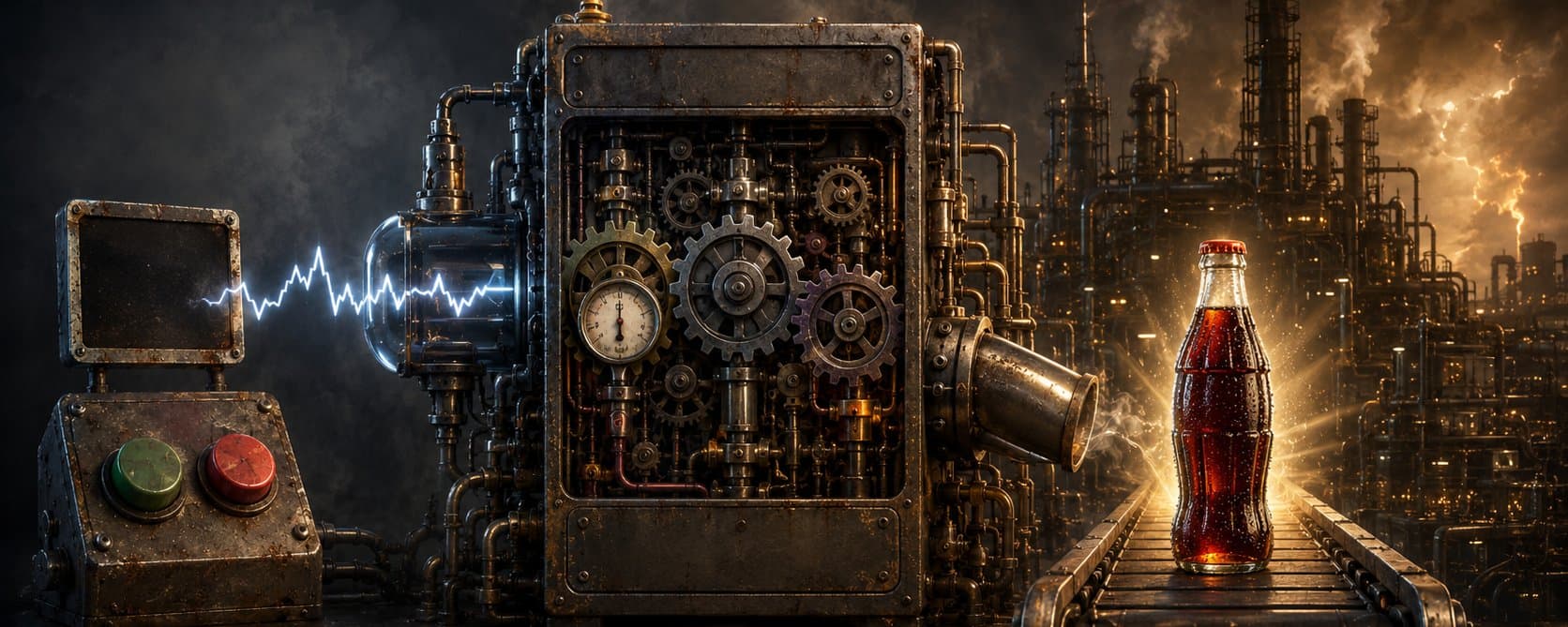
Start as the dumbest market maker, end up selling cola
When it comes to market-making strategies, the first impression is ultra-strong infrastructure, extremely low latency, complex algorithms, and top-tier account fees. The institutions are names like HRT, Jump, Citadel Securities, and the practitioners seem like Ivy League geniuses from math and physics backgrounds.
When it comes to Gamma Scalping, it's almost another set of mysterious filters: precise pricing models, Vol Surface, N-leg hedging, dynamic Delta hedging, with a bunch of Greek letters jumping around on the screen, as if you can't even enter the door without first mastering stochastic calculus.
One feels like a manipulator of computer science and microstructure, the other like a god's-eye view of financial engineering and stochastic processes.
But if we temporarily set aside whose machine is faster or whose model is more precise, and ignore the complex risk constraints in the real world, and only look at the final step when the strategy lands in the trading system, we find that they are actually answering a very basic question:
After the price changes, how much should I buy, how much should I sell, and how much position should I hold in the end?
It's essentially no different from manual trading by ordinary people—everyone only has two buttons: long and short.
Even from this perspective, the simplest fixed-distance order book market making and the seemingly sophisticated Gamma Scalping may not be as far apart as one might imagine.
This article originates from Zhihu user "大空驴" @short_donkey and his original link. He is a pioneer in publicly sharing knowledge in the early perpetual contract market-making strategy field. After rereading his article today, I have incorporated my own insights to write this piece.
Start with the Dumbest Market Maker
Assume the current price is 100. No price prediction, no study of OFI, lead-lag, toxic order flow, etc. Just place a buy order at 99 and a sell order at 101. If the price drops to 99, I buy a bit; if it rises back to 101, I sell, making 2 units.
The simplest fixed-distance order book market making, Fixed Distance Market Making, is exactly this.
Of course, real market making isn't this stupid. In a live environment, you also need to consider adverse selection, inventory, order book depth, fill probability, queue position, fees, and volatility.
But let's delete all that for now and only look at what it ultimately does: the lower the price, the more inventory you hold; the higher the price, the less inventory you hold.
This strategy essentially defines an inventory curve: buy when it falls, sell when it rises. If the price moves in one direction continuously, you'll feel increasingly uncomfortable; if the price oscillates back and forth, you can trade back and forth.
Remember this behavior. Gamma Scalping below is actually not much more advanced.
Gamma Scalping
No showing off. Let's quickly explain what Delta and Gamma are. Delta means the sensitivity of the derivative's price relative to the underlying price, mainly used in options. For example, the Delta of a perpetual contract can be roughly approximated as 1, so we often call it a linear contract: if the spot goes up by 1, the contract theoretically goes up by 1 as well.
Options are different. The Delta of a Call is generally between 0 and 1, and a Put is between -1 and 0. Moreover, this Delta is not fixed; it changes continuously with the underlying price.
Gamma is the Delta of Delta. More precisely, it is the sensitivity of Delta to the underlying price, i.e., the second-order sensitivity of the option price to the underlying price. If you don't yet grasp what it really is, that's fine; just know the mathematical relationship: when the price changes, Delta changes, and Gamma determines how fast Delta changes.
Suppose you buy a Call. The current Delta is 0.5, and you hold a positive Gamma position, i.e., a Long Gamma position.
You don't want to bet on whether the underlying will rise or fall, so you sell 0.5 units of spot (in practice, futures or perpetuals are often used) to hedge this directional exposure. The Call gives you +0.5 Delta, the futures give you -0.5 Delta, summing to roughly 0. Thus a great "market-neutral strategy" is born.
Sounds advanced, but essentially it's just going long one side and short the other to offset first-order directional risk. But the problem immediately arises: options are not linear products; Delta moves. Suppose the underlying rises a bit, and the Call's Delta changes from 0.5 to 0.6. Then you originally sold only 0.5 futures, and now the portfolio has an extra +0.1 Delta. To return to Delta Neutral, you need to sell another 0.1.
Conversely, if the underlying falls, the Call's Delta drops from 0.5 to 0.4, and the 0.5 you sold earlier becomes an extra short of 0.1, so you need to buy back 0.1.
This process of continuously adjusting the hedge position based on Delta changes is called Dynamic Delta Hedge. It's actually not complicated at all. For a Delta Neutral Long Gamma position, the final behavior implemented in the trading system is: sell when it rises, buy when it falls.
The more the underlying rises, the larger the Call's Delta becomes; to maintain neutrality, you keep selling the hedge leg. The more it falls, the smaller the Delta becomes, and you gradually buy back the previously sold hedge leg. As for when to adjust, how much to adjust, continuously or discretely—those are engineering issues later. But the basic trading direction is that simple.
Does it look familiar? The dumbest Market Maker we just discussed does the same thing. When the price goes down, his buy orders keep getting filled, and inventory increases; when the price goes up, he keeps selling, and inventory decreases.
Although the Long Gamma Trader holds an option and has a set of Greek letters, which seems several degrees more advanced than the Fixed Distance MM that buys at 99 and sells at 101, if we temporarily cover the option leg and only look at his hedging trades to maintain Delta Neutral, it ultimately manifests as the same inventory adjustment process: "the higher the price, the more you sell; the lower the price, the more you buy."
So instead of memorizing what Gamma is from the start, it's better to remember a more practical understanding: Gamma determines how much your target Delta changes after a price change; and once the target Delta changes, you must trade.
You can even push it one step further: Gamma itself does not create profit out of thin air; it only causes your target position to change with price. Long Gamma means after a rise, the target position is lower; after a fall, the target position is higher. So dynamic hedging naturally manifests as trading against the price. Short Gamma is the opposite: after a price rise, to hedge you continue buying; after a price fall, you continue selling—chasing trends. That's why Long Gamma likes the market to "move," while Short Gamma fears large unexpected moves.
If Long Gamma is so comfortable, why isn't everyone Long Gamma? Because this "sell when up, buy when down" curve is not free. You already paid for it when you bought the option. We'll discuss IV, RV, and Theta later.
At this point, the connection between Gamma Scalping and Market Making is already revealed: they are not the same strategy, nor do they necessarily earn the same kind of money, but both can be described by a very simple question—when the price becomes another price, how much inventory do I want to hold?
The dumbest market maker manually defines his inventory change through orders; the Gamma Trader has the option's Delta/Gamma define that inventory change for him. The financial products and execution methods differ, but when stripped down, the system only receives two types of instructions: buy a bit, sell a bit.
It Doesn't Mean They Earn the Same Kind of Money
From the above, it's easy to draw an overreaching conclusion: since Fixed Distance Market Making and Long Gamma + Delta Hedge both end up as "buy when down, sell when up," isn't Gamma Scalping just a market-making strategy dressed in financial engineering?
Not quite.
The simplest market maker actively places two quotes at 99 and 101, hoping others will trade with him. He buys at 99, sells at 101, and the 2-unit spread is the spread he actively quotes. As long as the market oscillates and he doesn't encounter smart traders who know the price is about to drop to 90 and specifically take his 99 buy order, he has a chance to capture that spread.
So the market maker's most direct source of income is the spread collected by providing immediate execution opportunities to others, at the cost of inventory risk and adverse selection: by standing ready to take the inventory others don't want, you risk being dumped with bad inventory.
Gamma Scalping is different. When you buy a Call, you don't naturally get a spread of buying at 99 and selling at 101. On the contrary, to re-hedge Delta, you often have to actively hit the market, even being the taker who pays the market maker.
What it truly owns is a Delta curve that changes with price: after a price rise, it forces you to sell a bit; after a price fall, it forces you to buy a bit. If the market generates enough actual volatility over a period, the profits from these dynamic hedges may recover the cost you paid to buy Gamma.
So from a PnL source perspective, there is a clear difference. The most basic market maker sells liquidity, collects spread, and bears the risk of being hit by toxic orders and inventory失控. The Long Gamma Trader, on the other hand, pays upfront for convexity and then tries to realize the actual price movements through dynamic Delta hedging.
One is most directly concerned with "Is this spread enough to cover adverse selection and inventory costs?" The other is most directly concerned with "Can the IV I bought in be covered by the RV that actually plays out?"
But the interesting part is precisely here: their income sources differ, yet their trading paths can look very similar. The market maker uses bid/ask and inventory models to artificially create an inventory function of "the lower the price, the more I want to buy; the higher the price, the more I want to sell." The Long Gamma Trader has an option that naturally gives him such a Delta function.
One is self-written, the other is bought.
At this point, an even stranger question arises: since all I want is this inventory curve of "buy when down, sell when up," why must I first buy an option?
Can I skip the option and write my own curve?
The answer is, of course, yes.
This leads to a very interesting concept from the original article: Virtual Gamma.
Without Buying an Option, Hand-Craft a Gamma
Since Long Gamma + Delta Hedge ultimately executes as "sell when up, buy when down," a natural question arises: if all I want is this effect of position changing with price, why must I first buy an option?
Suppose I hold no options at all. The BTC price is 100. I define a very crude strategy: for every 1 unit the price drops, I buy 1 more; for every 1 unit the price rises, I sell 1. Then my position is no longer fixed but becomes a function of price. The lower the price, the more I hold; the higher the price, the less I hold. In other words, I hand-craft an inventory curve: when the price moves, the target position moves accordingly.
Meaning: the higher the price, the less inventory I want; the lower the price, the more inventory I want. Isn't that similar to the Long Gamma Delta Hedge?
An options trader is forced to continuously adjust the hedge leg because Delta changes with price. Here, without any options, I directly define a rule: "when the price becomes X, I hold Y position." The resulting actions are the same.
By now you can understand what the original text calls "Phantom Gamma." The name sounds a bit mystical, but it's actually quite easy to understand: your account has no Gamma in its positions, but you use trading rules to create inventory behavior similar to Gamma.
Strictly speaking, this of course does not mean you have conjured a real option out of thin air. Gamma is originally the second-order sensitivity of a specific nonlinear product. However, if you only look at the dynamic trading process and the second-order characteristics of the final PnL, you can completely use linear products to discretely replicate part of the effect of Gamma.
This is exactly the answer I derived manually in my previous posts:
The most typical example is actually a grid. When the price drops one grid, add a bit of position; when the price rises one grid, reduce a bit of position. The grid strategy doesn't know any Greek letters at all; it's just a very rigid rule table written in advance: when the price reaches 99, I hold this much; when it drops to 98, I hold that much more; when it rises back to 100, I reduce again. Every time the price moves to a new level, the system adjusts the position to the corresponding level according to this table.
If the grids are drawn denser and denser—for example, instead of adjusting only when the price drops 1%, you adjust a little every 0.1% or 0.01% drop—then this grid-by-grid position adjustment begins to look more and more like a continuous change. Gamma in options feels similar, except that the rule "when the price reaches here, my Delta should become this much" is manually written by the programmer using grid parameters, while the nonlinear structure of the option itself naturally provides it.
Fixed Distance Market Making is similar. You place buy orders below the current price and sell orders above it, seemingly "earning the spread," but from the perspective of the inventory path, you are also letting the price determine your position: as the market moves down, you keep passively buying, and your inventory increases; as the market moves up, you keep selling, and your inventory decreases. Placing orders is just the implementation method; what really happens behind the scenes is still the mapping from price to inventory.
So if you delete all product names and only look at the trading system, many strategies can actually be unified into a very simple question: when the price changes from 100 to 101, how much should I change my position? When it goes back from 101 to 100, how much should I change it back? Gamma Scalping uses options to answer this question; Market Making lets quoting rules answer it for you; grid trading lets you draw a bunch of grids in advance to answer it.
You could even go further back. Many people find Gamma mysterious when they first encounter it because financial engineering starts with "the second derivative of the product price." But for those who actually build trading systems, understanding from the other end might be more natural: as long as your position itself changes with the price, the price path no longer produces only first-order PnL but begins to exhibit second-order effects.
You are no longer just "I have 1 BTC, so if BTC rises 1%, I earn 1%." Instead, as BTC rises or falls, the amount of BTC you hold also changes.
This is also why I feel the word "Gamma" is sometimes made too mysterious. It certainly has a strict mathematical definition, but when it comes to strategy execution, a Greek letter doesn't suddenly fly out of the screen to help you make money.
But here a new problem immediately arises: if I don't need to buy options and can just write a program that "buys when it falls, sells when it rises" to hand-roll Gamma, then can't I get it for free without paying IV and Theta?
Obviously, it's not that easy. Because an option just packages this nonlinear curve and sells it to you. If you replicate this curve yourself, you still have to pay transaction costs, inventory risk, gap risk, discrete hedging errors, and even get trapped deeper and deeper when the market moves in one direction.
Nonlinearity does not make costs disappear; it just moves the cost from the option price into your execution and risk management.
At this point, we can continue to ask the next question: since neither bought Gamma nor hand-rolled Gamma is free, what exactly are these strategies making money from?
At this point, I should formally discuss IV, RV, and volatility, but I think these are not for beginners and should be left for next time.
And there is another group of people doing something even more interesting.
They don't just buy these curves; they are responsible for producing these curves and selling them to others.
The Charming Cola Factory
Finally, 大空驴 told a story about a cola factory:
When I explain selling options to non-option traders, I often use this example: Sugarcane exists naturally; humans have records of eating sugarcane very early on. Coca-Cola is not natural; it is a processed product from sugarcane, water, acesulfame, etc. Some people like sugarcane, some like Coca-Cola, and the consumer markets for the two do not completely overlap. But this absolutely does not mean that the sugarcane industry and the cola industry have similar business models.
Sugarcane production is not a high-tech industry; its main costs may be labor and land. Countries with suitable climates and land can easily develop this low-value-added, labor-intensive industry.
In contrast, the cola industry requires not only sugarcane as a raw material but also involves complex production processes, including sugarcane refining, addition of flavorings and preservatives, secret beverage formulas, packaging design, brand marketing, and global distribution networks—a series of processes and technology chains. Cola production generally requires large-scale investment, deep market promotion, and brand building to succeed. Moreover, it involves the application of advanced technologies, such as carbonated beverage formulation and bottling technology. This is a high-value-added industry with higher profit margins, but it also requires more capital investment and higher-level management.
Cola is like options. When the first can of cola appeared, the price must have been very high. Only with increased market competition did cola become a cheap product at a few yuan per can.
He compared linear assets to sugarcane and options to cola. I think this metaphor is particularly friendly to beginners. Linear products like spot and futures are simple in structure: if the price goes up by one unit, you earn one unit; if it goes down, you lose one unit. They are like natural raw materials sitting there.
But options are different. They reprocess these linear things into a nonlinear payoff structure. Clients can buy a Call that says "if it falls, I lose at most this much; if it rises, I can still profit," or a Put that says "if the market really crashes, you have to pay me." Essentially, they are buying a redesigned profit distribution.
But these nonlinear payoffs don't fall from the sky. After a client buys an option, they only see an extra Call or Put in their account. The market maker responsible for quoting has to figure out how to produce this thing.
He might combine spot, futures, options of other strikes, options of other maturities, and then constantly delta hedge, managing Gamma, Vega, inventory, and tail risk. The client sees a can of cola that is already filled and labeled; the market maker sees sugar, water, bottles, machines, logistics, and production lines.
So from this perspective, selling options is quite like a processing industry. You take the most basic first-order assets in the market as raw materials, process them into the nonlinear payoff the client wants through models, hedging, execution, and capital, and then quote a price to sell it. A truly professional options market maker is not simply sitting there guessing whether the market will go up or down tomorrow, or even just guessing "what the future volatility will be." It's more like calculating a business: the client is willing to buy this bottle of cola at this price; can I produce it at a lower cost?
This also explains why the same option, at the same market price, can yield very different results for different market makers. Some people do delta hedging cheaply—low fees, small slippage, internal orders that can net against each other—so hedging the same risk costs very little.
Others have slower machines, worse fee rates, poor inventory management, and chase the order book only after the market moves. In the end, for the same product, one sells at this price and makes a nice profit, while the other sells at the same price and loses money. The market shows everyone the same selling price, but each factory's production cost is completely different.
The same applies to the options market. Pricing models are something everyone can learn; Black-Scholes is not a trade secret. What really creates the gap is how you turn that theoretical price into a real tradable price, and how you cheaply dispose of the risk the client hands you.
This connects back to the earlier Market Making. The dumbest market maker just places orders on both sides of the order book to earn a few ticks of spread. A more advanced one does inventory management, dynamic quoting, and order flow prediction. For options market making, the "inventory" simply expands from a simple spot position to a full set of Delta, Gamma, Vega, and term structure. On the surface, the machines get more complex, but at the core, it's still the same old questions: What risk have I taken on? How should I hedge this risk? How much does hedging cost? Can the client's payment cover my costs?
And this is where I find the most interesting connection between Gamma Trading and Market Making. Earlier, we started from the dumbest market maker, just studying how positions adjust after price changes. Here, the problem becomes industrialized. An excellent options market maker doesn't just manage one Gamma curve for themselves; they receive in bulk every day all kinds of nonlinear curves that clients want, and then use their trading system to break down, net, hedge, and recombine these risks.
At the very beginning, we only had two buttons: buy and sell.
Later, we added inventory rules to them.
Then, we used Delta and Gamma to describe these rules.
Finally, someone built a factory, packaged these rules into products, and sold them to others.
This is roughly the journey from being the dumbest market maker to eventually selling cola.