OKX Boss Star's Sarcasm at Binance: The 'Selective Compliance' of Crypto Giants
OKX boss Star's subtle jab at Binance reveals the 'selective compliance' of crypto giants
Recently, a certain exchange added a deposit and withdrawal module. Star, the boss of a competitor, saw it and commented: "We've had this feature for a long time, but for well-known reasons, it's temporarily not available to users in China." Seeing this, I chuckled to myself—when it comes to subtle digs, Star is indeed a master.
With a mindset of enjoying the drama, I reposted and commented: "Core trading functions are open to mainland users, but deposit and withdrawal functions are not. The 'compliance definition' here is quite peculiar."
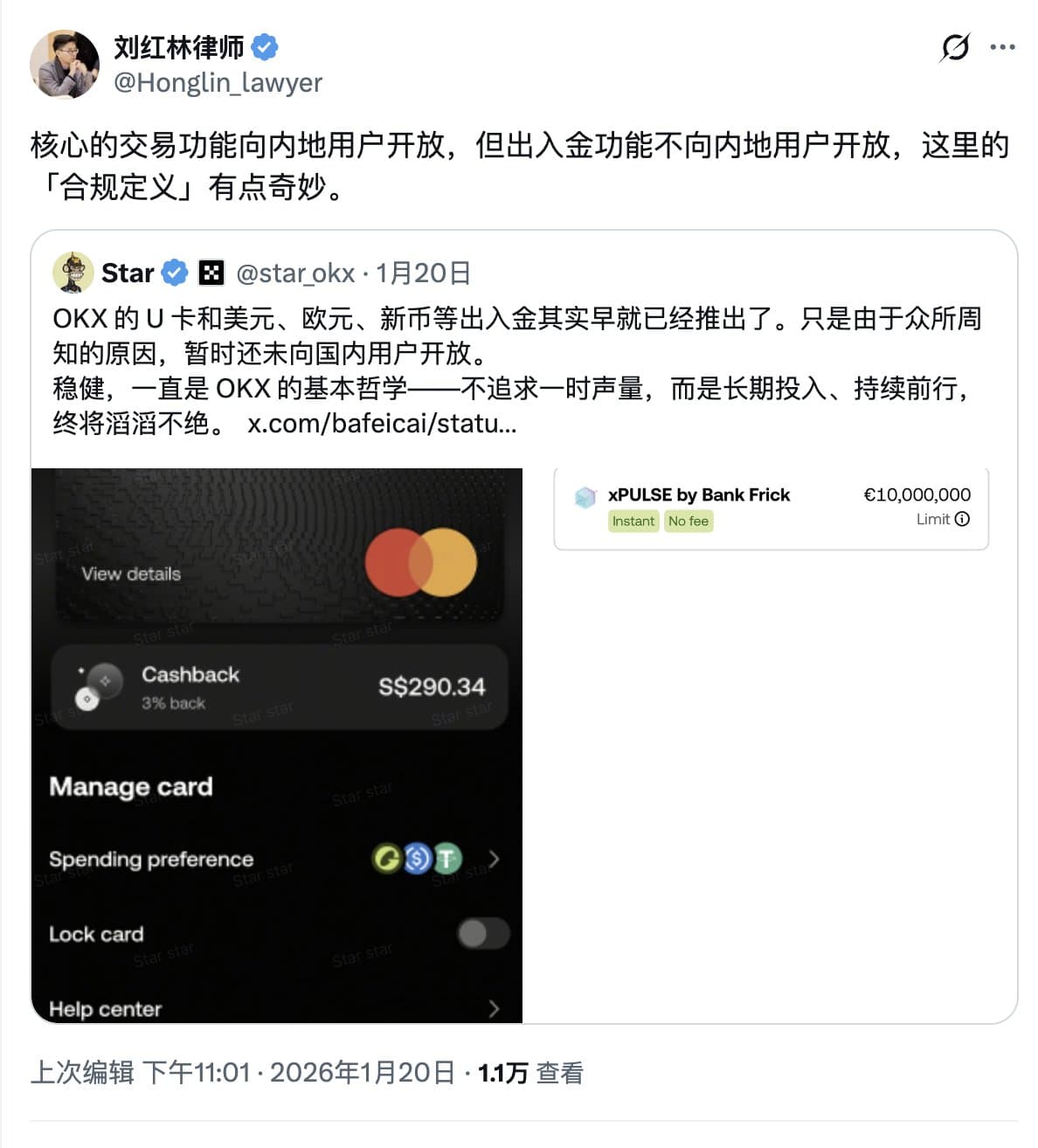
This is no joke. It may seem like just a deposit and withdrawal issue, but behind it lies the most core and unspoken survival rule of the global crypto market—'selective compliance.'
Let's shift our focus from a small bank card to the broader, darker depths of the 'crypto world.'
In this world that champions decentralization, how do centralized giants (exchanges, payment institutions, banks) dance in the cracks of various national regulations? Why can some businesses 'turn a blind eye' while others must 'cut off a limb'? Why can Chinese users trade contracts worth hundreds of millions of dollars on exchanges but cannot compliantly buy a cup of coffee?
This article revolves around the theme of 'selective compliance,' offering practitioners, investors, and observers in the Web3 industry a perspective to see through the fog and understand the real rules of this 'dark forest.'
Chapter 2: China's Crypto Policy 'Red Lines' and 'Gray Areas'
To understand why institutions practice 'selective compliance,' we must first clarify the regulatory net they face.
Mainland China's regulation of virtual currencies was not achieved overnight but is a decade-long 'siege history.' The attitude of Chinese regulators toward virtual currencies has gone through three key stages, each reshaping the industry's survival landscape.
1.0 Era: Risk Prevention and Cutting Off Banking Channels (2013-2017)
In December 2013, five ministries issued the "Notice on Preventing Bitcoin Risks." This was the first official classification of Bitcoin—as a 'specific virtual commodity.'
Classification logic: Regulators at the time believed that Bitcoin lacked the attributes of legal tender and compulsion and was not a true currency.
Core red line: Financial institutions (banks, third-party payment providers) were prohibited from providing services for Bitcoin transactions.
Gray area: Ordinary individuals, under the premise of self-risk, had the freedom to participate in trading. This left a legal survival gap for the early 'crypto world' and provided the legal basis for platforms like 'Huobi' and 'OKCoin' to register and operate domestically.
2.0 Era: Comprehensive Crackdown on ICOs and Fiat Trading (2017-2021)
On September 4, 2017, seven ministries jointly issued the "Announcement on Preventing Risks of Token Issuance Financing" (the '9.4 Announcement').
Background: The ICO (Initial Coin Offering) frenzy triggered massive financial risks and social unrest.
Draconian measures: ICOs were classified as 'unauthorized illegal public financing,' suspected of illegal token sales, illegal securities issuance, illegal fundraising, financial fraud, and pyramid schemes.
Industry upheaval: Domestic exchanges were forced to close fiat trading pairs (CNY/BTC) and 'went overseas.' From this moment, USDT (Tether) replaced the renminbi as the benchmark in the Chinese crypto world, ushering in the era of 'crypto-to-crypto trading.'
3.0 Era: Comprehensive Blockade of Illegal Financial Activities (2021-Present)
On September 15, 2021, the People's Bank of China and nine other ministries jointly issued the "Notice on Further Preventing and Handling Risks of Virtual Currency Trading Speculation" (Yin Fa [2021] No. 237, or '9.24 Notice'). This was a landmark final verdict. This time, it was no longer just a risk warning but explicitly classified virtual currency-related business activities as illegal financial activities. This includes: virtual currency exchange, buying and selling virtual currency as a central counterparty, providing matching services for virtual currency trading, token issuance financing, and virtual currency derivatives trading.
The document explicitly stated for the first time that 'overseas virtual currency exchanges providing services to residents in mainland China via the internet also constitute illegal financial activities.' This rule directly shattered the 'safe harbor' illusions of overseas exchanges. It not only held exchanges accountable but also pursued legal responsibility for relevant domestic employees and legal persons, unincorporated organizations, and individuals providing services such as marketing, payment settlement, and technical support. This was called a 'full-chain crackdown.'
Given the severity of the '9.24 Notice,' why do exchanges like OKX and Binance still have massive mainland user bases? Why are active Chinese communities still visible? This involves the 'gray areas' and 'legal gaps' in Chinese law enforcement.
Current judicial practice and mainstream legal views hold that simply holding virtual currencies is not illegal. Although Chinese law does not recognize the 'currency' attribute of virtual currencies, some judicial precedents recognize them as 'virtual property' protected by the Civil Code. This dual structure—'holding is not illegal' but 'operating is illegal'—creates a peculiar phenomenon:
Running an exchange is a crime (illegal business operation, operating a casino).
Conducting an ICO is a crime (fraudulent fundraising).
But individuals buying and selling coins (as long as it doesn't involve money laundering) is typically seen as a 'self-risk' civil act or falls into an administrative gray area, not a direct criminal offense.
China has tens of millions of existing crypto users. From a law enforcement cost perspective, targeting every individual involved in trading is impractical. Therefore, regulatory focus remains on curbing new growth, cutting off funding channels, and punishing related crimes (e.g., money laundering, fraud), rather than completely eliminating individual trading behavior.
This regulatory logic gives institutions an opening. The 'selective compliance' strategy of institutions essentially bets on regulators' 'catch the big, let the small go' enforcement scale and uses offshore structures to create barriers to legal recourse.
Chapter 3: The Shadow War of Payment Channels—U Cards, Offshore Banks, and Compliance Arbitrage
Returning to the opening of this article—OKX's trading functions can be open to mainland users, but the deposit and withdrawal (U Card) function must be blocked? Behind this lies the most fragile link in the Web3 world: the fiat currency channel.
For mainland users plagued by 'card freezing incidents,' U Cards (Crypto Debit Cards) are seen as a lifeline. The basic logic is: users deposit USDT into the app, the platform converts it to USD/EUR, deposits it into a Visa/Mastercard debit card, and users can spend globally (including linking to Alipay/WeChat in China).
This seemingly simple process is actually supported by a complex global industrial chain involving multiple stakeholders:
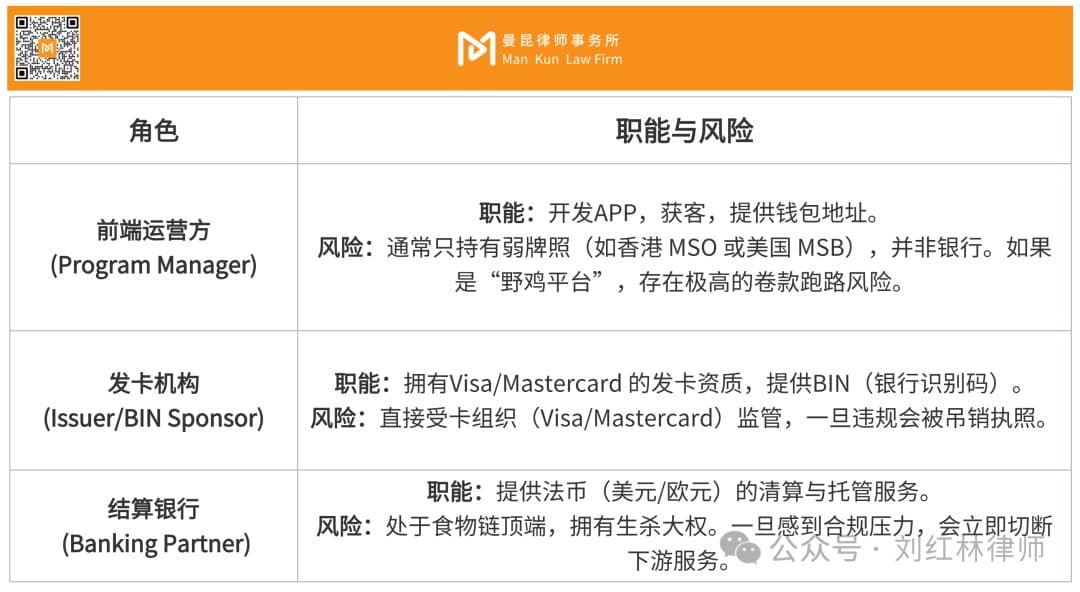
In OKX's case, Bank Frick is a key player. The essence of the U Card is to bypass China's foreign exchange controls, enabling cross-border asset transfer and spending. If the scale is small, it can be concealed; once it grows, it easily violates China's criminal law on 'illegal business operations' (involving illegal foreign exchange trading). OKX, as a large exchange striving for global compliance, cannot afford to offend the global banking system over a small U Card.
Trading functions are the core profit source and exist in the 'gray area' of offshore regulation, so they can be risked and retained. U Cards involve fiat settlement and lie in the 'red line' area of regulation, so they must be decisively cut off. This is the coldest calculation logic of 'selective compliance.'
Chapter 4: Exchange Survival Tactics—'Fake Delisting' and Offshore Structures
If the blocking of U Cards represents a 'retreat' by institutions, the continued operation of core exchange trading businesses is their exquisite 'advance.'
After the '9.24 Notice' in 2021, top exchanges like Coinbase, Binance, and OKX issued statements saying they would delist mainland Chinese users. This event was called the 'Great Retreat' of the crypto world. But years later, the results are starkly different.
Coinbase (then led by Li Lin) implemented the most thorough delisting policy, directly closing existing mainland user trading. As a result, Coinbase lost its core market, liquidity dried up, and it was eventually forced to sell to capital under Justin Sun.
Binance and OKX adopted a more flexible strategy—'fake delisting, real operation.' They temporarily stopped new user registration with +86 phone numbers but left technical backdoors. For example, users could register with an email and later bind a +86 phone number as a 'security verification method' rather than 'identity location.' Although mainland Chinese ID verification was banned, users with Chinese passports could often pass by filling in a non-Chinese 'country of residence' (even if they wrote Egypt or Argentina). Furthermore, a gray market for buying and selling 'overseas KYC certification materials' emerged online, with exchanges often 'cracking down hard for a while, then easing up.'
To support this operational model, exchanges built extremely complex offshore company structures. This is not just tax avoidance but aims to sever the chain of legal liability. A typical structure is as follows:
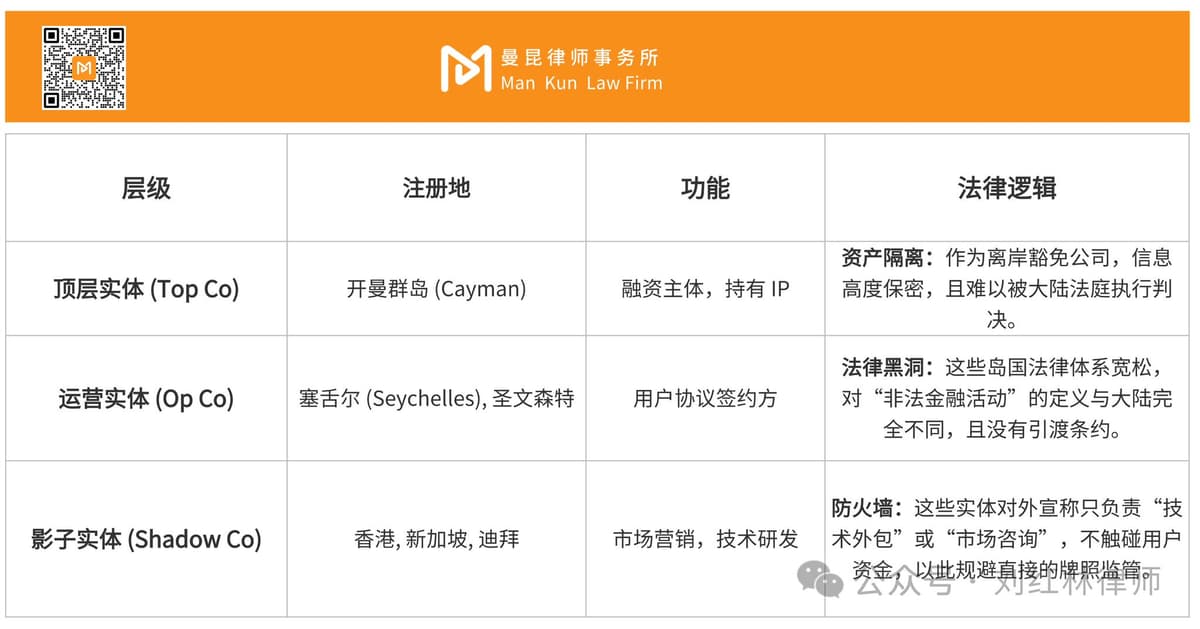
When facing regulatory inquiries: 'Why are you still serving Chinese users?' all offshore exchanges wield the same shield—'reverse solicitation.'
Their core argument: 'We did not actively market to China (Active Marketing). These Chinese users came to our website (registered in Seychelles) through VPNs, voluntarily requesting our services. According to international business practices, this is the user's autonomous behavior and not subject to Chinese law.'
This is somewhat insulting to the audience. These exchanges have full Simplified Chinese interfaces, employ large Chinese customer service teams, and conduct extensive promotions in Telegram Chinese groups and Chinese social media, not to mention reimbursed trips and banquets for KOLs in Japan, South Korea, Southeast Asia, and Dubai.
At the end of 2022, Hong Kong issued the "Policy Statement on the Development of Virtual Assets in Hong Kong," attempting to reclaim its position as Asia's crypto hub. For institutions with mainland backgrounds, Hong Kong is both a 'bridgehead' and a 'besieged city.'
Hong Kong's strategy is clear: bring cryptocurrencies into the formal financial regulatory system. The Hong Kong Securities and Futures Commission (SFC) introduced a VASP (Virtual Asset Service Provider) licensing system, allowing licensed exchanges (e.g., OSL, HashKey) to serve retail investors.
This seems like a major boon for Web3 institutions but is actually a tighter constraint. One of the SFC's regulatory details includes a clear red line: licensed institutions must ensure they do not provide services to residents of jurisdictions that prohibit cryptocurrency trading (especially mainland China).
This creates a huge paradox:
To be compliant: institutions must apply for a Hong Kong license.
To make money: institutions must rely on mainland users (since the Hong Kong local market is too small to support an exchange's massive expenses).
To get the license: institutions must purge mainland users.
Faced with this dilemma, institutions once again demonstrated their superb skill of "selective compliance," which I call the "dual personality" strategy:
On one hand, they loudly announce applications for Hong Kong licenses, praise Hong Kong policies, lease expensive offices in Central, Hong Kong, and host lavish Web3 summits. The goal is to create a brand image of "embracing compliance" and "strong financial strength," gain trust from capital markets, and attract unsuspecting retail investors.
On the other hand, the real profit centers (high-leverage contract trading, wealth management products, and services for mainland Chinese users) remain in offshore entities (such as Seychelles or BVI). The Hong Kong entity is often just a "shell" or is responsible only for extremely limited, low-leverage spot business.
This is why we see many exchanges in Hong Kong, even those that have obtained licenses (or in-principle approvals), offering extremely basic Hong Kong versions of their apps with very poor liquidity. They never intended to make money through their Hong Kong compliant entities; it's just an expensive "billboard."
What deserves more attention is: when institutions successfully evade the iron fist of external regulation through "selective compliance," they also escape the constraints of that regulation. In this corner lacking sunlight, internal corruption and market manipulation thrive.
In traditional financial markets (such as Nasdaq), exchanges, brokerages, market makers, and custodians are strictly separated, checking and balancing each other.
But in Web3, top exchanges combine all these roles into one:
It is the exchange: providing the matching engine.
It is the brokerage: directly holding user assets.
It is the market maker: owning its own quantitative team (though often under the guise of an independent entity, like Alameda Research for FTX).
It is the referee: deciding which coins get listed and which get delisted.
This concentration of power leads to extreme moral hazard. Lawyer Hong Lin previously exposed the "scythe" nature of certain exchanges in the article "How Virtual Currency Exchanges Harvest Token Project Parties?": The exchange has full data on user positions and orders. During periods of intense market volatility, the exchange uses this "God's-eye view" to execute targeted liquidations, creating extremely brief price anomalies (flash crashes) to force liquidate high-leverage users, commonly known as "pulling the network cable" or "slaughtering pigs."
Furthermore, to get listed on certain top exchanges, project parties not only have to pay exorbitant listing fees but are also required to provide a large number of tokens as "liquidity support." These tokens are often eventually sold to retail investors, becoming additional profit for the exchange.
In the US market regulated by the SEC, a former product manager at Coinbase was sentenced for insider trading. But on offshore exchanges, such behavior is almost an open secret. Before a new coin is listed, on-chain data often reveals precise purchases by mysterious addresses. Due to the lack of investigative and enforcement powers of regulators, this "front-running" behavior is almost cost-free. Employees exploit information asymmetry to harvest retail investors in the secondary market.
The reason they dare to be so unscrupulous is precisely because they know their main user base (e.g., mainland Chinese users) is in a legally weak position. A user involved in "illegal financial activities," even if cheated by an exchange, would not dare to report it to the police, as it would be like walking into a trap.
Conclusion
The crypto world is like a dark forest. You thought "compliance" was a value, but later you find it's more like an arithmetic problem: wherever there's profit and manageable risk, you try to keep it; wherever it triggers the iron fist of fiat settlement, foreign exchange regulation, or upstream banks, you cut it off immediately, cleaner than anyone else.
So you see a very surreal, yet very real phenomenon: trading functions can "turn a blind eye" to mainland users, but channels involving fiat settlement like deposits/withdrawals and U-cards must be "cut off decisively." This isn't about who is kinder or more responsible for users, nor who understands compliance better; it's about the different costs of risk.
So-called "selective compliance" is essentially a survival optimization: doing business in the cracks of regulation, pushing responsibility and compliance costs outward as much as possible, and keeping profits in your own pocket. User experience has never been the top priority; the top priority is always "can I continue to survive and make money." As for whether you can legally buy a cup of coffee — sorry, that's your problem, not the platform's KPI.
But this game isn't a perpetual motion machine. Regulation will converge, settlement systems will tighten, Visa/Mastercard and upstream bank risk controls will become stricter, and the buffer of offshore structures will thin. Arbitrage opportunities will eventually go to zero, not because of moral awakening, but because costs rise, and the system forces everyone to shift their accounts from "gray profits" to "compliance costs." The dark forest won't disappear, but the lights will certainly increase.
As for ordinary users — it's fine to watch the show, but don't mistake "still usable" for "legal," and don't mistake "being nice to you" for "being responsible for you." In the dark forest of the crypto world, the most expensive tuition is often paid when you are most convinced that "everything is fine."