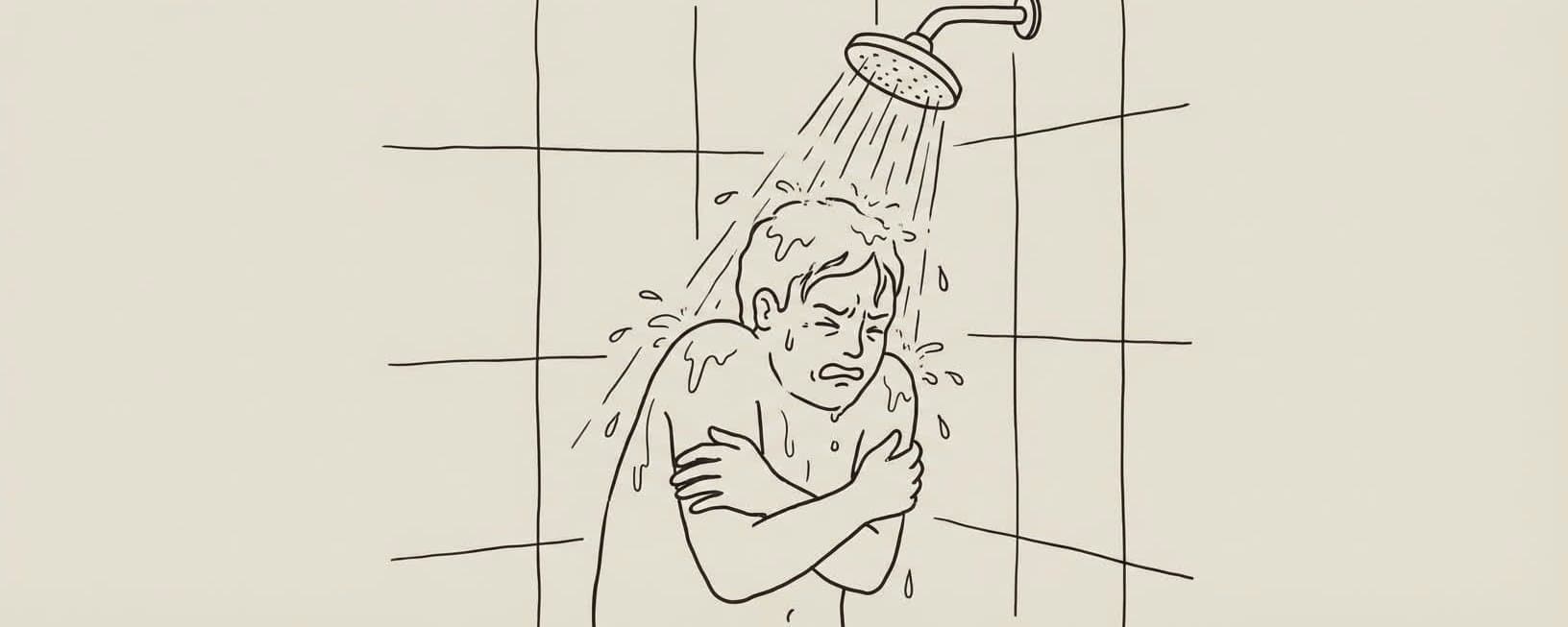
A Cold Shower Is a Little Gold Mine
This summer, I tried taking cold showers for about 3 months and felt pretty good. I wasn't used to it at first, but gradually adapted. Later, when the weather turned cold, I switched back to hot showers.
The other day, I was watching Andrew Huberman's video, where he mentioned the many benefits of cold showers, especially their positive impact on dopamine. So I started trying cold showers again, but this time the challenge was significantly greater than in summer.
To avoid taking too big a step, I adopted the hot-cold alternation method: 3 minutes of hot water (to dilate blood vessels), 1 minute of cold water (to constrict blood vessels), then repeat for 2-3 cycles, ending with cold water.
Having 3 minutes of hot water as a base made the 1 minute of cold water more bearable, but when the cold water, around 10 degrees Celsius, hit my body, I still couldn't help but yell out, even jump up. The first round of cold water had the strongest impact; subsequent rounds were slightly better, but still outside the comfort zone.
These seemingly slightly masochistic few minutes, if viewed from an investment perspective, yield quite substantial returns.
Hardware "Reboot"
The human body was not designed for a constant-temperature environment. Throughout the long history of evolution, comfort was the exception, and cold was the norm. When you turn on the cold water tap, you are actually activating an ancient code.
More importantly, it changes your chemical environment. Cold water can significantly boost dopamine levels. This boost is not like the spike from sugar or caffeine followed by a crash; it is a steady, sustained state of alertness that can last 2-3 hours.
In an era where attention is a scarce resource, being able to gain this mental sharpness through a physical method without taking any drugs is a huge advantage in itself.
- Many people mistakenly equate dopamine with "happiness," but that's not entirely accurate. In neuroscience, dopamine is more often referred to as the "motivation molecule."
- Dopamine is the chemical that drives humans to pursue goals. In a low-dopamine state, you feel like "scrolling on my phone is fine, I don't want to move"; in a high-dopamine state, you feel like "I want to complete that task, right now."
- Dopamine and norepinephrine are usually released together; the former helps you focus, the latter makes you alert. This combination creates a kind of "tunnel vision," allowing you to lock onto a goal for a long time, ignoring background noise, which is very helpful for deep work.
- Dopamine can improve mood. This improvement is not a brief excitement like eating sugar, but a deep sense of control and confidence.
Software "Patch"
The philosophy behind cold showers also matches very well with the "Voluntary Discomfort" advocated by the Stoics. But why seek out hardship?
Because excessive comfort makes us fragile. When you get used to constant temperature, soft beds, and hot food, your "baseline" gets raised. Once the environment becomes slightly harsher, you feel pain. A cold shower is a way to reset the baseline. When you can calmly face cold water, other troubles in life—traffic jams, difficult emails, bad weather—seem less unbearable.
This is actually training an extremely core ability: cutting the automatic connection between stimulus and response.
When cold water hits you, the body's automatic reaction is panic and rapid breathing. This is the same reaction you have when facing a work crisis or social pressure. By forcing yourself to calm down and control your breathing in the cold water, you are essentially rewriting your neural circuits. You are telling your brain: "Although this is very uncomfortable, I am still in control."
Eat That Frog
Morning is often a battle of willpower. The brain tends to choose the path of least resistance. Taking a cold shower is a counter-operation.
This is not just about showering; it might be the first decision of the day. You stand there, your rationality tells you to turn on the cold water, but your instinct tells you not to. When you finally execute the rational command, you win a small victory.
This victory may seem insignificant, but it is crucial. Because it sets the tone for the day: you are not someone who follows impulses; you are someone who can overcome short-term discomfort for long-term benefit. This self-identity will snowball, influencing every subsequent choice you make in work and life.
This might be why this simple habit yields such amazing returns. In a world full of shortcuts and comfort traps, those who willingly choose discomfort possess an invisible competitive advantage.
Taking a cold shower requires very little in terms of space and equipment—just a showerhead to get started—and the returns it brings are very substantial. This is what Taleb refers to in Antifragile as "asymmetric payoff" (low risk, high reward). Such a great investment opportunity—don't you want to give it a try?