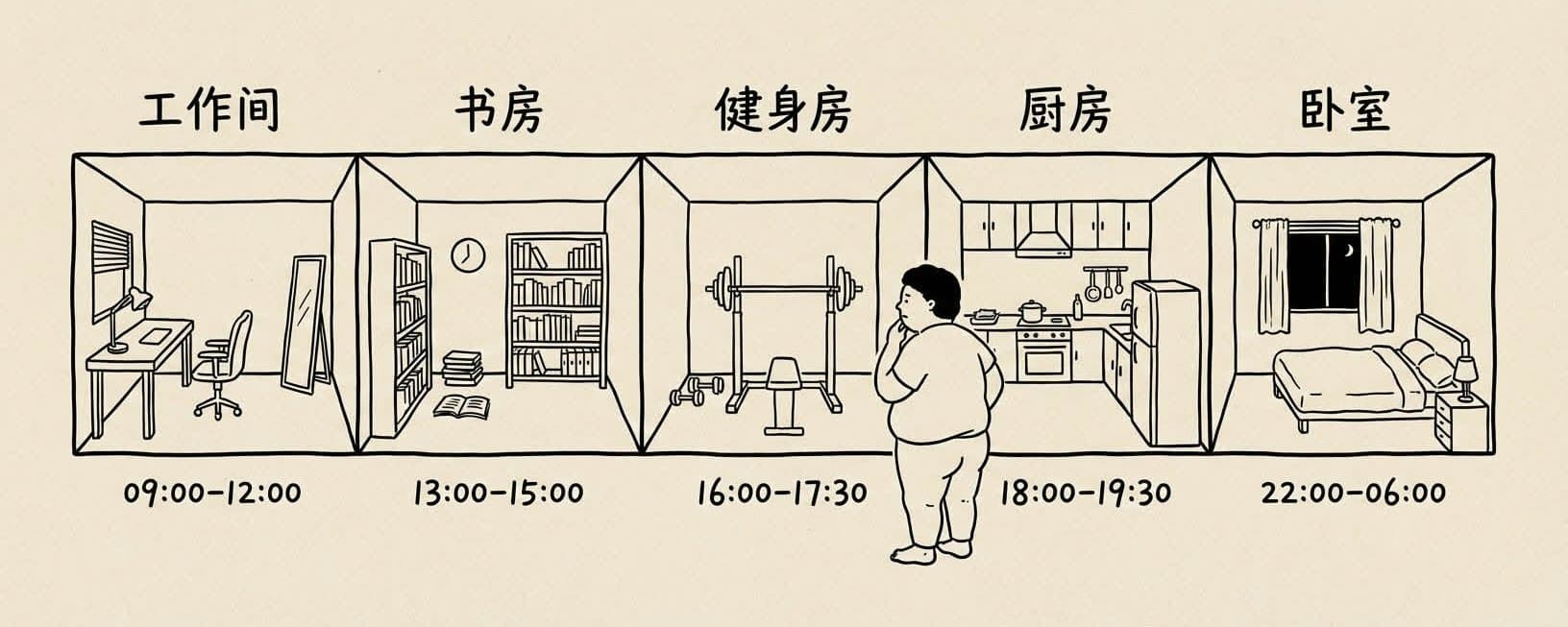
Routine is the Compound Interest of Life
We usually think of Routine as the antonym of "freedom." It conjures images of dull repetition, rigid schedules, or a life whose end is visible from the start. This is a huge misunderstanding.
Before discussing Routine, let's first look at the compound interest formula:
FV=PV×(1+r)nFV = PV \times (1 + r)^n
Placing it within the grand context of life, talent, opportunity, and the intensity of a single effort constitute that foundational growth rate r. Many ambitious people fixate on r. They try to achieve a massive FV through one all-nighter, one brilliant idea, or one explosive sprint.
But this is difficult to sustain.
The role of Routine is to control the exponent n.
In many ways, Routine is like dollar-cost averaging. If you only write when you "feel inspired" or only exercise when you're "in good form," your n is intermittent, and your growth curve is jagged.
A good Routine is a commitment: no matter how I feel today, no matter if r is large or small, that n will automatically increase by one.
When n is sufficiently large, it is no longer linear accumulation but exponential explosion. Those great novelists who get up early every day to write thousands of words don't do it because they have thousands of words of inspiration daily, but because they have turned writing into a physiological rhythm like brushing their teeth. They don't fight it; they just execute it.
This is the essence of Routine: it automates difficult things, thereby putting time on your side.
Many people think, "I don't design a Routine because I don't want to be constrained." But the truth is: there is no such thing as "having no Routine."
If you don't proactively design your life's flow, your body and environment will design one for you. This "default Routine" is typically co-authored by your biological instincts (laziness) and the external world (temptations).
When you pick up your phone and mindlessly scroll for two hours, that in itself is an extremely efficient and stable Routine.
Since the "default Routine" is also automated, why do we still feel exhausted?
Because you haven't completely given up. There's still a voice inside wanting to improve, constantly trying to pull this car, which is sliding toward the comfort zone, back. This is the source of decision fatigue: an endless civil war.
This bargaining is very energy-consuming. Precious energy is wasted on "deciding what to do" rather than on "doing the thing" itself.
A good Routine (like "putting on running shoes = going out") is a non-negotiable rule. It bypasses the "negotiation" phase and goes straight into action. In this process, your precious willpower is not consumed by internal friction but is preserved intact for truly important questions: How to solve this difficult problem? How to polish this work better?
If we view life as a long-term investment, establishing a Routine means you transform from a short-sighted speculator into a long-term value investor.
Speculators rely on mood, luck, state, inspiration (r), while investors rely on system and time (n).
When you start designing a Routine, you are essentially reallocating assets. You no longer say, "I can't help it, I just can't control myself," but begin to analyze your life like analyzing a poor balance sheet: "Oh, it seems under the trigger condition of 'high stress,' I automatically purchase the asset of 'avoidance.' I need to adjust my strategy and swap it for 'exercise.'"
This is not easy. Changing habits is always painful, but if you persist, even with just tiny daily adjustments, the power of compound interest will manifest.
At first, you only change the 30 minutes after waking up. A year later, you'll find you've become a different person.
You haven't just changed what you do; you've changed who you are.
So, stop viewing Routine as a dull schedule. It is the investment strategy you formulate to end internal friction and reclaim control. It is your weapon against entropy increase, against mediocrity, against chaos.
Routine is the compound interest of life.