DeepMind Sprouted from a Theme Park Simulation Game
In 1996, I acquired my first computer. Of course, in a student's eyes, it was more of a gaming machine. That Pentium 100 computer had a hard drive of only 540MB, but at that time, I felt it was large enough to contain the entire world. I played hundreds of games on it, and among the earliest ones was a game called Theme Park.
Thirty years later, I discovered that Gemini, which I use every day, and DeepMind behind it, actually derive their spiritual essence directly from this ancient game.
This story is written in the personal biography of DeepMind founder Demis Hassabis. I got this book yesterday and read it through in one sitting. The content is rich, covering from his childhood to the competition with OpenAI in 2025, but the part about simulation interested me most.
"Simulation" has always been the direction I am most interested in within the AI field, and I have discussed it periodically before. In the book, this part is not the main focus and is only briefly mentioned. I spent some more time searching for additional materials. After reading these materials, I realized: simulation is fundamentally the origin and core of DeepMind.
Theme Park
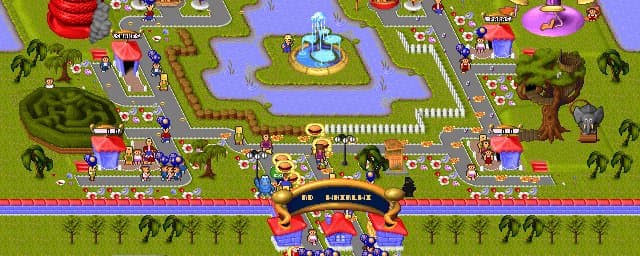
In 1994, the 17-year-old Hassabis was already serving as the lead programmer and co-designer of Theme Park at Bullfrog Productions. Unlike monster-fighting or level-clearing games, Theme Park allowed players to design, build, and operate a theme park within a compressed miniature world.
In the game, he did not use rigid scripts to dictate how visitors should move. Instead, he extravagantly allocated about 200 bytes of memory to each pixel character. The memory stored their independent hunger, thirst, happiness, and budget. Each pixel character did not possess true intelligence, but they began to have their own local condition-driven motivations. (In 1994, mainstream PCs were 486 models, mostly with 4M - 8M of memory.)
Something magical happened. If the player, aiming to make money, set the salt content of fries very high, visitors who ate the fries would generally become thirstier. They would then change their route and move toward drink stalls.
If there were too few drink stalls, queues would lengthen. If queues became too long, some visitors would become irritable, angry, reduce their satisfaction, and even leave the park early. A small change in local parameters would eventually evolve into fluctuations in crowd flow, changes in mood, changes in revenue, and even disorder throughout the entire park.
Hassabis did not write any line of code to make visitors "riot in queues." In this park simulator, he witnessed "emergent behavior" firsthand for the first time: by setting extremely simple local rules and placing them into a simulated environment, complex collective intelligence would naturally "grow" out.
Theme Park ultimately sold 15 million copies, becoming one of the most successful simulation games in history.
For an ordinary player, Theme Park was fun. But for Hassabis, it meant the beginning of a worldview. Once you have personally seen "how simple rules grow complex order" during your youth, your way of viewing the world inevitably changes.
Is traffic a kind of emergence? Is the market a kind of emergence? Is society a kind of emergence? Could intelligence itself also be a kind of emergence?
After reading his entire life path, one finds: games, more specifically simulation games, for him were the purest prototype of AGI thought - setting rules in a controlled universe, and order manifests itself.
Simulating a Nation
By 1998, Hassabis's ambition expanded. He founded Elixir Studios, attempting to create a game called Republic: The Revolution. He was no longer satisfied with the local order of a commercialized theme park, but attempted to simulate a more grand system: politics, factions, power, wealth, influence, mobilization, loyalty, corruption, social sentiment, resource flow.
The visitors in Theme Park already had states like thirst, hunger, happiness, and budget, but they ultimately were not "someone." In Republic, what Hassabis initially wanted was something else, more difficult: these virtual citizens were not just combinations of parameters, not just pawns responding to stimuli, but each was a person with daily life, beliefs, and motivations. In a sense, each person was themselves. The promotional materials at that time said: one million citizens, each with their own hopes, dreams, and homes.
This meant he attempted to simulate not just "how the state machinery operates," but also "how people in society exist as themselves."
This time he failed. From project management, technical scale, gameplay balance, development cycle, and commercial results, various problems occurred.
But if it is understood merely as "ambition too big, so it crashed," its significance is underestimated. He encountered a deeper problem: a world where 'each person is themselves' is unlikely to be achieved by writing rules, even if the rules could be as complex as thousands.
Simulation as Intelligence
Hassabis realized that to truly create that kind of self-evolving, universally capable simulation system, he must first understand: how exactly does the biological brain produce intelligence? So he decisively left the gaming industry and entered University College London to pursue a Ph.D. in cognitive neuroscience.
In 2009, in his doctoral thesis, he proposed a groundbreaking theory: the hippocampus of the human brain is not merely a hard drive for storing memories; it is more of a simulation engine. Through fMRI experiments, he proved: whether people recall the past, imagine the future, or even daydream, the brain is actually invoking the same neural circuitry. The core function of this circuitry is to construct and run an "internal simulation model." The essence of how our brains produce intelligence is their ability to internally construct and run simulation models about the real world.
The DeepMind Era
In 2010, with the epiphany that "the brain is essentially a simulation engine," DeepMind was formally established. From day one, this "gene" was deeply imprinted in the company's DNA: AI no longer relies on cumbersome code rules preset by humans. Whether thrown into a controlled physical sandbox or into a vast ocean of data, intelligence must emerge bottom-up through algorithms' self-exploration.
Thus, we saw AI figuring out perfect strategies to clear levels and defeating human players in Atari games. We saw AlphaGo playing millions of games against itself in the digital world of Go, defeating all human chess players.
In an interview with Lex Fridman, Hassabis pushed the idea of "simulation" to the limits of the universe and physics. He proposed a viewpoint: any pattern generated in nature can be discovered and simulated by algorithms.
Because nature is not random. The structures of the physical world and biological systems are products left after billions of years of evolution and natural selection. Therefore, behind these phenomena lies a "hidden map."
So we saw the success of AlphaFold. It constructed an extremely precise internal simulation model in the physical world of proteins, finding the folding codes of life from the vast combinatorial space of amino acids as numerous as stars, and won the Nobel Prize.
Now its sandbox is no longer confined to a single chessboard or protein map. It is incorporating human text, images, sounds, and code into its vast native multimodal world model, attempting to understand and deduce human society, the most complex and grand real sandbox. This is Gemini, which we use every day.
I have written several essays about DeepMind papers, discussing their particularly distinctive concept: AGI may not be a single model, but a macro-market state catalyzed by the interaction of millions of agents.
Once I thought this was purely academic deduction. But now I understand that this is clearly the perfect projection of Hassabis's personal worldview.
Virtual Cells and Life
Now Hassabis is pursuing a dream that has been brewing for 25 years: building a complete "virtual cell" model.
He plans to start with yeast, simulating all dynamic interactions and pathways inside a cell. If such high-precision life simulation can be achieved in a silicon-based environment, then future scientific experiments will advance at a hundredfold speed within computers. He believes AI will one day, through simulation conducting combinatorial searches in a "primordial chemical soup," unravel the ultimate mystery of how life originated.
Everything is the Original Theme Park
From adjusting the salt content of fries for virtual characters, to letting AI autonomously 'evolve' new code like life evolution; from the crude pixel sandbox in electronic games, to attempting to fold the laws of the universe in a physical sandbox. Hassabis firmly believes that information is the most fundamental unit in the universe, and AI is the ultimate tool for simulating these information structures.
Thirty years ago, I fiddled with the mouse before that Pentium 100, watching the characters form long queues, endlessly delighted.
At that time, I would never have thought that the pixel sandbox contained in a few megabytes of memory was actually a miniature rehearsal for humanity's path to AGI. The soul of DeepMind had already quietly sprouted in that crude theme park at that time.