Biochemical Successology
I am 31 years old, unmarried, and have lived alone for about 10 years. If living alone and entrepreneurship were an experiment, then below are the two most obvious conclusions I can summarize:
During my solitary years, I once tried posting strict rules on the wall to seek the "perfect week" in my life. These included daily exercise, abstinence, cooking for myself, avoiding takeout, and related plans.
This was as difficult as reaching the heavens. Yet, it was effortlessly achieved with a small tube of medication.
—That’s right. At one point, I suffered from acute prostatitis and took tamsulosin for a while. During its effect, I "miraculously and easily" accomplished the "perfect week." As I reveled in my self-discipline, I coincidentally read the medication’s instructions. It turned out that this week of puritanical living was only possible due to its significant side effect of reducing libido.
This was the small prologue to my journey of hormonal awareness and exploration.
After recovering and stopping the medication, my life returned to its previous chaos. Appetite and libido, once my endocrine system normalized, came back vividly and fiercely. Using a bit of self-imposed moral discipline to fight against the body’s biochemical foundation is like throwing tissue paper into a machine with steel gears.
Following the biochemical clues, I began conducting biochemical experiments on myself. The first target was dopamine—the hormone with the greatest and most critical influence on human behavior.
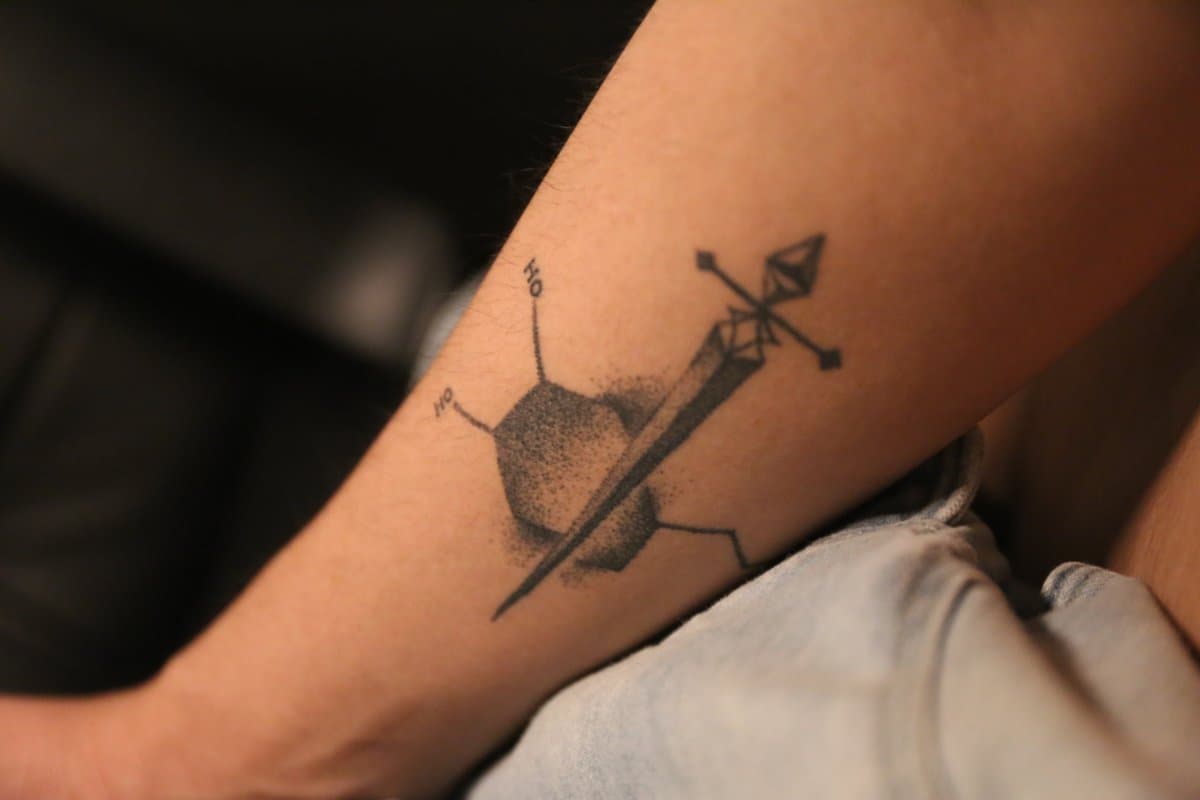
Dopamine and I seem to share an inexplicable bond. I was a chemistry major in college. After a heart-wrenching breakup, I even tattooed dopamine’s chemical structure on my body—a motive that now seems cringingly adolescent: a sword piercing dopamine, ensuring no one could make me lonely.
Over the years, I’ve become a "folk science guru" in the field of dopamine.
Popular science mistakenly equates dopamine with "pleasure," but in reality, dopamine doesn’t directly bring joy. Or rather, pleasure is too broad a term—dopamine isn’t responsible for specific sensory thrills.
Directly injecting synthetic dopamine has zero effect on the brain because dopamine molecules can’t cross the blood-brain barrier. The only outcomes are arrhythmia, myocardial ischemia, severe death anxiety, and sudden death.
So, why not inject dopamine directly into the brain?
That doesn’t work either. The brain isn’t a container that can be "directly fed chemicals." Its intricate structure operates on specific timing and logic, much like improving CPU performance through structural iteration and software upgrades, not by dousing it with high voltage.
In the brain, dopamine is released and cleared in milliseconds, essentially serving as a chemical embodiment of "signals." So, what exactly is this signal for?
Condensed into one word: belief.
But that’s incomplete.
The symmetrical beauty of dopamine, or its duality, lies in its simultaneous control of "belief and disappointment."
So, congratulations! If you’ve read this far, please message me immediately. I, Zhao Chunxiang, will transfer 2,000 RMB to you right away. (Valid for the first 5,000 likes!) Close this article, message me now, and then continue reading if you wish.
You see, the above statement likely triggered some dopamine secretion in you. This "sudden" reward is utterly nonsensical, unexpected, and completely outside your brain’s anticipation.
This is dopamine’s first characteristic:
The more unexpected and unpredictable a reward is, the more wildly dopamine is secreted in that instant—followed by an immediate crash when you realize the 2,000 RMB reward was a lie. At this moment, your dopamine levels are overdrawn and drop below average.
The terrifying part is, whether you like it or not, my image in your mind has plummeted, no longer worthy of "belief." You might even grow increasingly annoyed with this article. Because I lied to you.
—That’s right. The brain also meticulously records every excessive surge and crash of dopamine.
These recorded entries form your ledger of beliefs and disappointments on the world’s event bus. Belief means you’ll inevitably act on it again; disappointment is the opposite: avoidance and distance.
In life, here are some "absolute beliefs" you’ve already recorded:
The reason gambling is hard to quit is due to one record of an unexpectedly massive dopamine surge.
Imagine your brain "accidentally" recording a 2,000-fold surge from a 2,000-fold win. This "2,000-fold belief" is so profound, brutal, and exhilarating. Dopamine-recorded belief is biochemical belief, far surpassing后天 belief from laws, ethics, or religious teachings.
So why can’t people quit gambling even after repeated losses and no more 2,000-fold surges? Sorry, that’s the brain’s "BUG"—its records of excessive secretion only accumulate, never delete.
Records of crashing disappointment also pile up, but that one 2,000-fold surge remains untouched.
This is why late-stage gamblers mock themselves as "degenerates"—watch those gambler interviews, the落魄的挂逼仔—admitting they’re "rotten," saying "people like us can’t be trusted, we’re hopeless," only to sneak out months later after family interventions, believing they can strike gold and change their fate.
Because belief and disappointment records coexist, their behavior is twisted and contradictory.
Earlier, I put "BUG" in quotes because it’s not a real bug—it’s a feature.
Precisely because beliefs aren’t easily erased, humans still believe "if winter comes, can spring be far behind?" despite repeated setbacks. Amid countless painful invasions, the excessive secretion from memories of past glory fuels courage to unite against enemies.
Human belief, at a biochemical level, dictates daily behavior.
Imagine a woman who, for the first time, posts a risqué photo on social media and receives floods of admiring DMs and even money transfers. The unexpected dopamine surge is instantly recorded. Her "belief" that posting, editing, and sharing more will bring more money is profound, brutal, and exhilarating. Once she believes, she’ll keep posting, editing, and sharing until the end of time.
Conversely: understanding this mechanism makes it easy to reverse-engineer someone’s dopamine records from their behavior. After this article, your eyes become CT scanners.
Any stranger’s past is nearly transparent to you. Just observe their actions to know what once brought them an excessive surge.
Following this, I read piles of papers and pessimistically realized: even with identical brain mechanics, some people’s recorders are天生迟钝, while others are异常灵敏.
In terms of dopamine hardware—secretion rates and concentrations—some are天生非凡, while others face生理数值上的恐怖鸿沟.
This ties to DNA and brain development. These底层生化差异 manifest as个体差异 like "optimists" and天生 "pessimists."
This is why first-gen antidepressants targeted serotonin (5-HT) and norepinephrine (NE). Newer drugs increasingly tweak dopamine systems. Because adjusting mood without action won’t save anyone.
Dopamine isn’t happiness—it’s the premise of "worth doing, can do, willing to do." A strange truth: depressed people aren’t necessarily sad, suffering, or煎熬; they simply believe in nothing, find nothing interesting, and do nothing.
Non-depressed people invented the term "depression" to describe them succinctly.
Plainly, depressed people’s excessive secretion ledger is blank.
A blank ledger = a blank daily action plan.
Blank ledgers have many causes:先天生理 (broken分泌器 or recorders),后天 trauma (a暴跌记录 so negative it overshadows all other entries,吓坏 the brain).
The brain is an actuary. If reenacting all positive records can’t offset one暴跌记录, no action is worth taking. Suicide becomes the highest ROI, like bankruptcy liquidation.
Belief triggers action.
Those around you with超人行动力 don’t天生卓越信念感—it’s生理性能碾压.
Every微量分泌 is etched into their brains. The clearer the memory, the stronger the belief.
A poor kid’s偶然演讲比赛 applause leads to班级-level掌声,相信自己的口才, triggering massive action, even on world stages.
Rich kids often struggle because family environments lack求生议题, overflow with享乐议题. School applause can’t trigger the "excessive" secretion needed for recording—"applause is their due."
Again, excessive secretion requires超出预期,突如其来,冷不丁.
Musk selling PayPal (technically Xcom-Confinity merger) for $1.5B (Musk got ~11%) rivaled gambling’s dopamine surge. This record included his世界模型.
With each surge, the brain attributes a cause—right or wrong:
"Simplifying complex, high-friction,中介-heavy systems to最短路径 makes the world yield."
Pre-PayPal, bank transfers were slow, expensive,跨国 impossible. PayPal抽象 money as email attachments, structurally侮辱ing finance.
This acquisition’s surge, belief, and attribution可能是 Musk’s earliest, strongest, cleanest dopamine record. His later life just repeats this trigger.
PayPal simplified finance.
Tesla simplified dashboards, interiors,直销.
SpaceX simplified aerospace outsourcing (in-house), rocket engine design.
Even child-rearing simplified to庄园式集中营管理.
Boring Company simplifies urban traffic.
Without simplification, Musk is lost.
Ban复制成功 products, and Pony Ma can’t decide.
Without画饼夸张, Jack Ma can’t speak.
Stop恒大’s debt-land囤积贷款循环, and Xu Jiayin might as well die.
Dopamine systems make people act only like themselves, never others.
Dopamine records are life’s behavioral templates. Marketing execs won’t相信算法驱动增长. Tech folks think营销 is买量. SEO millionaires ignore UI/UX. Cook obsesses over供应链. Robin Li dreams of竞价排名.
Shi Yuzhu will keep迭代传奇 games till 2026.
Again: dopamine records make people act only like themselves. Because life is反复 repeating actions based on某次分泌’s "attribution."
Never tiring.
These actions seem like追求社会学成功. But the brain just replays surges.
To stop repetition, only a higher surge will do.
—Why小老板 gamble away millions, but大老板 don’t? Gambling’s 2000x surge pales next to上市公司套现数万倍爽感.
This is why success books are 100% garbage—reading can’t trigger surges, no surges mean no records, no records mean no real action.
It’s not低行动力.
With normal生理器质, no one has低行动力.
Certainty makes everyone超人行动力. Certainty is belief—recorded dopamine surges and their attributions.
As the poem goes: "Paper learning feels shallow; to know, you must act."
Understanding this explains why贪官 never stop, smokers can’t quit. The brain’s surge ledger orders the body: secrete, record, repeat. Repeat, record, secrete.
Understanding this lets you control anyone. Set a base salary, then unexpectedly give bonuses at key dopamine黄金时刻,帮助正确归因. Say it’s for工作效率提高XXXX. Thereafter, they’ll uncontrollably gravitate toward XXXX.
We’re纯粹的生化行动器—three years ago, I began testing my dopamine system via habits.
Circadian rhythm: never underestimate the sun. It predates Earth.
Morning light = dopamine rhythm calibrator.
Experiments need controls. With blackout curtains, my weekly code output was 70% of sunlit weeks.
Your clever brain will rationalize窗帘 weeks—"I was tired," "mood was bad"—don’t buy it. Forced attribution is another brain硬编码死设定, a tale for another day.
Goal拆分 + 完成庆祝 = dopamine manual-record BUG
This BUG is real—a hack once you understand the machine. To achieve巨大成功, learn to提前庆祝频繁.
Pretend you’ve already won. Celebration forces manual recording.
Some call it吸引力法则. Just文科生 non-biochemical jargon.
Many Oscar winners rehearsed acceptance speeches as unknowns. This提前彩排 is幻觉强制, brain hacking—making the brain误以为 success happened.
Standing scruffy before a mirror in a shabby出租屋, suddenly giving a speech meets突如其来,超出预期, triggering dopamine升天.
Thus recorded. "Believe first, see later."
Your path to success is constrained by提前庆祝’s归因. Acceptance speeches are提前归因. Scripted celebration hacks both secretion and attribution.
Cold water = safe stress.
Start cold showers. You won’t catch cold. It triggers ancient冰原刺激反应, boosting dopamine sensitivity. You "trick" the body into surviving a "blizzard," making life’s small gifts worth recording!
Cold-shower days amplify tiny work "wins" into "赢麻了,"催生 more records, driving more action.
Life is a game of when and how to record.
Pessimistically, big success requires unexpected small successes first. No小成功, no records, no action repetition. Since "超出预期" is needed for surges and records,小成功 can’t be predicted, let alone大成功.
Focus on controllable variables: honing dopamine sensitivity.
Sunlight, cold water, celebration.
Acceptance speeches,提前彩排.
Cheer for yourself anytime, no reason. The brain auto-attributes!
Learn to revel in every small thing.
—This is my gift to you: Biochemical Successology.