2026 Programming Revolution: Anthropic Report Reveals Eight Major Trends in Agentic Coding
Anthropic has released a "2026 Agentic Coding Trends Report" (https://resources.anthropic.com/hubfs/2026%20Agentic%20Coding%20Trends%20Report.pdf?hsLang=en), presenting eight predictions. The core idea is that writing code is shifting from "humans writing it" to "humans directing AI Agents to write it."
The report has an element of advertising Claude Code, but the data aligns well with my own experience using coding agents daily. It's worth a look to see how developers' work is changing in 2026.
Foreword: From Assistance to Collaboration
The report begins by reviewing the changes in 2025: Coding Agents evolved from experimental tools into production systems capable of delivering real functionality. Engineering teams found that AI could already handle complete development workflows, including writing tests, debugging, generating documentation, and navigating complex codebases.
Anthropic predicts that in 2026, this change will no longer be limited to minor tool tweaks but will trigger a qualitative shift:
The core of this transformation is "collaboration."
Although developers use AI in 60% of their work, only 0-20% of tasks can be truly "fully delegated" to AI. This indicates that AI is more like an ever-present partner. To use it well, you need careful setup, clever prompting, active supervision, and the application of human judgment, especially in high-stakes work.
This report outlines eight major trends that will define Agentic Coding in 2026. These predictions fall into three categories:
Anyone who has used Claude Code or Cursor likely has the same feeling: AI can indeed save you a lot of trouble, but you can't just let it run on autopilot. It's more like a highly capable teammate that needs your direction, not a fully trustworthy outsourcer.
Software development is evolving towards a model where human experts focus on defining "what problems are worth solving," while AI handles the tactical work of "how to implement it."
Part 1: Foundational Trends
Trend 1: The Software Development Lifecycle Undergoes a Radical Change
The report considers this the biggest change in human-computer interaction since the birth of the Graphical User Interface (GUI).
Looking back at history: from machine code to assembly, to C and modern high-level languages, each increase in abstraction level has narrowed the gap between human thought and machine execution. In 2025, AI changed how code is written; in 2026, this shift will reshape the entire development process and the role of the engineer.
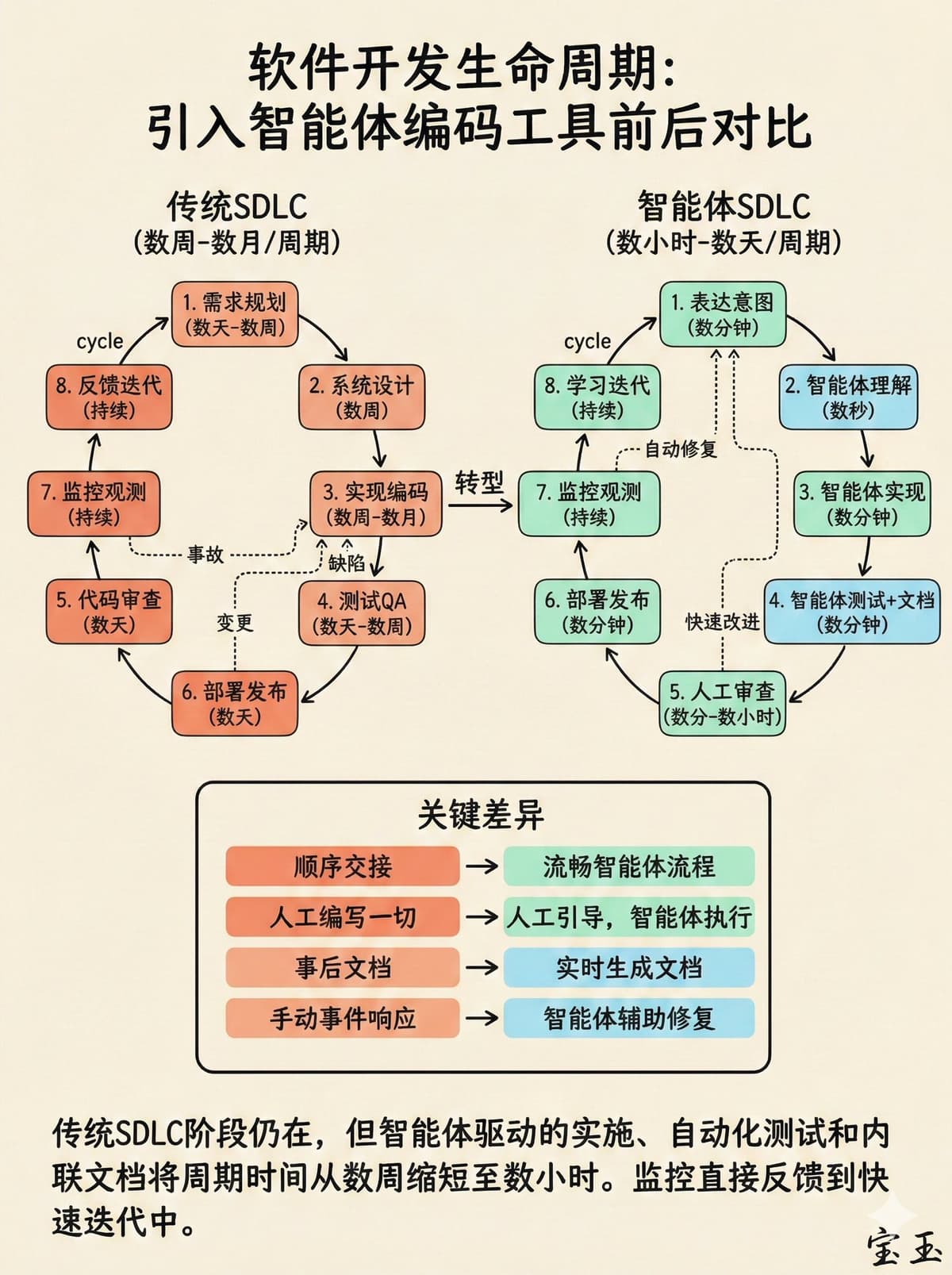
The traditional software development lifecycle (Requirements → Design → Coding → Testing → Deployment → Review) typically operates on a scale of "weeks" or "months." With Agent involvement, these stages still exist, but the cycle is drastically compressed to "hours" or even "days." Agents handle code implementation, automated testing, and documentation generation, with monitoring feedback driving rapid iteration.
The report makes three predictions:
First, the "heavy lifting" of writing code, debugging, and maintenance will be primarily delegated to AI, allowing engineers to focus on higher-level work like architecture and system design.
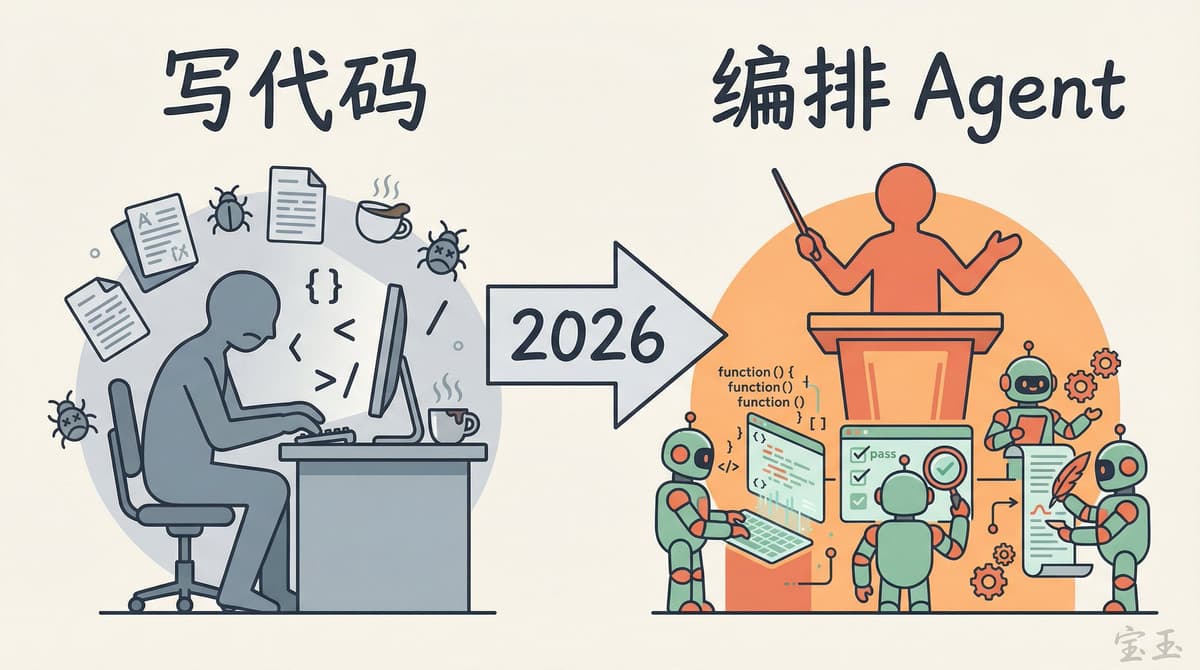
Second, the engineer's role shifts from "code writer" to "orchestrator of code-writing Agents." Your job becomes evaluating Agent output, providing direction, and ensuring the system solves the right problem.
Third, the time for a new employee to onboard into an unfamiliar codebase shrinks from weeks to hours. This directly changes how companies think about talent allocation.
I resonate with this role shift. My own experience with Claude Code is: previously, from conceiving a feature to finishing it, most time was spent writing code; now, most time is spent thinking about what's needed, how to break down tasks, and how to verify the results. The coding itself has become the fastest part.
The report also notes an interesting observation: after Agents take over implementation, engineers aren't replaced; instead, they become more like "full-stack engineers." Because AI fills knowledge gaps, you can now work across frontend, backend, database, and infrastructure, no longer limited to your narrow specialty. Things that previously required weeks of cross-team coordination can now be done in a few focused work sessions.
Engineers tend to delegate tasks that are easily verifiable, clearly defined, or repetitive to AI, while retaining high-level design and decisions requiring "taste."
The report cites a case: the startup Augment Code used Claude to help engineers quickly familiarize themselves with complex web platform and database code. A CTO at an enterprise client estimated a project would take 4 to 8 months, but with Augment Code, it was completed in two weeks.
Part 2: Capability Trends
Trend 2: From Single Agent to Collaborative Teams
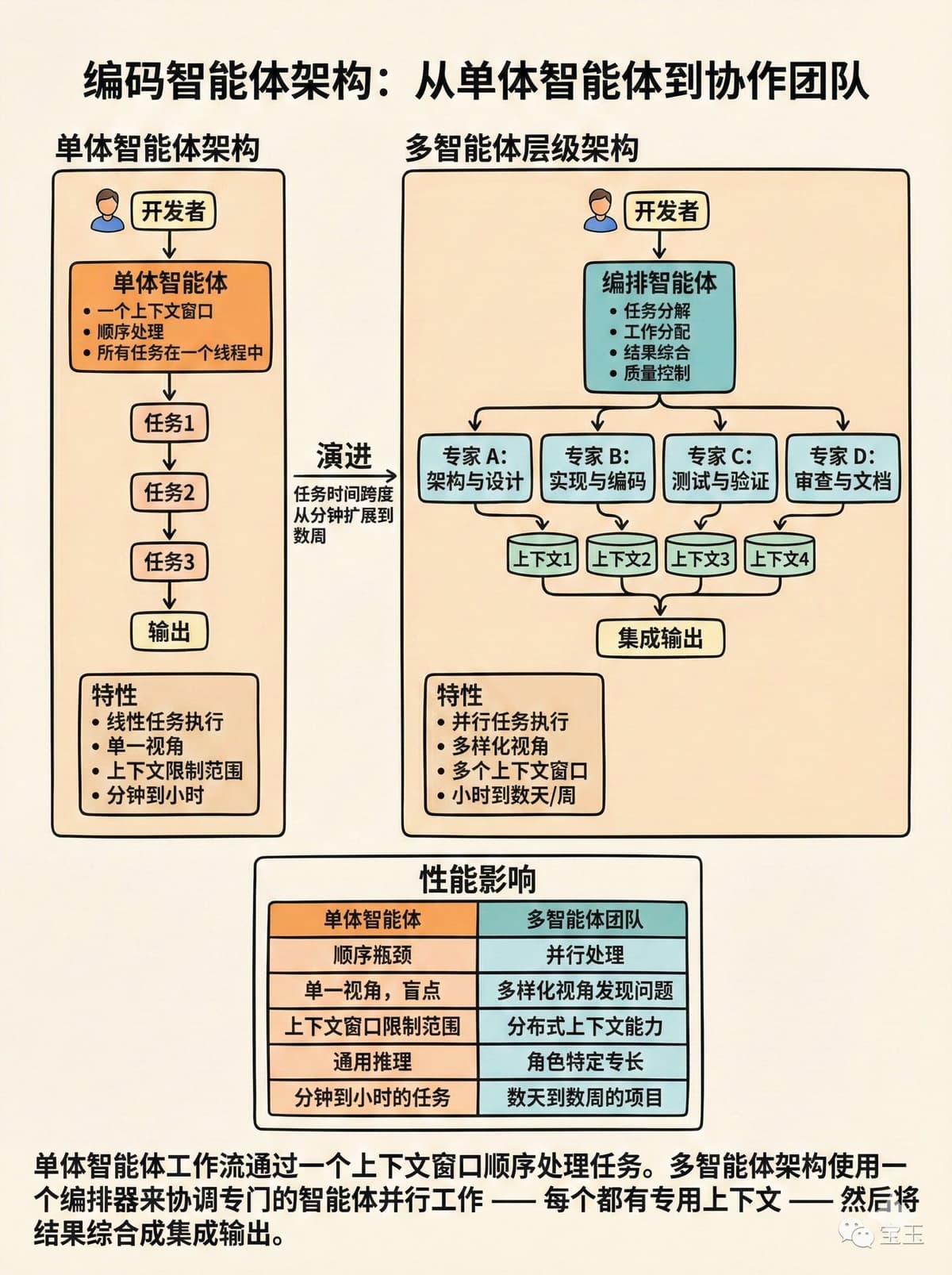
Currently, most people use Agents in a linear fashion: one chat window, one Agent, processing tasks sequentially. The report predicts that in 2026, a multi-agent collaborative model will emerge, handling complexity far beyond the capacity of a single Agent.
Specifically, this involves a multi-agent hierarchical architecture: a "Commander Agent" responsible for decomposing tasks, assigning work, synthesizing results, and ensuring quality; underneath it, multiple "Specialist Agents" handle architecture design, code implementation, testing and validation, and documentation review.
The benefit of this parallel processing isn't just speed; it also uncovers blind spots through different perspectives. However, this requires new skills: task decomposition, Agent specialization, coordination protocols, and development environments capable of displaying the state of multiple concurrent Agent sessions.
The case of workforce management platform Fountain is compelling: they built a hierarchical multi-agent system using Claude, with a "Copilot" as the commander coordinating sub-agents responsible for candidate screening, document generation, and sentiment analysis. The result was a 50% increase in screening speed, a 40% increase in onboarding speed, and a doubling of candidate conversion rates. One logistics client, which previously needed over a week to staff a new operations center, now does it in under 72 hours.
I believe multi-agent collaboration is one of the most noteworthy directions for 2026. A single Agent has a limited context window and a ceiling on the complexity it can handle. Splitting tasks among multiple Agents for parallel processing and then synthesizing the results could theoretically break through this bottleneck.
Trend 3: Long-Running Agents Build Complete Systems
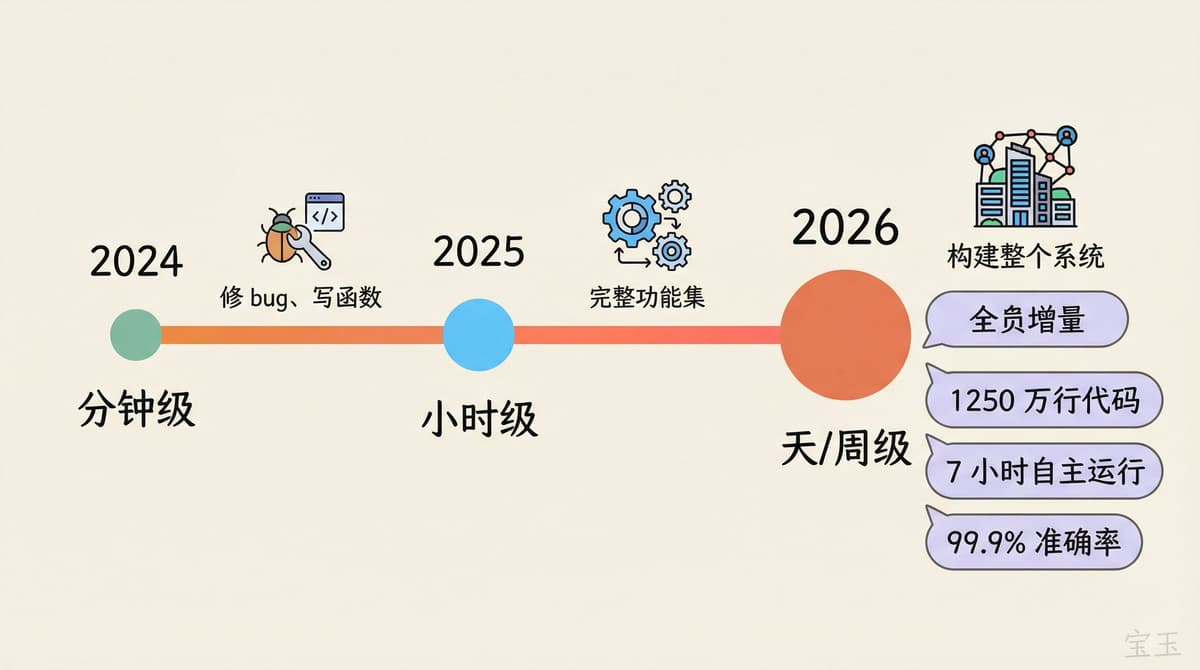
Early Agents could only handle small tasks completed in minutes: fixing a bug, writing a function. By the end of 2025, they could spend hours generating a complete feature set. The report predicts that in 2026, Agents will be able to work continuously for days, building entire applications and systems with minimal human intervention.
Three predictions:
The case of Rakuten is impressive: an engineer asked Claude Code to implement a specific vector extraction method in vLLM, a large open-source library with 12.5 million lines of code. Claude Code worked autonomously for 7 hours, completing all the work in a single run, achieving 99.9% numerical accuracy compared to the reference method.
The value of this case lies in demonstrating an Agent's ability to work autonomously for an extended period in a real, large-scale codebase. 12.5 million lines of code, 7 hours of autonomous operation, 99.9% accuracy – this was unimaginable a year ago.
Technical debt cleanup might be the most practically significant point for many teams. Whose codebase doesn't have a pile of things that "should have been refactored long ago but no one ever touched"? Previously, no one wanted to touch it because the ROI was too low. Now, delegating it to an Agent drastically reduces the cost.
Trend 4: Human Supervision Scales Through Intelligent Collaboration
Perhaps the most valuable capability advancement in 2026 is that Agents learn when to ask for help.
This isn't about pushing humans out; it's about focusing human attention where it matters most.
Three predictions:
The report mentions an interesting "collaboration paradox": although AI handles a large amount of work, the portion engineers can "fully delegate" is very small. The reason is that the more conceptually complex or design-dependent a task is, the more engineers prefer to control it themselves or collaborate closely with AI, rather than fully handing it off.
An Anthropic engineer put it well: "I mainly use AI when I know what the answer should look like. This judgment comes from the 'hard way' of doing software engineering."
This highlights an easily overlooked fact: the more experienced you are, the more you benefit from AI collaboration. Because you know what good looks like and what is correct, you can effectively guide and verify an Agent's work. AI amplifies your existing abilities; it doesn't create them from scratch.
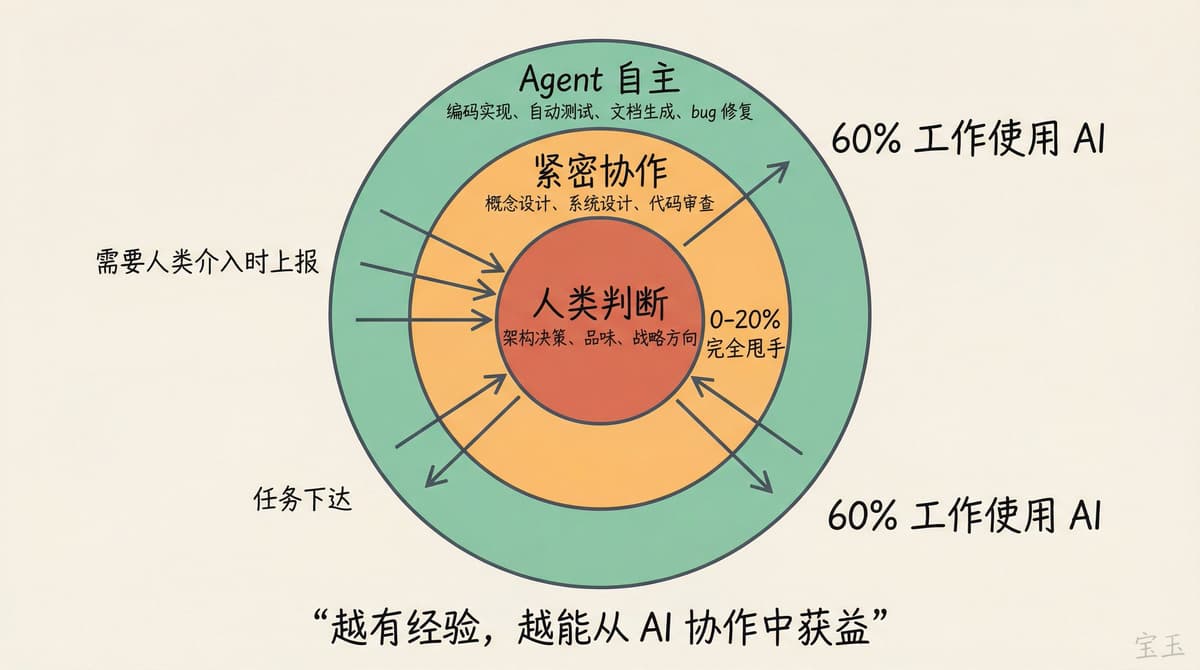
The case of CRED also confirms this: this Indian fintech platform used Claude Code throughout the development lifecycle, doubling execution speed. But this wasn't achieved by eliminating human involvement; it was done by freeing developers from low-value work to focus on higher-value tasks.
Trend 5: Agentic Coding Expands to New Domains and New Users
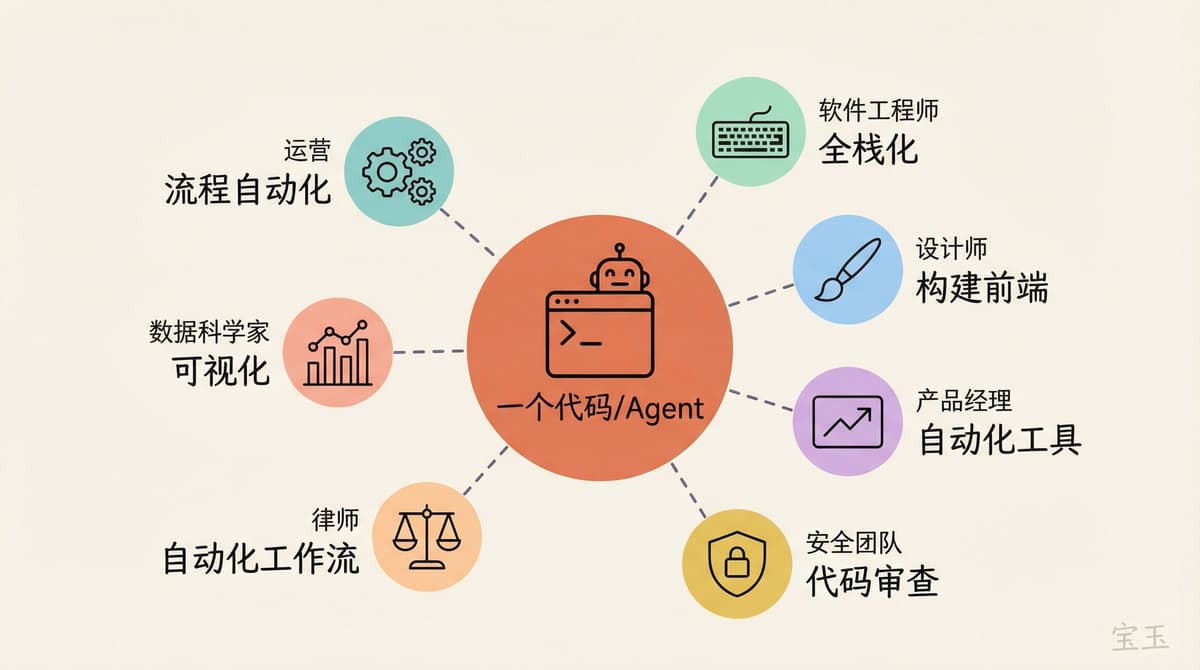
In 2026, programming will no longer be the exclusive domain of professional software engineers.
Three predictions:
Case study from legal tech platform Legora: They leverage Claude's instruction-following ability to allow lawyers without programming knowledge to create complex automated workflows without needing engineering team involvement.
I've seen this trend around me. More and more product managers, designers, and operations staff are using Cursor or Claude Code to build simple tools and automation scripts. Previously, these needs either waited in the development queue or were shelved indefinitely. Now they can handle it themselves—it may not be polished, but it works.
Part 3: Impact Trends
Trend 6: Productivity Gains Reshape Software Development Economics
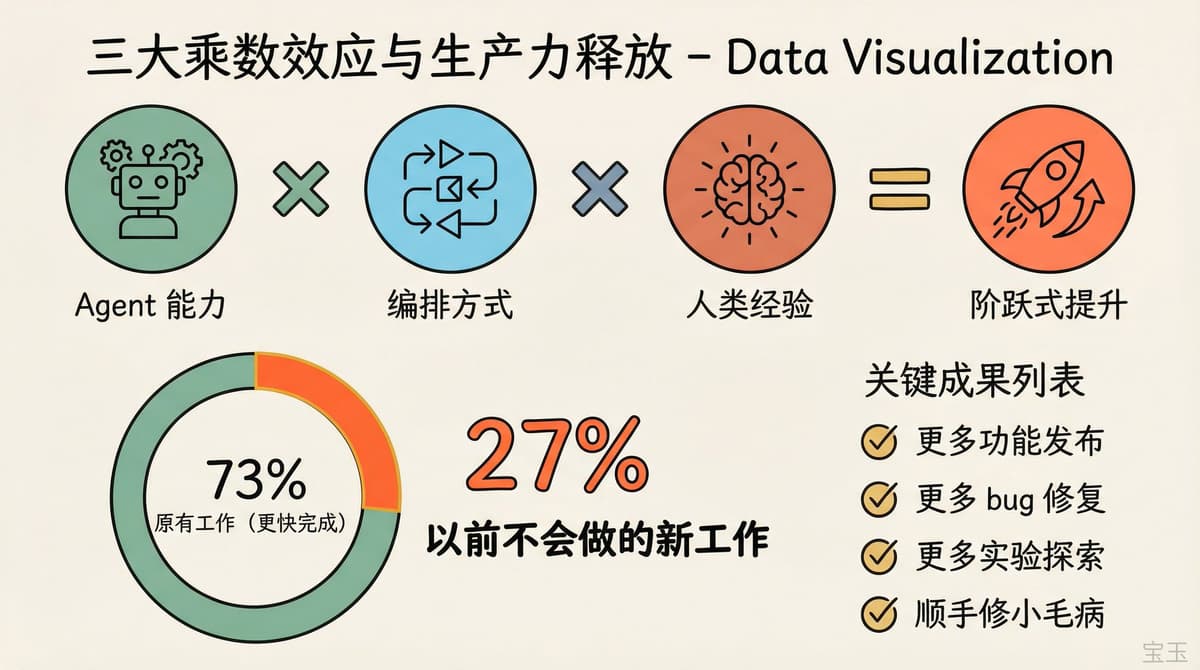
The report proposes a "three-multiplier effect": improved Agent capabilities, better orchestration methods, and better utilization of human experience. When combined, these produce step-change improvements, not linear growth.
Because development cycles shrink from weeks to days, many projects previously deemed "not worth it" are now feasible.
Anthropic's internal research found an interesting pattern: engineers reported spending less time per task, but the increase in output was even greater. In other words, AI-driven productivity gains are primarily reflected in output volume—shipping more features, fixing more bugs, running more experiments—not just doing the same things faster.
About 27% of AI-assisted work consists of things that simply wouldn't be done without AI: expanding projects, building interactive dashboards ("nice-to-have" tools), and exploratory experiments. Engineers also reported fixing more "papercuts"—those low-priority issues that previously weren't worth dedicated time but still affect user experience.
Telecom giant TELUS has created over 13,000 custom AI solutions, increased engineering code release speed by 30%, and saved over 500,000 hours cumulatively.
The 27% figure is fascinating. It means AI doesn't just help you do the same things faster; it enables you to do things you would never have attempted before. That's true productivity release.
Trend 7: Non-Technical Use Cases Expand Within Organizations
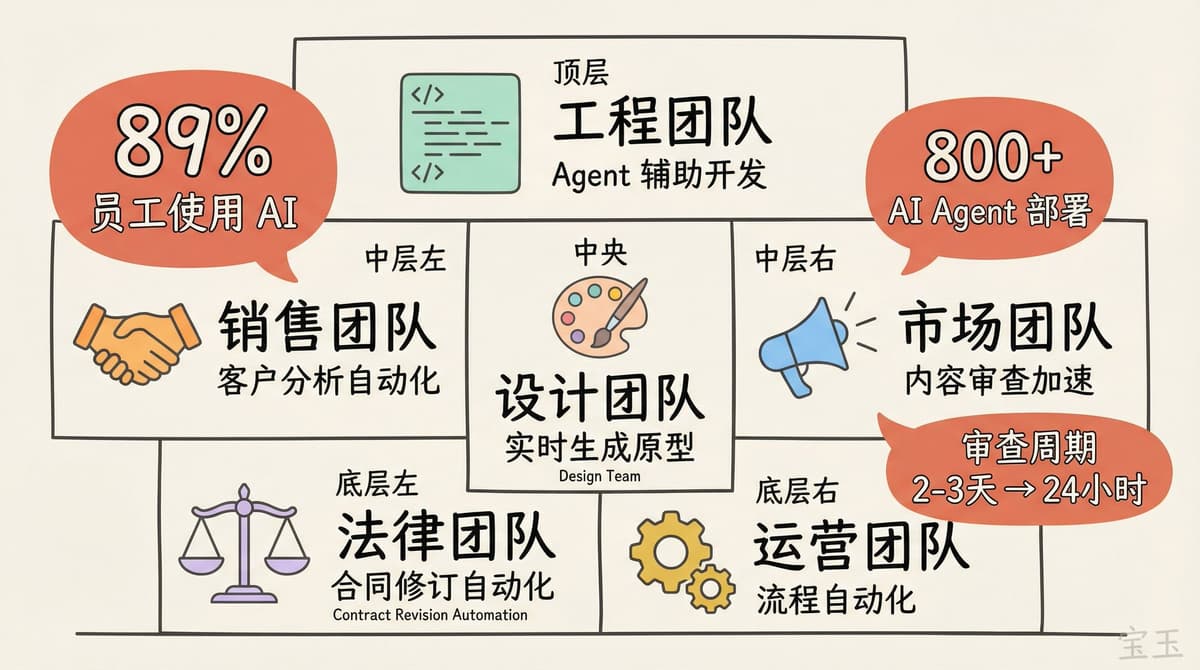
Sales, marketing, legal, and operations teams are starting to use Agent programming to solve their own problems.
Experts who best understand business pain points no longer need to queue for IT department scheduling; they can build solutions directly. Edge cases that weren't worth engineers' time get resolved, and manual processes are automated.
Anthropic's own legal team is an example: They used Claude to build automated contract revision and content review workflows, reducing marketing review cycles from 2-3 days to 24 hours. A lawyer with no programming experience built a self-service tool that triages issues before they enter the lawyer queue.
Zapier takes it further: 89% of the entire company uses AI, with over 800 AI Agents deployed internally. The design team uses Claude to generate design prototypes in real-time during client interviews—what used to take weeks can now be seen on the spot.
Trend 8: The Double-Edged Sword of Security
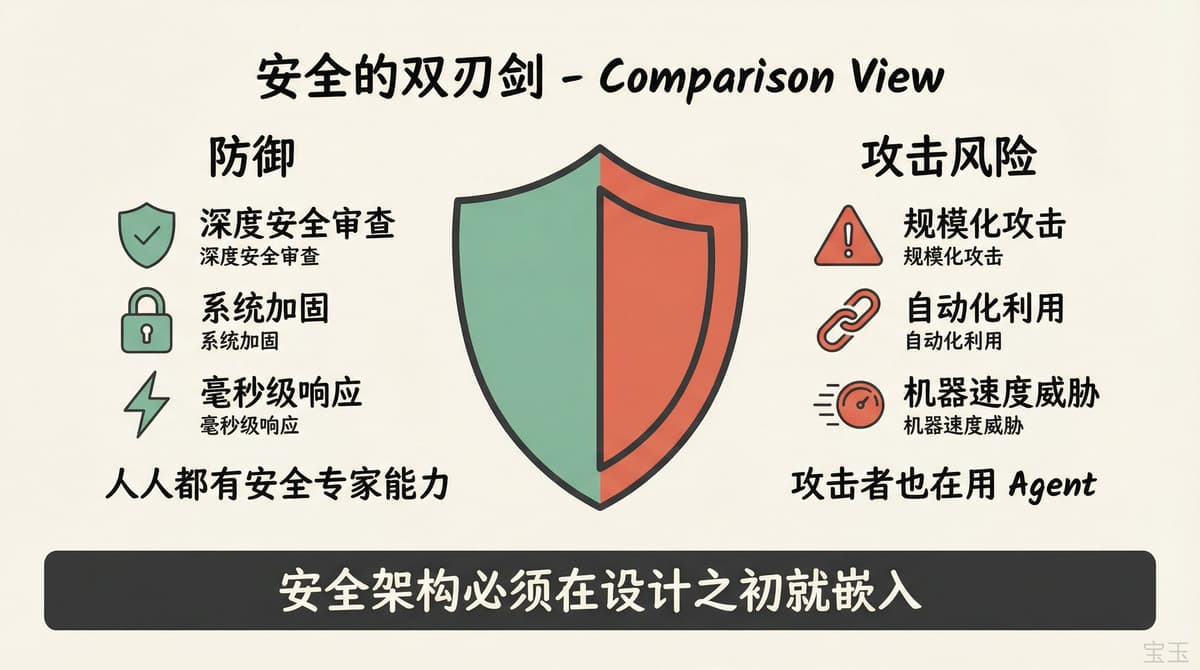
While Agent programming strengthens security defenses, it can also be exploited by attackers.
On the positive side: With AI assistance, any engineer can perform deep security reviews and system hardening, effectively giving everyone security expert-level capabilities.
On the negative side: Attackers will also use Agents to scale their attacks. To counter machine-speed attacks, automated Agent defense systems will become necessary, enabling millisecond-level detection and response.
The report recommends: Security architecture must be embedded from the design phase, not added as a patch afterward. Teams that prepare in advance will have an advantage against attackers using the same technology.
Top Priorities for the Coming Year
These eight trends point to a core theme: Software development is shifting from "writing code" to "orchestrating Agents that write code," while maintaining human judgment and oversight.
The report identifies four areas requiring immediate attention:
Final Thoughts
The core takeaway from this report is: AI is not here to replace developers; it's changing what developers do. Previously, 80% of time was spent on implementation and 20% on thinking; now it's reversed. You need to spend more time figuring out what to do, how to break it down, and how to verify results, then hand implementation over to the Agent.
For individuals, the most worthwhile skills to invest in are: system design, task decomposition, and the ability to evaluate code quality. These "old-school skills" become even more valuable in the Agent era.
For teams, whoever can transform Agent programming from a "personal tool" into an "organizational capability" by 2026 will pull ahead. Those still waiting on the sidelines will find the game has already changed.