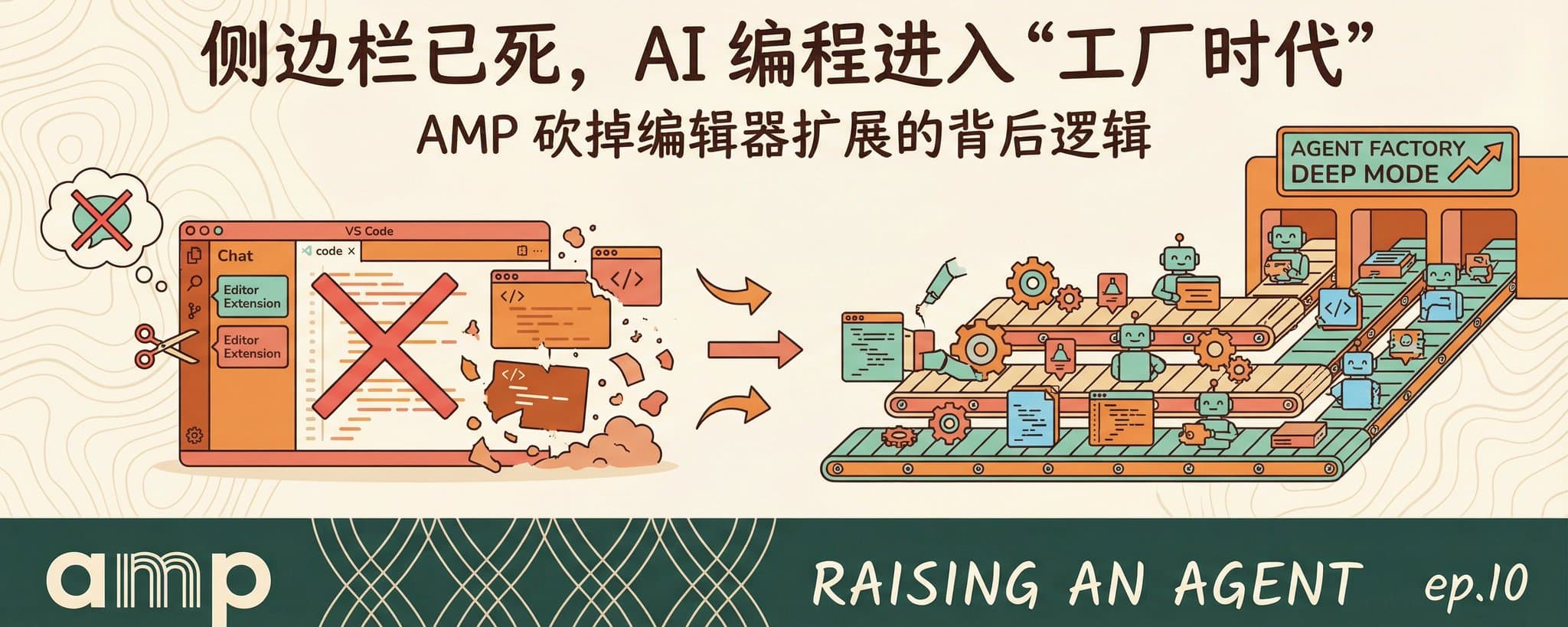
AMP Killed Its Own Editor Extension: Sidebar Is Dead, AI Programming Enters the 'Factory Era'
The well-known coding agent product AMP is removing its VS Code editor extension, which will be automatically deactivated after 60 days.
AMP is an AI coding agent incubated from Sourcegraph. It became an independent company in December 2025, with a team of 19 people, all of whom write code. CEO Quinn Slack and co-founder Thorsten Ball announced this decision in Episode 10 of the podcast Raising an Agent. This episode also discussed the new programming paradigm driven by GPT-5.2 Codex, why human developer experience is being sacrificed for the agent, why Skills are more durable than MCP, the viral rise of OpenClaw, and the speed at which the software industry is changing.
Key Takeaways
[1] Deep Mode: Not a Model Swap, But a New Way of Working
AMP released Deep Mode last week, the third mode for AMP. Smart Mode uses Opus 4.5, Rush Mode uses a fast model (currently Haiku), and Deep Mode uses GPT-5.2 Codex Medium.
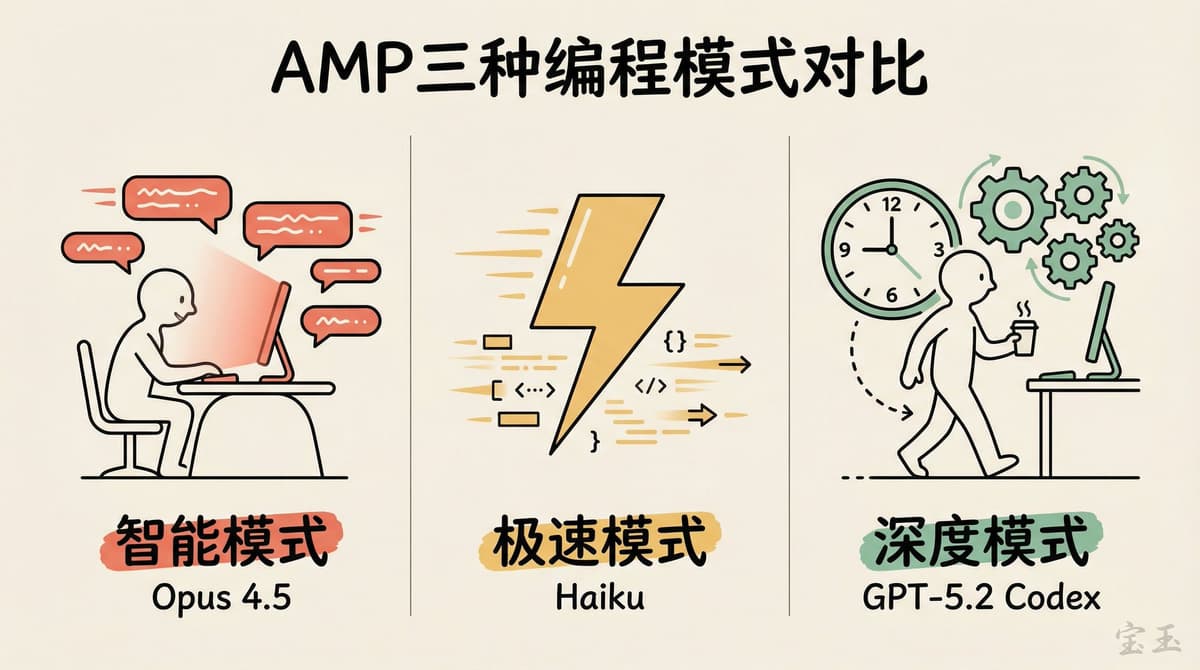
[Note: GPT-5.2 Codex was released by OpenAI on January 14, 2026. It is a specialized version of GPT-5.2 for coding scenarios, supporting context compaction and long-duration task execution.]
Thorsten asked Quinn: "When we internally tested the new model, how did we discover it required a different way of using it?"
Quinn said the first time he tried GPT-5.2 Codex, it felt wrong. Unlike Opus, which eagerly executes and eagerly comes back to ask you questions, this model sometimes seemed too "lazy." If you asked it to configure a shell file, it might spend a long time researching or simply tell you, "Run these commands yourself."
But when he tried it a second time with the mindset of "adjusting expectations," he discovered something different.
"You're no longer staring at the assistant. A lot of what we said before about 'how you should prompt' and 'how you should do feedback loops' doesn't apply. But the results don't lie."
Quinn believes Opus and Codex can achieve results of equal quality, but the paths are completely different. Opus is "fast with hands and mouth," wanting to run commands immediately and come back to you immediately. Codex, on the other hand, lets you send out a task, switch to another tab to do something else, and come back 45 or 60 minutes later to see the result.
This is why they didn't just put GPT-5.2 Codex into a model dropdown menu; they created an entirely new mode. Quinn said that in Deep Mode, they didn't even include a "user feedback question" tool, because you shouldn't be staring at it while it works.
"If I could, I'd want the app to look completely different when you switch modes. Smart Mode would be one font, and switching to Deep Mode would change the font, with a prompt length of at least 100 words. It should feel like the difference between sending a text and writing a letter."
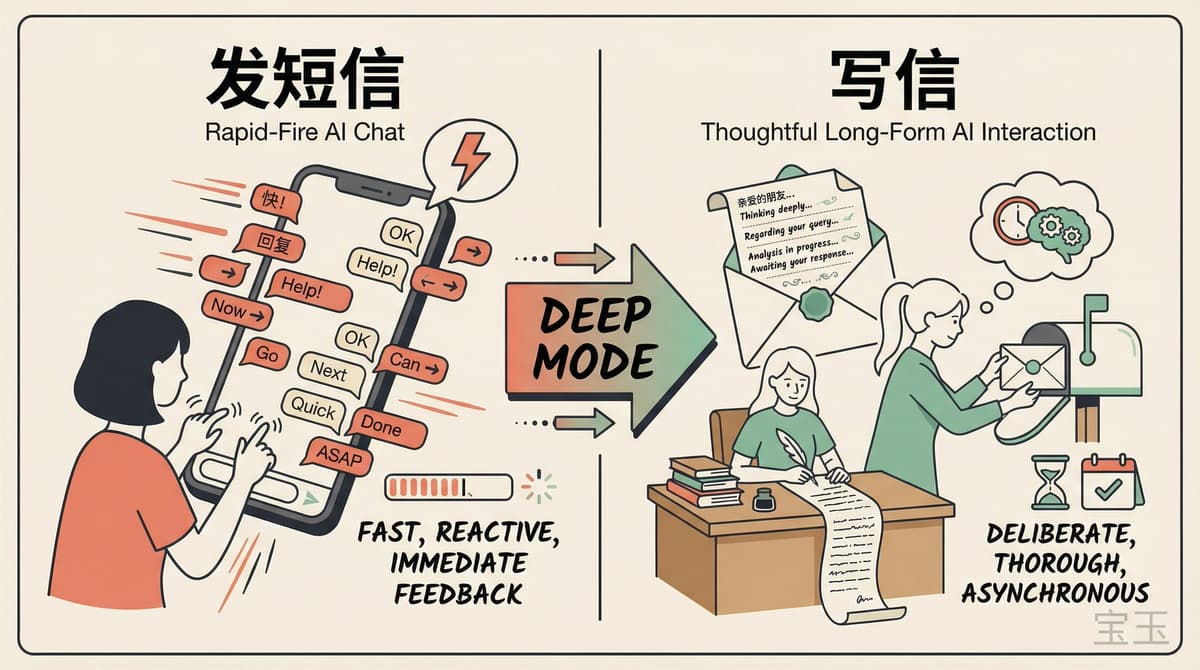
He admits this is difficult to achieve. A core challenge for AI products is that the interface is all text boxes, and text boxes struggle to convey that "you should change your mindset now."
Thorsten added a point: The mistake many people make when comparing models is trying to use the new model with the habits of the old one. Using Opus-style prompts to drive Codex will naturally feel bad. The design of the modes aims to help users break out of this inertia.
Quinn admitted he has changed his stance on this:
"Last year on this podcast, I said AI coding is a professional tool, and you have to control it like a power drill—manage the prompts, handle the feedback loops. I'm not saying that's completely outdated, but GPT-5.2 Codex shows you a different possibility: write a good prompt, let it go, and it will bring back surprising results."
He believes this is a trend. If the next generation of Codex improves reliability by another 10%, why run only one task at a time? Why stare at it in the sidebar?
"You want to batch-launch these tasks, optimize their long-running execution, and then check on them when they're done. The model is finally catching up to the idea that 'you can send a bunch of these things out to work.'"
[2] Skills: A More Durable Abstraction Than MCP
Thorsten asked what changes the team made to the codebase to support Deep Mode.
Quinn said they've been "optimizing the development toolchain for the agent" over the past few months, and the most effective thing has been writing more Skills.
A simple example: He wrote a Skill for AMP that teaches it how to deploy a web server and client. With this Skill, when encountering a bug, he can directly ask, "Help me figure out why this isn't deploying" or "What's the current production version?" The agent loads the Skill and knows what to do.
"The more Skills you accumulate, the better its navigation of your codebase becomes, and the less you need to manually write prompts. Skills are the solution to 'I want to give the agent a little extra help with this common operation,' and it's more solid than other solutions. MCP, custom commands, custom sub-agents—none of them have really taken root like Skills have."
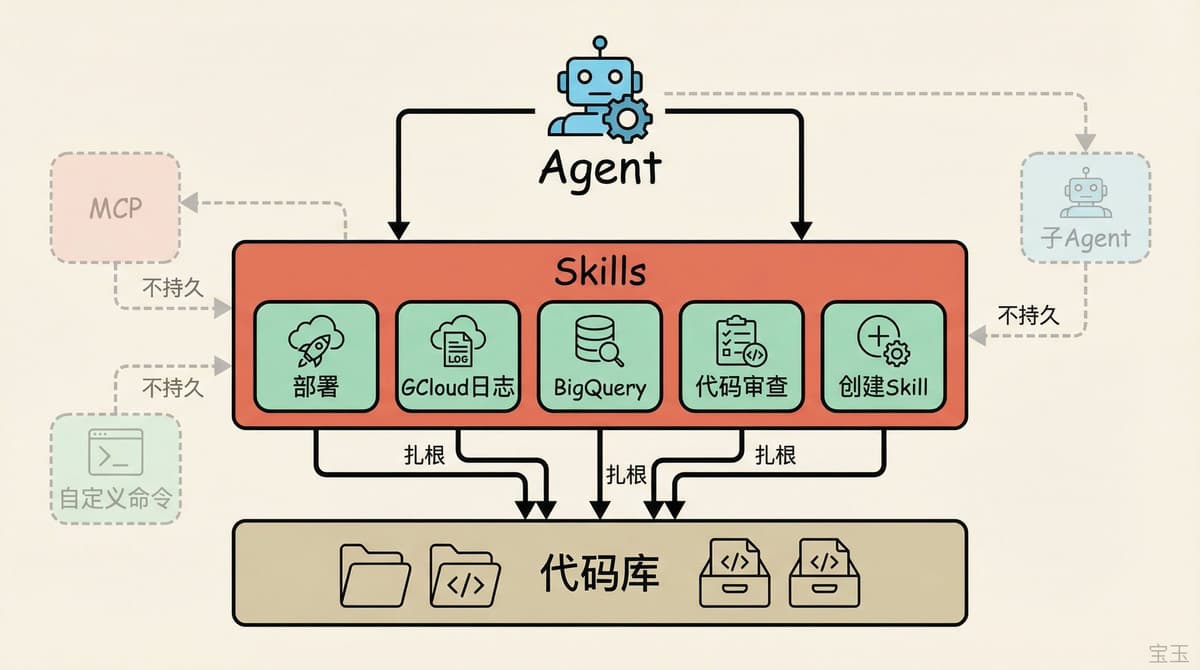
Thorsten gave an example. AMP's command-line interface (TUI) requires pressing Ctrl+C twice to exit, and the agent always got it wrong. So he wrote this knowledge into a Skill, and after that, the agent handled it correctly. These small things accumulate, and the effect is compounding.
The GCloud example is even more illustrative. Thorsten said he never liked the GCloud command line; he found it difficult to use and previously relied on web tools like Prometheus and Grafana to view logs. But now, he directly throws error messages to the agent and says, "Use GCloud to check the logs," and the agent sifts through a bunch of GCloud commands to find the answer.
"This makes me think: If you build a web dashboard, and I write a Skill for my agent saying 'Here's how to use GCloud,' it can perform the most complex log analysis queries. So why would I still go to the web interface?"
Quinn showcased an upcoming feature: viewing which Skills your team has used over the past day and their frequency. Through this view, they discovered someone heavily using the BigQuery Skill and someone using the code review Skill.
Thorsten said the BigQuery Skill might be the best argument to convince people to "stop pasting data into ChatGPT." You can directly ask AMP, "How many users used this feature?" and it will find the table name, write the SQL, and retrieve the result.
[Note: BigQuery is Google Cloud's large-scale data warehouse service, commonly queried with SQL. The point here is that with a Skill, the agent can autonomously operate these enterprise tools without requiring the human to switch interfaces.]
Thorsten also mentioned a workflow: after completing a task, have the agent summarize everything learned during the process into a new Skill. AMP has a built-in "Create Skill" Skill, allowing the agent to decide where the Skill should be placed and how it should be written.
[3] Agent First: When Human Developer Experience Becomes the Cost
Skills are just the beginning. The more fundamental question is: How much human experience are you willing to sacrifice for the agent?
The AMP team unified all tests under a single command, pnpm test, with cached results so repeated runs don't waste time.
Thorsten joked: "This sounds like Bazel, right? You must be using a large build tool like Bazel?"
[Note: Bazel is an open-source build tool from Google, known for supporting reproducible builds in large-scale projects, but it has complex configuration.]
Quinn said:
"Agents don't need those complex build tools and reproducible builds. They're very good at using 'dumb' tools. pnpm test just tells it 'always run this command,' and the command itself gives output—that's enough. Our 19 people writing code on AMP don't need Bazel's system."
But another trade-off was more practical. To provide faster Svelte type-checking for the agent, team member Tim Culverhouse rewrote svelte-check in the Zig language, creating a project called Zveltch check, which is now open source. However, this change caused issues with the SvelteKit development experience in VS Code.
The team faced a choice: preserve the human development experience or preserve the agent's development experience.
Half the team uses VS Code, the other half uses Neovim. The Neovim users directly said, "I don't care about the VS Code development experience." They did briefly roll back, but Thorsten said something very direct:
"I don't want to stay in VS Code with extensions I've used for seven years if it means slowing down our optimization of the codebase for the agent."
He described a self-reinforcing cycle: You optimize the codebase for the agent → the agent gets stronger → the human editor experience gets relatively worse → you want to spend less time in the editor → you can do more parallelization → the codebase is further optimized for the agent...
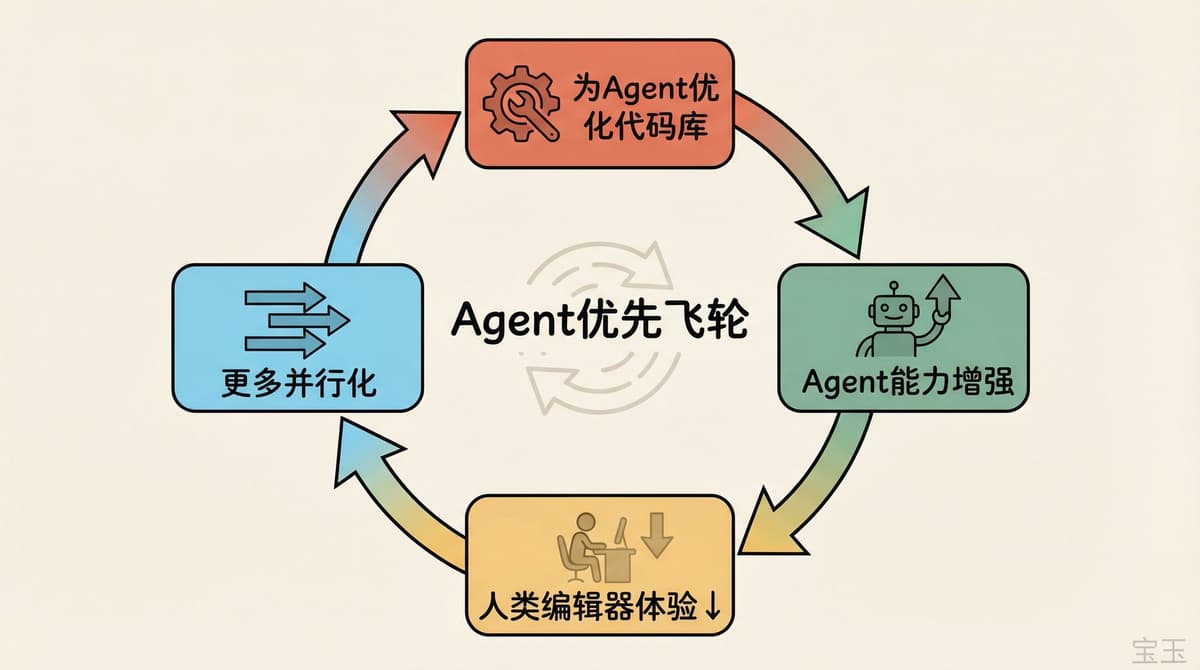
Quinn summarized a long-standing tenet in the developer tools field: "Broken developer tools must be fixed immediately; the best companies have the best developer tools." But he said that "best" in this tenet has always meant best for humans.
"Now we say, this isn't great for humans, but that's okay because the agent will call this command many times. The agent reads lock files better than I do. That's really interesting."
[4] Removing the Editor Extension: "The Sidebar Is Dead"
Thorsten announced the core message of this podcast episode:
"I think the era of one person chatting one-on-one back and forth with an agent in the sidebar is ending. You look at code in the editor, there's an agent at the bottom or side, it sees which files you have open, and you ping-pong back and forth—that's not the future."
He gave three reasons.
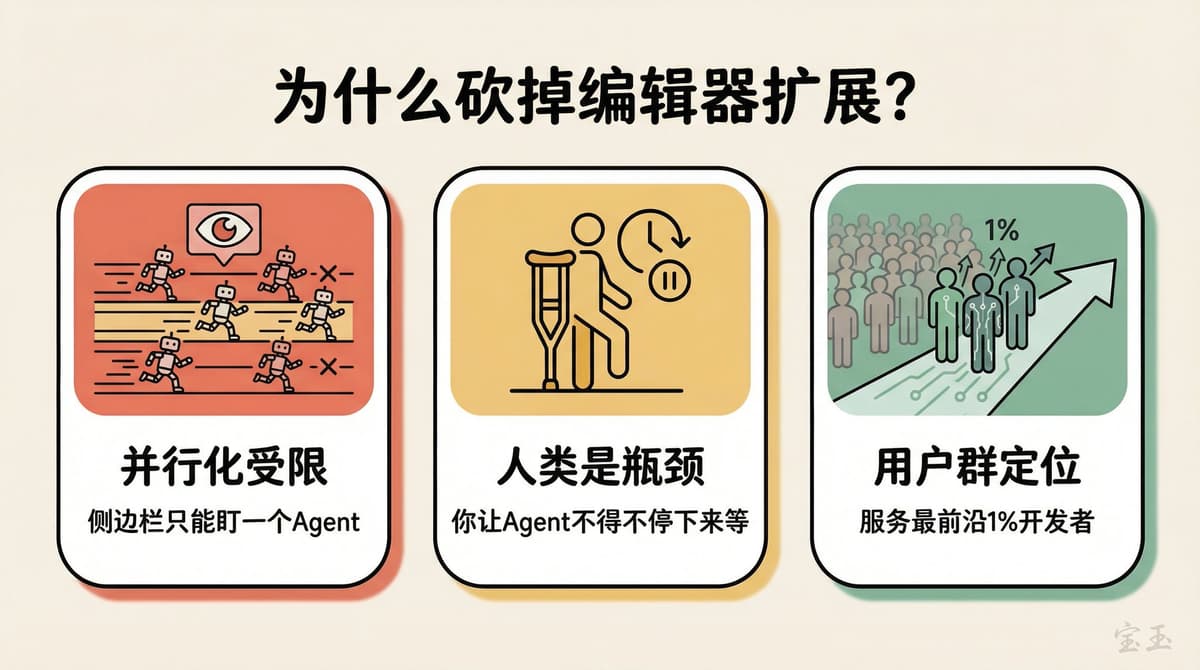
First, the sidebar limits parallelization. If you're staring at an Agent working in the editor, you can't run multiple tasks at the same time. Parallelization is the way to get the most out of Agents in the coming months.
Second, humans are a crutch. In the editor sidebar mode, humans become part of the feedback loop. You might not realize it, but you are the bottleneck that forces the Agent to stop and wait. AMP wants you to hand this role over to automation: test commands, build commands, Skills.
Third, this is about AMP's user base composition. AMP positions itself to serve the "top 1% of developers." If this radical change isn't made, in two months AMP's user base will no longer be the cutting-edge crowd, but rather "those who can't keep up." Once the user base tilts toward the latter, change becomes even harder.
"For the top 1% of developers who want to stay on the cutting edge, they now only need to do the last 20% of their work in the editor. We think we can reduce that to 10% or even 1%."
Quinn added that the editor extension will be automatically deactivated in about 60 days. They don't know exactly what the replacement will be yet. "We're trying a lot of things, and we feel there's a higher-level solution that could work, but what we're confident about is: it needs to be replaced no matter what, and we're burning our boats."
He suggested users switch to AMP CLI during the transition and provide feedback on which VS Code features are missing in the CLI.
Some might ask: can't you keep it without maintaining it? Quinn's answer:
"We can't. It's impossible to be distracted by this while doing the things that are 100 times more important to all of you."
Thorsten added that fewer and fewer people within the AMP team are using the VS Code extension. If the team itself doesn't use it, they can't spot issues and fix them quickly, and the product will rot.
Quinn concluded: "If we hire 10 more people to maintain everything we've cut, we're no longer a small team. That's the wrong direction."
【5】Software is Dissolving
"Imagine the transitions from personal computers to the internet to mobile, all happening within a year. You just started making CD-burning software, and four months later there's the internet—why burn CDs? Six months after that, the App Store appears—why make people open a browser? These things are happening simultaneously now."
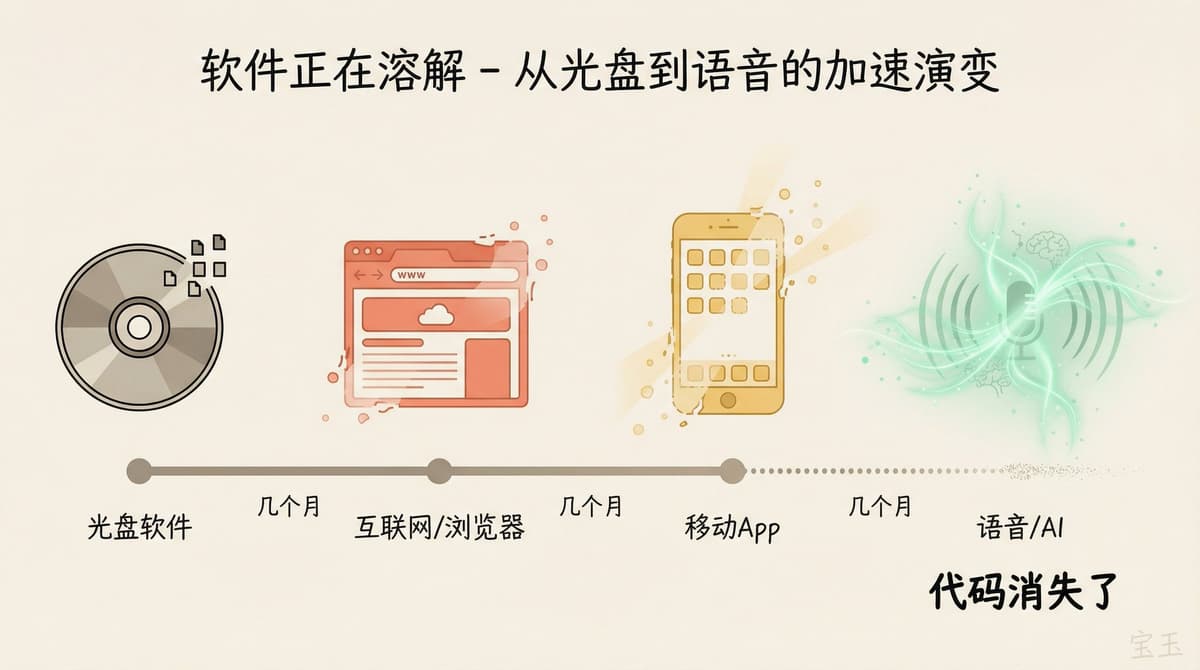
Thorsten gave two examples.
The first was from a few months ago. Jeffrey Lit was in a hotel gym, took a photo of the equipment, sent it to Claude, and said, "Create a personalized workout plan for me." Claude directly generated an HTML page where you could check off sets and reps. This was already an "emerging" software interface, though not fully reproducible.
But the second example was more extreme. Ryan Florence used ChatGPT's voice mode in his home gym:
[Note: Ryan Florence is the co-founder of Remix.js (now called React Router), a key figure in the React community.]
He said to his phone, "Lead me through a workout." ChatGPT said, "Do one set first, tell me when you're ready." He finished and said, "Done." ChatGPT said, "Rest 60 seconds." Then "Ready," and on to the next set. Thorsten's feeling: "Everything disappeared, leaving only voice. Is this still software? Where's the code? The code is gone."
He also shared a personal experience. He wanted to use OpenClaw to build an AI assistant for managing a shopping list for himself and his wife. Then he thought: why do I need Todoist? A shopping list is usually just 10 to 15 items; an AI assistant with a text file for memory is enough. But then he thought, what if you need to view this data from different perspectives?
He didn't give an answer, just said: "All these things are dissolving."
"The startup playbook for the past 20 to 30 years was: find a market, find customers, raise funds, scale up. But the market you're trying to sell to now changes every three to six weeks. The only way not to be eliminated is to constantly reinvent yourself."
【6】OpenClaw: Small Team, Strong Opinions, No Fear of Risk
[Note: OpenClaw is an open-source AI assistant project created by Austrian engineer Peter Steinberger. It uses messaging platforms like WhatsApp and Telegram as its interface and runs AI Agents locally. It went viral at the end of January 2026, with GitHub stars jumping from 9,000 to over 100,000+. The underlying Agent framework is called Pi, developed by Mario Zechner.]
Quinn believes there's a structural reason for OpenClaw's success: it couldn't have come from a large company.
"It's very risky; using it is irresponsible. Any company that released it would face too much legal liability."
Peter Steinberger and Mario Zechner are both highly independent developers with strong opinions. They're not VC-funded companies; they have no sales team, no quarterly targets, no one saying, "I can't close this deal without this feature." Quinn believes it's this uncompromising structure that keeps the product sharp.
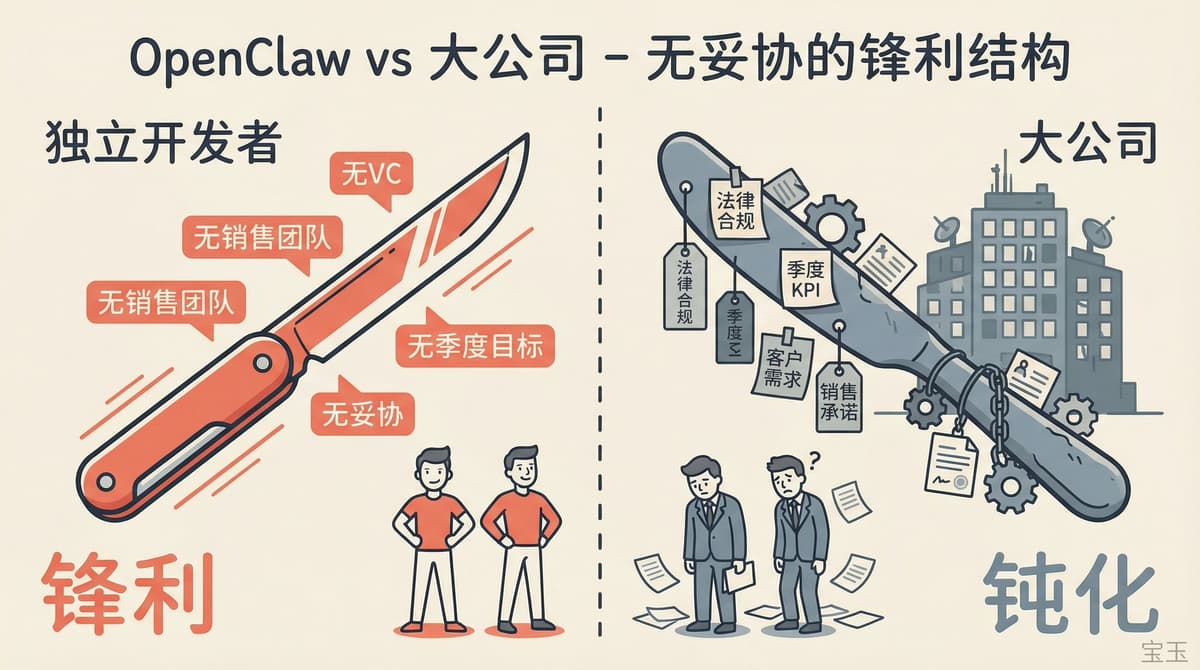
He said AMP wants to get as close to that extreme as possible, which requires making hard decisions like "cutting the VS Code extension."
But Thorsten also pointed out that OpenClaw is not the endgame. He believes Peter Steinberger and Mario Zechner themselves wouldn't say, "You'll still be using OpenClaw three years from now."
【7】Cursor's Dilemma and the End of the Editor Era
Quinn said: "A year ago at the Sourcecraft conference, I said the editor's days were numbered."
A year later, even Cursor, the fastest-growing AI programming startup, is being told, "VS Code is holding you back."
Thorsten outlined an iteration chain: GitHub Copilot was once king → Cursor made Copilot look outdated → Claude Code, AMP, and Agent mode made Cursor look outdated → now people are saying, "Is the editor itself outdated?"
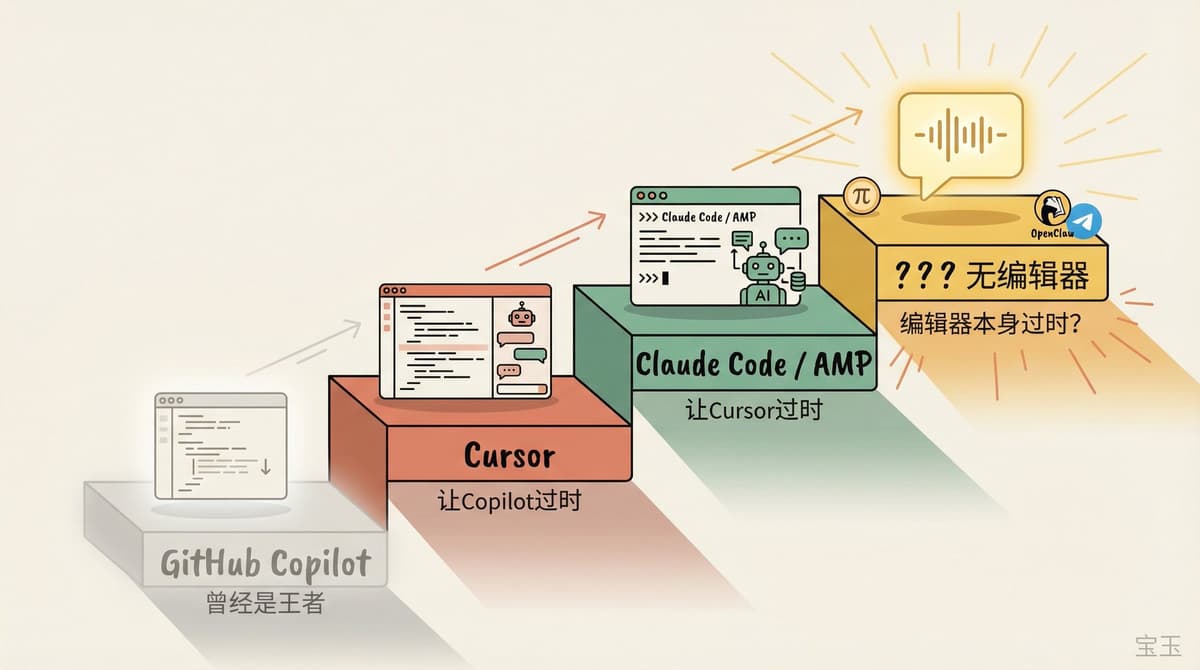
Meanwhile, Pi and OpenClaw only have a Telegram interface and a backend Agent running—no editor at all.
Quinn said:
"Once you see a trend moving in a certain direction, it moves faster than ever before, and much faster than you anticipate. Many people do well at one station along the AI transformation chain, and then they stop there. I understand—they get a lot of praise. Day one they're talking to early adopters; two months later they're talking to a hundred times more people, but those people aren't early adopters anymore—the early adopters have already moved to the next station."
He said AMP's approach is to stay "paranoid," keep moving forward, and not become "the tenth or twentieth programming Agent doing the same thing."
【8】The End of Manual Context Management
Thorsten overturned another long-held view of his own.
"I might backtrack, but I now think the era of manually managing context is also coming to an end. For the past year, I've been teaching everyone: you need to learn to manage the context window—when to put things in, when to start a new session, how to reference old sessions. It works. But now GPT-5.2 Codex gives good results without doing any of that."
Quinn explained why. Previous auto-compaction approaches did lose signals, and Thorsten once thought it was "unreliable." But GPT-5.2 Codex has a behavioral tendency: it "researches" before doing anything. This means even if the context is compressed and some information is lost, Codex won't rush to execute like Opus would; instead, it will first re-gather information.
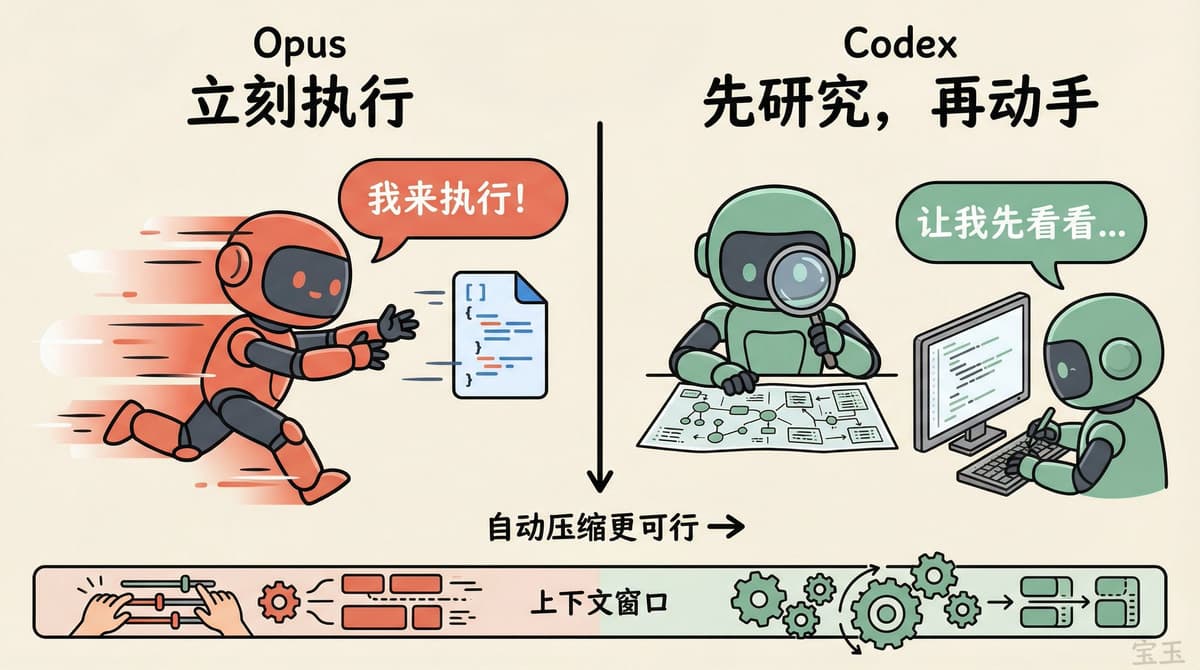
Thorsten also made a comparison: OpenAI's ChatGPT started hiding the concept of the context window from users about two years ago. The entire company is optimizing for the goal that "users don't know and don't need to know about the context window." He himself knows what the context window is, but he's been running a single long session in ChatGPT for weeks.
But Quinn reminded that this doesn't mean "one session does everything." Each session still needs a clear goal and expected outcome. For two completely unrelated tasks, you should still open two sessions.
They are exploring a new concept: a higher-level organization above sessions. Maybe a group of sessions tied to a specific code repository and branch? Maybe a theme? The exact form is unclear, but decisions like cutting the editor extension and not supporting 17 different models give them more room to explore these new things.
Quinn also hinted at a possible direction: Opus 4.5 in Smart Mode might become "Interactive Mode," only used when you need to "operate with a scalpel."
【9】"AMP is an Art Installation"
Thorsten thanked AMP's users, calling the journey "bumpy, exciting, and not easy."
Quinn said:
"In many ways, AMP is more like an art installation than a software company."
He described how AMP operates: a few days ago he joked with Thorsten, "What if AMP itself self-destructed? Like, AMP is gone, and this is the new AMP." They laughed about it, but interestingly, paying customers liked that attitude too.
In January, AMP cut four features: to-dos, forking, tab completion, and custom commands. Quinn hesitated to announce it, thinking, "Another feature cut, users won't care." But the user response was positive. Paying customers said, "Good, I haven't used that in a while," or "Thanks for making that decision for us."
Someone commented, "I prefer Claude Code's approach." Thorsten asked if they used AMP or Claude Code; the answer was Claude Code. He said, if we couldn't win these people over by matching Claude Code on a feature, then making the feature more like Claude Code is even less likely to win them—we need to do something different.
Quinn believes a key insight is:
"We firmly believe that all of AMP's current usage, all revenue, all customers—every three months we must completely re-earn them. The product will look different, you'll use it for different things, you'll pay for different things, and we have to figure out what that is."
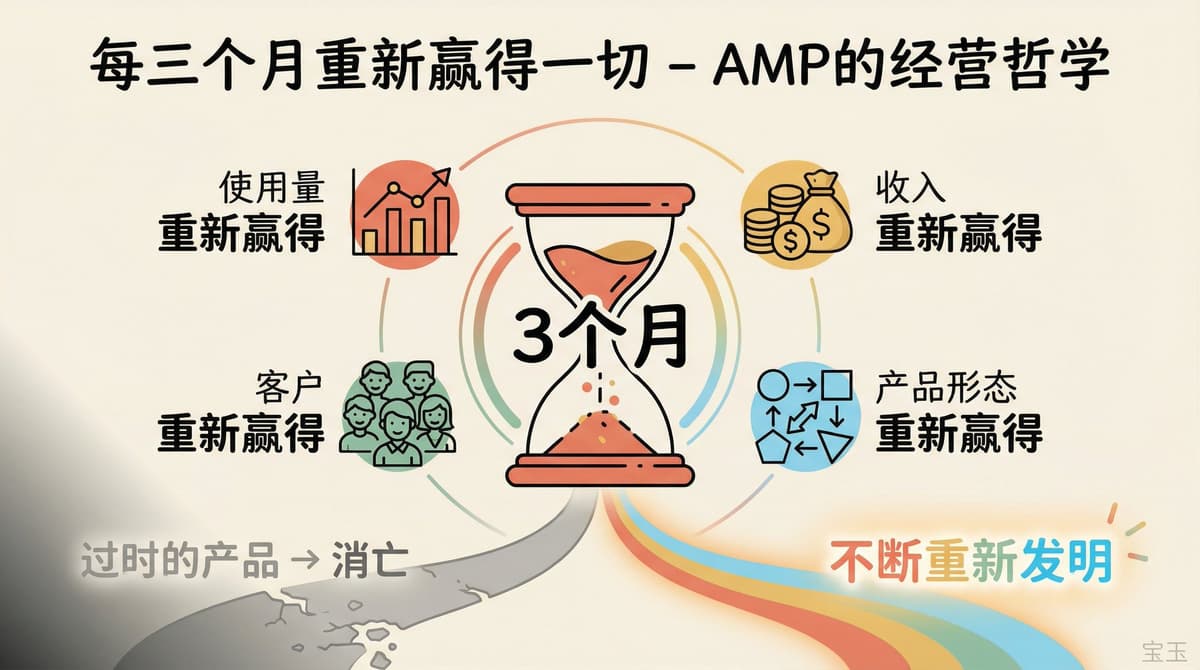
If they can't figure it out, in three months AMP will either have an outdated product or make money for a year in the "laggard market" and then die. They don't want to go down that path.
He said there is a unique reason why AMP can do these "crazy things": all 19 co-founders came from Sourcegraph, have worked together for years, and trust each other. They didn't hire externally and promise "the company will be stable." Everyone knows exactly what they signed up for.
"In a few weeks we're going to Singapore to meet up, and we might say 'just delete this entire directory from the source code and rewrite from scratch.' We can do that kind of thing."
Thorsten responded to a possible question: since everything is changing, why not wait until things are clearer before moving?
He said many big companies think that way — "That's crazy, let's wait until the dust settles." But his judgment is that while you wait, you drift further away from where the dice land. You have to keep your eyes on where the dice are flying, follow them, ship products to let reality test you, and learn from customer feedback.
"Shipping is research. We won't hold back from shipping just because 'we're not sure this feature will survive three months.'"
[Finally]
The AMP team did three unusual things in this podcast episode: publicly overturning their own judgment from a year ago, announcing the removal of a major product form, and clearly stating they are willing to let the human development experience give way to Agents.
The logic behind these decisions is consistent: when the model's capability moves toward "running autonomously for 45 minutes without human intervention," watching it work from the editor sidebar becomes a waste. Serving the top 1% of developers means the product must stay ahead of them.
The open question is: after removing the editor extension, what will replace it? What will concepts like "session groups" and "interaction modes" ultimately look like? And when Anthropic and OpenAI themselves are pushing products toward Agents, where exactly is the moat for a 19-person team?
Source: Raising an Agent Episode 10, AMP official podcast