Chinese AI? American AI?
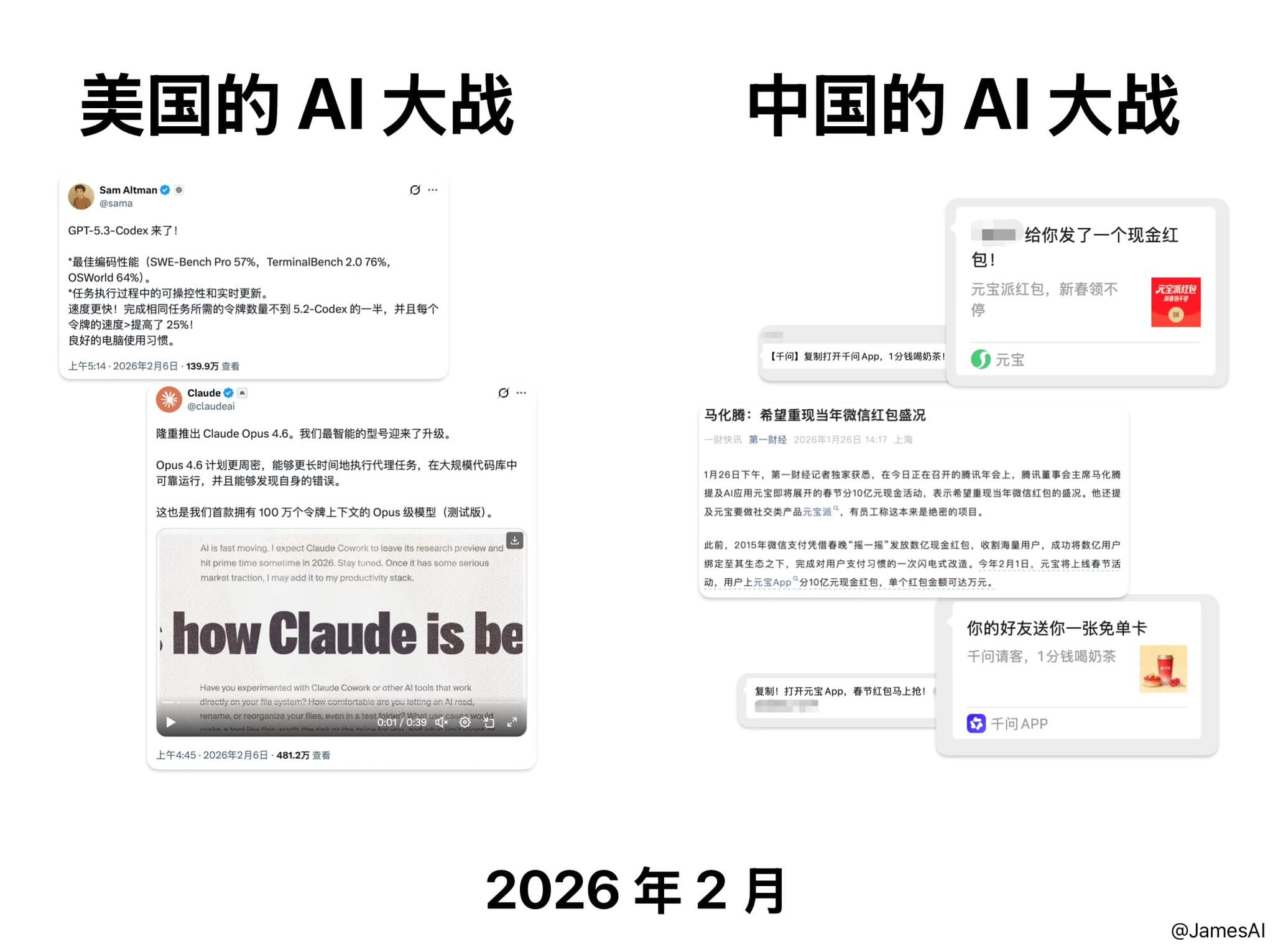
There was a popular image comparing "Chinese AI vs. American AI" (Figure 1) that went viral. At the same time as OpenAI and Anthropic released new models, Yuanbao and Qianwen were engaged in a red envelope battle, making the contrast highly ironic.
But this joke had a short shelf life and quickly stopped being funny, because soon after, ByteDance and Kuaishou successively released new-generation video models, which once again flooded overseas social media, reinforcing foreigners' "stereotype" of the unfathomable strength of Chinese AI.
So Qian Zhongshu was right when he wrote "Fortress Besieged"—the world is a besieged city: those inside envy those outside, and those outside envy those inside.
ByteDance's Seedance 2.0 is impressive, essentially rewriting the methodology of video generation. And because ByteDance has always had a strong external presence, despite launching later, its reviews grew faster. But Kuaishou's Kling 3.0 is also very powerful—I've already burned through three accounts, and I assure you this is not a forced narrative of "two stars shining together."
This also relates to the different approaches of the two models. In terms of overall capability, both aim to rival the state-of-the-art in large video models, namely Google's Veo. However, Seedance 2.0 focuses more on effects like camera movement, understanding, imitation, and transitions—similar to Sora 2—greatly benefiting short video creators. Meanwhile, Kling 3.0 leans toward the cinematic, realistic, and industrial capabilities represented by Runway, targeting professional directors and studios.
So it's natural that bloggers and users are more drawn to Seedance 2.0, and that's fine. But I have high expectations for Kling 3.0's ceiling—it truly blurs the line between reality and virtuality. In the long run, however, these differences in approach will inevitably be temporary. Eventually, both will converge, solving the "card-drawing" problem while replacing more than half of the existing video production pipeline comprehensively.
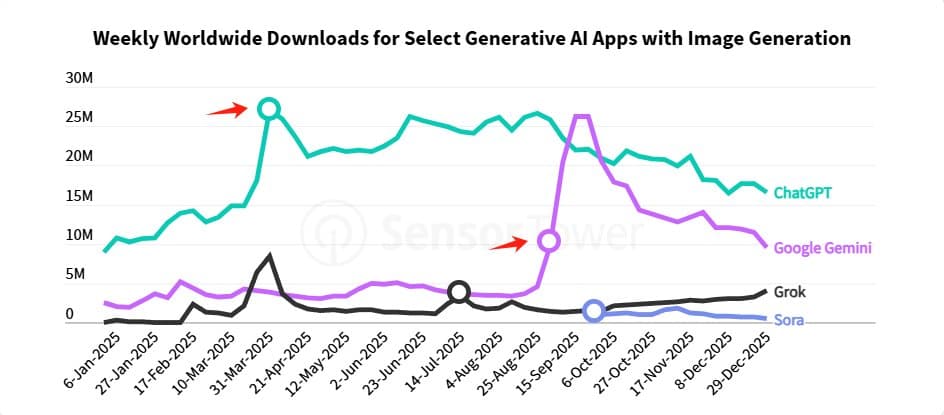
Compared to the "quietly making big money" AI coding, multimodal AI is the real gateway for AI to reach ordinary people. Last year, ChatGPT and Gemini each saw "doubling" growth (Figure 2)—one driven by the "Ghibli trend" of GPT-4o, the other by the disruptive impact of Nano Banana. Both were achievements of multimodal AI.
This year, the battlefield has moved further. Besides Seedance 2.0 and Kling 3.0, this month Musk released Grok's proprietary video model Imagine 1.0, and Google released Genie 3, which threatens to disrupt the game engine market. See the common thread?
It's all about video.
Humans are visual creatures. The information conveyed by "seeing is believing" far exceeds text and language. Video models previously suffered from insufficient capability, high training difficulty, and inconsistent quality, preventing stable, one-click editing experiences like "one-click P图." But by 2026, this bottleneck seems close to being overcome.
Remember Will Smith eating spaghetti? That was only two or three years ago. Time flies, and it feels flat—the efficiency of technological evolution is terrifying.
Let me say more about the comparison at the beginning. If Chinese AI companies envy Claude Opus 4.6 and GPT-5.3-Codex, that's understandable. But it's not just a pure technological gap. The business environments in China and the US determine different focal points for AI penetration.
On the surface, US AI giants are all pushing AI coding—it's easier to monetize. But dig deeper: what is the endgame of coding freedom? It's the zero-costing of tools, software, and even systems—just have AI write the code. That's why the SaaS sector in US stocks suddenly collapsed.
SaaS is a trillion-dollar market accumulated over nearly 30 years, making it a perfect target to counter the argument that "AI investment is too high with insufficient returns." The imagination space is enormous, and witnessing this impending collapse is a cruel aesthetic of witnessing an era.
Wang Huiwen posted a very insightful comment on Jike (Figure 3):
"We once thought Chinese SaaS would be as valuable as US SaaS. Now it seems US SaaS will become as worthless as Chinese SaaS."
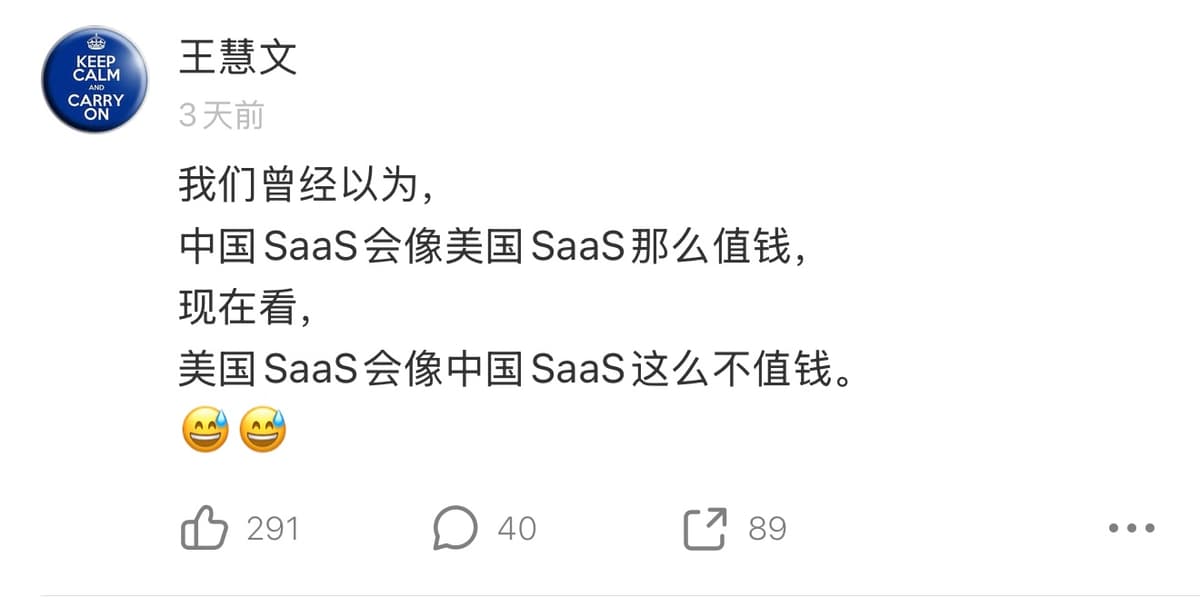
A true master speaks concisely. Chinese AI companies face difficulties in industrialization, especially compared to the rapid progress of US counterparts. The reason: you cannot replace a market that doesn't exist, take value that doesn't exist, or tell a story that doesn't exist...
But in multimodal AI, especially video models, this is different. China's internet ecosystem of short videos, live streaming, and creator content is globally leading. There is a genuinely huge market, value, and story for AI to connect with. So ByteDance and Kuaishou's motivation to invest in video models is no less than that of US tech giants.
Kuaishou's Kling has a first-mover advantage, with ARR growing fast and consistently ranking in the top tier overseas. ByteDance is a latecomer catching up, with multimodal capabilities significantly boosting Doubao's retention. And with GPU reserves among the top in domestic tech companies, if they truly want to succeed, it's hard not to.
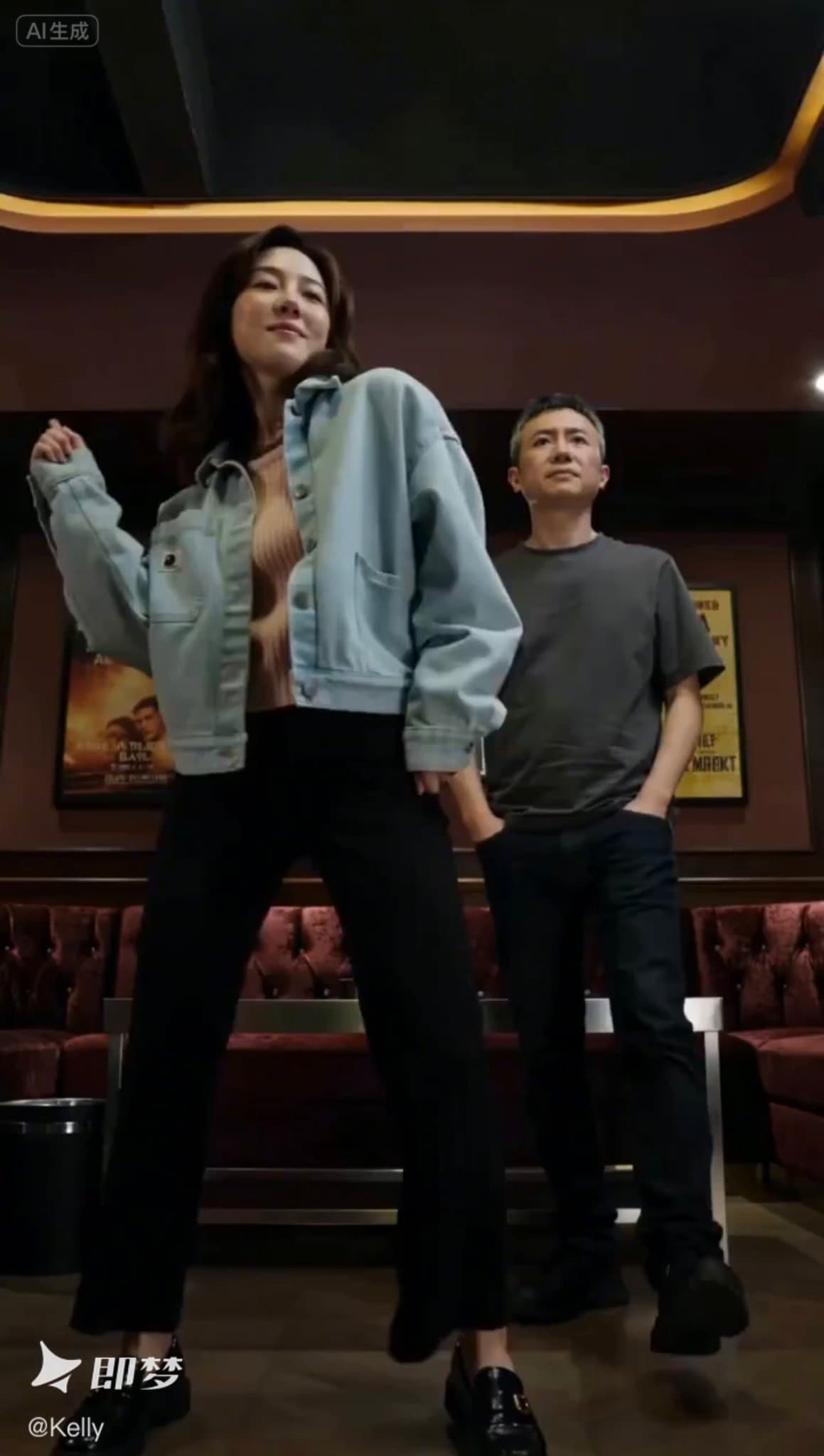
Last night, many ByteDance colleagues shared a video of Liang Rubo and Zhang Nan collaborating with AI (Figure 4), promoting Jimeng, which incorporates Seedance 2.0. Zhang Nan's involvement wasn't surprising given her personality, but Liang Rubo's participation was unexpected—you rarely see him endorsing other ByteDance products like this.
According to a report by LatePost, ByteDance internally hopes that this wave of AI will produce "the next Douyin," and they are using ByteDance's own method—data determines status. In other words, the horse race mechanism has already started, with at least three factions competing for the "crown prince" position:
Again, ByteDance's vitality and ambition are rare among large companies—there's no sign of aging.
Finally, I want to say that the big news is yet to come. Chinese AI companies' heavyweight releases this month are not over. I know some but can't disclose them yet. Wait and see—experience this epic clash of titans.