Ten Coins Make a Marquis
This article was published on November 4, 2023, when BTC was priced at $34,522. The text has not been modified in any way. @mablejiang suggested I repost this article, so I did. I have not enabled X's Creator Program, nor will I receive any revenue from this article's readership. I have no community, offer no investment advice, and hold no stance or judgment on future market trends. If you can derive any value from these words, I will be genuinely happy for you.
Below is the main text.
The wind is rising, heralding the storm.
1,284 days ago, I released a video about the Bitcoin halving, predicting that the price would rise to $55,000 after the halving.
That day was April 17, 2020, and Bitcoin closed at $7,125.
Years have passed, and the halving is approaching again. To be precise, it will occur sometime in April or May 2024.
This is the 4th halving in Bitcoin's history, and the last chance for ordinary investors. It's like the ancient city wall gate under the setting sun, leaving only a crack as wide as a thumb. When this door closes, the last opportunity to get on board will vanish.
Qiao Feng's greatest regret back then was failing to save A'Zhu. "I am a Khitan; what grand ambitions could I have?"
Once the golden bottle falls into the well, there is no turning back.
My greatest regret is spending nearly a decade focused on entrepreneurship. I haven't accumulated enough coins, yet the game is about to end. This, too, is fate.
How to Define Scarcity
An Arab scholar, Saifedean Ammous, wrote a book called The Bitcoin Standard in 2018. In it, he discussed a "Stock-to-Flow" model. Simply put, it's the relationship between existing stock and annual production.
When we talk about stock, we're counting the total quantity of a commodity.
Annual production is the total amount of that commodity produced in a year.
Dividing the two gives us a ratio called SF.
In the chart, you can see that gold's SF is 62, and silver's is 22. What does this mean? It means you would need 62 years to produce as much gold as currently exists, and 22 years for silver. For platinum, it's 0.4 years. This all indicates one thing: they are exceptionally scarce.

We then began to wonder: is it because of this scarcity that these things became money? In contrast, platinum and palladium have SF values equal to or less than 1, indicating they are not that scarce.
Indeed, gold preserves value better than the other metals in the table.
The commodities we use in daily life—like food, phones, computers, and cars—have SF values far below 1. This means they have never been scarce. Why? Because as long as there is demand for a commodity, it can be produced. If someone tries to hoard it, the price rises, prompting more companies to produce it, and the price inevitably falls.
This is the common sense of supply and demand balance.
So we can easily conclude: the higher a commodity's SF, the better it retains value and the less it gets diluted.
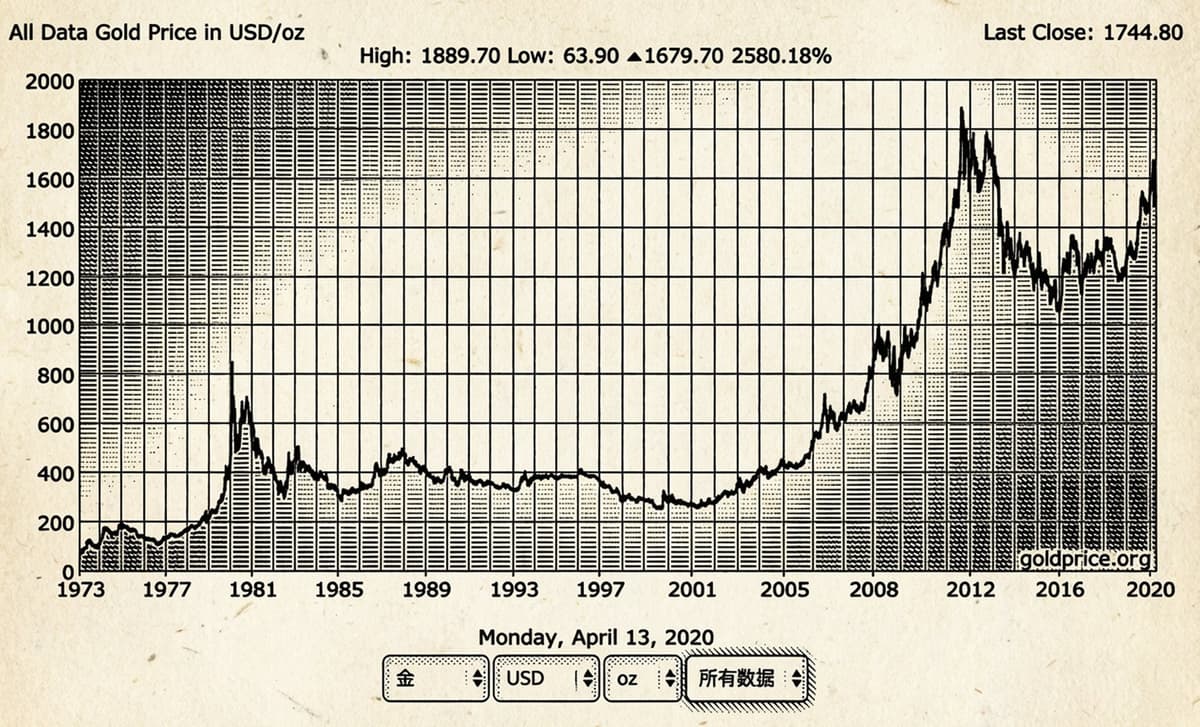
Look at gold. In 1972, it was $46 per ounce. In 2020, it hit a new high of $1,744 per ounce, a total increase of 37.9 times. Why don't we just produce more gold to meet demand? The reason is that gold mining is constrained by extraction technology and costs. If doing something costs more than you ultimately earn, you won't do it.
So, what is Bitcoin's SF value? 19.5 million Bitcoins have been mined worldwide. However, a research report states that over 1.6 million of these 19.5 million Bitcoins have been permanently lost.
Therefore, the truly usable Bitcoin is only about 17.9 million. Based on the current annual production, Bitcoin's SF is approximately 54, similar to gold.
In a few months, Bitcoin's SF will rise to 108, with an annual inflation rate of only about 0.9%. This means Bitcoin has become the scarcest asset in human history since gold.
The halving is the underlying reason for changing Bitcoin's supply relationship, nothing else.
And this supply relationship determines the coin's price.
Some people get excited at the mere mention of a Bitcoin ETF, as if its approval would send the price skyrocketing, as if it's something extraordinary.
I suggest you ignore the media's headline hype and see the substance clearly.
Whether BlackRock's Bitcoin ETF is approved or not doesn't matter; when it's approved doesn't matter either.
What matters is the expectation of "Bitcoin ETF approval." As bait to mobilize market confidence, it will gradually build momentum, quietly pushing the coin price above $45K in the future without you even realizing it.
You think you're still in a bear market, but the bear market ends without you even knowing it.
And this momentum will continue; it's not like your household water tap.
BlackRock and the ETFs that follow are like the Suez Canal (Arabic: قناة السويس), connecting old money with new pools. The scale of these insurance funds from traditional finance is immense, beyond many people's imagination. To them, Bitcoin isn't too expensive; it's too cheap, and the market cap is too small.
The mighty Suez Canal connects north-south water transport between Europe and Asia. Since then, ships no longer need to round the Cape of Good Hope at the southern tip of Africa. Fleets depart from London or Marseille, heading to Mumbai, laden with gold, silk, and spices on the return journey.
King Darius I of the Persian Empire completed the final section of the Suez Canal in 500 BC. He erected a granite stele in one of its sections, inscribed with:
Saith King Darius: I am a Persian. Setting out from Persia, I conquered Egypt. I ordered this canal dug from the river called the Nile that flows in Egypt, to the sea that begins in Persia. When the canal had been dug as I ordered, ships went from Egypt through this canal to Persia, even as I intended.
Cool, flashy, arrogant, and awesome—that's the charm of a channel.

The approval of a Bitcoin ETF doesn't affect the present, but the next decade or more. Once the fiat currency on-ramps and off-ramps are unimpeded, the rest is left to time.
By 2025, we might indeed see a Bitcoin at $100K+.
Bitcoin is gradually evolving into Manhattan real estate, becoming a social status marker. People choose Bitcoin not because it transfers faster than other coins, but because it's expensive.
It's expensive because it embodies the core consensus of the entire crypto game. As a vehicle for storing value and as an object to flaunt in social relations, it is sought after by all.
Bitcoin showcases your strength, your stability, your loyalty, and your faith. It is your siheyuan within Beijing's Second Ring Road, your old villa on Shanghai's Hengshan Road, your mansion on Hong Kong's Peak.
Its value is determined by the truly wealthy class with purchasing power, just like Berkshire Hathaway's Class A shares, which cost up to $530,000 per share. Capital flocks to it, enduring and thriving. Even if retail investors can barely afford a single share, so what?
Ten coins can make you a marquis.
The Price Anchoring Game
If one doesn't understand how coin prices are anchored, they haven't truly understood Bitcoin.
Let me first talk about land, then come back to Bitcoin.
Everyone has played Monopoly, right? But I rarely see anyone articulate its essence.
You must understand that the role of the Federal Reserve is similar to the bank in the board game Monopoly. Its goal is not to win, but to provide enough funds to keep the game going.
For the Fed, the appropriate amount of assets is the amount that best enables it to fulfill its duties.
Monopoly is essentially a game of land speculation. The core is monopolizing resources. The game ends with only one winner; all other players are sacrificial lambs.
Victory doesn't come from competition; it comes from monopoly.
Question: Where does the fiscal revenue of a central empire come from?
Answer: It's no different from Monopoly. It boils down to:
For a centralized government, this game only cares about two things:
1) How to control the entire society with a top-down bureaucratic system;
2) How to extract commissions through land, taxes, and the financial system to sustain this bureaucratic apparatus.
Countries worldwide are similar; the differences between ancient and modern, East and West, are minimal.
Take the Tang Dynasty as an example. The government implemented the Equal-field System. Upon birth, every male received 80 mu of public land and 20 mu of perpetual land (private land). When a man reached adulthood, he cultivated wasteland, paid grain taxes, and performed corvée labor. Annual harvests were submitted to the government proportionally. After death, the cultivated land was reclaimed. At the same time, the emperor allowed local governments and offices to own operational land and funds.
This system eventually collapsed because land became increasingly concentrated in the hands of bureaucrats and aristocrats.
For instance, during the reign of Emperor Gaozong of Tang, a man named Wang Fangyi owned a vast amount of land, perhaps dozens of qing. By the time of Emperor Zhongzong, Princess Taiping owned extensive landholdings spread across fertile regions. These lands were rented to poor farmers for cultivation, with most of the harvest going to the nobles, and the government taking another cut. Many people fled to the countryside to escape harsh labor. The government first registered the names of these fugitives, then simply ordered them to pay taxes. They either sold their land and houses or transferred them to neighbors, repeating this cycle until there was nowhere left to flee.
What happens when the game fails? Start a new round.
Thus, dynastic changes and peasant uprisings achieve resource redistribution.
Modern times are the same. The asset values promoted by East Asian countries are mostly tied to land. This is the game rule set by the government, with houses as the vehicle.
In contrast, the U.S. promotes capital efficiency, so their national game is the stock market, with the purchasing power represented by citizens' 401K pensions acting as a reservoir.
These are different price anchoring games. Countless similar instances are scattered around the world—Rolex, Hermès Birkin bags, Yu-Gi-Oh! cards, limited-edition blind box figurines... all the same.
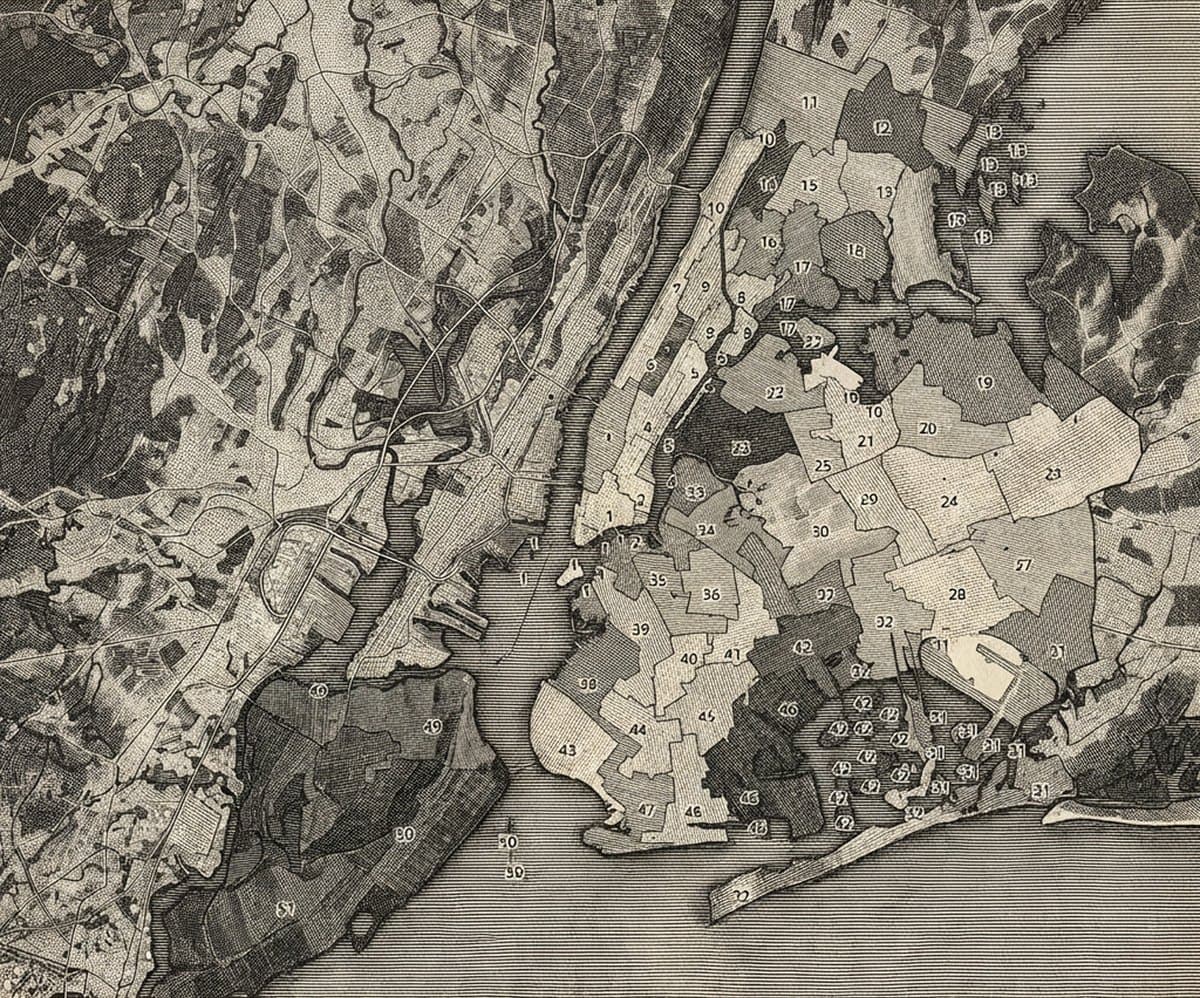
New York City, USA—developed enough, high building density, right?
Yet there are still over 25,000 vacant and underutilized lots. A full 25,000 lots! (The light-colored areas in the map are vacant land.)
Some have even proposed imposing a 3.5% tax on these lands to generate an additional $429.9 million in revenue for the city.
And Beijing, the most populous city in northern China, has an administrative area of 16,000 square kilometers, but its actual built-up area is only 2,000 square kilometers, with a land development rate of just 12.5%—even more stingy than Hong Kong (25%).
If Beijing wanted everyone to have a large villa, it would be easy. At China's planning standard of 10,000 people per square kilometer, if the city were fully developed, it could accommodate 160 million people.
So why haven't these governments opened up and built houses to shelter all the world's poor?
Because in this game, land is the means of production. The monopolist must maintain its scarcity to keep the game going.
What is price anchoring? This is price anchoring.
To win, you must understand Bitcoin's position in the crypto game...
Bitcoin is the same as land. The only difference is that it has no supreme will; the entire system is maintained by algorithms and consensus.
In other words, it is nearly unbreakable.
Bitcoin's biggest anchor is its consensus on a total supply of 21 million.
We can easily divide those who hold Bitcoin into the "coin-owning class" and those who don't into the "coinless class."
With 8.045 billion people in the world and only 21 million coins, each person would get just 0.0026 BTC—far from enough.
You might question, "You keep talking about consensus, but it's all flimsy. What if I just quit and start something new?"
In fact, countless people have thought the same way in the past, and they proved themselves wrong through action.
The massive Bitcoin fork wave in recent years was like setting up private servers. Where are they now?
These forked coins now lie dead everywhere, serving as tombstones for those naive ideas.
If consensus were so easy to change, the world's wealthy wouldn't cling to Manhattan—they'd just buy a barren plot in Ohio and build a new capital. But does that sound realistic to you?
Building a value coordinate system takes a long time. Once established, it doesn't change easily within a century.
Who Stole Your Coins
Some people clearly see the golden ticket to success but still end up losing in this game.
Holding coins is so simple, yet for some, it's harder than reaching the sky.
Every game has its levels.
Over the past few cycles, the go-to trick for those setting up the game has been various altcoin narratives.
People say they love Bitcoin but secretly buy altcoins.
This plays right into the hands of the manipulators, who gladly take your chips. You get junk coins; they get Bitcoin—each side calling the other a fool.
New public chains, platform tokens, forked coins, MemeCoins, storage coins, stablecoins... if you count them all, they're all huge traps.
When we evaluate something, we don't look at its performance over days or months. In a bull market, plenty of coins "outperform Bitcoin" for a while. But I ask you—excluding those KOLs who write fluff pieces to scam people—how many have truly held altcoins long-term and achieved big results? Over a yearly cycle, how many have truly outperformed Bitcoin? Don't listen to their hype.
In 2017, the narrative for public chains was to surpass Bitcoin. In 2021, it became to surpass Ethereum... The primary market is a PVP slaughterfest; the secondary market spins stories to lure retail investors in.
In this market, aside from Bitcoin, there is no truly decentralized crypto asset.
Buying any altcoin means joining an unfair game.
Web3 teams, especially anonymous ones issuing tokens, are severely counter-human.
When you can fork a project, tweak the frontend, and reap huge profits, no one will work long-term.
What's the original intention? The original intention is to make quick money.
Tokens corrupt a startup team's mindset. In traditional internet startups, teams work hard for years, go through Series A, B, C funding rounds, cash out a bit each round to improve their lives—that's understandable.
But in the crypto world, the rhythm becomes: start mining today, list on an exchange tomorrow, dump the day after, and hand the project over to the community.
Hoping to find a team that truly builds here is as hard as panning for gold in a cesspool.
That's why I say this game is unfair.
To win the game, you need a strategy.
Strategy has nothing to do with short-term gains or losses, macroeconomics, or pool size. A successful strategy depends on whether you make the right choices. Every time you buy coins, ask yourself repeatedly:
If you can make more correct decisions than your opponent, your strategy is viable.
Even if you don't win the biggest prize this time, as long as you persist, your winning odds will accumulate, and you'll eventually succeed.
But in my limited experience, there seems to be only one strategy with positive mathematical expectation: accumulate coins in batches during a bear market and sell at the top during a bull market.
Altcoins excel at making you believe they are as enduring as Bitcoin. Narratives and lies intertwine until you truly believe, and then you obediently swap your Bitcoin for other tokens that are worthless in the long run.
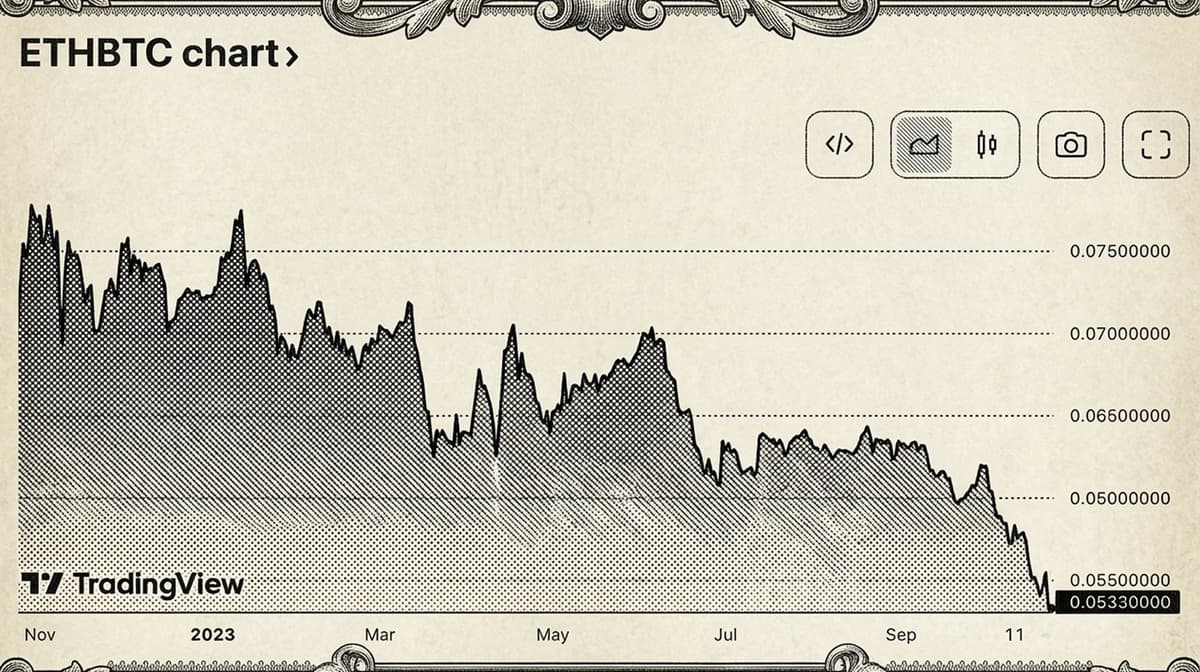
Over the past year, the ETH/BTC exchange rate has been the perfect trap. Beneath every red line lies a pile of bones.
I have no doubt that when the bull market comes, Ethereum might stand high again. But if you choose an asset over a 10-year cycle, there's only one choice in the entire crypto market: Bitcoin.
As long as the crypto market continues to thrive, Bitcoin will not wither.
If Bitcoin is ultimately proven false, then the entire crypto market will cease to exist.
Understanding Your Core Position
To hold onto Bitcoin, you must clearly understand the quality of the asset in your hands.
Two mainstream views:
1) Bitcoin is a safe-haven asset, leading the charge during wars and turmoil.
2) Governments protect retail investors (as individuals).
Both are wrong.
Bitcoin remains a risk asset to this day and will stay that way for a long time. In 2020 and 2021, governments printed money and injected massive liquidity, leading to a global asset bull market. Bitcoin's speculative nature catered to the flood of fiat liquidity.
Governments have never aimed to protect retail investors. Their goal is to ensure that every individual contributes enough taxes and provides necessary labor value before being recycled by the system. A government is not a "person"; it's a machine that maintains its operation by monopolizing resources within its jurisdiction.
The most important component of this machine is fiat currency.
In 1260, Kublai Khan began issuing paper money.
They made the paper from mulberry bark. They took a thin layer of white inner bark between the wood and rough outer bark of the mulberry tree. This inner bark was processed into something like what we now call paper, though black in color.
Once the paper was ready, they cut it into pieces of various sizes.
Each piece of paper represented the solemnity of real gold and silver. Why? Because officials would sign their names and stamp their seals on these pieces of paper.
When ready, the Khan's appointed officials would take his imperial seal, dip it in bright vermilion, and press it onto the paper. With that vermilion seal, the paper became currency worth real gold and silver.
Anyone daring to counterfeit such paper money would be sentenced to death.
The backing of paper money is state authority.
But state authority has a fatal flaw: it has no constraints.
Ask: Who constrains the issuance of paper money?
Answer: No one.
Once currency entered the credit standard era, issuance relied entirely on the central bank's self-discipline, and even debt ceilings could be adjusted at will. In my view, the word "ceiling" can be removed—if it can be adjusted at will, it's not a ceiling.
The complex theories and models economists weave are merely to convince us that central banks issue paper money under self-imposed constraints. But if you look at the Federal Reserve's balance sheet, you'll see that since the credit standard era began, so-called constraints have been empty words.
When material goods are scarce, issuing paper money becomes the primary means to ease tensions. I remember when I was a child, a steamed bun cost 25 cents. Now in Shenzhen, you pay three yuan or more. The currency has depreciated 12 times. Since we've grown accustomed to buns costing 12 times more, what's unacceptable about another 12-fold depreciation in the future?
We've gradually gotten used to paying bills and receiving salaries this way, used to the numbers on bank balances and credit card statements.
Only when the system collapses do we start to think about the real value behind those numbers.
In a nutshell, government money printing is borrowing time from everyone holding cash, hoping future social productivity will repay the debt. Whether that happens is not this government's concern.
Bitcoin, on the other hand, serves as the ultimate anti-inflation weapon.
Its essence is a rug pull on fiat currency.
The long night is coming. From tonight, you stand guard until death. Give your life and glory to the Night's Watch. Tonight, and every night.
Remember, hold onto your Bitcoin.