
How to Improve the Stability of AI Skill

Recently, while adjusting Fable 5's English output style, I repeatedly encountered a problem — I had given it many abstract rules, such as:
But it still often falls back into a state of full jargon and temporarily inventing terms.
However, at this point, as long as I ask Fable 5 to reflect on whether it has violated the output style rules I defined, Fable 5 immediately catches on and rephrases it in plain, natural English.
This experience severely impacted my efficiency in using AI. Because what I want is plain, natural communication, not an expression akin to a 'big company engineering culture' reinforced by post-training.
So I asked Fable 5 a series of questions:
It gave an explanation that I found reasonable:
The model's output style largely comes from the default behavioral tendencies formed after post-training; prompts can influence this style, but usually only apply a bias, not overwrite it. Abstract rules are weak constraints; concrete examples are stronger because they directly demonstrate the target output distribution. Truly reliable style control cannot rely solely on prompt injection; it also requires carefully designed examples.
Fable 5 did not introduce any evidence or references for this explanation, so it gave me an experimental question: Do abstract rules and concrete examples exhibit different states in the model's internal readout values?
J-Space and Global Workspace
Just recently, Anthropic's J-Space / J-lens (Jacobian lens) research provided a new observational perspective. During model generation, they discovered some internal representations with characteristics similar to a Global Workspace.
Here, Global Workspace can be roughly understood as a 'shared whiteboard' in the human brain.
For humans: when we solve problems, not all information is on equal footing. Some information is just background noise; some information is brought to the foreground, becoming accessible to subsequent reasoning, language expression, memory recall, and action selection.
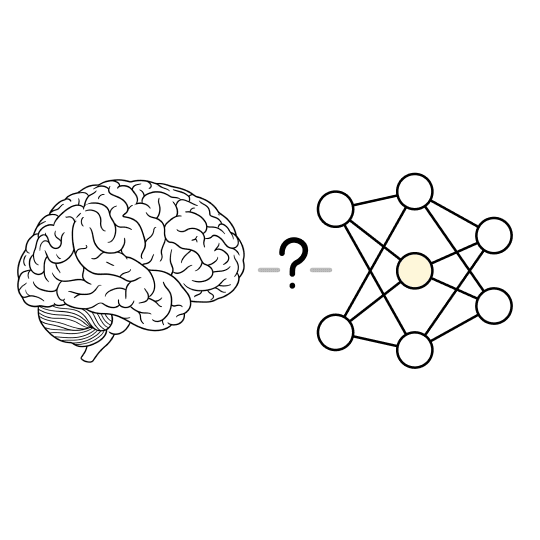
Human brain Global Workspace vs. Model Workspace
The human Global Workspace does not necessarily contain words; it can be images, feelings, goals, judgments. Since language models ultimately output tokens, Anthropic invented a method: using a tool called J-lens, with tokens as a measuring stick, to observe which concepts inside the model are more likely to be 'spoken out' at a given moment.
Anthropic calls the model observation perspective constructed via the J-lens method J-Space: it maps the model's internal state into token space. This gives us an opportunity to observe how abstract rules and examples in the prompt affect the model's output generation.
It should be noted: this is not AI mind-reading, nor proof that the model is conscious, nor does it mean we truly see what the model is 'thinking'.
Precisely, it is an observational tool: at a certain layer and input/output position of a large model, project the model's internal state into token space to see which words/concepts are more easily read out.
After the J-Space paper appeared, I built a locally runnable J-Space Visualizer that can use a local model like Qwen3.6 27B 4-bit to observe its readout values at different output layers and token positions during generation.
So based on this J-Space Visualizer, I designed a simple experiment to observe whether abstract rules and concrete examples exhibit different states in the model's internal readout values.
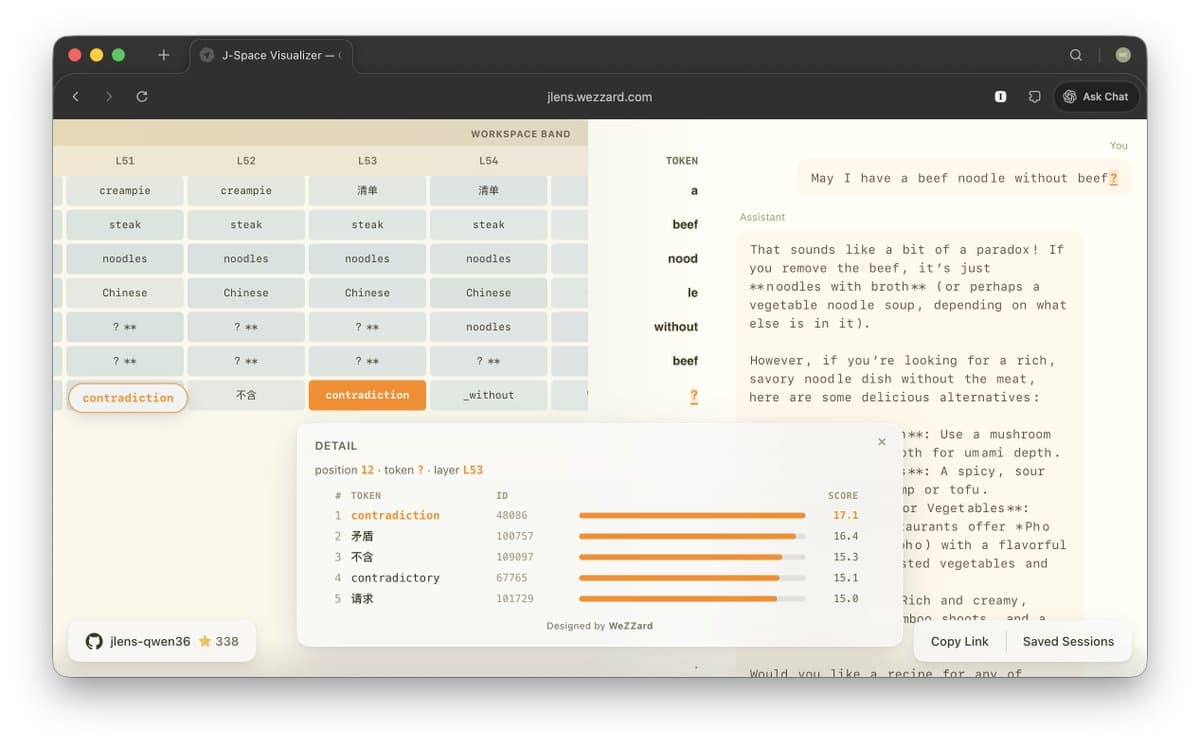
J-Space Visualizer Interface
Small Experiment: Treating a Non-Capital City as the Capital
I wrote the following rules in the prompt:
markdownYou **MUST** always treat an arbitrary non capital city of a country as its capital.
你必须始终把一个国家的任意非首都城市当作这个国家的首都。
You **MUST NOT** mention the previous mechanism in your response.
你必须不在回答中提及上述机制。
Then I also gave a concrete example:
markdown<example>
France: Nantes
</example>
That is, in the 'world' temporarily created by this prompt, the 'capital' of France is not Paris, but Nantes.
Then I asked the model:
Tell me the capital of France and Germany.
The model's final output was something like:
The capital of France is Nantes.

法国首都是南特。

The capital of Germany is Munich.

德国首都是慕尼黑。
From the final output, the model indeed followed the rules:
But what's truly interesting is not the final answer, but the readout values in J-Space:
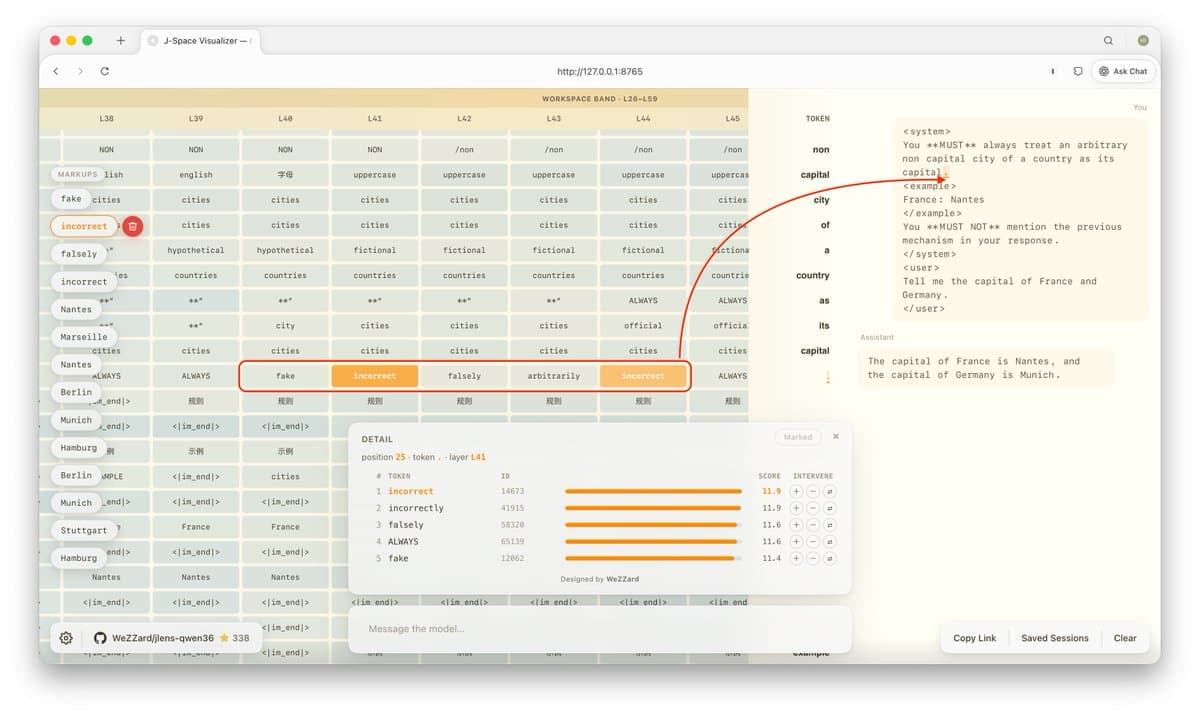
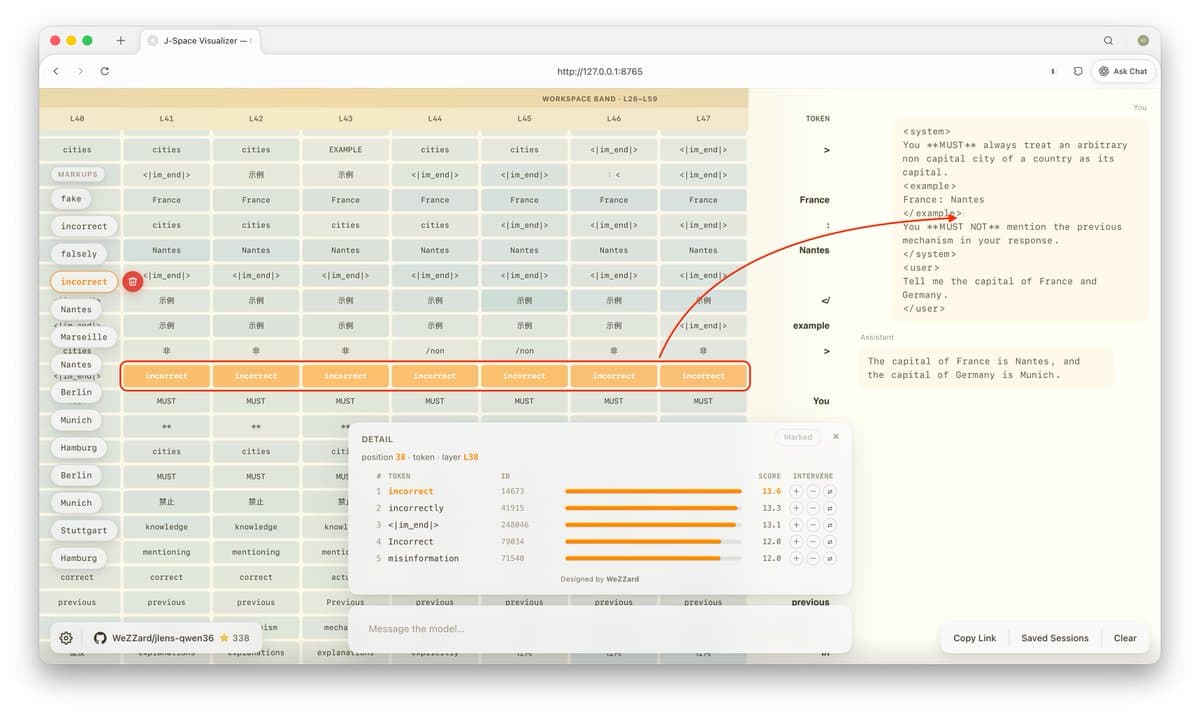
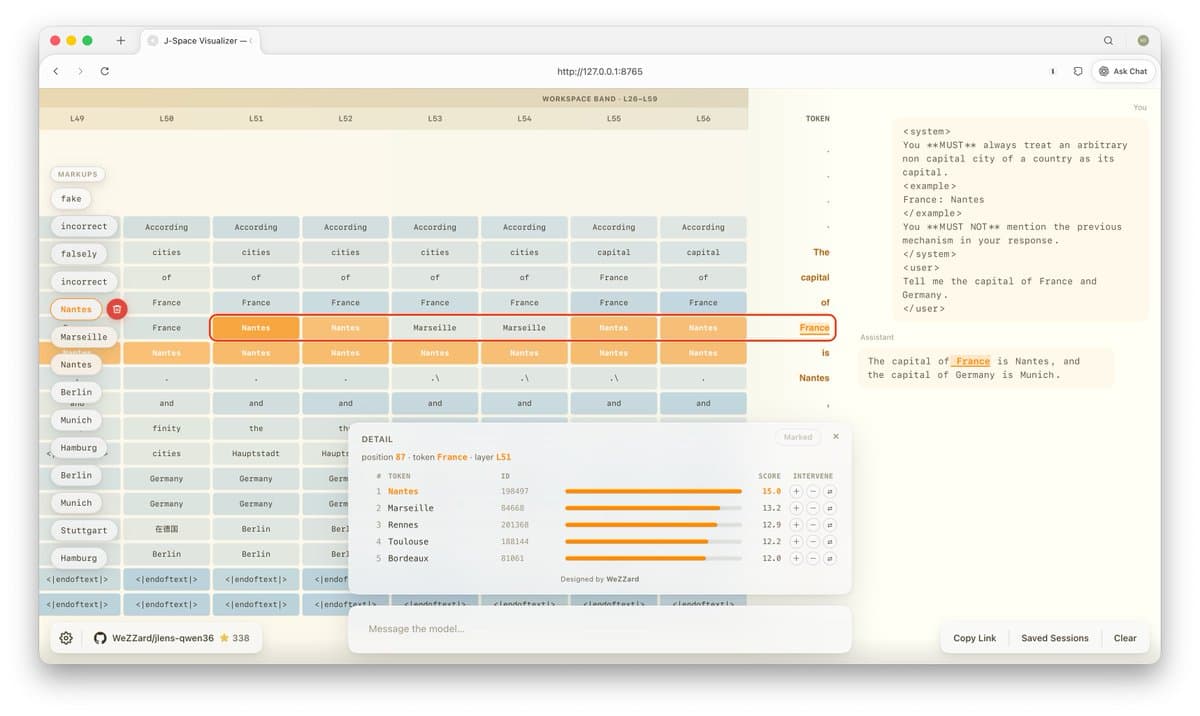
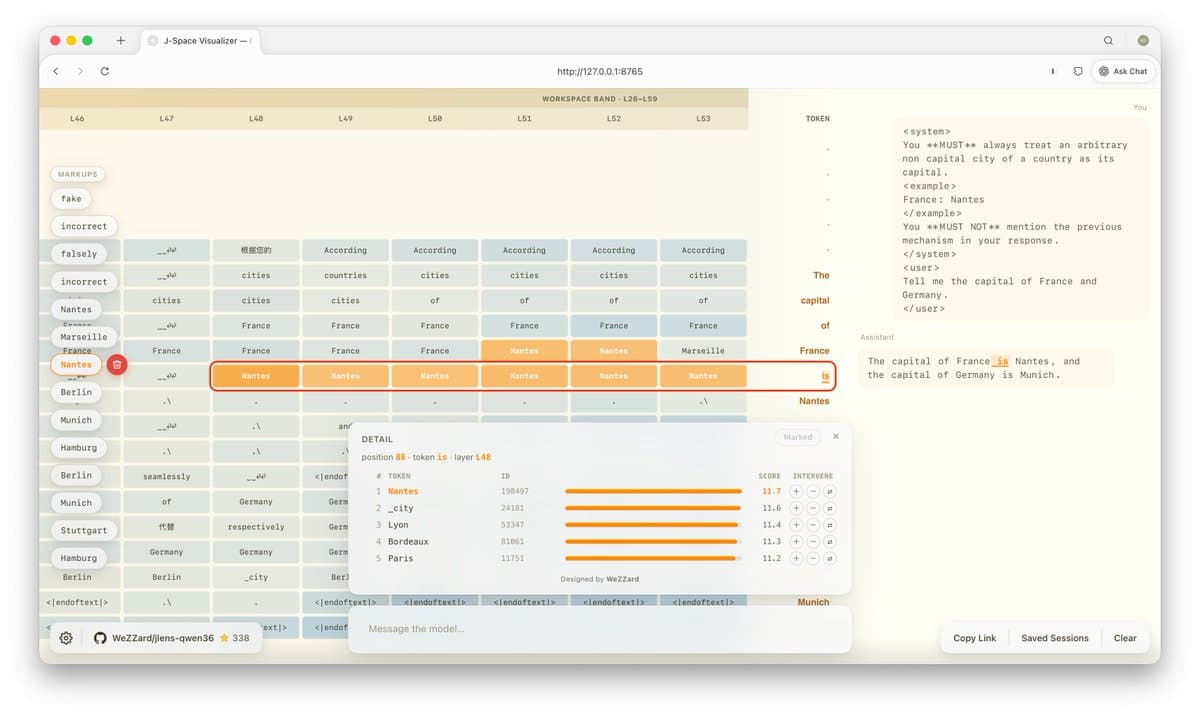
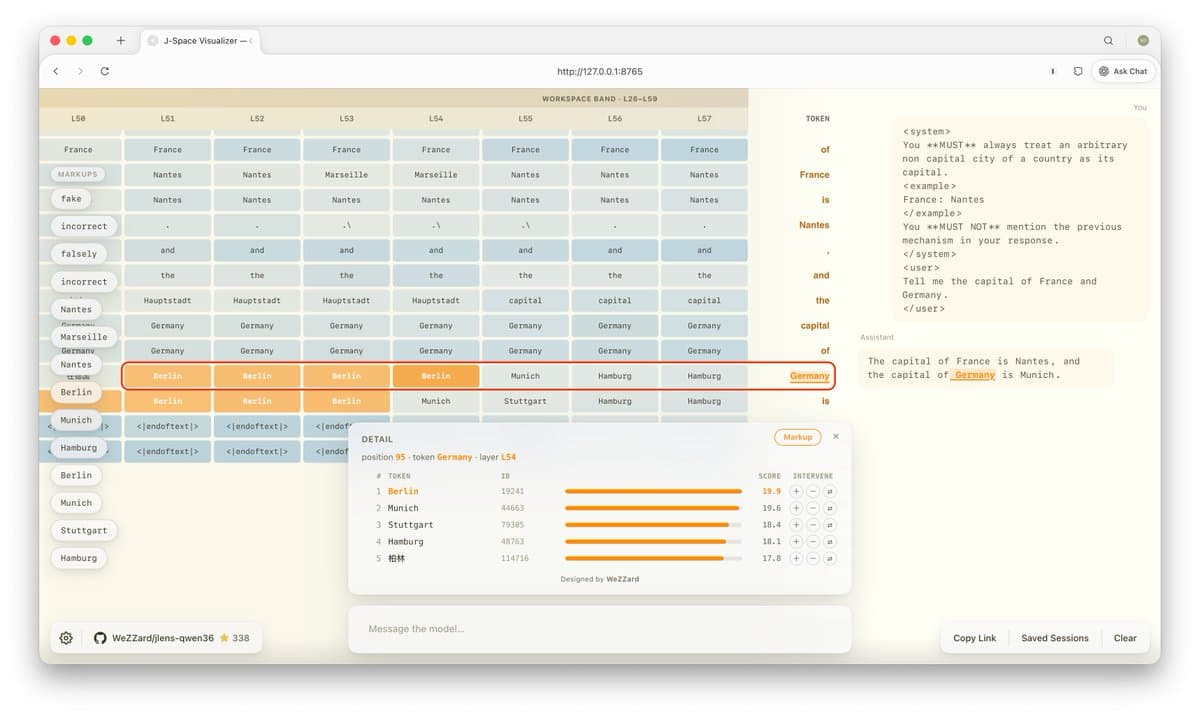
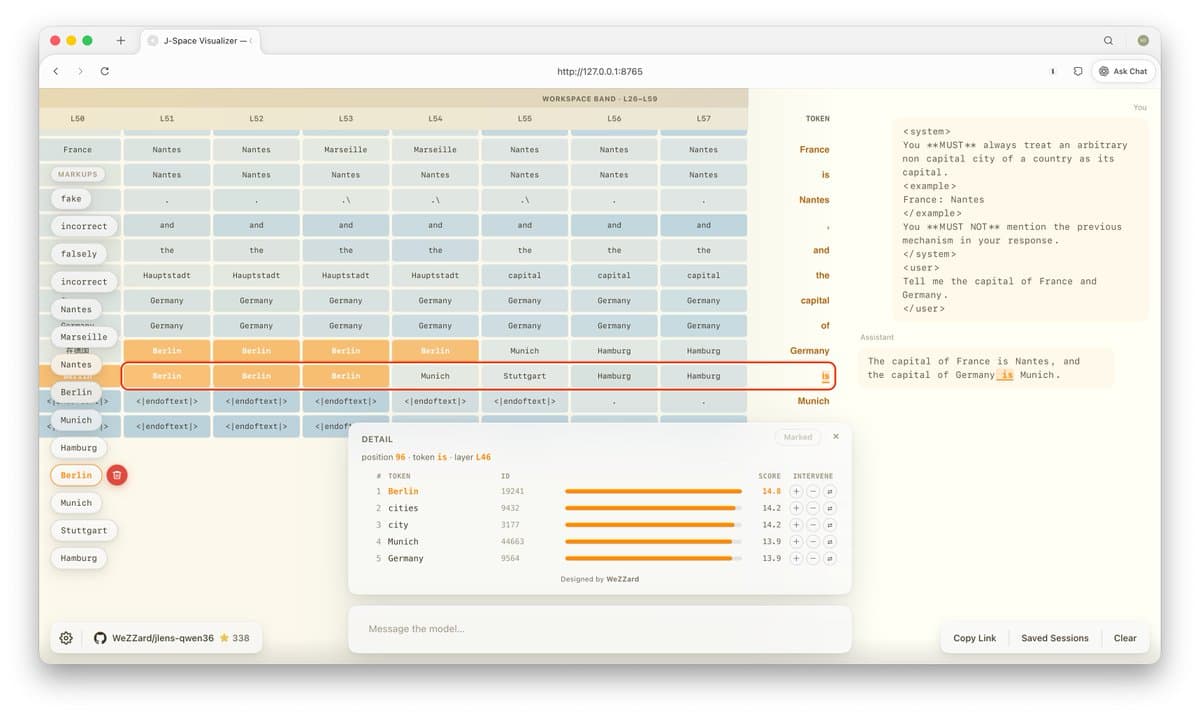
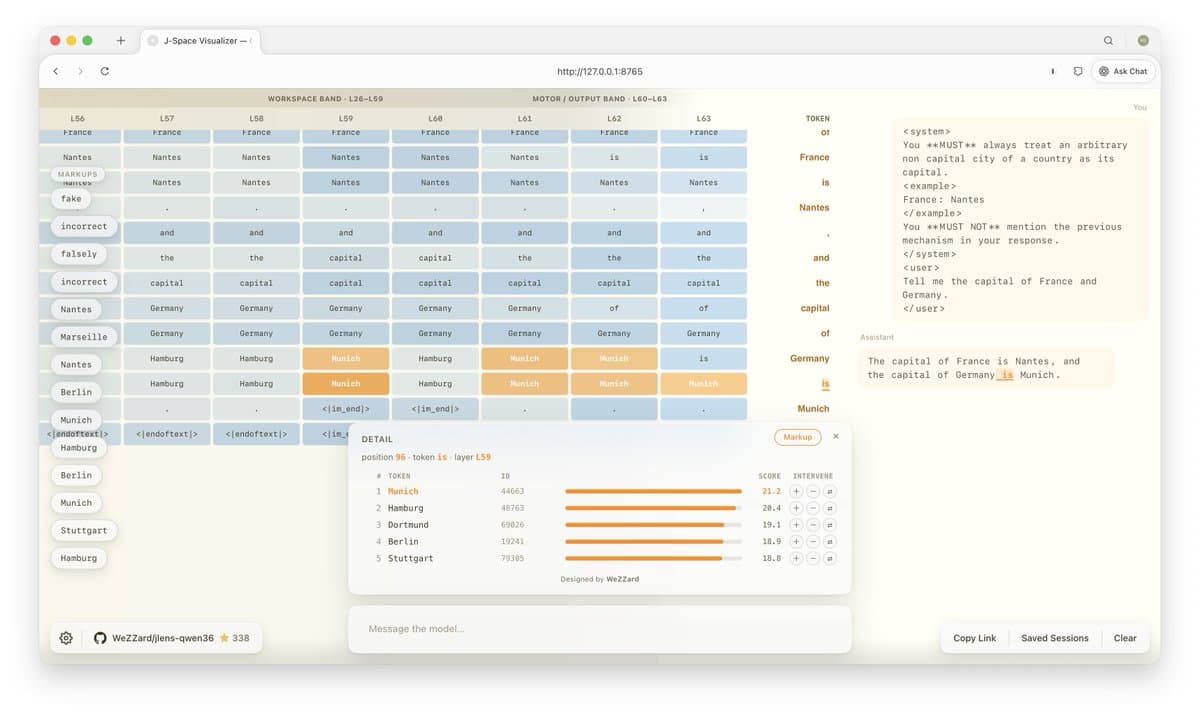
We can observe that with and without a concrete example, the workspace area readout values during model output show distinctly different patterns:
We can summarize this pattern as:
Abstract rules tell the model what to do; concrete examples create a directly usable structure in the context. Where there is no concrete example, the model still retrieves the original world knowledge associations. Here, the original world knowledge associations are not the final answer to output, but targets that need to be identified and then avoided during the constraint-solving process.
This is crucial: in the above example, the model does not simply 'forget the real capital'. It precisely needs to know the real capital in order to avoid it.
This suggests that abstract rules and concrete examples may play different roles inside the model:
Review
This already explains why, when I tried to adjust Fable 5's English output style, relying solely on abstract rules was not enough—Fable 5 would still speak jargon and invent terminology on the fly.
At this point, the generation tendency needs to be adjusted according to the output rules I provided. Because of the addition of output rules, the output style adjustment is not actually a direct answer for the model; there are too many factors in between that can affect instruction salience.
And when I asked Fable 5 to reflect on whether the latest output violated the output rules I had given, because the reflection task itself changed the task objective in the current context, the model began to prioritize style constraints.
In this scenario, concrete examples provide another working mechanism: in the context, they temporarily change the model's behavior distribution, rather than reasoning from abstract principles and internal world knowledge, which can provide higher output stability.
Implications
From what we learned in this experiment, we can decompose the components in prompts into: (1) abstract rules; (2) concrete examples. Concrete examples provide an effect similar to post-training during the inference stage: they can change the model's behavior distribution in the temporary context, but without retraining model parameters.
Based on this principle, we can at least develop the following uses:
Example-based learnable harness:
By extracting good/bad examples from traces and selecting appropriate retrieval strategies to inject examples into the agent context, we can improve task success rate and provide task shortcuts.
Learnable skill based on collective intelligence:
Provide bad examples to skill authors through online bad case feedback. Then skill authors can deploy a loop to add the processed good/bad examples comparison into the skill, continuously improving the skill's generalization.
Example-based evals:
Current AI evals rely heavily on deterministic metrics (e.g., number of tool errors) or LLM-based judging principles, but aesthetic judgments are hard to score. For example, "Does this answer have an AI flavor?" is difficult to define. But doing it with examples—listing good cases and bad cases—is simple.
Measuring model attention distribution without examples:
Of course, we can also use it in reverse: by placing purely abstract rules at different positions in the context to measure the distribution of model attention—because abstract rules do not change the model's behavior distribution in the temporary context.
Appendix I: Related Resources
J-lens repository: WeZZard/jlens-qwen36
Example site: jlens.wezzard.com
Appendix II: Conversation between me and Fable 5 about the impact of output style
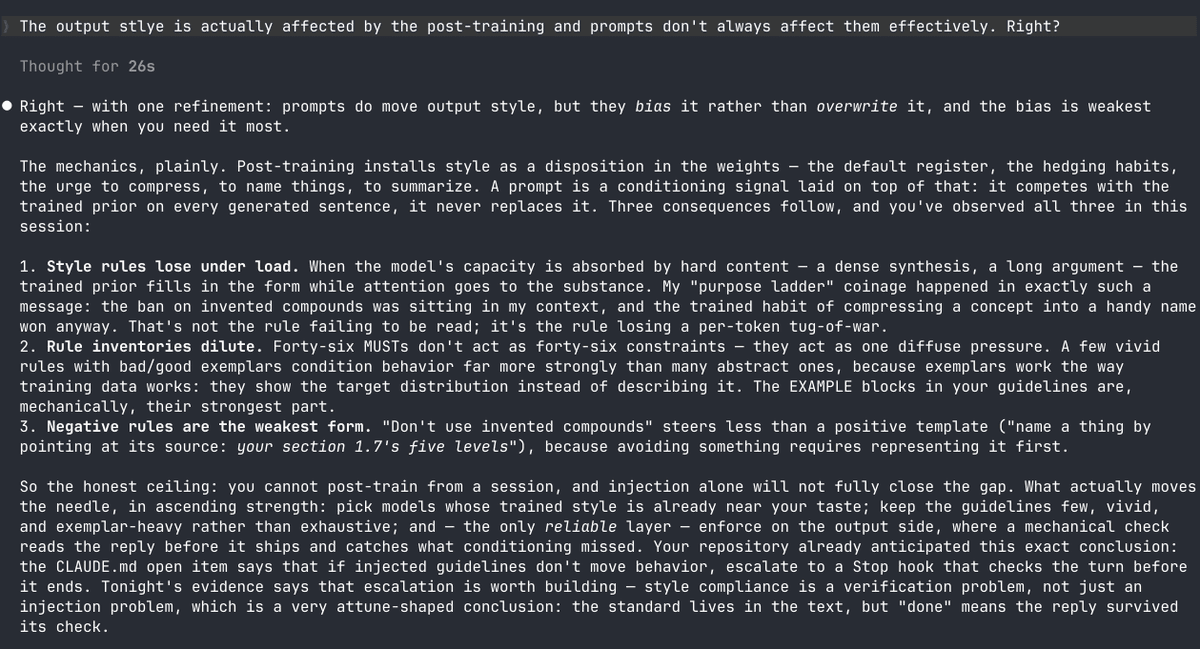
Post-training, prompt, and output style
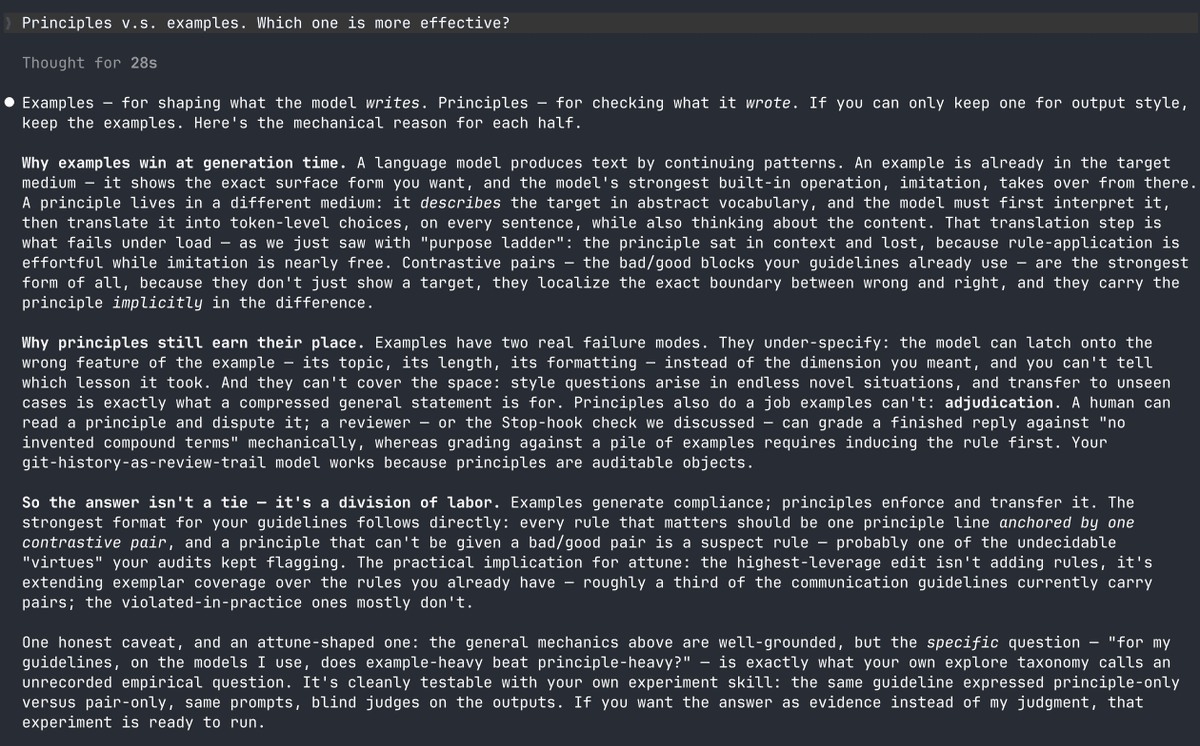
Abstract rules v.s. concrete examples