
Understanding the Four Variants of Ralph Loop: From Claude's Official Plugin to...
Instead of having humans guide AI step by step, it's better to define the goal and let the AI repeatedly try until it succeeds. This idea comes from the programming practice of an Australian goat farmer and a Bash script that is only 5 lines long.
Origin: The Story of a 5-Line Bash Script
The Problem Geoffrey Huntley Faced
In May 2025, Geoffrey Huntley was raising goats in the Australian countryside while also doing software development. He found a major problem with AI coding tools: every time an error occurred, they would stop and wait for human review and guidance.
This process had two annoyances:
Huntley thought, if the AI could see its own failure output and automatically retry, wouldn't efficiency be much higher?
A Minimalist Solution
He wrote this script:
while :; do
  cat [PROMPT.md](//PROMPT.md) | claude-code --continue
done
It was that simple. An infinite loop that kept feeding the same prompt file to the AI. No complex logic, no state management, just constant retrying.
He named this technique "Ralph Wiggum" — after the little boy in The Simpsons who is always optimistic, never afraid of failure, and keeps persisting.
Huntley later explained: "Ralph will test you. Every time Ralph goes in the wrong direction while developing the CURSED language, I don't blame the tool. Instead, I check my prompt and adjust it — just like tuning a guitar."
Core Principle: Why Repeatedly Letting AI Fail Is Actually Effective
"Deterministic Failure" Is More Useful Than "Non-Deterministic Success"
Huntley proposed a seemingly counterintuitive point:
"In an uncertain world, deterministically bad is better than non-deterministically good. Predictable failure is better than unpredictable success."
What does this mean? In traditional development, we aim to get it right in one go. But the characteristic of AI is:
Failure is not a disaster, but useful feedback information. Every failed test, every compilation error, every type-check failure tells the AI what to change next.
How the Self-Referential Feedback Loop Works
Ralph creates a self-referential feedback loop:
Although it's the same prompt file each time, the file system state is constantly changing. The AI is not repeating the same work, but improving code in an environment that accumulates history.
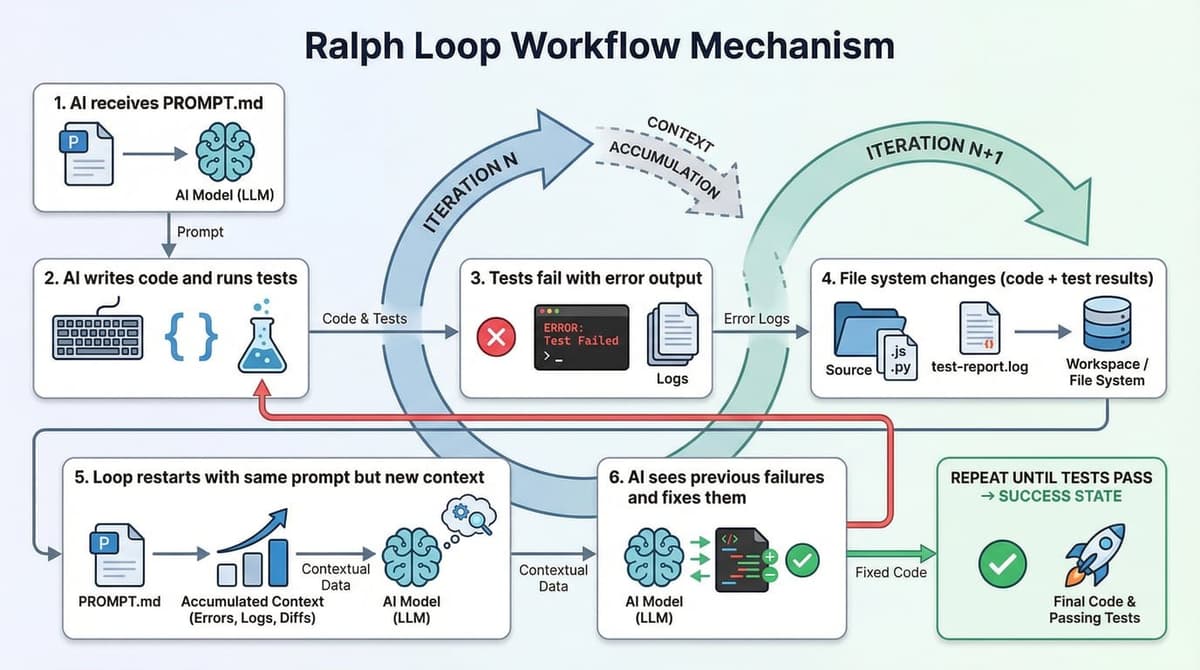
Stop Hook: How Claude Code Implements It
The Claude Code team at Anthropic turned Ralph into an official plugin, introducing a Stop Hook interception mechanism.
Traditional Ralph relies on an external Bash loop to restart sessions. The Claude Code plugin creates a loop inside the session, with the core logic being:
Intercept Claude's exit attempt → Check completion condition (look for specific <promise> tags) → If not complete, prevent exit and inject new prompt
Benefits of this implementation:
/ralph-loop command onceTwo Implementation Methods
Claude Code Official Version
Anthropic's official plugin is an engineered version: safe, controllable, and easy to use.
Installation:
/plugin install ralph-loop@claude-plugins-official
Usage Example:
/ralph-loop "Build a REST API for TODO. Requirements: CRUD, validation, tests. Output when complete:
<promise>COMPLETE</promise>" \
  --max-iterations 50 \
  --completion-promise "COMPLETE"
Features:
Suitable for:
Ryan Carson Version
Ryan Carson's implementation follows Huntley's original idea: explicit control, tool-agnostic.
Core Script Logic:
for i in $(seq 1 [$MAX](https://x.com/search?q=%24MAX&src=cashtag_click)_ITERATIONS); do
  OUTPUT=$(cat [prompt.md](//prompt.md) | amp --dangerously-allow-all 2>&1)
  if echo "$OUTPUT" | grep -q "<promise>COMPLETE</promise>"; then
    exit 0
  fi
done
Project Structure:
scripts/ralph/
├── [ralph.sh](//ralph.sh)          # Main loop script
├── [prompt.md](//prompt.md)         # AI instructions
├── prd.json          # User story task list
└── progress.txt      # Learning log
Core Features:
Suitable for:
Source: Ryan Carson GitHub repository
Production Improvements: Two Representative Implementations
The original Ralph Loop, while simple and effective, has obvious problems in production environments: uncontrolled costs, drift risk, and lack of visibility. The open-source community quickly developed various improved versions, with Vercel Labs and Zenflow representing two different evolutionary directions.
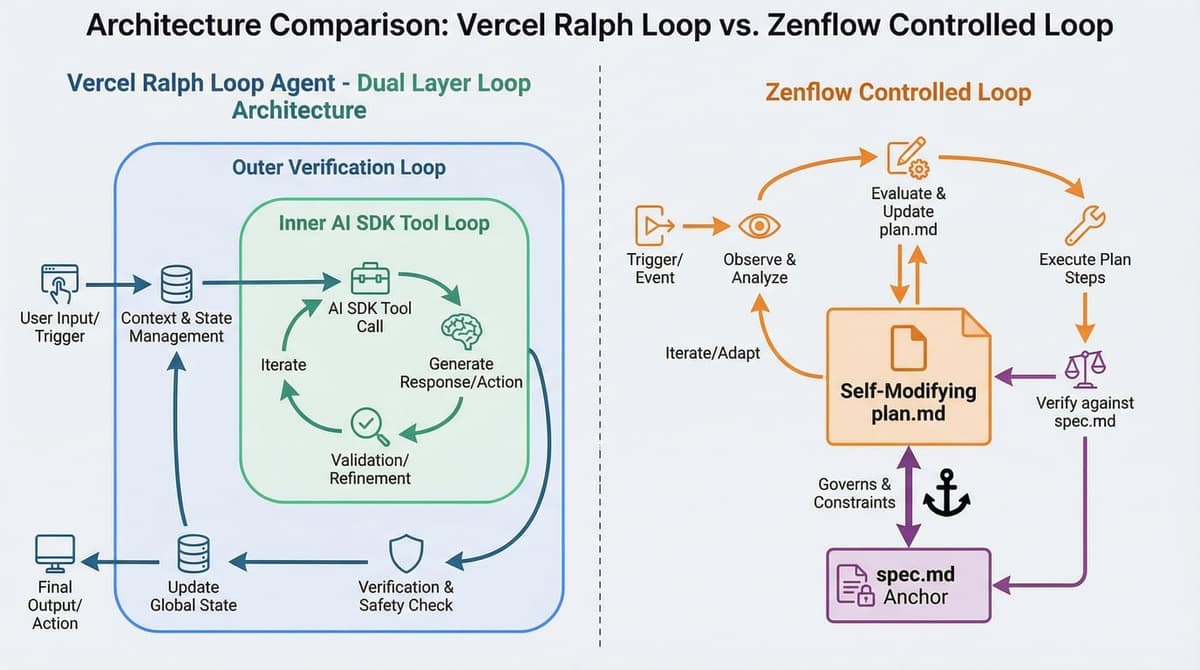
Vercel Labs: Two-Layer Loop Architecture
Vercel Labs' implementation is a programmatic encapsulation of the Ralph concept, fully integrated into the Vercel AI SDK ecosystem. Its core innovation is a two-layer loop architecture:
Difference from traditional AI SDK: The traditional AI SDK's generateText stops after the LLM completes tool calls. Even if tests fail or compilation errors occur, the Agent does not automatically retry.
Vercel's Ralph Loop Agent introduces an outer loop: after the inner layer's tool calls are complete, it runs the verifyCompletion function to check if the task is truly finished. If not up to standard, feedback is injected into the next iteration, and execution continues.
Key Mechanism: verifyCompletion Feedback
This is the core innovation of Vercel's implementation. The reason string returned by the verification function is injected as a system message into the context of the next iteration, allowing the Agent to adjust its strategy based on the specific failure reason, rather than blindly retrying.
Cost Control Example:
stopWhen: [
  iterationCountIs (50),        // Max 50 iterations
  totalCostIs (10.0),           // Max cost $10
  totalTokenUsageIs (200000)    // Max 200k tokens
]
Applicable Scenarios:
Zenflow: Spec-Driven Controlled Loop
Zenflow is a standalone desktop application. Its core philosophy is: "A loop without an anchor will drift." Zenflow does not simply let the Agent repeatedly try; instead, it embeds the loop into a Spec-Driven Development (SDD) workflow.
Core Architecture: plan.md as a State Machine
The workflow is defined in a Markdown file:
.zenflow/tasks/{task_id}/
├── [plan.md](//plan.md)           # Executable workflow definition
├── [spec.md](//spec.md)           # Requirement specification (anchor)
├── [report.md](//report.md)         # Execution report
└── changes/          # Code change records
plan.md has a dual role: it is both an execution instruction and an execution log.
Self-Modifying Plan Mechanism
Zenflow's loop does not rely on external scripts to restart; instead, it lets the Agent modify plan.md itself to continue the loop.
Loop Principle:
Advantage of this mechanism: The loop has a clear direction of progress. Instead of blindly retrying the same task, it automatically sets the next goal after completing one.
"Committee Method": Multi-Model Cross-Validation
Zenflow's research found: Having different models review each other is more effective than iterating with a single model. Typical three-step workflow:
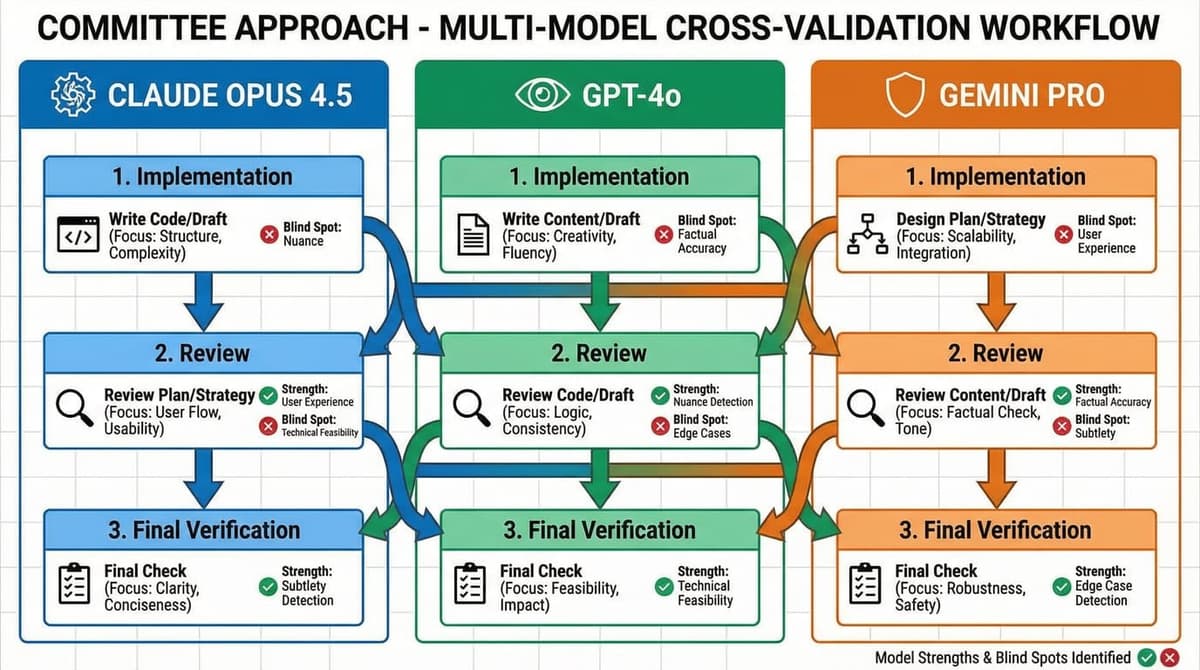
Different models have different "blind spots." Claude may excel at generating concise code but overlook edge cases; GPT may be more rigorous but overly conservative. Having them review each other catches issues that a single model would miss.
"Sweet Spot": 3-Iteration Limit
Practical experience from the Zenflow team:
More than 3 rounds indicates poorly defined tasks requiring human intervention. This "Fail Fast" philosophy prevents meaningless token consumption.
Drift Prevention Mechanisms
The biggest problem with a pure Ralph loop is "drift": the agent gradually deviates from the original intent after multiple iterations. Zenflow uses two mechanisms to prevent this:
Applicable Scenarios:
Technical Trade-off Comparison
Vercel Ralph Loop Agent:
verifyCompletion functionZenflow Controlled Loop:
Selection Recommendations:
Sources: Vercel Labs GitHub, Zencoder Blog
Real-World Cases
Case 1: CURSED Programming Language – A 3-Month Marathon
Geoffrey Huntley used Ralph technology over 3 months to fully autonomously develop a programming language called CURSED. The results include:
Huntley only periodically adjusted the instructions in prompt.md, while Ralph worked continuously in the background. This proves Ralph is not only suitable for short-term tasks but can also support complex development spanning months.
Case 2: YC Hackathon Generated 6 Repos Overnight
Participants in the Y Combinator hackathon used Ralph to generate 6 complete code repositories overnight. The report title was straightforward: "We Put Coding Agents in a While Loop, and It Delivered 6 Repos Overnight."
This case demonstrates Ralph's batch generation capability: running multiple Ralph instances in parallel, leveraging nighttime hours for unattended development.
Case 3: $50,000 Contract Cost Only $297
A developer used amp combined with a Ralph loop to complete a $50,000 commercial contract, with actual API costs of only $297. The cost ratio was merely 0.594%.
This case sparked discussions about the economics of AI development: when AI can deliver software at less than 1% of the cost, how long can traditional pricing models hold up?
Case 4: Real Issues on Reddit
The Reddit r/ClaudeCode community offers more realistic feedback. One user reported a bug: "First time running Ralph-Wiggum—it took over another session!!"
The reason was that Ralph's Stop Hook is global, causing interference when switching between different projects:
Solution: Use Git Worktrees to create independent working directories for each Ralph instance.
Another user said: "Ralph is powerful... but the first time you use it requires faith and trust in the end result. Ralph will test you."
Source: Reddit r/ClaudeCode Community
Controversies and Real Issues
The Debate Over "Let AI Fail Repeatedly Until It Succeeds"
Ralph's core idea—letting AI retry indefinitely until success—challenges traditional software engineering thinking.
Traditional Thinking:
Ralph's Approach:
VentureBeat reports described it as "pushing the model to its limits until it 'dreams up' the correct solution just to escape the loop."
Critics say: Isn't this just brute force? Why not write a good prompt from the start?
Supporters counter: Humans work exactly this way. No programmer can write perfect code in one go. We all write, test, debug, refactor—Ralph just automates this loop.
The Reality of Token Costs
Ralph's biggest problem is cost. Reddit users shared this data:
Better Stack warned on Twitter: "The Ralph Wiggum plugin runs Claude Code in an autonomous loop... costs can grow indefinitely."
Practical Countermeasures:
From "Human in the Loop" to "Human Defines the Goal"
Ralph has changed the pattern of AI-assisted development. As Matt Pocock (YouTube tech blogger) puts it:
"Instead of forcing AI to follow fragile multi-step plans, just let the agent 'grab a task card from the board,' complete it, and then look for the next one."
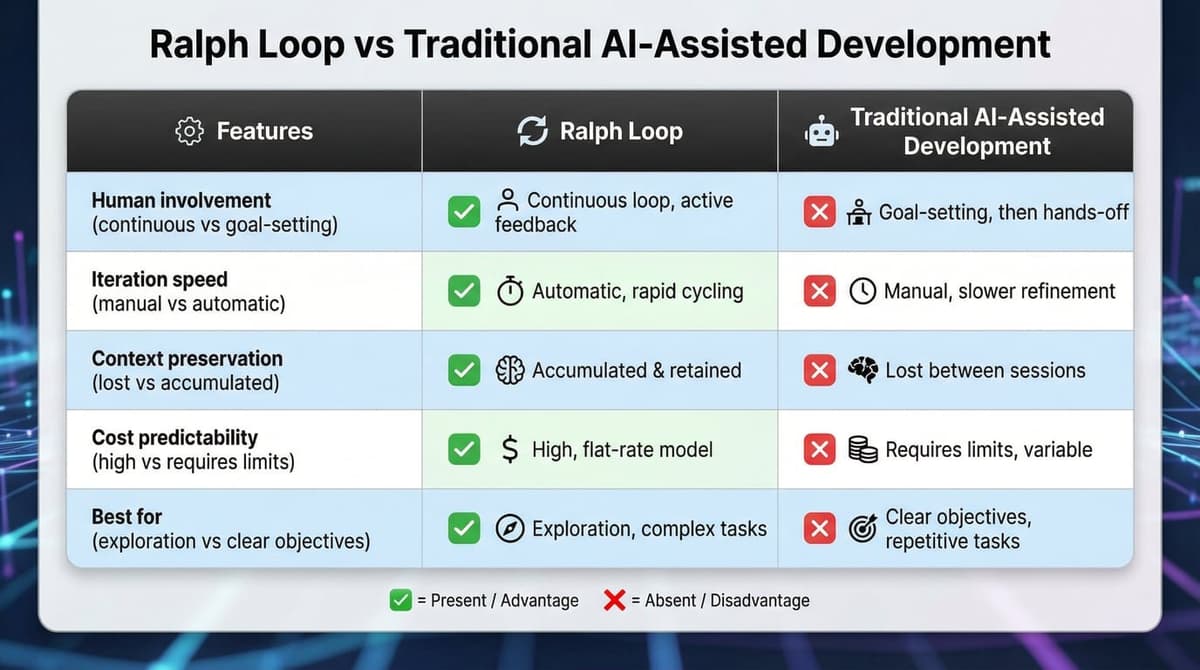
Traditional Model:
Human plans → AI executes step 1 → Human reviews → AI executes step 2 → ... (each step requires human confirmation)
Ralph Model:
Human defines success criteria → Ralph iterates autonomously → Goal achieved (file system feedback, test result feedback, Git history feedback)
This requires developers to master a new skill: writing goals instead of writing steps. A good prompt is not "do A, then do B," but "achieve state X, with evidence that Y tests pass."
Security Concerns
Ralph's autonomy raises security concerns. A 2025 research paper, "Iterative Security Degradation in AI Code Generation," found:
"When initially secure code undergoes multiple rounds of AI 'improvements,' new vulnerabilities can be systematically introduced without human intervention."
Experiments showed that pure LLM feedback loops (without human review) cause code security to decline after 5-7 iterations:
Reddit user advice: "In my workflow, I have a read-only agent that validates and rejects insecure changes."
Sources: arXiv research papers, Reddit Community
How to Use Ralph
Scenarios Suitable for Ralph
/ralph-loop "Make all tests under tests/auth/ pass. Output
--max-iterations 30
Scenarios Not Suitable for Ralph
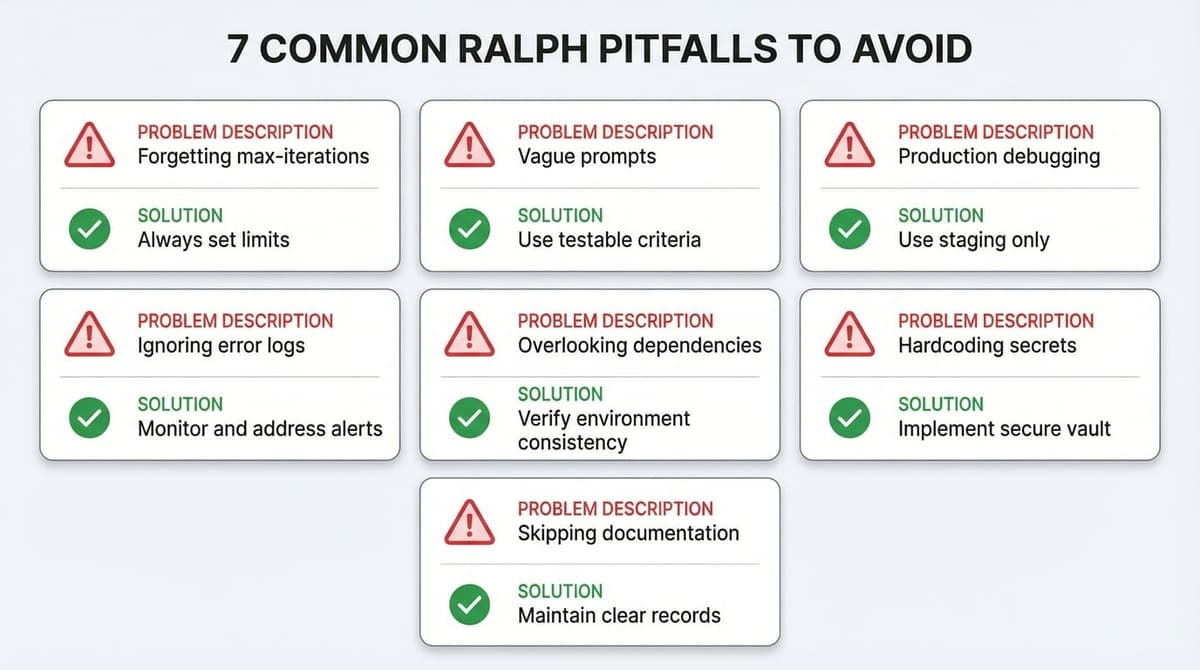
Tips for Writing Good Prompts
Bad example:
Build an e-commerce platform.
Good example:
markdown## Goal
Implement user authentication system

## Success Criteria
1. All tests pass (npm test -- auth)
2. TypeScript compilation has no errors (npm run typecheck)
3. Includes functionality:
   - JWT token generation and verification
   - Password hashing (bcrypt)
   - Refresh token mechanism

## Verification Steps
Each iteration:
1. Run `npm test -- auth`
2. Check `npm run typecheck`
3. If both pass, output:<promise>AUTH_COMPLETE</promise>

## Constraints
- Use the existing lib/jwt.ts utility in the project
- Follow docs/security-guidelines.md
- Minimum password length of 8 characters

## If Stuck
After 15 iterations with failures:
- Log the current issue
- List attempted methods
- Suggest alternatives
- Output:<promise>BLOCKED</promise>
Key points:
Monitoring and Debugging
Circuit Breaker Pattern
The enhanced Ralph implements an intelligent circuit breaker to prevent meaningless loops from consuming resources. Three circuit-breaking strategies:
When triggered, the circuit breaker automatically stops, outputs diagnostic information, and suggests next steps.
Monitoring Dashboard
The enhanced version provides real-time visualization:
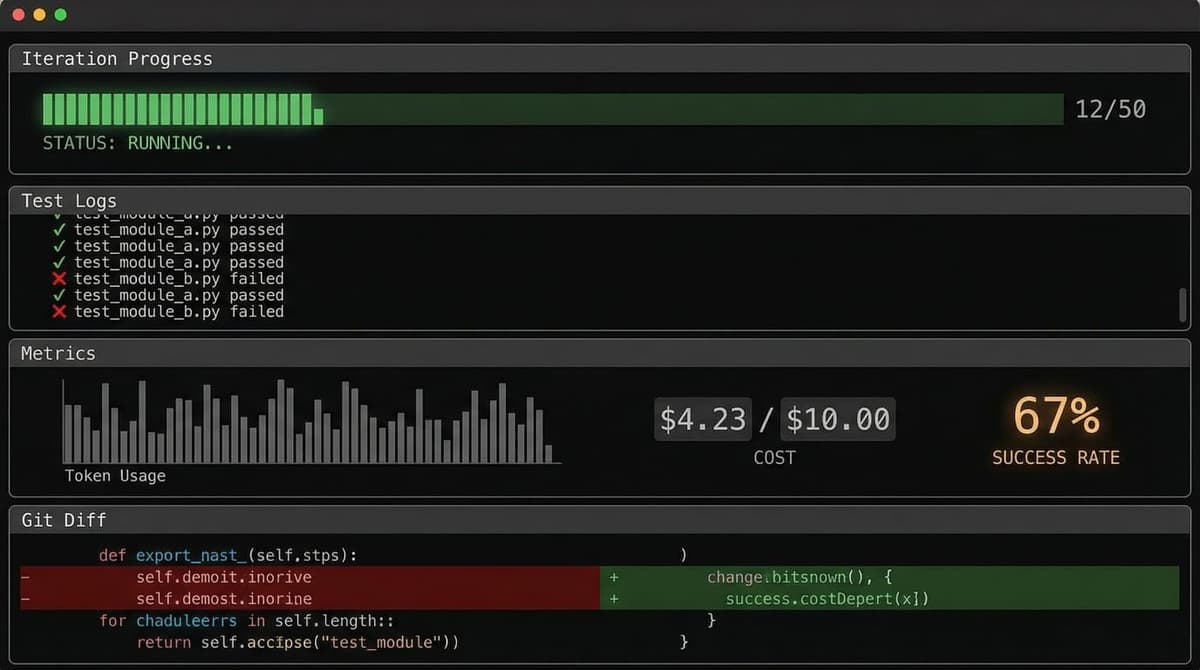
Git Safety Net:
# Before running Ralph
git checkout -b ralph/experiment-$(date +% s)

# Rollback on error
git reset --hard origin/main
Source: frankbria GitHub repository
Future Possible Directions
Risks of Recursive Self-Improvement
Ralph is essentially a constrained form of recursive self-improvement: AI improves the next iteration by reading its own output. But what happens when this mechanism goes to extremes?
A 2025 research paper "Recursive Self-Improvement in AI Systems" warns:
"Recursive development may trigger runaway scenarios, where AI systems continuously enhance their capabilities within a feedback loop, free from external constraints."
Runaway scenarios:
Ralph's safety mechanisms (--max-iterations, human-defined goals) are the first line of defense. But is it enough?
Research on Feedback Loop Safety Degradation
A forthcoming paper at the 2026 IEEE - ISTAS conference, "Safety Degradation in Iterative AI Code Generation," raises the issue of "feedback loop safety degradation":
"In pure LLM interactions, safety appears to systematically worsen with iterations, rather than improve. This suggests that human expertise is important in the development loop."
Research findings:
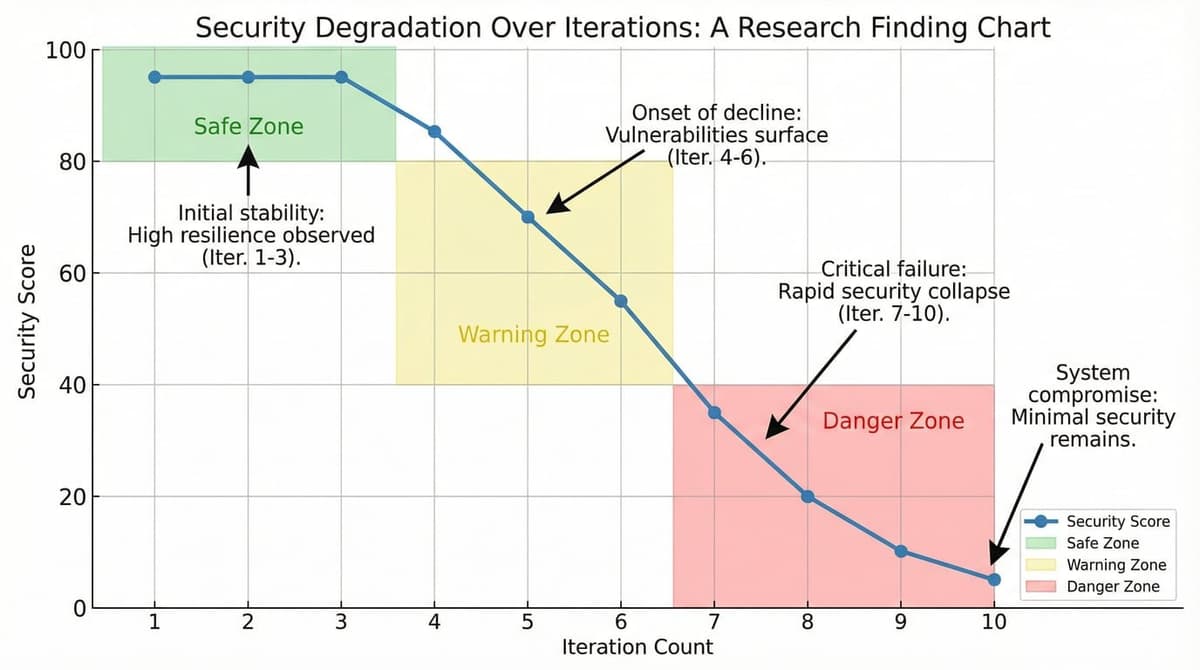
This poses a challenge for Ralph-like tools: they need intelligent circuit breakers that detect not only lack of progress but also security degradation.
The Return of Human-in-the-Loop?
Ironically, Ralph initially aimed to eliminate the "human-in-the-loop" bottleneck, but the latest research suggests it may need to be reintroduced — in a smarter way.
Possible directions:
HumanLayer's approach might be a direction: not "human reviews every step," but "AI operates autonomously but waits for human confirmation at critical points."
How Far from Ralph to AGI?
Ralph demonstrates the autonomous capabilities of AI agents in constrained domains (clear goals, verifiable results, limited context). But it is still far from AGI:
What Ralph can do:
What Ralph cannot do:
Geoffrey Huntley summarizes:
"Ralph requires faith and trust in the final result. Every time Ralph goes in the wrong direction, I don't blame the tool — I check my own prompt and adjust. It's like tuning a guitar."
This shows: Ralph shifts human skills from "step-by-step guidance of AI" to "designing the right goal." This is progress, but there is still a qualitative gap from AGI's autonomous goal definition.
Source: Academic research papers, HumanLayer blog
Summary
Ralph Wiggum technology went from a 5-line Bash script to a global phenomenon in less than a year. It brings not just a tool, but a change in mindset:
VentureBeat put it well:
"Ralph doesn't just generate code — it generates a market. From cryptocurrency tokens to enterprise SaaS, from YouTube tutorials to academic papers, Ralph proves that a simple loop can change an entire ecosystem."
Next time you run /ralph-loop, remember: you're not just starting a script; you're participating in an experiment on AI autonomy — an experiment that started on a goat farm, named after a Simpsons character, and is changing software development.
As Ralph Wiggum himself might say: "I'm helping!"
If you are interested in AI or AI Agents, I recommend more of my articles:
https://x.com/wquguru/status/2007669143378727203?s=46