
The AI Community's Anxiety Marketing Has Become Too Ridiculous
By Lan Xi
The wave of "Lobster Fever" sparked by OpenClaw is becoming increasingly surreal.
If, right after the Spring Festival holiday, having Lobster installed at home was still a joke, still stuck at the stage of using Nano Banana to create images for a laugh, then last weekend's long queue outside Tencent Tower waiting for free Lobster installation can only be described as "this has now become art."
I'd like to cite a joke; its original version goes like this:
"How old should a little boy be before he shouldn't enter the women's bathhouse?"
"When he wants to enter the women's bathhouse, he shouldn't enter."
The fundamental logic of the Lobster matter is essentially the same: if you need someone to help you install Lobster, then you probably don't actually need Lobster...
Everyone agrees that brave people enjoy the world first, but admitting that you're not among them and don't deserve to enjoy the world first is very difficult.
OpenClaw is an awesome innovation, no doubt, but its awesomeness isn't at the level of universal benefit. Quite the opposite, it's a means to raise the upper limit of AI usage.
It's an "overclocking" solution for those who have already pushed existing AI tools—from ChatBot to Coding—to their limits, a way to break through those limits.
It's not a万能钥匙 for those who, even today, haven't personally written a prompt exceeding 500 words to achieve a shortcut overtaking.
Actually, Anthropic's report makes it very clear: the gap between the theoretical utilization rate "blue zone" and the actual utilization rate "red zone" of AI across various industries is vast:
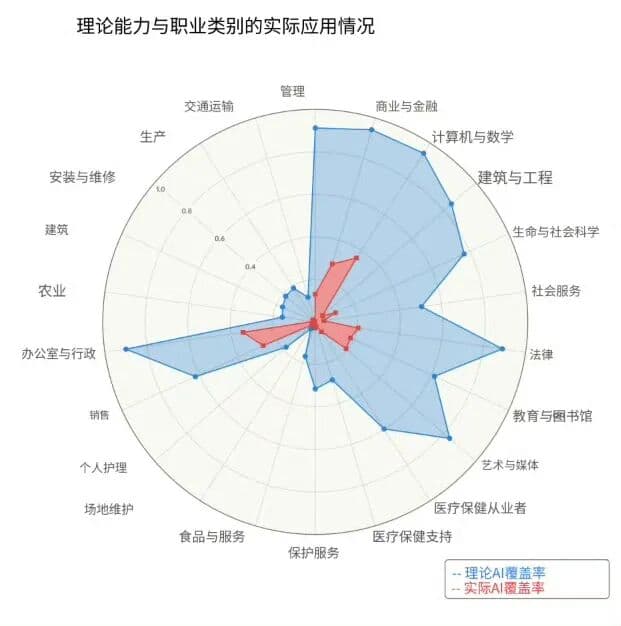
Considering this is based on Claude's data—compared to ChatGPT and Gemini, Claude is the most focused on productivity scenarios—it's even more telling for the general public who only treat AI as a聊天对象.
Another Lobster paradox is that only if your time cost is sufficiently high can you accept a work outsourcing model priced in Tokens.
Why has AI Coding monetization surpassed all other industries? Because programmers are the most典型个体化高薪职业; time equals productivity.
Encouraging ordinary people to use Lobster is a共谋 between model manufacturers and cloud computing platforms. They're already earning hard money, yet还要负担所谓的"digital employees," and the saved time is then spent watching more short dramas—the entire闭环 is awkward.
Even more离谱 is that starting this week,各地已经陆续发布"养龙虾"的补贴 policies. An开源项目 on a nonexistent website tied together with白纸黑字的红头文件 is truly somewhat abstract.
I've always said: yes, AI solves production problems, changes the尴尬 of "just needing a programmer," but ultimately, it cannot create real demand. Or rather, FOMO itself becomes the demand.
Abundance in one form inevitably leads to scarcity in another. The abundance of锤子 corresponds to the scarcity of钉子. If you can't see the钉子, then you are the钉子.
In the setting where FOMO equals demand, using Lobster, being able to use Lobster, is more important than what you do with Lobster, more worthy of posting on朋友圈.

web3's corpse isn't even cold yet, and web4 has already emerged. These热情满满的活动 fully prove a定律: wherever there are韭菜, there will be币圈.
Conversely, A股, which loves writing小作文, has maintained高度克制 at this time. Lobster concept stocks appeared quite late. What does this说明? It说明 even stock investors hesitated in their most擅长自我欺骗...
To say something unpleasant: you好不容易装上龙虾, environment周全, models配好, have it recommend stocks for you daily. Then the AI runs through millions of Tokens, from the Iran situation to the chip revolution, delivering a "McKinsey-level" report with every detail, making you无比满意, feeling a sense of power like having the world at your fingertips.
But from the结果来看, it and your coin-toss decision are actually没什么区别.
Because赚钱的逻辑 isn't like this, never has been. The more common矛盾 in the world is knowing too many道理 yet still not living a good life.
Just like the standard for evaluating whether an asset has泡沫 is "even大爷大妈 are starting to buy it," seeing Zhou Hongyi today也表示要搞一键安装的龙虾说明 this matter差不多也快到头了.
However, in terms of progress, the AI industry in 2026 has indeed entered a "great分化" version.
The first分化 lies between the前沿层 and the大众层; Lobster is just the latest媒介.
Earlier during the Spring Festival, a document about 2026大失业 completely generated by AI刷屏全网. Nowadays, AI胡编乱造 isn't called胡编乱造; it's called非虚构写作—also a奇景.
The AI industry's认知更新 happens daily or even hourly, yet ordinary people remain麻木不仁的接着奏乐接着舞. The失真感 caused by this碰撞 is a很有意思的社会化现象.
On one side, there's恨其不争的捉急; on the other,与我何干的悠闲.奋斗逼 and躺平逼狭路相逢,只好各道一声傻逼.
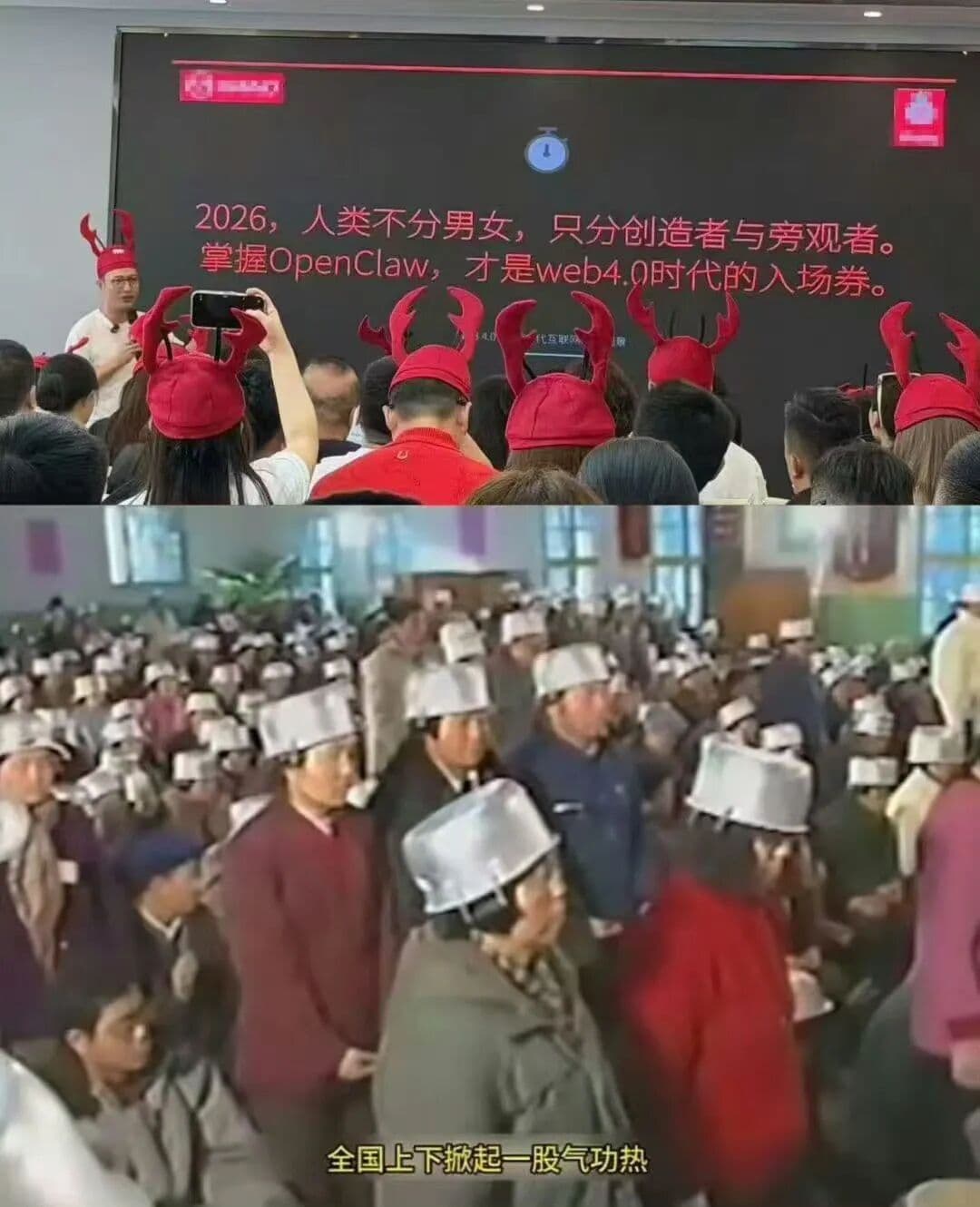
I have no doubt AI will淘汰掉大多数人, but predicting the艰辛大多数人 can付出 to avoid淘汰 is also一厢情愿,属于了解AI但不了解人类的错觉.
Like Andrej Karpathy spending two hours writing a dashboard to record his heart rate, then惊呼应用商店不存在了,未来所有人都会像他一样给自己写App...
This guy seems to live in a world without TikTok, or simply doesn't know how users, to avoid typing a few extra words, let无限上下划的产品吞噬掉几乎所有时间消费.
The second分化 lies in the方向背离 between大厂 and小虎.
Over the past month or more, domestic互联网大厂烧掉了 over 60 billion RMB just to push DAU to a漂亮数字, making the most mainstream ChatBot an入口.
Meanwhile, among the surviving "AI六小虎," all have strategically放弃 AI应用路线,转而选择主在海外市场卖API.
战绩可查: Kimi用20天的收入超过了去年全年;智谱最高档订阅产品一度断货; MiniMax调用量单周登顶OpenRouter...
Thus we see "DAU无用论"又被翻出来广为传诵. Of course, the main传诵者 are从业者 who have never made百万级DAU products—let's not mention that to avoid尴尬.
Unfortunately, the AI圈不怎么读书; otherwise, Tocqueville's "The Old Regime and the Revolution" should be mentioned more frequently. The决绝与浪漫 of the French告别过去, turning处刑台 into一道道靓丽的风景线,是多么辉映时代.
Only老登张口闭口林俊旸;咱们自己人都说junyang.
The third分化 lies in中国和美国各走各路.
A year ago, after DeepSeek火出圈, many who懂 nothing but love到处掺合纷纷建议要把梁文锋保护起来,别让他出国参加交流活动时被万恶的美国给扣了.
姑且不论贷款开团的做法,真实发生的情况是, in global conferences this year, the entire industry has been in a "pretend China doesn't exist" world线.
For example, the recent AI Impact Summit, which contributed the名场面 of Sam Altman and Dario Amodei raising fists instead of牵手, had all notable AI companies attending—except China's.
This is a相当吊诡的画面. As one of the two poles of the global AI industry, China's AI companies始终处于缺席状态 in major industry summits. The背道而驰 of存在感和地位,违和感已经无法视而不见了.
This is当然地缘政治的结果之一. Both sides似乎假设 a market environment不受对方任何影响.但实际上, China's programmers几乎全是Anthropic付费用户, while美国同行们也把中国的开源模型捧上了天.
至于龙虾热潮的内外两开花,更是把"技术没有国界线"写在了明面上.
The survival guide for the "great分化" version should place克服焦虑第一条. If真要统计, humans错过 AI风口怕是多达百十个 weekly, but风口上已经没有猪了;那里成了一个打卡点.
Including Lobster, I actually推荐大家都去尝试,前提一定是基于你的好奇和兴趣,而不是因为看着别人都用,心里急得慌.
"哥,你当初不是跟我说AI是用来提效的吗?怎么你搞了AI之后越来越忙了?还一整夜一整夜的不睡觉,抖音也不刷了,番茄也不看了,王者也不打了,张口闭口就是什么Skills、Mcp、OpenClaw,我都有点分不清了,到底是你在用AI,还是AI在用你啊?"