Research Report on New Progress in Local LLM Deployment: Usability Thresholds, Costs, and 12-Month Extrapolations for Individuals with Qwen3.8-27B and DeepSeek-V4-Flash
Executive Summary
Local large language model (LLM) deployment has become genuinely viable for individuals for the first time in 2026. Qwen3.8-27B (Apache 2.0, 262K native context) and DeepSeek-V4-Flash (284B total / 13B activated MoE, 1M context, MIT license) constitute a "dual sweet spot for personal deployment": the former compresses flagship-grade Agent capabilities into a single 24GB graphics card, while the latter brings frontier-class models within reach of 128GB unified memory devices for the very first time[1][2][3][4]. This feasibility stems from the compounding realization of three software dividends—factory-integrated speculative decoding (boosting single-stream speed by 1.7–2.6× for 27B models), near-lossless 4-bit quantization (95.6% Top-1 match rate), and over 100× KV cache compression (reducing 1M-context KV cache down to 2–7GB)[5][6][7].
Threshold Conclusion: The 27B sweet spot = a 24GB NVIDIA GPU. Q4 weights take up ~17GiB; with MTP enabled, the RTX 3090/4090 achieves a measured 40–65 tok/s with comfortable 32–64K contexts at a complete system cost of around ¥20,000–30,000. The RTX 5090 can reach 133–206 tok/s, though street prices command up to a ~135% markup over MSRP[8][9][10]. The 284B-MoE sweet spot = 128GB unified memory (quantized version runs at 20–35 tok/s with complete systems at ¥14,000–34,000) or 4×48GB multi-GPU setups (¥100,000–130,000 class, achieving up to 367 tok/s under DSpark)[11][12][13]. The underlying mechanism is: decode speed ≈ memory bandwidth ÷ activated weight bytes per token. With 13B activated parameters, achieving 20/40/60 tok/s requires only ~150/300/450 GB/s. Choosing the architecture before buying hardware is far more decisive than simply expanding the budget; the intermediate 70B dense tier has been hollowed out, squeezed from both sides[14].
Payback Conclusion: The reference system determines everything. Compared to DeepSeek's official API (a heavy 300M tokens/month bill costs only ~¥113), hardware of any tier will never break even. Compared to flagship APIs (Max class), the payback period is 8–13 months; compared to Alibaba Cloud Model Studio API for the same model, it is ~36 months; and compared to a Claude Max 20x subscription (¥1,420/month), it is ~15 months[15][16][17][18]. The combination that makes economic sense converges on: "Heavy Agent User (≥300M tokens/month) + ¥20,000-class Hardware + High-Priced Reference System." Intangible values such as privacy compliance, offline availability, zero rate limits, and custom fine-tuning make the payback equation viable from Day 0.
12-Month Forward Extrapolation (Baseline Scenario, ~60% Probability): Models will become stronger and cheaper—the Qwen4 family is expected to land in 2027 Q1 (around Spring Festival), DeepSeek V5 is expected in 2027 Q2, and the flagship activation ratio will continue to drop toward 2–3%. Hardware will become more expensive—DRAM/GDDR price hikes are projected to peak in 2027, NVIDIA faces a consumer vacuum until 2027 H2, and the M5 Ultra (512GB / 1.2TB/s) will hold a de facto monopoly over the large-memory sweet spot tier during this window. Software dividends will persist and automatically benefit installed hardware[19][20][21][22][23]. The primary downside risk is license tightening: the probability of "publishing weights, tightening licenses, and trimming top configurations" becoming the new normal is ~70% (estimated), but downloaded weights cannot be retroactively revoked—promptly archiving key weights is a zero-cost hedge[24][25].
Condensed Advice for Decision Makers: Users whose requirements are already covered by current models should purchase hardware on demand without waiting (the "wait-and-see" logic fails during price-hiking cycles). The only valid reason to wait with a definitive time anchor is the Qwen4 sweet-spot release in 2027 Q1. For data-sensitive, locality-dependent users, the current historically permissive window of "Apache 2.0 + MIT" is well worth seizing[26][27].
1. New Progress in Local Deployment: Simultaneous Advances Across Models, Software, and Hardware
As of August 2026, local LLM deployment has evolved from a niche geek flexing exercise into a practical choice for developers and SMEs. On one end, the capability density of open-source weights continues to rise—models runnable on a single 24GB GPU are beginning to outperform year-old flagship cloud APIs on Agent benchmarks. On the other end, the inference software stack is simultaneously reaping dividends across speculative decoding, low-precision quantization, and KV cache compression, while the hardware front suffers severe price surges driven by the DRAM supercycle. This chapter reviews the current landscape across models, software, and hardware to establish a coordinate system for the deployment thresholds and cost estimations in subsequent sections.
1.1 Model Side: Open-Source Weights Enter a Dual Sweet Spot of Capability and Deployability
1.1.1 Release of Qwen3.8-27B: 28B Dense Multimodal, 262K Native Context, Apache 2.0, Filling the Personal Flagship Gap
Announced on August 3, 2026 alongside Qwen3.8-Max and open-weighted on August 14, Qwen3.8-27B stands as the quintessential representative for individual local deployment[1]. Its exact parameter count is 27,781,427,952, utilizing a 64-layer hybrid architecture (48 layers of Gated DeltaNet linear attention + 16 layers of GQA full attention). It natively supports a 262,144-token context window (extensible to 1M via YaRN) and operates as a native vision-language model (supporting image and video inputs)[1][2]. Released in BF16 safetensors format (55.6GB), it carries an Apache 2.0 license—permitting commercial use, modification, and redistribution without revenue or monthly active user thresholds[2].
In terms of capabilities, official scores of 61.7 on SWE-bench Pro, 73.0 on Terminal-Bench 2.1, and 84.3 on OSWorld allow it to surpass Opus 4.6 Max on agentic workflows, trailing only on upper-tier knowledge and pure reasoning tasks. Within two weeks of release, it secured two "#1 Open-Source Weights" third-party endorsements on the Harvey Legal Agent benchmark and the Arena.ai Image-to-WebDev leaderboard[28]. More critically for deployers: its hybrid linear attention architecture requires only ~16GiB (BF16) of KV cache when fully running 262K context, while its 4-bit quantized weights take ~17GB. For the first time, a 24GB VRAM card can simultaneously accommodate "flagship-tier capability + long context"[1][29].
1.1.2 Official Release of DeepSeek-V4-Flash: 284B Total / 13B Activated MoE, 1M Context, MIT License, Bringing Frontier Capabilities to the Desktop
Released on July 31, 2026, the official DeepSeek-V4-Flash-0731 represents the other pole of localizable frontier capabilities. Its architecture is a sparse Mixture-of-Experts (MoE) with 284B total parameters and 13B activated parameters (43 layers, 256 routed experts top-6 + 1 shared expert). HuggingFace metadata reports 304.18B—the difference being the DSpark speculative decoding draft module bundled directly into the checkpoint[3][30]. Its native 1M context is extended from 65,536 via a YaRN factor of 16, under the most permissive MIT license[3][4].
In deployment economics, V4-Flash reduces the threshold by ~4–5× compared to the previous generation V3/R1 (671B total parameters, FP8 weights ~642GB, conventionally requiring at least an 8×H100 node costing ¥1.2 million+). The official QAT native MXFP4 mixed-precision weights measure only 155.4 GiB, running at full precision on 2×H200 or 3–4 workstation GPUs. When compressed to 82.5–104GB via community dynamic quantization, 128GB unified memory devices can run frontier-class models locally for the first time[4][11][31][32]. A critical cognitive boundary to maintain is: "13B activated ≠ 13B VRAM"—memory capacity is determined by total parameters, as all expert weights must remain resident in memory[31].
1.1.3 Stratification Solidification: Trillion-Parameter API-Only Models Pull Away from Locally Deployable Tiers
In contrast to the expansion of personal sweet spots, the top end has completely detached: while Kimi K3 (2.8T total parameters, 896 experts) opened its weights under a modified MIT license, deployment requires ≥1.5TB VRAM with an official recommendation of a 64-GPU supernode costing tens of millions of RMB—marking the total decoupling of "open weights" from "personally deployable"[33]. Meanwhile, Qwen3.8-Max (2.4T-A95B), the first open-weight Max-tier model, carries a custom commercial license and trims vision modalities, remaining effectively API-driven[25]. The middle layer has spawned a gray zone of "nominally open, practically undeployable" models; GLM-5.2 (744B/40B activated, MIT) pushes right against institutional deployment ceilings[34].
Consequently, the upper limit of locally deployable capability has stabilized into two tiers: the ≤35B dense tier and the 100–400B highly sparse MoE tier. Commercial logic supports the continued supply of these two tiers: open-source model token share on OpenRouter surged from 34% in January 2026 to 65% in June. Market pressure dictates that "closed-source = elimination," preventing vendors from abandoning small-to-medium open-weight releases[27].
Table 1-1 Representative Locally Deployable Open-Weight Models in 2026
| Model | Release Date | Total/Active Params | Architecture | Native Context | License | Personal Deployment Threshold |
|---|---|---|---|---|---|---|
| Qwen3.8-27B | 2026-08 | 27.8B (Dense) | Hybrid Linear Attention VLM | 262K (YaRN to 1M) | Apache 2.0 | Single 24GB GPU (4-bit ~17GB)[1] |
| DeepSeek-V4-Flash-0731 | 2026-07 | 284B/13B (MoE) | CSA+HCA Hybrid Attention | 1M | MIT | Full precision ≥192GB; Quantized 128GB unified memory[4][11] |
| Qwen3.8-Flash-Next | 2026-08 | 125B/6B (+51B n-gram table) | GDN+QSA (Qwen4 Preview) | 262K | Qwen Community License 1.0 | FP8 ~168GB, nearing 192GB workstation tier[19] |
| GLM-5.2 | 2026-06 | 744B/40B (MoE) | DeepSeek V3.x base derivative | ~202K | MIT | Institutional tier (8×H100 class), beyond personal scope[34] |
| Gemma 4 31B Dense | 2026-04 | 31B (Dense) | Pure Dense | 256K | Apache 2.0 | Runs on single 24GB GPU; coding trails same-tier Qwen[35] |
The table above reveals two structural realities. First, the "dual-polar sweet spot" for personal deployment has crystallized: 27B dense + 24GB single card, and 300B-class highly sparse MoE + 128–256GB unified memory. The middle 70B dense tier has been hollowed out because it demands both 48GB+ VRAM and massive bandwidth. Second, the activated parameter ratio has become the new competitive metric—falling from 5.5% in V3 to 4.6% in V4-Flash, and 4.8% in Flash-Next (or 3.3% counting the n-gram table). Vendors are trading "parameters actually read per token" for usable generation speeds on consumer-grade bandwidth, a trend that directly dictates the performance headroom for software dividends discussed in the next section[19].
1.2 Software Side: Inference Stack's Three Major Dividends Continuously Lower Thresholds
1.2.1 Factory-Integrated Speculative Decoding: llama.cpp Merging MTP Brings 1.7–2.6×, DeepSeek Packs DSpark Draft Module into Checkpoint
Speculative decoding (using a small draft model or draft heads to predict tokens, followed by parallel verification on the target model with strictly equivalent output distribution) transformed in 2026 from a "user-side plugin trick" into an official vendor artifact. Following the merge of MTP support into llama.cpp on May 16, 2026 (PR #22673), Qwen3.x-27B with built-in MTP heads achieved measured single-stream speedups of 1.7–2.6×: the RTX 3090 jumped from 38.9 to 65 tok/s, DGX Spark from 7.0 to 18.0 tok/s, and RTX 5090 reached ~140 tok/s[5][36]. DeepSeek went a step further by packaging the DSpark draft module directly inside the V4-Flash 0731 checkpoint. DeepSeek officially reported an additional 60–85% single-user speedup on top of the existing MTP-1 acceleration, with total throughput climbing +51%. Both vLLM 0.25 and llama.cpp (PR #25784, ~1.9×) have landed this, with 8×H20 production tests logging 600+ single-concurrency TPS[30][37][38]. The Apple ecosystem caught up in tandem: mlx-lm 0.21 boosted 70B models on M5 Max from 45 to 95+ tok/s (~2.1×)[39]. The practical implication: when evaluating local speeds for new models, baseline bandwidth requirements can be discounted by 40–50% thanks to out-of-the-box speculative decoding—essentially upgrading hardware by a generation for free.
1.2.2 Full-Stack Low-Precision Rollout: FP4 (NVFP4/MXFP4) and 2-Bit Dynamic Quantization Cut Ultra-Large Model Sizes in Half and Half Again
In 2026, 4-bit has become the default "perceptually lossless" baseline: Qwen3.8-27B's Q4_K_M (17.1GB) maintains a 95.6% Top-1 match rate against BF16, with a quality cliff appearing only when dropping from Q4 to Q2[6]. Hardware-native FP4 has fully entered inference engines: on consumer Blackwell, NVFP4 achieves 1.6× throughput over BF16 with 41% lower energy consumption and only 2–4% quality loss[40]. DeepSeek-V4-Flash pushed the paradigm to "official weights are quantized weights"—96% of expert parameters are natively stored in QAT MXFP4, allowing Unsloth to repack them bit-for-bit losslessly (KLD ≈ 0). Dynamic 2–3 bit quantization further compresses the 284B model to 82.5–104GB at the cost of KLD rising to 0.24–0.36, rendering quality "usable though not pristine"[11]. For individual users, the greatest value of FP4 is not merely higher speed, but enabling previously unrunnable models to fit into memory.
1.2.3 KV Cache Compression Revolution: 1M Context KV Memory Footprint Reduced from Hundreds of GB to Single-Digit GB, Context Bottleneck Returns to Weights
The VRAM economics of long contexts were rewritten in 2026: traditional GQA dense models required ~300GB of KV cache for a 1M context. DeepSeek MLA brought this down to 65–84GB, while the V4 generation's CSA (4× compression) + HCA (128× compression) + K=V sharing compressed 1M KV cache down to 4–7GB, and just 2–3GB when combined with KV quantization. In this 100×+ overall reduction, architectural innovation contributed ~100× and KV quantization contributed 2–4×[7][41]. General KV quantization in inference engines also showed striking gains: q4_0 KV reduced 256K context KV memory from 8.2GB to 2.3GB (-71%) with negligible quality degradation[42]. Qwen3.8-27B leverages 48/64 layers of linear attention so that a fully utilized 262K context requires only 16GiB (halved to 8GiB with FP8 KV)[29]. Consequently, long context is no longer an independent bottleneck; the primary barrier to running 1M context locally has returned to the weight volume itself—64–128K remains the sweet spot on 128GB devices, while 1M still demands 200GB+ memory-class hardware[4].
Table 1-2 Comparison of Gains from the Inference Stack's Three Software Dividends (2025-09 ~ 2026-08)
| Dividend | Milestone Progress | Measured Gains | Hardware Implication |
|---|---|---|---|
| Integrated Speculative Decoding | llama.cpp PR #22673; DSpark in checkpoint; LM Studio 0.4.14 stable release | 27B dense single-stream 1.7–2.6×; DSpark adds another +60–85% on top of MTP (official claim) | Baseline bandwidth demand discounted by 40–50%[5][37] |
| Full-Stack Low-Precision Rollout | QAT native MXFP4; NVFP4 in vLLM/SGLang/llama.cpp; Dynamic 2–3 bit | 4-bit near-lossless (Top-1 95.6%); 284B compressed to 82.5GB (~53%) | VRAM/RAM capacity threshold lowered by ~2–4×[11][6] |
| KV Cache Compression | CSA/HCA architectural compression + FP8/Q4 KV quantization | 1M context KV compressed from ~300GB to 2–7GB; 256K KV reduced by 71% | Long-context bottleneck shifts from KV back to model weights[7][42] |
The compounding effect of these three dividends is non-linear: quantization determines whether a model fits, KV compression determines how long the context can scale, and speculative decoding determines execution speed. However, all three possess operational boundaries—MTP gains concentrate on dense models (~1.17× on MoE), 2-bit quantization works reliably only on highly redundant MoE models (≥100B), and low-bit KV quantization accumulates retrieval errors beyond 32K context lengths[36][42]. This explains why 2026 model releases co-design these three technologies as "out-of-the-box defaults" rather than leaving them for users to assemble manually.
1.3 Hardware Side: Bandwidth Race Coexists with Memory Price Surges
1.3.1 Three Hardware Routes Take Shape: Discrete NVIDIA GPUs / Apple Unified Memory / AMD Strix Halo & DGX Spark Large-Memory Mini PCs
The pricing metric in the hardware race has shifted from TOPS to "memory bandwidth × capacity." The first route is discrete NVIDIA GPUs: the RTX 5090, with 1,792GB/s bandwidth and FP4 support, defines the performance ceiling for the 27B tier (133–206 tok/s with MTP enabled), though the lack of NVLink on consumer cards restricts multi-GPU scaling[36][10]. The second route is Apple Unified Memory: the M5 Ultra Mac Studio announced on August 25, 2026 offers up to 512GB unified memory and 1.2TB/s bandwidth (starting at ¥46,999 in China, shipping September 22). Bandwidth calculations estimate it running V4-Flash quantized tiers at 55–75 tok/s on a single machine, making it currently the only "out-of-the-box" single-node 300B-class solution[21]. The third route is large-memory mini PCs: AMD Strix Halo (256GB/s) and NVIDIA DGX Spark (~273GB/s) lack the bandwidth to run dense 27B models smoothly (achieving only 10–13 tok/s), but they are well-suited for low-activation MoE models; their 128GB capacity paired with quantization handles "usable-grade" execution of V4-Flash[43].
1.3.2 GDDR7 and DRAM Price Hikes: RTX 5090 Jumps from $1,999 MSRP to $4,100+ Street Price in 2026-08, Procurement Logic Rewritten
In stark contrast to software dividends, hardware costs deteriorated drastically in 2026. AI servers siphoning HBM capacity forced the top three memory makers to scale back consumer DRAM/GDDR wafer starts; in 2026 Q1, mainstream DRAM contract prices surged +92% year-over-year. TrendForce data showed 3GB GDDR7 dies climbing to $60–70, pushing the 32GB VRAM cost on the RTX 5090 to ~$320—roughly 30–40% of the entire board cost[44][26]. Retail pricing spiraled out of control: US street prices for the RTX 5090 reached $4,100–4,900 (a ~135%–145% markup over the $1,999 MSRP), while brand-new non-reference cards traded for ¥27,500–35,000 in China; official pricing for the RTX PRO 6000 96GB jumped from $8,565 to $16,000 within 18 months[10][26][45]. Price inflation cascaded across entire systems—a single 16GB DDR5 stick jumped from ¥450 to ¥1,800 (+300%), Strix Halo complete systems rose from $1,999 to $3,449 amid severe shortages, and DGX Spark prices were bumped by ~18%[43][26]. On the supply side, the RTX 50 SUPER series was indefinitely shelved, with market forecasts predicting price increases will peak in 2027 and stabilize only in 2028[26].
The implication for procurement logic is immediate: model weights are free, APIs are cheap, and software gains are delivered cost-free, while hardware alone is growing more expensive. The "wait-and-see" strategy fails within the 2026–2027 window; waiting will not make local deployment cheaper. Starting with Chapter 2, we dive into hands-on deployment thresholds and detailed cost modeling for specific models across this landscape.
2. Qwen3.8-27B: Usability Hardware Thresholds for Individuals
Bottom line up front: As of 2026-08, Qwen3.8-27B is the dense model with the highest "capability-to-hardware demand ratio" for local personal deployment. Its individual usability threshold falls into three tiers: 16GB VRAM / 32GB Unified Memory is Runnable, 24GB NVIDIA GPU is Usable, and RTX 5090 or 48GB-class VRAM is Uncompromised. Among these, the 24GB NVIDIA GPU (RTX 3090/4090) represents the price-performance inflection point: achieving 40–65 tok/s with Q4 quantization and speculative decoding, comfortably supporting 32–64K contexts at a total machine cost of ¥20,000–30,000[8][5]. Backing this conclusion are two hardware realities: Q4 weights occupy only ~17GiB, and the hybrid attention architecture compresses the 262K context KV cache to ~16GiB[29][46].
2.1 Specifications and Quantization Ecosystem
2.1.1 Architectural Specs: 27.78B Parameters, 64-Layer Hybrid Attention (48× Gated DeltaNet + 16× GQA), 262K Context YaRN-Extensible to 1M
Qwen3.8-27B was announced on 2026-08-03 and open-weighted on August 14 under an Apache 2.0 license (commercial use and modifications allowed without revenue restrictions)[1]. Exact stored parameters number 27,781,427,952, featuring a hidden dimension of 5,120, FFN intermediate dimension of 17,408, and a vocabulary size of 248,320 (unshared embedding and lm_head)[1]. Architecturally, it builds on the qwen3_5 foundation: 48 of its 64 layers are Gated DeltaNet linear attention, while 16 layers are GQA full attention (24 Q heads / 4 KV heads, head_dim 256), arranged such that full attention occurs every 4 layers[1][47]. It supports a native 262,144-token context window with official support for YaRN extrapolation to 1 million tokens (though official notes warn that static YaRN degrades short-context performance and is not recommended by default)[1]. A single-layer MTP (Multi-Token Prediction) head was built in during training—the hardware-independent prerequisite for the 1.7–2.6× speculative decoding speedup discussed later[1][5]. Furthermore, it is a native multimodal model (supporting image and video inputs), allowing personal deployments to handle vision tasks out of the box[1].
The direct benefit of this hybrid architecture for local deployment lies in the KV cache budget: only 16 of the 64 layers generate KV cache, consuming ~64 KiB per token (FP16). Running the full 262K context takes ~16GiB, which drops to ~8.7GiB when using FP8/q8_0 quantized KV[29][46]. If it were an all-attention model of the same size, the 262K KV demand would be roughly 4× higher (~64GiB estimated), making a 24GB card completely out of the question. Thus, the budget works out: ~16–17GiB for Q4 weights + several GiB for long-context KV cache fits squarely inside a 24GB card. BF16 raw weights take 55.6GB, making quantization mandatory on personal hardware[2]. Note that actual KV memory usage depends on whether the inference engine correctly recognizes the hybrid architecture; unoptimized engines that allocate across all layers will consume ~4× more memory, the primary reason for conflicting community benchmark reports[46]. YaRN extrapolation to 1M context has limited practical relevance for personal single-card setups: at 64 KiB/token, 1M context KV cache demands ~61GiB, far exceeding single-card memory budgets; the 262K native window remains the realistic ceiling[29].
2.1.2 Quantization Matrix: Official FP8 Near-Lossless; GGUF UD-Q4 as the Quality Inflection Point; 2-Bit Only Suitable for Experiments
At release, official weights were provided in BF16 and official FP8 (block size 128 fine-grained quantization at ~28GB, officially described as "virtually identical in performance to the original")[48]. Community quantizations across GGUF, AWQ, and MLX caught up within two weeks, producing 319 variants, with Unsloth Dynamic V3.0 receiving official public acknowledgement from the Qwen team[1][49]. The table below summarizes size and quality loss across mainstream quantization tiers:
Table 2-1 Qwen3.8-27B Quantization Tier – Size – Quality Loss Comparison (2026-08, GGUF-Centric)
| Quantization Tier | Size | Quality Metrics | Assessment |
|---|---|---|---|
| BF16 (Raw) | 54.7–55.6 GB | Baseline | Workstation tier only |
| Official FP8 (block-128) | ~28 GB | Officially near-lossless[48] | 48GB tier / vLLM scenarios |
| Q8_0 | 28.9 GB | KLD 0.00064, Top-1 match 98.92%[6] | Quality surplus, unnecessary |
| Q6_K / AD-Q6_K | 22.9–25.0 GB | KLD 0.00107, Top-1 match 98.67%[6] | Recommended when headroom allows |
| Q5_K_M / AD-Q5_K_M | 19.8–20.2 GB | KLD 0.00419, Top-1 match 97.34%[6] | Sweet spot for 32GB cards |
| UD-Q4_K_XL (Unsloth) | 17.9 GB | KLD 0.00955, Best 4-bit[6] | Default recommendation for individuals |
| Q4_K_M / AD-Q4_K_M | 17.1 GB | KLD 0.01126, Top-1 95.59%; PPL loss ~0.3% vs Q8[6][50] | Sweet spot for 24GB cards |
| UD-Q3_K_XL / AD-IQ3_S | 13.4–13.8 GB | KLD 0.03247, Top-1 92.41%[6] | Usable on 16GB devices; perceptible loss |
| UD-IQ2_XXS (2-bit) | 9.0 GB | KLD 0.25663, Top-1 79.44%[6] | Experimental / emergency use only |
| UD-IQ1_S (1-bit) | ~6.2 GB | Retains ~77% capability[49] | Novelty; runnable on 8GB RAM |
In the table, KLD represents the Kullback-Leibler divergence of the output distribution relative to BF16 (lower is better), and Top-1 match rate measures first-token agreement with BF16, both derived from AtomicChat standardized held-out evaluations[6]. Key takeaways: First, Q4 is the clear quality inflection point—Top-1 agreement drops gently from 98.92% (Q8) to 95.59% (Q4), but plummets to 79.44% at Q2; the error curve steepens sharply below 4-bit[6]. In terms of PPL, the relative degradation of Q4_K_M against Q8_0 is only ~0.3%, which is negligible[50]. Second, within the 4-bit tier, quantization authors make a substantial difference: LM Studio's Q4_K_M has a KLD of 0.02094, roughly 2.2× higher than Unsloth's UD-Q4_K_XL (0.00955)—choosing the right quantization implementation is more critical than stepping up a bit-width tier[6]. Third, 2-bit quantization remains below the usability threshold for dense models under 30B: the 2026 quantization consensus confirms that static 2-bit quantization incurs a 10–20% loss on benchmarks, keeping 4-bit as the production baseline[51]. While Unsloth's 1-bit build fits inside 8GB RAM, it retains only ~77% of capabilities and serves purely as a tech demo[49]. Additionally, Blackwell-architecture GPUs (RTX 50-series) can leverage NVFP4 (~23.4GB), which runs ~1.5× faster than BF16 on FP4 Tensor Cores, pushing SGLang decode past 200 tok/s on an RTX 5090[9][52]. MLX 4-bit (~15–18GB) serves as the standard container on Apple Silicon[53].
2.2 Hardware Benchmarks and the Three Usability Tiers for Individuals
This chapter defines "usable for individuals" as satisfying three criteria simultaneously: decode speed ≥15 tok/s (exceeding human reading speed for fluid interaction), context length ≥32K comfortable / ≥128K for full experience, and negligible quantization loss (Q4 tier or higher). Before interpreting benchmarks, consider three major variables: quantization format (Q4_K_M at ~17GiB is the community standard), inference engine (llama.cpp is the main driver for personal deployment; vLLM 0.27.1 has documented regression reports on this model[54]), and speculative decoding—enabling Qwen3.8-27B's native MTP head in llama.cpp with --spec-type draft-mtp yields a 1.7–2.6× speedup on the exact same card without altering output distribution[5]. However, MTP gains are concentrated in code, structured output, and low-temperature sampling; at temperature 0.8, draft acceptance rates can plummet from ~88% down to ~25%[5][55]. Beyond decode speed, prefill / Time-to-First-Token (TTFT) represents a hidden threshold: on long contexts, initial prefill dominates wait times—filling a 262K context on an RTX 5090 takes ~4.5 minutes, while 100K TTFT on DGX Spark takes ~90 seconds[46][56].
Table 2-2 Hardware Tier – Speed – Context – Individual Usability Assessment (Qwen3.8-27B Benchmarks, Extrapolations Noted)
| Hardware | Typical Config | Decode tok/s (No Spec / +Spec) | Comfortable Context | Assessment |
|---|---|---|---|---|
| 16GB Discrete GPU (4060 Ti 16G, etc.) | Q3_K/IQ4_XS | ~10–15 / — | 8–32K, constrained | ❌ Trial tier, not for primary use |
| M4 Pro / M5 Pro 48G | oMLX/MLX 4bit | 15–16 / ~35–50 (est.) | ≤32K (32K TTFT hits 97–113s) | ⚠️ Barely passes[53] |
| Strix Halo 128G | Q4_K_M / ROCmFP4+MTP | 12.3–14 / 24.5 (AMD official)–36 | 32K daily; 262K feasible | ⚠️ Subpar without spec decoding[55][57] |
| DGX Spark 128G | Q4 / NVFP4+MTP | 8.8–11.6 / 21.4–23 | 262K unconstrained | ⚠️ Passable but sluggish[9][56] |
| RTX 3090 24G | Q4_K_M, llama.cpp | 31 / 41–53 | 32–64K (192K tight) | ✅ Meets standard[8][58] |
| RTX 4090 24G | Q4_K_M/AWQ | 35–45 / 55–65 | 32–128K | ✅ Sweet spot[8][59] |
| M4 Max 48/128G | MLX 4bit + MTP | 28–33 / 63 (short context) | ≤16K fast; cliff past 31K | ✅ Qualified pass[53] |
| RTX 5090 32G | Q4_K_XL / NVFP4+SGLang | 60–74 / 133–206 | Full spec within 128K; 262K drops MTP | ✅✅ Full experience[9][60][46] |
| 2×3090 / 2×4090 48G | FP8+MTP3, vLLM | 63 / 105–210 (code) | 128K+ (steep long-context decay) | ✅ Full experience[61][62] |
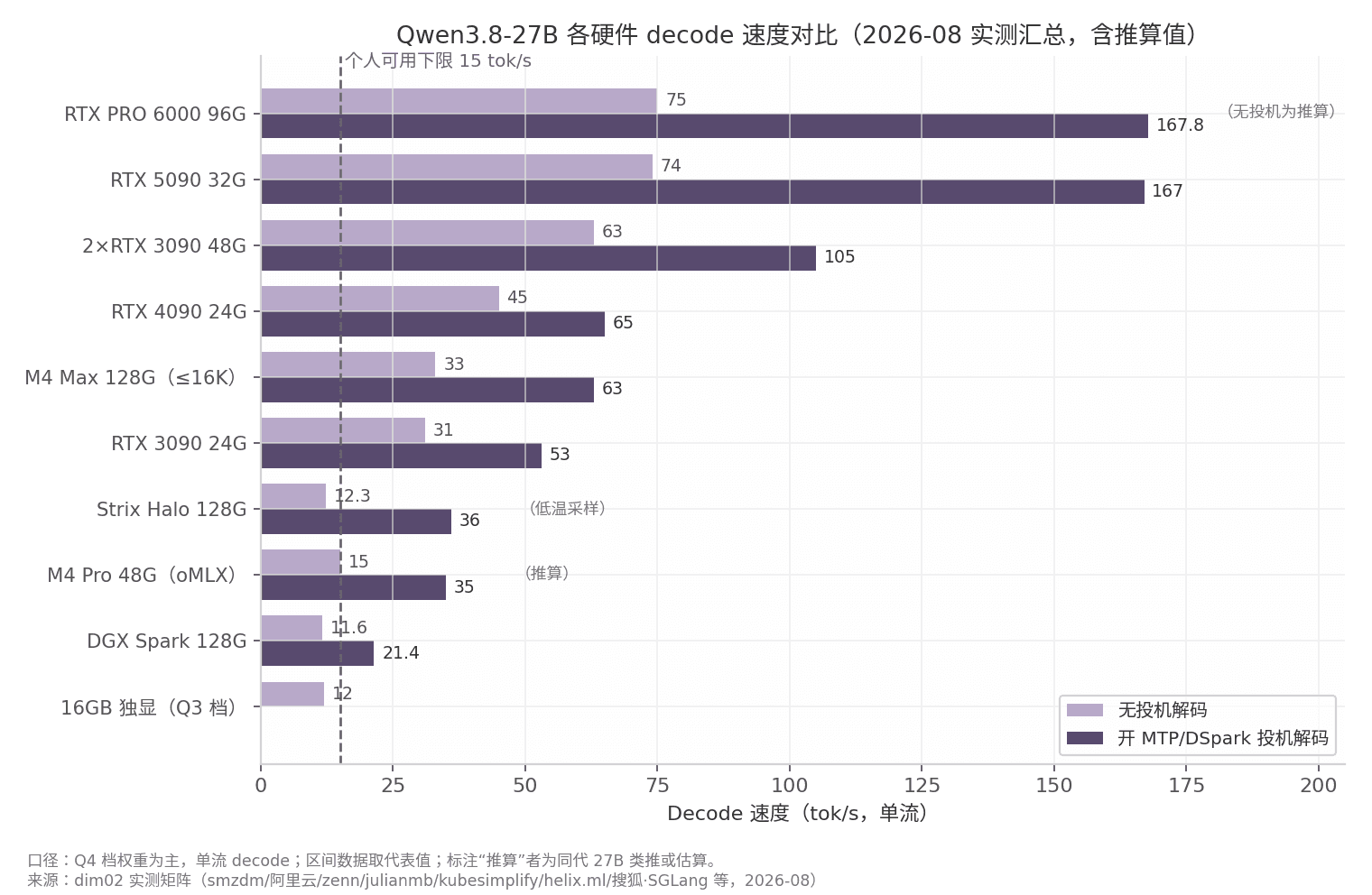
| RTX PRO 6000 96G | NVFP4+DFlash2 | ~75 (est.) / 167.8 median | 262K full-load production | ✅✅ Absolute ceiling[63] |
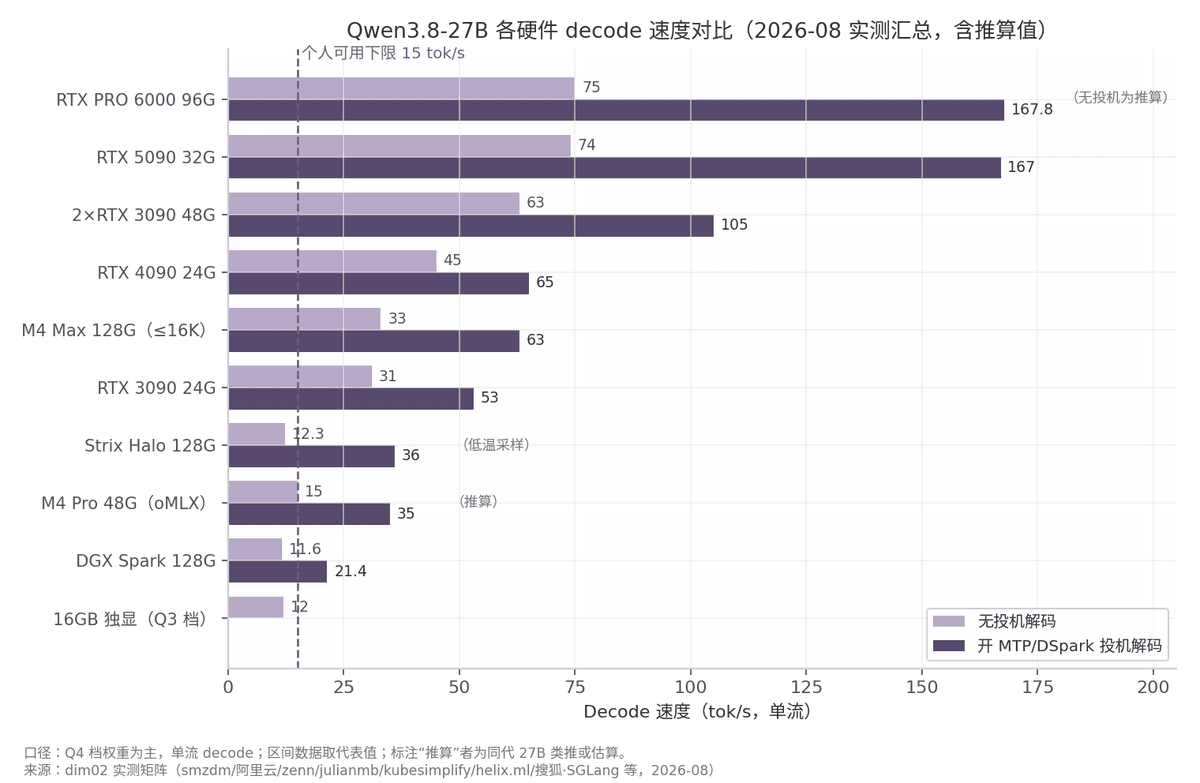
Figure 2-1 Methodology: Q4 weights predominantly, single-stream decode; interval data picks representative values, and entries labeled "est." are extrapolated from same-generation 27B models. Sources: smzdm / Alibaba Cloud Developer / zenn / julianmb / kubesimplify / helix.ml / Sohu citing SGLang team benchmarks (2026-08)[8][9][46][63][55][56].
Together, the chart and table demonstrate two structural findings. First, speculative decoding raises performance far more affordably than hardware upgrades: jumping from an RTX 3090 to an RTX 5090 without speculative decoding improves speed by only ~1.4× (31 → 45–74 tok/s), whereas turning on MTP on the same card delivers a 1.5–2.3× boost—software dividends effectively grant a generational hardware upgrade for free[5]. Second, decode speed scales almost strictly with memory bandwidth: unified memory devices (DGX Spark / Strix Halo at ~273GB/s) cap out at 20–40 tok/s; 24GB GDDR6X cards (~1TB/s) land at 40–65 tok/s; and the RTX 5090 (1.8TB/s) hits 133–206 tok/s. Doubling memory bandwidth roughly doubles measured decode speed, a direct reflection of dense models requiring a complete weight sweep for every single generated token[46][56].
2.2.1 Runnable Tier: 16GB VRAM or 32GB Unified Memory, 10–15 tok/s, Limited to Short Contexts
16GB of VRAM accommodates only Q3/IQ4 weights (~13.4–15GB), leaving less than 2GB for KV cache. Measured decode speeds hover around 10–15 tok/s, supporting only 8–32K contexts[58]. Lower-memory devices show even bleaker numbers: an M4 32GB base model manages only 5–6 tok/s on MLX 4-bit[53]; 12GB cards (like the RTX 3060) running Q4_K_M must offload layers to system RAM, degrading throughput significantly[64]. 32GB unified memory machines fare similarly: an M4 Pro 48G running oMLX Q4 achieves ~15 tok/s, with TTFT climbing to 97–113s at 32K context, rendering long documents impractical[53]; a 16GB M4 mini running a 3-bit quantization logs just 3.7 tok/s, failing completely in hands-on coding Agent tests[53]. This tier is classified as "Trial": suitable for evaluating model behavior and casual chat, but inadequate as a reliable productivity driver.
2.2.2 Usable Tier: 24GB NVIDIA GPU (3090/4090) Q4+MTP Reaches 40–65 tok/s, 32–64K Context Comfortable
24GB NVIDIA cards mark the current price-performance sweet spot. Without speculative decoding, Q4_K_M achieves ~31 tok/s on an RTX 3090 and ~45 tok/s on an RTX 4090 (in line with Qwen3.6-27B's 44 tok/s on the same card[59]); enabling MTP lifts the 3090 to 41–53 tok/s and the 4090 to 55–65 tok/s. Across dozens of community benchmarks, the 24GB tier (3090/7900 XTX/4090D) consistently clocks 40–53 tok/s on Q4 quantization[8][58][5]. For context scaling, combining 17GiB Q4 weights with q4 KV quantization allows a 192K context to run inside 22.6GB VRAM while sustaining 59.5 tok/s (MTP3, first-hand benchmark)[65]; specialized engines like NInfer hit 148.6 tok/s on an RTX 4090 for code generation, proving that optimized engines unlock far higher performance than default frameworks[66]. Head-to-head comparisons cement this tier's standing: on an RTX 4090 24GB under Q4_K_M, Qwen3.8-27B matches the speed and VRAM curves of the prior-generation Qwen3.6-27B (~49 tok/s for both) while delivering superior quality (coding pass@1 of 12/12 vs 8/12). Compared to the similarly sized Gemma 4 31B, it offers better VRAM headroom and coding Agent performance, leading evaluators to crown it "the best default choice for a single 24GB card"[67]. Overall verdict: 32–64K context runs comfortably, 128K is fully usable—this is the clear dividing line between "Usable" and merely "Runnable."
2.2.3 Uncompromised Tier: RTX 5090 Reaches 133–206 tok/s Within 128K; 48GB Tier Unlocks Full 262K
The 32GB RTX 5090 sets the single-card performance ceiling: 60–74 tok/s natively, ~133 tok/s with MTP under standardized testing, and ~167 tok/s in coding workloads; SGLang's Day-0 test logged 206.1 tok/s with NVFP4 + DSpark speculation[9][60]. Within 128K context, users can enjoy both MTP acceleration and long contexts simultaneously. Pushing to the full 262K requires compromises: FP16 KV alone consumes ~15.75GiB, which combined with Q4 weights totals ~32.4GiB—surpassing the 5090's 31.84GiB usable VRAM. KV must be quantized to q8_0; after quantization, the nominal footprint is ~28GiB, but runtime buffer contention disables MTP, resulting in 63.7–66.4 tok/s idle decode dropping to 30.4 tok/s under actual long text, alongside a 4m 27s prefill time for 262K tokens[46]. Users who require uncompromised 262K context with zero speed degradation should step up to the 48GB tier: a modified 48GB RTX 4090 handles full 262K + MTP (68.6 tok/s on short text, extrapolated from Qwen3.6-27B)[68]; a production-tuned 96GB RTX PRO 6000 reaches a median of 167.8 tok/s and 332 tok/s in peak code generation, representing the current benchmark ceiling[63]. Dual-card setups (2×3090/4090) achieve an uncompromised experience but exhibit sharp long-context degradation: 2×4090 on FP8+MTP3 drops to ~26 tok/s at 128K, offering mediocre cost-efficiency[61][62].
2.2.4 Pitfall Checklist: Strix Halo/DGX Spark Subpar for Dense Models; M4 Max Severe Decode Drop-off Past 31K
Four common misconceptions require highlighting: First, Strix Halo (128GB, ~256GB/s bandwidth) running this dense model out-of-the-box achieves only 12.3–14 tok/s, missing the 15 tok/s usability floor; heavy optimization (ROCmFP4 + MTP) can boost it to 30.6–36 tok/s, but gains rely on low-temperature sampling and collapse to non-speculative levels as temperature rises (due to draft rejection spikes, see Section 2.2)[55][57]. Second, DGX Spark's single-stream ceiling is ~23 tok/s (a physical limitation of its 273GB/s bandwidth), with SGLang's Day-0 NVFP4+DSpark test reaching only 38.3 tok/s—buyers are paying for 128GB capacity and concurrency, not raw speed[9][56]. Third, the M4 Max suffers a severe long-context cliff: clocking 63.1 tok/s at short contexts and ~42 tok/s between 4–16K, it plunges to 11.3 tok/s at 31K, leading to the verdict: "safe to use only within 16K"[53]. Fourth, framework versions contain landmines: vLLM 0.27.1 on the 5090 experiences severe decode degradation as context deepens (plunging from 85.2 to 11.3 tok/s at 32K), directly contradicting the near-flat scaling observed in llama.cpp; local deployments currently favor llama.cpp or SGLang[46][54].
All three tiers above assume a "27B dense model where all weights participate in every token's computation." If we lift this architectural constraint, the Mixture-of-Experts (MoE) approach activates only a fraction of parameters per token, delivering multiples of the speed at the same memory bandwidth—the subject of our next chapter on DeepSeek-V4-Flash.
3. DeepSeek-V4-Flash: Usability Hardware Thresholds for Individuals
Chapter 2 established that the threshold for a 27B dense model is dominated by VRAM capacity. This chapter tackles a model with 10× the parameter count. Key finding up front: The bottleneck structure for DeepSeek-V4-Flash (284B total MoE, 13B activated) has shifted from pure VRAM to "Total Memory Capacity + Memory Bandwidth", allowing a 128GB unified memory device to achieve usable speeds of 20–35 tok/s. A 284B MoE is paradoxically more suitable for home deployment than a 70B dense model—a victory of architecture over sheer budget. Crucial caveat: this conclusion holds only for quantized/compressed weights; native precision weights require ~155GB, which cannot fit into any 128GB single-node machine[3][11].
3.1 Architectural Dividends: Why a 284B Model Can Run at Home
3.1.1 Activating Only 13B Per Token: Decode Bandwidth Demand Depends Solely on Active Parameters
V4-Flash features a 43-layer MoE architecture containing 256 routed experts. For each token, it routes to and activates only 6 of them, alongside 1 shared expert, totaling ~13B active parameters[3][30]. The 0731 official release checkpoint includes the built-in DSpark draft module, bringing HF metadata to 304.18B—a difference in reporting scope rather than an architectural contradiction[3]. During token-by-token generation (decode), only the activated weights need to be retrieved from memory. Based on 13B active parameters: under Q4/FP4 precision (~0.55 bytes/param), each token reads ~7–8GB; under 2-bit precision (~0.30 bytes/param), it reads ~4GB[14]. This means maximum decode speed memory bandwidth activated weight bytes per token. Compared to the 27B dense model in Chapter 2, which reads all ~16GB per token, 13B active parameters bring frontier-grade model speeds within reach of consumer-tier memory bandwidth (256–1200GB/s) for the very first time. Direct comparative experiments prove this: on the same 256GB/s Strix Halo, a 70B dense model crawls at 4.7–5.05 tok/s (reaching 94% of its theoretical limit with zero headroom)[69], whereas Llama 4 Scout (109B total, 17B active) hits 20.23 tok/s[70]—a larger model running 4× faster entirely due to fewer active parameters. MoE has thus become the architectural antidote to consumer bandwidth limits: selecting the architecture before buying hardware is far more decisive than merely increasing your budget.
Two accompanying realities must be clarified: First, "13B activated does not mean 13B VRAM": the entire 284B expert weight set must permanently reside in memory, so capacity requirements are governed by total parameters[11][31]. Second, DeepSeek embeds the DSpark draft module directly into the checkpoint, officially claiming an additional 60–85% single-user speedup and a +51% total throughput gain on top of the accelerated MTP-1 baseline (official claims, lacking third-party replication)[37]; independent llama.cpp tests show DSpark delivering a 1.84–1.91× speedup[71]. Speculative decoding has evolved from a user-applied hack into a factory standard, effectively discounting baseline bandwidth requirements by another 40–50%.
3.1.2 CSA+HCA Hybrid Attention: 1M Context KV Cache at Just ~2–10GB
V4-Flash's attention stack stacks three layers of compression: an MLA-style single KV head (64 attention heads share 1 KV head), Compressed Sparse Attention (CSA, compressing consecutive tokens 4×, with an indexer selecting the Top-512 KV entries), and High Compression Attention (HCA, offering a 128× compression ratio), reinforced by a 128-token sliding window branch to preserve local precision[72]. DeepSeek officially states that at 1M context, V4-Flash's KV cache is only 7% of the previous V3.2 generation[41]. Measured empirical data confirms ~6.9KB per token, translating to ~6.9GiB for 1M tokens[73], which drops further to ~2–3GB if NVFP4 KV quantization is applied[41]. For comparison: V3.2's traditional MLA required ~83.9GB for 1M context, while earlier GQA dense 70B models required hundreds of gigabytes[74][7]. Breaking down the savings: the single KV head delivers one order of magnitude, CSA (4×) and HCA (128×) sequence compression contribute another two orders of magnitude, and mixed-precision KV storage (BF16 for RoPE dimensions, FP8 for non-RoPE) shaves off nearly half of what remains[7][41]. The KV cache has been demoted from "the primary long-context bottleneck" to single-digit gigabyte pocket change, returning the 1M-context bottleneck squarely to the weight volume itself—precisely what CSA/HCA was designed to achieve.
3.1.3 Quantization Paths: Native 155GB vs Quantized Sweet Spot 91–104GB Form Two Distinct Tiers
Official V4-Flash weights are themselves the product of Quantization-Aware Training (QAT): routed experts (accounting for ~96% of parameters) are natively stored in MXFP4, with the remainder in FP8/BF16, yielding a disk footprint of 155.4 GiB[11][31]. This provides a unique advantage: Unsloth can perform bit-for-bit lossless repacking of MXFP4 experts, creating the first GGUF builds with zero quantization error[11]. Loading native mixed precision requires ≥192GB of accelerator memory[4][75], whereas dynamic quantization compresses the threshold to fit 128GB machines:
Table 3-1 Major Quantization Paths for DeepSeek-V4-Flash: Size, Quality, and Operating Memory Requirements
| Quantization Scheme | Weight Size | Quality (KLD, lower is better) | Recommended Total Memory | Positioning |
|---|---|---|---|---|
| Official MXFP4+FP8 Native | ~155.4 GiB | Baseline (0) | ≥192GB | Uncompromised baseline, 2×H100 / 4×96GB tier |
| Unsloth UD-Q8_K_XL | 162GB | ≈0 (bit-for-bit lossless) | 169GB (+DSpark 179GB) | Only fully lossless GGUF |
| Unsloth UD-Q4_K_XL | ~155GB | 0.0094 (near-lossless) | 162GB | Near-lossless |
| Unsloth UD-IQ3_XXS | 104.2GB | 0.2403 | 110–135GB | Officially recommended sweet spot |
| Unsloth UD-Q2_K_XL | 96.8GB | 0.2992 | 102GB+ | Sweet spot for 128GB devices |
| Unsloth UD-IQ2_M | 90.9GB | 0.3612 | 102GB (+DSpark) | Primary choice for 128GB devices |
| Unsloth UD-IQ1_S | 82.5GB | 0.4962 | 92GB | Extreme minimum, noticeable quality risk |
| antirez ds4 IQ2 (asymmetric) | 80.8 GiB | No official KLD | ~96GB | ~98% resident in 3090-class VRAM |
Data sources: Unsloth official documentation and GGUF repository[11][71], ds4 repository[14]; KLD is measured relative to lossless UD-Q8_K_XL. The DSpark draft module (Q8_0) requires an additional ~10.9GB of weights and ~10GB of operating headroom[11].
The table reveals a critical structural profile: "a steep size cliff alongside a gentle quality slope." Compressing from the 162GB lossless tier down to the 91–104GB sweet spot reduces weight size by ~40%, while KLD increases only from 0 to 0.24–0.36. For a highly redundant 284B MoE model, the quality loss from 2–3 bit dynamic quantization is far lower than on dense models of equivalent bit-width; community benchmarks show that under a 2-bit recipe, MMLU still achieves 79.5 with a 70/70 score on 130K needle-in-a-haystack retrieval[76]. Pushing down to 1-bit (82.5GB), however, drives KLD to 0.4962, introducing noticeable degradation suitable only for extreme experimentation[11]. The sweet spot is made possible by asymmetric quantization: routed experts comprise the bulk of parameters but serve only a few tokens per forward pass, making them resilient to aggressive quantization; conversely, attention, shared experts, and routers degrade rapidly under aggressive quantization. Mainstream recipes compress experts to 2–3 bit while preserving critical tensors at Q8[14][11]. Beware of fabricated benchmarks: content farms have claimed "284B Q4_K_M takes only 7.5GB and runs at 65 tok/s on an 8GB card"—physically impossible claims[31]. Users should stick to verified distributions like Unsloth or ds4 that publish per-tensor validation logs.
3.2 Hardware Benchmarks and the Three Usability Tiers for Individuals
Adopting the three-tier "Runnable / Usable / Uncompromised" framework from Chapter 2, thresholds are calibrated to empirical 284B-class MoE distributions (not mechanically copied from the 27B dense thresholds of ≥15 tok/s and ≥32K context): Runnable = decode ≥10 tok/s with context ≥22K; Usable = decode ≥20 tok/s with comfortable 128K context; Uncompromised = 512K–1M context usable (accepting multi-minute prefill times).
3.2.1 Runnable Tier: 128GB Unified Memory, Quantized Version at 20–35 tok/s
128GB of unified memory is the absolute baseline for bringing 284B models into the home, with real-world anchors across three platforms: a MacBook Pro M3 Max 128GB running the ds4 engine (2-bit, 32K context) generates 26.68 tok/s[77], while aggregate benchmarks show the M5 Max 128GB reaching ~34 tok/s[78]; an AMD Strix Halo 128GB (Ryzen AI MAX+ 395, 256GB/s) peaks at 32 tok/s using a proprietary ROCm stack + DSpark (~15.6–19 tok/s on generic Vulkan), with multiple Framework community members independently reporting 20–30 tok/s across 100K–500K contexts[12][79]; a single NVIDIA DGX Spark achieves 26.7 tok/s on short contexts, dropping to 12–15 tok/s at 131K context[80][81]. Hybrid GPU + host memory setups also fit here: an RTX 5090 32GB + 192GB DDR5 host system achieves sustained 22–25 tok/s decode via FreeToken hybrid execution (arXiv paper, independently replicated)[82]; a secondhand server with dual RTX 3090s reaches ~33 tok/s, though context is capped at 22K[83]. The context sweet spot for this tier is 64–128K: 64K is rock-solid, 128K requires validation, 256K is experimental, and 1M offers zero operational headroom[76]. A theoretical lower bound has also been demonstrated: a 64GB Strix Halo streaming 81GB of 2-bit weights via mmap + NVMe decodes at ~1.9 tok/s[14]—proving that memory deficits can be offset by storage, though speeds drop below practical usability. Note that the 20–35 tok/s ceiling depends on DSpark or custom engines: under standard llama.cpp/Vulkan stacks, Strix Halo and Spark land at 12–19 tok/s, in a "usable but sluggish" gray zone[12][80].
3.2.2 Usable Tier: M5 Ultra 256GB or 96GB-Class GPUs
The capacity floor for the Usable Tier is 256GB, driven by strict mathematics: native or near-lossless weights consume ~155–162GB; adding 128K–256K context KV cache (~1–3GB under CSA/HCA), framework runtime overhead (20–40GB), and DSpark draft buffers (~21GB) leaves zero comfortable headroom on 128GB or 192GB hardware[11][76][75]. Above this threshold, the tier splits into two distinct paths. Unified Memory Path: The Mac Studio M5 Ultra (256GB / 1.2TB/s bandwidth) released on 2026-08-25 is calculated to deliver 55–75 tok/s based on bandwidth (Extrapolated value: scaled from M3 Ultra 819GB/s benchmarks running 22B-activated Qwen3-235B at 24–30 tok/s, mapped to 13B active parameters at 1.2TB/s; no third-party tests existed as of 2026-08-29, with shipments starting September 22)[21][84]; a budget alternative is a secondhand M3 Ultra 512GB, benchmarked at 27–37 tok/s[77][78][85]. GPU Path: A single RTX PRO 6000 96GB spans 43.6 tok/s (custom CUDA backend) to 161 tok/s (vLLM-Moet experimental 2-bit build)[86][87]; 4× RTX 4090s (96GB total VRAM, SM89 patch + vLLM) deliver ~82 tok/s natively, surging to 367 tok/s on 8K inputs with DSpark (219 tok/s at 128K), fully executing 768K contexts[13]—the fastest personal setup tested, at the expense of multi-GPU power draw and setup complexity.
3.2.3 Uncompromised Tier for 1M Context: Dual DGX Spark, Dual H100, and 512GB Mac
The only consumer-accessible setup benchmarked running a full 1M context is Dual DGX Spark (TP2, 200Gbps QSFP direct connect): 41 tok/s at 1M context (41.8 cold / 41.1 warm), with a TTFT of ~334s on 512K input[80]; an independent repository utilizing NVFP4 KV logged 55–82 tok/s single-stream at 1M context, though it lacked full 1M retrieval accuracy validation (the discrepancy stems from comparing max configured context against short-prompt speeds)[88][81]. Data center reference points: 2× H100 80GB under official vLLM decodes at 66.9 tok/s with 1M context initialized[89]; 8× A800 hits 40.6 tok/s single-stream[90]. The 512GB Mac represents a unique profile of "uncompromised capacity with runnable speeds": an M3 Ultra 512GB decodes at 27.39 tok/s[77], though 512GB/256GB configurations were discontinued between March and May 2026, leaving only secondhand and refurbished channels[91].
Table 3-2 DeepSeek-V4-Flash "Personal Usability" Three-Tier Thresholds: Configuration, Speed, and Context Comparison
| Tier | Representative Config | Quantization / Engine | Measured Decode | Comfortable Context | Evidence Type |
|---|---|---|---|---|---|
| Runnable | 128GB Unified Memory (M3/M5 Max Mac, Strix Halo, DGX Spark); or RTX 5090 + 192GB DDR5; Extreme: Dual 3090 + 768GB DDR4 | IQ2_M ~91GB / Q2_K_XL / FreeToken Hybrid | 20–35 tok/s (Mac 26.7–34; Strix Halo 15.6–32; Spark 12–27; Hybrid 22–33) | 64–128K (Spark decays to 12–15 tok/s at long context) | Multi-source benchmarks[77][12][82][80] |
| Usable | Mac Studio M5 Ultra 256GB; or 1–2× RTX PRO 6000 96GB; or 4× RTX 4090 96GB | 4-bit / MXFP4 + MTP/DSpark | M5 Ultra est. 55–75; PRO 6000 43.6–161; 4×4090 82–367 | 128–256K comfortable, 768K executable | M5 Ultra is extrapolated[21], others are measured[13][86] |
| Uncompromised | Dual DGX Spark TP2; 2× H100 80GB; 512GB Mac (Secondhand) | FP8 / NVFP4 + DSpark | Dual Spark 41 @1M; 2×H100 66.9; M3 Ultra 512GB 27.4 | 512K–1M (512K TTFT ~5.6 min) | Measured[80][89][77] |
The progression between tiers is worth detailing: stepping from Runnable to Usable elevates bandwidth from 256–614GB/s to 1.2TB/s or introduces GDDR6X/7 bandwidth, lifting decode from 20–35 to 43–367 tok/s. Stepping from Usable to Uncompromised is no longer about speed, but Total Memory Capacity—a 1M context requires native weights (~155GB) plus KV cache and runtime overhead, making 256GB the practical floor[76]. Two anomalies stand out: First, the 4×4090 setup's 367 tok/s vastly outpaces other configurations in its tier because DSpark speculative gains peak on short inputs (8K tokens), decaying to 219 tok/s at 128K[13]. Second, Dual Spark's 41 tok/s at 1M context vs 82.4 tok/s on short prompts demonstrates that long-context decode degrades significantly due to KV retrieval and interconnect overhead[80][81]. For individuals, the realistic "uncompromised sweet spot" is 256K–512K; the value of 1M context lies in "being runnable" rather than high throughput—full-context prefill on consumer hardware takes minutes (Dual Spark 512K input TTFT is ~5.6 minutes), which is intolerable for interactive use and best reserved for offline batch analysis of massive documents[80].
3.2.4 Bandwidth Estimation Formula: 20/40/60 tok/s Requires ~150/300/450 GB/s
Translating the mechanics from Section 3.1.1 into a computational formula (calculated for Q4/FP4 precision without speculative decoding):
Where is memory bandwidth, is active parameter count, bytes/param, and is the speculative decoding speedup factor[14][71]. Substituting values: achieving 20/40/60 tok/s requires ~150/300/450 GB/s respectively (Q4 tier, without DSpark); using 2-bit weights or enabling DSpark discounts these bandwidth requirements by 40–50% each. The power of this formula lies in its falsifiability—it defines the theoretical ceiling, with any shortfall representing engine overhead. Five independent benchmark sets align closely with these estimates: Strix Halo at 256GB/s → measured 15.6–32 tok/s[12]; DGX Spark at 273GB/s → 12–27 tok/s[80][81]; M3 Ultra at 819GB/s → 27–37 tok/s (engine overhead consumes ~1/3 of theoretical throughput)[77][85]; RTX 5090 + DDR5 hybrid setup bottlenecks on host memory at 80–90GB/s, achieving 22–25 tok/s when amplified by expert caching[82]; RTX PRO 6000 (GDDR7 1792GB/s fully loaded) → 43–161 tok/s[86][87]. Across an order of magnitude from 256GB/s to 1792GB/s, the formula's direction and scale hold true. The largest discrepancy appears on the M3 Ultra (theoretical ~110 tok/s vs measured 27–37), primarily caused by MLX/llama.cpp scheduling and dequantization overhead rather than raw bandwidth—indicating ~3× software optimization headroom on existing hardware, making the M5 Ultra projections conservative[85][21].
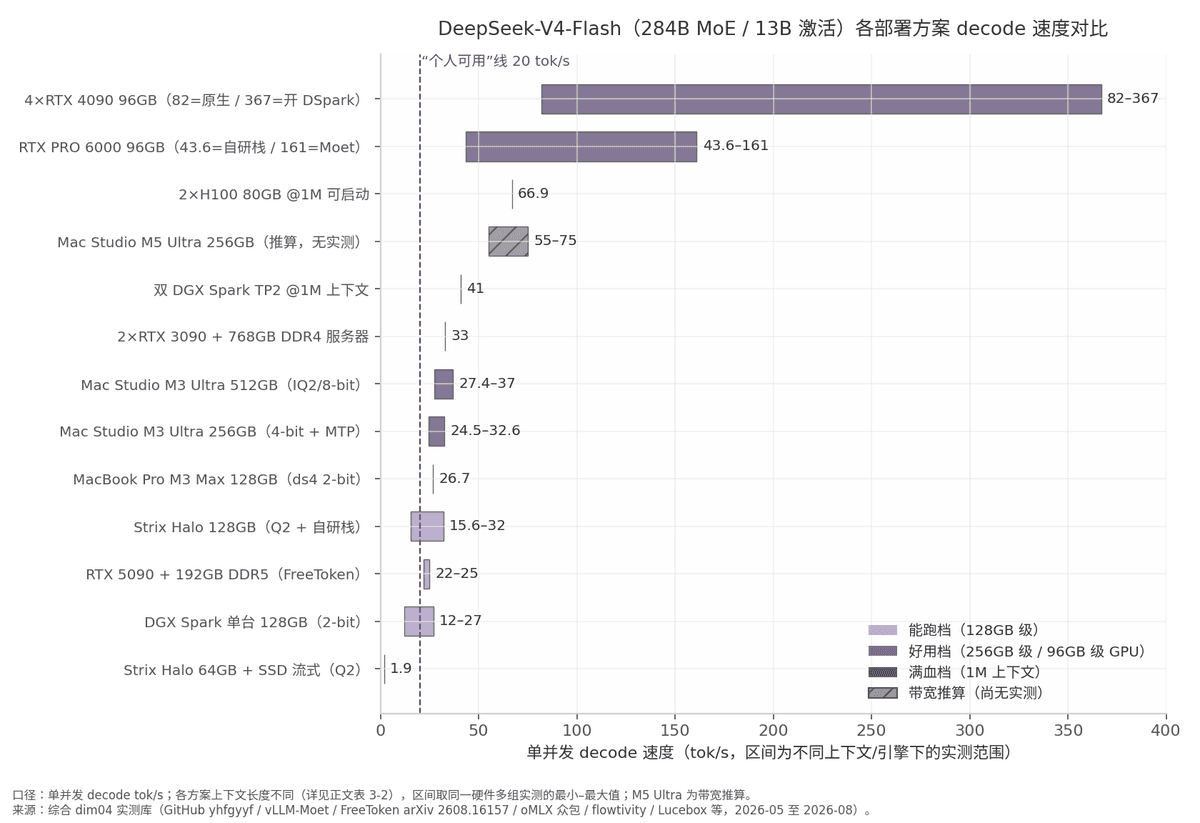
Figure 3-1 Single-concurrency decode speeds across deployment setups. Scope: Aggregated community benchmarks from 2026-05 to 2026-08; bars show min-max ranges across engines/contexts on identical hardware; M5 Ultra is bandwidth-extrapolated (hatched); dashed line marks the 20 tok/s "personal usability" threshold. Sources: GitHub yhfgyyf/vLLM-Moet, FreeToken (arXiv 2608.16157), oMLX crowdsourcing, flowtivity, Lucebox, ds4, etc.[77][12][82][80][13][86]
The bandwidth formula delivers the final verdict for this chapter: hardware thresholds for V4-Flash boil down to a simple math problem of bandwidth × capacity, rather than GPU compute TOPS. This is the structural reason why 128GB unified memory machines beat single flagship GPUs, mirroring the inverse of Chapter 2's dense route where VRAM capacity dictated everything. The budgets for these three tiers (~¥14,000–34,000 for Runnable, ¥45,000–150,000 for Usable and Uncompromised) will be translated into TCO and payback timelines in Chapter 4.
4. Cost Estimation and Payback Period
This chapter translates the hardware thresholds from Chapters 2 and 3 into August 2026 system budgets and builds a payback model against cloud APIs and subscriptions. Core finding up front: Amid the memory/VRAM super-inflation cycle, upfront hardware investments have surged ~30–135% over 2025 levels, while cloud inference prices continue to fall. Whether local deployment is cost-effective depends entirely on your reference frame—compared to DeepSeek's direct official API, local hardware at any tier will never break even under individual workloads; compared to flagship APIs or high-tier subscriptions, heavy users can compress payback to 8–15 months. All prices reflect 2026-08 market conditions, reported primarily in Chinese Yuan (CNY) with US Dollar (USD) annotations (at 1 USD ≈ 7.1 CNY).
4.1 Tiered Hardware Budgets (2026-08 Market Conditions)
4.1.1 Four-Tier Full-System Budgets
Continuing the tier naming from Chapters 2 and 3: Tier A (27B Comfortable, ≈24–32GB NVIDIA GPU system), Tier B (27B Uncompromised Long Context, ≈48GB VRAM or 128GB Unified Memory), Tier C (284B-MoE Runnable, ≈128GB Unified Memory Mini PC), Tier D (284B-MoE Usable, ≈192GB+ Unified Memory or Multi-GPU). Against the August 2026 backdrop of DRAM/GDDR7 contract prices up +92% YoY and consumer DDR5 up ~300% over 2025, all budgets reflect high-water marks within the inflation cycle[44][26].
Table 4-1 Four-Tier (A/B/C/D) Full-System Budget Table (2026-08, CNY)
| Tier | Representative Config | VRAM/RAM | Core Component Price | Total System Price | Approx. USD | Capability Match |
|---|---|---|---|---|---|---|
| A | RTX 4090 24GB Single-GPU System | 24GB | Card ¥15,000–17,000 (New inventory; secondhand inverted to 19,000–21,000)[92] + Base system ¥6,000–9,000 | ¥21,000–26,000 | $3,000–3,700 | 27B Q4+MTP @ 40–65 tok/s |
| A | RTX 5090 32GB Single-GPU System | 32GB | Card ¥27,500–36,400 (Blower models from ¥34,999 on JD.com)[93][94] | ¥30,000–45,000 | $4,200–6,300 | 27B FP8, 133–206 tok/s within 128K |
| B | RTX 4090 48GB Modded GPU System | 48GB | Card ¥19,999–23,999 (JD.com official/flash deals)[95][96] | ¥28,000–38,000 | $3,900–5,400 | 27B FP8 unconstrained + 262K context |
| B | Mac Studio M4 Max 128GB | 128GB UMA | Delisted from Apple Store; 3rd party 128GB/4TB listed at ¥35,670 (OOS, 8–12 wk lead time)[97][98] | ¥30,000–36,000 | $4,200–5,100 | 27B @ ~22–28 tok/s, silent & low power |
| C | Strix Halo 128GB Mini PC (Minisforum, GMKtec, etc.) | 128GB UMA | System ¥13,999–15,999 (Domestic presale/crowdfunding)[99]; Overseas same spec up to | ¥14,000–16,000 | 2,000–2,300 | 284B Quantized @ 20–35 tok/s |
| C | NVIDIA DGX Spark (128GB/4TB) | 128GB UMA | China ¥33,800–34,899; US $4,699 (+18% in 2026-02)[100] | ¥33,800–35,000 | $4,800–4,900 | 284B Quantized + full CUDA stack |
| D | Mac Studio M3 Ultra 192GB | 192GB UMA | US $5,499–6,999; China custom order est. ¥45,000–55,000 (256GB delisted)[97][101] | ¥45,000–55,000 | $6,300–7,700 | 284B single-user long context |
| D | Dual RTX 4090 48GB (96GB Pool) | 96GB | Cards 2×¥24,000 + 1600W dual-socket platform ≈¥12,000 | ¥55,000–65,000 | $7,700–9,200 | 284B Q4, 70B FP8 |
| D | 4×RTX 4090 48GB Rack Server (192GB) | 192GB | Taobao full-system fixed price | ¥150,499[102] | ≈$21,200 | 284B Q4 unconstrained, 235B native |
Note: A secondhand route (Dual RTX 3090 48GB pool system at ¥10,000–14,000) reduces Tier A costs by 30–50%, but circulating cards are mostly out-of-warranty high-mileage mining cards with user-assumed risk[103].
Analysis & Key Observations: First, Tier A exhibits an unusual price inversion: since July 2026, secondhand RTX 4090 prices (¥19,000–21,000) have surpassed remaining new stock (¥15,000–17,000); buying new essentially secures a 3-year warranty and zero mining risk[92]. Meanwhile, domestic RTX 5090 street prices stand at 1.8–2.3× initial MSRP, with US street prices at a 135% premium over the $1,999 MSRP[93][10], pushing the Tier A ceiling to ¥45,000. Second, Tier C is the only category exhibiting a cross-border price inversion: domestic Chinese pricing for 128GB Strix Halo systems remains at ¥14,000–16,000, while identical overseas configurations climbed to $3,449–3,649 (≈¥24,000–26,000) due to DRAM contract pricing. Domestic presale pricing has not fully factored in memory hikes and carries imminent upward adjustment risk[99][103]. Third, Tier B and Tier C overlap heavily in price (~¥30,000) while offering entirely different capabilities—Tier B purchases bandwidth and context headroom for 27B models, whereas Tier C purchases access to the 284B model class. This overlap illustrates why choosing the model architecture must precede setting the budget.
4.1.2 Total Cost of Ownership: Electricity, Residual Value, and Hidden Costs
Beyond upfront hardware costs, electricity and depreciation over a 3-year holding period dictate real net TCO. Power baselines reflect wall-power draw under continuous inference: RTX 4090 system ~550W, RTX 5090 system ~700W (custom boards measure 620W load, 717.6W peak)[104], modded 4090 48GB system ~600W[96], M4 Max continuous load ~120W, M3 Ultra ~260–300W[101], Strix Halo inference typical ~130W (cTDP 45–120W)[105], DGX Spark measured ~100–181W[100]. Electricity rates are modeled at residential (¥0.55/kWh) and commercial (¥0.90/kWh)[106].
Table 4-2 Annual Operating Cost and 3-Year Net TCO Estimates (2026-08, CNY)
| Tier & Representative Config | Typical Power | Annual Power @4h/day (Res.) | Annual Power @8h/day (Res.) | Annual Power @24h/day (Res. / Comm.) | 3-Year Residual Rate (Empirical) | 3-Year Net TCO (Estimated) |
|---|---|---|---|---|---|---|
| A - RTX 4090 System | 550W | ¥442 | ¥883 | ¥2,650 / ¥4,336 | 40–60%[107][108] | ≈¥14,400 (Price ¥23,500, 50% residual, 8h/day) |
| A - RTX 5090 System | 700W | ¥562 | ¥1,124 | ¥3,373 / ¥5,519 | 40–60% | ≈¥22,100 (Price ¥37,500, 50% residual) |
| B - 4090 48GB Modded | 600W | ¥482 | ¥964 | ¥2,891 / ¥4,730 | 40–50% (No warranty discount) | ≈¥21,000 (Price ¥33,000, 45% residual) |
| B - M4 Max 128GB | 120W | ¥96 | ¥193 | ¥578 / ¥946 | 50–60% (C2C secondary market)[107] | ≈¥17,100 (Price ¥33,000, 50% residual) |
| C - Strix Halo 128GB | 130W | ¥104 | ¥209 | ¥626 / ¥1,025 | 30–40% (Soldered RAM, fast iterations) | ≈¥10,400 (Price ¥15,000, 35% residual) |
| C - DGX Spark | 180W | ¥145 | ¥289 | ¥867 / ¥1,419 | 30–40% | ≈¥23,000 (Price ¥34,000, 35% residual) |
| D - M3 Ultra 192GB | 300W | ¥241 | ¥482 | ¥1,445 / ¥2,365 | 35–55%[107] | ≈¥28,900 (Price ¥50,000, 45% residual) |
| D - Dual 4090 48GB | 1,100W | ¥883 | ¥1,767 | ¥5,300 / ¥8,672 | 40–50% | ≈¥38,300 (Price ¥60,000, 45% residual) |
| D - 4×4090 48GB | 2,300W | ¥1,847 | ¥3,694 | ¥11,081 / ¥18,133 | 40–50% | ≈¥94,000 (Price ¥150,000, 45% residual) |
Note: Net TCO = Total System Price × (1 − Residual Rate) + 3-Year Electricity (8h/day residential rate baseline), calculated per table parameters; excludes summer AC cooling overhead (adding ~¥500–1,500/year for 24h high-power tiers) and maintenance labor.
Analysis & Key Observations: The power cost gap between unified memory platforms and multi-GPU discrete setups spans 5–10×: an M4 Max running 8 hours/day costs just ¥193/year in electricity, whereas a dual 4090 48GB system consumes ¥1,767/year. In a 24/7 commercial scenario, a 4-GPU server exceeds ¥18,000/year in electricity (~12% of total hardware cost). For 24/7 Agent workloads, power draw directly swings hardware selection—the annual power bill of a Tier C unified memory system (¥626–1,025) is lower than a single month of certain cloud subscriptions. On the residual value side, an anomalous signal emerges: the AI boom has caused large-VRAM cards to appreciate with use. 3.5 years after launch, new RTX 4090 cards (MSRP ¥12,999) trade above ¥15,000, and secondhand units command ¥19,000–21,000, achieving zero real 3-year depreciation[92]. This stands in stark contrast to the standard ~40% first-year depreciation for gaming GPUs[108] or datacenter TCO models where 3-year residual value sits around 30% (e.g., an 8×H100 node bought for 75k)[109]. Mac residual values remain equally robust: 22–28% in enterprise trade-ins, and 50–60% in C2C markets[107]. Overall, 3-year residual assumptions of 40–60% for 4090/5090 class, 30–40% for Strix Halo mini PCs, and 35–55% for Mac Studios serve as prudent baseline estimates.
Hidden costs cluster across four areas: ① Power Delivery & Circuitry—The RTX 5090 requires a 1000–1200W ATX 3.1 PSU (with 12V-2×6 connector melt risks still prevalent); dual/quad GPU rigs need 1600W/3000W feeds. A standard 16A home circuit caps out at ~3.5kW, meaning a 4×4090 rig running full load approaches residential branch limits. ② Acoustics—Blower-style 4090 48GB cards generate 65 dB at 5000 RPM under load (vs 30–40 dB comfort zones), effectively demanding a dedicated server closet; custom water-cooling loops add ¥500–3,000[94]. ③ UPS & Racks—A standby 1500VA UPS costs ¥200–680, while a 4-GPU server requires a 3kVA+ online UPS (from ¥1,600) and a 4U rack enclosure (¥1,000–5,000)[110]. ④ Warranty Risk—Modded 48GB cards lack manufacturer warranties and have a ~2% failure rate; budgeting for a multi-thousand Yuan repair is prudent[94]. Together, these ancillary items add 3–8% to total system budgets, exceeding 10% on high-end Tier D builds.
4.2 Cloud Comparison and Payback Model
4.2.1 Price Spectrum: Reference Systems Across Three Orders of Magnitude
The economic viability of local deployment depends entirely on the counterfactual: "If I don't buy hardware, who gets the money?" Verified prices in August 2026 span three orders of magnitude:
Table 4-3 Cloud Reference System Price Spectrum (Verified 2026-08)
| Level | Reference Target | Price (Per Million Tokens: Input / Output) | Notes |
|---|---|---|---|
| Floor Price | DeepSeek V4-Flash Official API | $0.14 / $0.28 (Cached input is just $0.0028, -98%)[15] | In CNY: Peak ¥3/¥9, Off-peak halved; Time-of-use pricing since 2026-08, weekends full-day off-peak[16] |
| Mid Tier | Alibaba Cloud Model Studio Qwen3.8-27B | ¥3 / ¥12 (Cached input ¥0.6)[17] | Direct 1:1 cloud comparison for local Tier A/B setups |
| Flagship | Qwen3.8-Max | ¥12 / ¥36 (≈$2/$6 international list)[111] | Closed-source flagship, 2.4T params, API-only |
| Flagship (Hosted) | V4-Pro @ Fireworks / Together | $1.74–2.10 / $3.48–4.40[112][113] | 4× higher than official direct API ($0.435/$0.87) |
| Subscription | Claude Max 5x / 20x | $100 / $200 per month (≈¥710 / ¥1,420)[18] | SemiAnalysis: 20x tier consumes up to ~$8,000 in equivalent API value monthly[114] |
| Subscription (Entry) | Copilot Pro / Cursor Pro / Claude Pro | $10 / $20 / $20 per month[18][115][116] | Quota-capped; heavy coding hits rate limits quickly |
Analysis & Key Observations: The primary characteristic of this spectrum is that "price spreads for the same model exceed price spreads across different models": official direct pricing for V4-Flash has driven pay-as-you-go API costs below flat subscription rates (a heavy user burning 300M tokens/month pays just ~¥113), while third-party hosted platforms charge up to 4× more for the identical model[112][113]. Subscriptions function essentially as "put options"—Anthropic reports that heavy Claude Code users consume 200 Max tier; one developer burned 10 billion tokens over 8 months (worth 800 in subscriptions[114][117]. Consequently, basing payback models on API list prices instead of actual out-of-pocket subscription costs severely distorts the conclusion. Furthermore, API prices experienced an upward trend across 2026 (Zhipu up +83% cumulatively, DeepSeek introducing peak/off-peak rates)[118], meaning reference spectra should be updated quarterly.
4.2.2 Usage Profiles
The input to the payback model is monthly token consumption. Real-world consumption data from 98 coding Agent users tracked by Vibe Usage between April and July 2026 shows: OpenCode users averaged 127M tokens/month, Claude Code users averaged 160M tokens/month, and OpenClaw users averaged 186M tokens/month. Prompt cache hit rates reached 91% on Claude Code (67% on OpenCode)[119]. We define three user profiles: Light (5M tokens/month) (casual Q&A and occasional assistance), Moderate Coding (30M–100M tokens/month) (heavy daily use of coding assistants), and Heavy Agent (300M+ tokens/month) (parallel multi-agent setups, repository-wide refactoring, automated CI/CD pipelines—roughly 2× the empirical average, representing power users). Billing estimates assume an input:output ratio of 10:1 and an 80% prompt cache hit rate for coding; for general workloads modeled at 5:1, bills increase by ~40–90%.
4.2.3 Payback Month Matrix and the "Payback Paradox"
The payback formula is defined as:
Three representative hardware price points are evaluated: ¥20,000 tier (Tier A RTX 4090 24GB system running 27B Q4 at 40–65 tok/s, monthly power ~¥70)[120], ¥50,000 tier (Tier D Dual-GPU 96GB setup, monthly power ~¥150), and ¥100,000 tier (Tier D High-End 192GB setup, monthly power ~¥200). Monthly equivalent cloud spend is calculated per Section 4.2.2.
Table 4-4 Usage × Tier × Reference System Payback Matrix (Unit: Months; "—" = Monthly Spend ≤ Electricity, Never Breaks Even)
| Monthly Usage | Reference Price Point (Monthly Spend) | ¥20k Tier (A) | ¥50k Tier (D Dual-GPU) | ¥100k Tier (D High-End) |
|---|---|---|---|---|
| 5M | V4-Flash Official (¥2) | — | — | — |
| 5M | Qwen3.8-27B Model Studio (¥10) | — | — | — |
| 5M | Qwen3.8-Max (¥43) | — | — | — |
| 30M | V4-Flash Official (¥11) | — | — | — |
| 30M | Qwen3.8-27B Model Studio (¥62) | — | — | — |
| 30M | Qwen3.8-Max (¥256) | 108 | 472 | 1,786 |
| 100M | V4-Flash Official (¥38) | — | — | — |
| 100M | Qwen3.8-27B Model Studio (¥207) | 146 | 877 | ≈14,286 |
| 100M | V4-Pro Hosted (¥524) | 44 | 134 | 309 |
| 100M | Qwen3.8-Max (¥852) | 26 | 71 | 153 |
| 300M | V4-Flash Official (¥113) | 465 | — | — |
| 300M | V4-Pro Official (¥343) | 73 | 259 | 699 |
| 300M | Qwen3.8-27B Model Studio (¥622) | 36 | 106 | 237 |
| 300M | V4-Pro Hosted (¥1,572) | 13 | 35 | 73 |
| 300M | Qwen3.8-Max (¥2,556) | 8 | 21 | 42 |
| Subscription | Copilot Pro (¥71/mo) | ≈20,000 | — | — |
| Subscription | Cursor Pro / Claude Pro (¥142/mo) | 278 | — | — |
| Subscription | Claude Max 5x (¥710/mo) | 31 | 89 | 196 |
| Subscription | Claude Max 20x / Cursor Ultra (¥1,420/mo) | 15 | 39 | 82 |
Note: Bold text = Payback ≤36 months (within standard 3-year depreciation cycle), economically viable. Baseline assumptions: electricity at ¥0.7/kWh, 10:1 input:output ratio, 80% cache hit rate; excludes hardware residual value (applying a 65% net salvage factor reduces payback months by ~35%) and maintenance overhead.
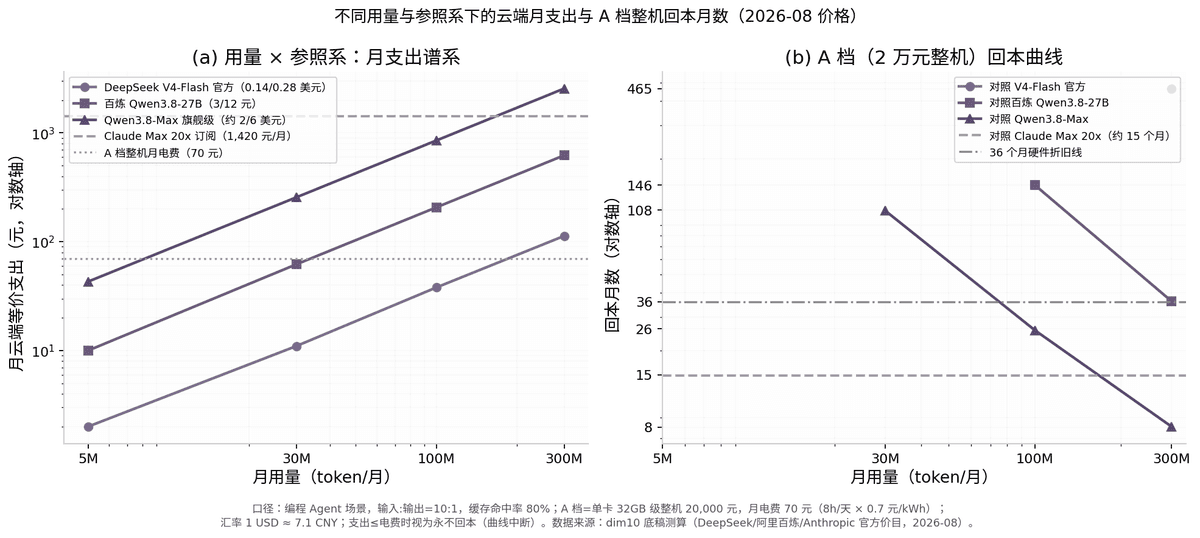
Figure 4-1: (a) Monthly equivalent cloud expenditure across reference benchmarks for three usage profiles; (b) Payback period in months for Tier A (¥20,000 system) relative to each reference benchmark. Discontinuous curve gaps indicate cloud spending is lower than monthly electricity, meaning the hardware never breaks even. Methodology and assumptions detailed in footnote; Sources: Official pricing from DeepSeek / Alibaba Cloud Model Studio / Anthropic (2026-08)[15][17][111][18].
The matrix reveals the "Payback Paradox": Whether local deployment breaks even depends almost entirely on the chosen reference frame, not the hardware itself. Against DeepSeek's direct official API, a heavy user's monthly bill (¥113) is on par with monthly electricity for a ¥20k system (¥70), yielding a best-case payback of 465 months—it will never break even across any hardware tier or individual usage level. Even if peak-hour pricing doubles the bill (~¥226/month), the ¥20k tier still requires ~128 months[16]. Shifting the baseline upward changes the outcome at every step: compared to Alibaba Cloud's API for the identical 27B model, a heavy user on a ¥20k setup breaks even in 36 months (just hitting the depreciation boundary); compared to flagship APIs (Max class) or hosted endpoints, payback tightens to 8–13 months; compared to a Claude Max 20x subscription (¥1,420/month), the ¥20k tier breaks even in 15 months, and the ¥50k tier in 39 months[18]. Tier C also holds a hidden advantage: a ¥15,000 Strix Halo system (drawing ~¥22/month in electricity at 8h/day) breaks even against Claude Max 20x in ~11 months, and against Model Studio 27B (at 300M/month) in ~25 months—unified memory's low power consumption gives entry-level tiers superior payback elasticity over power-hungry discrete GPU setups.
Secondhand hardware accelerates payback further: a Dual RTX 3090 rig (48GB VRAM pool) costing ¥10,000–14,000 is the cheapest entry into the 27B sweet spot[103]. At a ¥12,000 median cost and ~¥60/month in power (~500W average × 8h/day), payback against a Claude Max 20x subscription drops to ~9 months, and ~21 months against heavy Model Studio 27B usage—roughly halving the payback timeline of a brand-new Tier A build. However, this comes with out-of-warranty and mining risks (all cards are out of warranty, with 2026 secondhand GPU prices up 10–25%), and their 936GB/s bandwidth ceiling blocks upgrades to FP8 and extended contexts. It is a calculated trade-off of risk and upgrade headroom for faster payback[103].
Setting "Payback ≤ 24 Months" as the feasibility threshold, viable setups converge on: Heavy Agent User (≥300M tokens/month) + ¥20,000-class Hardware + Flagship API or ≥¥700/month High-End Subscription as Reference. For all other combinations, the economic justification must rely on intangible benefits: Data privacy and compliance (in regulated environments where cloud APIs are legally non-viable, payback is immediate on Day 0), offline availability and operational continuity (immunity from model deprecation, outages, or API downtime), zero rate limits (converting queuing bottlenecks into hardware utilization), fine-tuneability (Qwen3.8-27B and V4-Flash are open-weight and support LoRA tuning, turning proprietary domain capabilities into assets rather than expenses), and cost predictability (capping hardware CapEx against broad 2026 API price increases)[118]. Factoring in a 3-year residual value of 40–50% further reduces all payback figures above by ~30–40%.
Three limitations must be noted: ① Capabilities are not fully identical—local 27B models do not match Qwen3.8-Max or Claude-level reasoning, implying an inherent quality concession when modeling payback against high-tier APIs. ② The practical usability threshold for running 284B MoE locally is tight below the ¥100,000 tier; high-end Tier D payback figures assume an operator willing to manage 4-GPU server maintenance. ③ API pricing remains highly volatile; if industry price hikes continue, the local deployment break-even point will drop further. Crucially, the memory price surge has not peaked (projected to peak in 2027[10]), meaning hardware and cloud prices are currently moving in opposite directions. The payback window calculated here is a dynamic snapshot, which the next chapter extrapolates across the next twelve months.
5. Twelve-Month Forward Extrapolations (2026-09 to 2027-08)
This chapter differs from the previous four: while earlier conclusions rested on released models, benchmarked hardware, and verified pricing, this section presents forward-looking projections for the upcoming twelve months. The methodology is structured across three layers: ① Anchoring on established facts (e.g., M5 Ultra already launched, Qwen3.8-Flash-Next already open-sourced), which carry the highest confidence; ② Attributing official roadmaps and first-hand leaks (The Information, J.P. Morgan, Gurman, etc.), with unconfirmed rumors downgraded; ③ Treating pure historical cadence extrapolations and single unverified sources as directional indicators only. Confidence is categorized into four tiers: high (multi-source cross-validated or officially confirmed), medium-high (single authoritative source supported by circumstantial evidence), medium (reasonable extrapolation or vendor self-reported data), and exploratory (directionally plausible but thinly evidenced), detailed in Appendix Table 7-1. Each extrapolation includes actionable implications for deployment decisions in Chapter 6.
5.1 Model Side Extrapolations
5.1.1 Release Cadence: Three Key Windows
Certainty over the next twelve months is anchored by three signal types: active canary tests, architectural previews, and formal roadmap commitments. The official release of DeepSeek V4.1 is expected in September–October 2026 (high): V4.1 Flash entered canary testing in June, The Information reported investor commitments to accelerate release cadences, and subsequent updates in late July and mid-August confirmed accelerated delivery[121][122]. A V4.5 release or R2-tier reasoning-focused model is slated for 2026 Q4–2027 Q1 (medium; R2's independent existence is exploratory due to repeated historical delays)[123]. DeepSeek V5 is most likely to land in 2027 Q2 (medium-to-exploratory): extrapolated from historical intervals (11 months for V3→V3.2, 5 months for V3.2→V4) and compute cluster expansions following its ~¥50 billion funding round in June 2026[122][124]. On the Qwen side, the open-sourcing of Qwen3.8-Flash-Next on August 26 was officially confirmed as an early preview of the Qwen4 architecture (125B backbone, 6B active, 51B n-gram lookup table embeddings). Given the ~5-month cadence seen from Qwen3-Next to Qwen3.5, and Alibaba's tradition of major Spring Festival releases, the full Qwen4 family will very likely land in 2027 Q1 around Spring Festival (medium-high)[19][20]. Among other players: GLM-5.5 (predicted by J.P. Morgan to cross 1T parameters) and MiniMax M3 Pro (2.7T, open-source) are expected before 2026 Q4 (medium-high)[125][126]; Kimi K4 is projected to continue scaling in 2027 H1 (medium)[127]; Gemma 5 should track Gemini 4 in 2027 Q1–Q2 (medium-high)[35]; and Meta's frontier models will likely remain closed-source (high)[128].
Table 5-1 Model Side "Timeline – Event – Confidence" Extrapolation Table (2026-09 to 2027-08)
| Time Window | Projected Event | Basis | Confidence |
|---|---|---|---|
| 2026-09/10 | DeepSeek V4.1 Official Release (Omni modalities, Agent toolchain) | Flash canary live + delivery commitments verified[121][122] | high |
| 2026 Q4 | GLM-5.5 (>1T, MIT open weights); MiniMax M3 Pro (2.7T) open weights | J.P. Morgan forecast; The Information report[125][126] | medium-high |
| 2026 Q4 | Qwen3.9 or Qwen4 small-size preview debuts GDN+QSA architecture | Flash-Next open-sourced + 5-month preview pattern[19][20] | medium |
| 2026 Q4–2027 Q1 | DeepSeek V4.5 or R2-class reasoning model | Acceleration commitment; R2 rumored with past delays[123] | medium (R2 exploratory) |
| 2027 Q1 (Spring Festival) | Full Qwen4 Family (Max class + 27B-class sweet spot) | Official architecture preview + Spring Festival cadence[19][20] | medium-high |
| 2027 Q1–Q2 | Gemma 5 (≤35B, Apache 2.0); Kimi K4 (Continued scaling) | Gemma annual cycle; K4 official slogans & IPO narrative[127][35] | medium-high / medium |
| 2027 Q2 | DeepSeek V5 (1.5–2T class, 2–3% active ratio, memory module in backbone) | 8–12 month major release cadence + post-funding compute expansion[122][124] | medium-to-exploratory |
| Entire Window | Meta flagship remains closed-source; mid-tier Llama models maintain open access | Muse Spark precedent & official tiered strategy[128] | high |
| Entire Window | 1M context becomes default API standard; Agent autonomy duration replaces static leaderboards | Cloud pricing sheets & vendor benchmark shifts[129] | high |
Analysis & Key Observations: First, release windows are heavily clustered: 2026 Q4 and 2027 Q1 account for 70% of the projected events. The Spring Festival window (around February 2027) represents a dual release tradition for both DeepSeek and Qwen, marking the year's primary model upgrade inflection. Second, confidence levels correlate with event nature: high-confidence events represent delivery on active canary tests, public previews, or official roadmap statements, whereas next-generation flagships lacking explicit signals (e.g., V5, R2) are rated exploratory—projections extending into 2027 H2 should be discounted accordingly. Third, the takeaway for individuals: The marginal benefit of waiting on model releases is concentrated in the six-month window of 2026 Q4 to 2027 Q1. If current requirements are met by Qwen3.8-27B or V4-Flash, waiting for the Qwen4 sweet spot (expected 2027 Q1) is the only wait-and-see justification backed by a concrete timeline.
5.1.2 Structural Trends: Deepening Sparsity Coexisting with Solidifying Dense Models
Over the next twelve months, model architectures will follow three trajectories established in 2026, all delivering net benefits for local deployment. First, deepening MoE sparsity will coexist alongside solidified ≤35B dense models (high): While 2026 flagships shifted universally to MoE, ≤35B dense models like Qwen3.8-27B and Gemma 4 31B Dense proved to be breakout hits. The three-tier structure (≥400B ultra-large MoE / 100–300B highly sparse MoE / ≤35B dense) will solidify—dense designs will not return to flagship tiers, but their immunity to routing collapse, quantization friendliness, and runtime maturity will ensure their dominance in on-device sweet spots[34][35]. Second, active parameter ratios will drop further alongside the rise of non-compute parameters (high directionally, medium on specific figures): Flagship active ratios dropped from 5.5% in V3 to 3.1% in V4-Pro and ~1.8% in K3. Both Qwen and DeepSeek are pursuing architectures that offload n-gram and conditional memory lookup tables to inexpensive DRAM/SSD, driving 2027 flagship active ratios toward 2–3%[19][130][33].
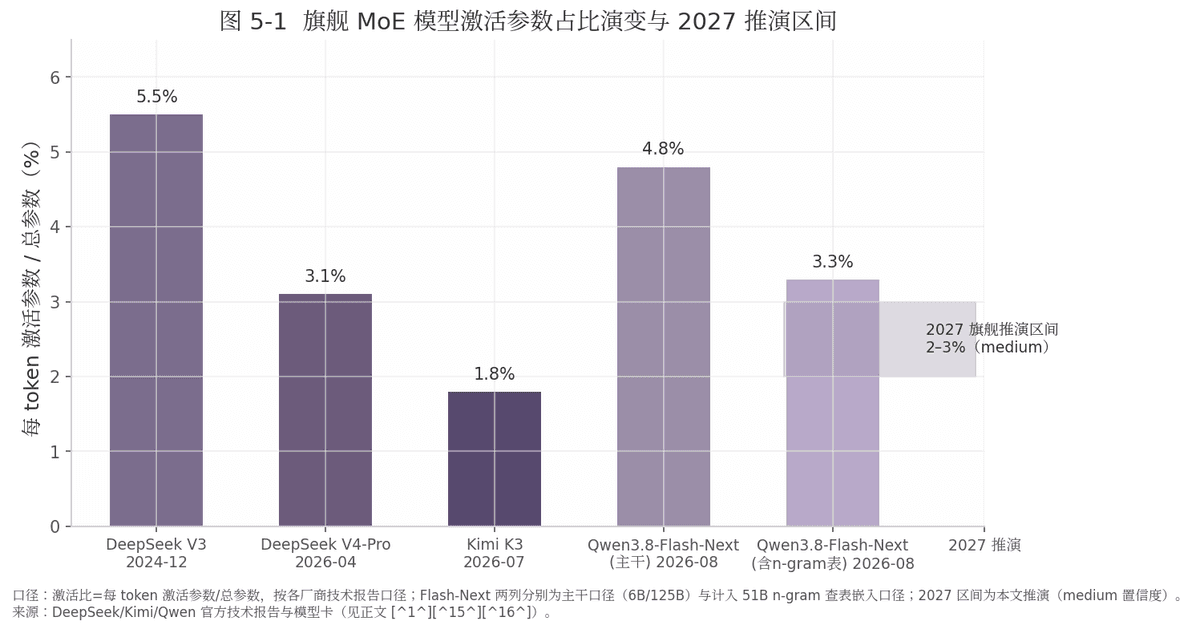
The direct consequence of falling activation ratios is that decode bandwidth requirements decouple from total memory footprint: 125–300B highly sparse models leveraging FP4/2–3 bit dynamic quantization and memory offloading will transform "running near-flagship models on 128GB unified memory" from a novelty into standard practice in 2027 (extrapolated from Flash-Next's FP8 footprint of ~168GB nearing this range)[19][33]. Third, Agent/Coding workflows will become the primary post-training battleground (high): Diminishing returns from pre-training scaling, combined with joint OpenAI/Anthropic/Google restrictions on CoT distillation, have made RL and Agent environments the sole battleground for capability differentiation. DeepSeek has established a dedicated Harness team targeting Claude Code benchmarks, and upcoming flagship releases will feature "autonomous task execution duration" over static benchmarks like MMLU as their primary marketing metrics[129][131]. Takeaway for individuals: when evaluating local utility for next-generation models, prioritize Agent benchmark performance and built-in speculative decoding modules over nominal parameter counts.
5.1.3 Risk: Open Source Enters a New Normal of "Publishing Weights, Tightening Licenses, Trimming Top Configurations"
The greatest downside risk over the next twelve months lies in licensing rather than model capability. Compounding signals—including Meta's closed-source flagships, Qwen's shift to custom licenses (qwen3.8-max, Qwen Community License 1.0), Kimi K3's modified MIT terms, and the upward drift of open-source sweet spots—indicate that the probability of "publishing weights, tightening licenses, and trimming top configurations" becoming the new normal is ~70% (directional assessment high, probability estimated)[128][24][25]. Offsetting pressures remain real: open-source model token share on OpenRouter climbed from 34% in January 2026 to 65% in June. Market pressure dictates that "closed source = elimination," keeping the probability of DeepSeek, GLM, or MiniMax going fully closed-source at only ~15%, and Alibaba at ~30% (tracked by whether MaaS revenue surpasses IaaS)[27]. Meanwhile, 2T+ parameter weights will continue the trend of "nominally open, practically undeployable"—as demonstrated by Kimi K3 requiring ≥1.5TB VRAM, widening the gap between the "world's strongest open-source model" and the "strongest locally deployable model"[25]. Takeaway for individuals: the current pairing of Qwen3.8-27B (Apache 2.0) and V4-Flash (MIT) represents a historically permissive window; downloaded weights cannot be retroactively restricted—promptly archiving key weights and quantization formats provides a zero-cost hedge against license tightening.
5.2 Hardware and Software Side Extrapolations
5.2.1 Hardware: Unified Memory Leaps Coexist with Consumer GPU Vacuums
The hardware landscape is stark: Apple's M5 Ultra (512GB unified memory, 1.2TB/s bandwidth), announced on 2026-08-25 (launching September 22 with 512GB configs shipping late October), stands as the only officially available desktop system within the window capable of running single-node FP16 70B or 400B+ quantized models, introducing official 4-node RDMA clustering support (~3× single-node performance)[21]. Given Apple's ~17-month Ultra cadence, the next generation will not arrive until 2028, leaving the M5 Ultra uncontested in its category (medium-high)[132]. NVIDIA's consumer lineup faces an extended vacuum: the RTX 50 SUPER series was indefinitely shelved due to 3GB GDDR7 dies costing 3× more than 2GB dies (high), while the RTX 60-series (Rubin architecture) will arrive in 2027 H2 at the earliest, remaining a paper launch throughout this window (medium-high)[22][133][134]. AMD will bridge the gap with Gorgon Halo in 2026 Q4 (~273GB/s bandwidth, no architectural leap, high), while the true generational leap, Medusa Halo (384-bit LPDDR6, theoretical 455–614GB/s bandwidth), is slated for 2027 and unlikely to be broadly purchasable before late in the window (medium)[135][136]. Domestically in China, Ascend 950PR volume shipments and the 950DT launch (2026 Q4) carry high certainty (high), though large-memory consumer-tier domestic GPUs remain absent[137].
Table 5-2 Hardware/Software Side "Timeline – Event – Confidence" Extrapolation Table (2026-09 to 2027-08)
| Time Window | Projected Event | Basis | Confidence |
|---|---|---|---|
| 2026-09/10 | Mac Studio M5 Ultra launches; 512GB configs ship | Apple official announcement[21] | high |
| 2026 Q4 | Gorgon Halo launches (~273GB/s); Ascend 950DT releases; First LPDDR6 flagship phones | AMD briefing; Huawei roadmap; SK Hynix mass production[135][137][138] | high / medium / high |
| 2026 Q4 | llama.cpp lands multi-batch speculative decoding; Ollama enables it by default | MTP merged; release cadence extrapolation[139] | medium |
| 2026 Q4–2027 H1 | No new NVIDIA consumer GPUs; Modded 96/128GB 5090 cards continue secondary circulation | SUPER cancellation verified; modded card precedents[22][140] | high / medium |
| 2027 H1 | Open-source flagships universally ship official FP4 checkpoints; Transformers v5.0 integrates ModelOpt | ModelOpt adopted as primary backend in vLLM/SGLang[141] | high / medium-high |
| 2027 H1 | Apple M7 base chip (~240GB/s, does not affect Ultra tier) | Gurman leak[132] | medium |
| 2027 H2 (Window End) | RTX 60-series nears launch but remains supply-constrained; Medusa Halo announced/sampling | Multi-source industry leaks[134][136] | medium-high / medium |
| Entire Window | DRAM/VRAM inflation persists, peaking in 2027 | Intel / Samsung / Apacer / TrendForce consensus pointing to 2028 relief[23][142][143] | high |
| Entire Window | FP4 + speculative decoding becomes standard inference stack; Consumer single-node practical context reaches 256–512K, 1M requires 512GB tier | KV compression benchmarks & runtime roadmaps[139][141][7] | high / medium |
Analysis & Key Observations: Three core implications emerge: First, the supply vacuum is structural: NVIDIA's consumer gap (spanning all of 2026 through 2027 H2) covers this entire extrapolation window. Large-VRAM consumer demand during this period can only be met by modded 48GB cards, 72GB RTX PRO 5000s, or unified memory systems, cementing the coexistence of grey-market modded GPUs and expensive enterprise cards[22][140]. Second, the bandwidth battleground has shifted to unified memory: the M5 Ultra's 1.2TB/s and Medusa Halo's projected 455–614GB/s establish "memory bandwidth × capacity" as the primary currency for local inference over raw TOPS. However, a significant timing gap exists: M5 Ultra hardware is available in October 2026, whereas volume production of Medusa Halo sits past 2027, giving Apple a temporary monopoly over the large-memory sweet spot[21][136]. Third, software dividends (FP4, speculative decoding) apply directly to existing installed hardware, meaning currently owned hardware will continue to get faster for free, while new hardware purchases will not become cheaper.
5.2.2 Cost Environment: Memory Inflation Persists Across the Window
Cost projections point consistently toward a challenging environment: Intel's CEO stated that DRAM shortages will persist for at least two years until 2028; Apacer warned that general DRAM supply could plunge up to 70% in 2027; TrendForce projects HBM/DRAM contract prices to continue surging through 2027. Memory and VRAM price hikes will span the entire extrapolation window, peaking in 2027, meaning local deployment will not become cheaper during this period (high)[23][142][143]. While retail consumer DDR5 saw minor pullbacks in March 2026, wafer-level pricing remains elevated, reflecting structural supply divergence rather than a cycle peak. The implication for procurement is a reversal of conventional wisdom: the "wait-and-see" approach fails during an inflationary cycle—buying early locks in hardware costs. Combined with the anomalous zero-depreciation profile of large-VRAM cards detailed in Chapter 4, purchasing Tier A/B hardware within this window carries significantly lower financial downside than in normal market years (estimated).
5.2.3 Software: FP4 and Speculative Decoding Become Standard, 1M Context Arrives on 512GB-Class Devices
Two software dividends will reach universal standardization within 2026 (high): NVFP4 has become a first-class quantization backend in vLLM/SGLang and will integrate into Transformers v5.0 in Q4; future open-source flagships released during this window will universally provide official FP4 checkpoints[141]. Speculative decoding has been standard across llama.cpp, MLX, and vLLM/SGLang since early 2026, delivering reliable 1.7–2.6× single-stream speedups[139]. In long contexts, CSA/HCA architectures have compressed 1M context KV cache to single-digit gigabytes. Running 284B-class MoE with 1M context on 128GB unified memory hardware has been repeatedly demonstrated (2-bit weights at ~81–91GB + KV at ~3–10GB), and will transition from experimental setups to mainstream supported workflows in llama.cpp/vLLM over the next twelve months (high). However, genuinely practical 1M context execution (at acceptable interactive speeds) will remain the domain of 512GB unified memory hardware or multi-node clusters (medium)[7][144]. Takeaway for individuals: waiting for software improvements offers diminishing returns, as updates automatically benefit existing hardware. The only proactive step required is selecting new models that ship with built-in speculative draft heads and official FP4 weights.
5.3 Scenario Analysis
Synthesizing model, hardware, and cost trajectories, we model three forward scenarios with deployment implications (probabilities estimated).
Baseline Scenario (~60% Probability): Evolution continues at current pace. Qwen4 lands in 2027 Q1, DeepSeek V5 in 2027 Q2, with licensing frameworks remaining stable. M5 Ultra scales shipments, NVIDIA remains in a consumer vacuum, and memory prices peak in 2027 without relief. Deployment Strategy: Buy hardware on demand; do not wait on hardware cycles. The 27B sweet spot (24GB NVIDIA GPU system) is immediately buyable. For users targeting 284B MoE models, the M5 Ultra 512GB (shipping late October) and 128GB unified memory mini PCs represent dependable options within the window. If current needs are met by existing models, the only wait worth considering is the Qwen4 sweet-spot release in 2027 Q1.
Optimistic Scenario (~20% Probability): Memory inflation eases early or breakthrough open-source models arrive ahead of schedule. Triggers: Faster-than-expected LPDDR6 scaling, DRAM contract price growth moderating sharply in 2027 H1, or DeepSeek V5 / Qwen4 sweet-spot models launching early under permissive licenses with active parameter ratios falling below 2%. Deployment Strategy: Extend the evaluation window to 2027 Q1, focusing on Qwen4 27B-class releases and Medusa Halo announcements. Users who already own 128GB unified memory hardware will automatically benefit from lower active parameter ratios without needing further hardware investment.
Pessimistic Scenario (~20% Probability): License tightening paired with further memory price shocks. Triggers: Alibaba MaaS revenue overtaking IaaS prompting custom licensing for Qwen4 sweet-spot releases, stricter domestic frontier model compliance rules delaying open-weight releases, or severe DRAM supply contractions driving system prices even higher. Deployment Strategy: Procure and archive immediately. Secure currently available Apache 2.0 / MIT model weights across multiple quantization tiers alongside existing hardware stock. On the hardware front, prioritize high-residual-value large-VRAM NVIDIA GPUs over soldered unified memory mini PCs to hedge against future price increases and generational obsolescence.
The common thread across all three scenarios is clear: Under every scenario, "downloaded model weights + owned hardware" represent the slowest-depreciating assets. Waiting on the model side offers only one concrete milestone in 2027 Q1, while waiting on the hardware side offers no clear milestones at all—setting the stage for the actionable recommendations in Chapter 6.
6. Conclusions and Actionable Recommendations
Chapters 1 through 5 established evidence across models, software, hardware, costs, and forward extrapolations. This chapter synthesizes those findings to directly answer four practical questions: What are the hardware thresholds? Is it worth buying? What should you buy? Should you buy now or wait? Bottom line up front: The capability barrier for local personal deployment has dropped to an all-time low, while the cost barrier sits at an inflationary high. Whether to buy is not a question of "how good the hardware is," but of your usage profile and counterfactual reference frame. Waiting offers zero hardware upside, and only one concrete model milestone in 2027 Q1.
6.1 Core Conclusions
6.1.1 Two Sweet Spot Tiers Established: 27B Dense + 24GB Single Card; 300B-Class MoE + 128GB Unified Memory
As of August 2026, the hardware requirements for personal local deployment have settled into two distinct, mathematically stable sweet spots. Sweet Spot 1: 27B Dense + 24GB NVIDIA GPU. Qwen3.8-27B requires ~17GB for Q4 weights and ~16GiB of KV cache for 262K context, fitting cleanly inside 24GB of VRAM. Enabling built-in MTP speculative decoding delivers measured speeds of 40–65 tok/s on an RTX 3090/4090 and 133–206 tok/s on an RTX 5090, with full system costs at ¥21,000–45,000[8][5][9]. Sweet Spot 2: 300B-Class Highly Sparse MoE + 128GB Unified Memory. DeepSeek-V4-Flash (284B total / 13B active) compressed to 91–104GB via dynamic quantization delivers measured speeds of 20–35 tok/s on 128GB unified memory hardware, bringing frontier capabilities to the ¥14,000–35,000 price point[11][77][12]. The middle 70B dense tier (demanding 48GB+ VRAM alongside massive bandwidth) has been hollowed out: at equivalent budgets, it is either slower than a 27B model or weaker than a 300B MoE. Supply-side releases are converging on these two extremes, effectively removing the 70B dense tier from practical recommendations[34].
6.1.2 Summary of Seven Cross-Dimensional Insights
The following seven insights synthesize cross-validated evidence across multiple dimensions, paired with their direct hardware procurement implications:
6.2 Actionable Recommendations by User Persona
6.2.1 Matching Personas to Solutions: API for Light Users, Self-Hosting or Subscription for Moderate Users, Hardware for Heavy Users by Scenario
Applying the usage profiles (Light 5M, Moderate Coding 30M–100M, Heavy Agent 300M+ tokens/month) and A/B/C/D tiers from Chapter 4[119], recommendations are structured as follows:
Table 6-1 Actionable Recommendations by User Persona (2026-08 Market Conditions)
| Persona | Recommended Solution | Budget | Expected Experience | Payback Logic |
|---|---|---|---|---|
| Light Users (≤5M tokens/mo) | Stick with cloud APIs, prioritizing DeepSeek direct API; off-peak rates & caching yield up to 98% savings[15][16] | ¥0 (~¥2/month cloud bill) | Instant access to flagship capabilities, zero maintenance overhead | Monthly power for any hardware exceeds cloud spend; will never break even; avoiding hardware is optimal |
| Moderate Coding Users (30M–100M tokens/mo) | Tier A self-hosted system (RTX 4090 24GB); Budget-constrained: secondhand Dual 3090 or maintain a ¥142/mo subscription[92][103][18] | ¥21,000–26,000; Secondhand route ¥10,000–14,000 | 27B Q4+MTP @ 40–65 tok/s, 32–64K context comfortable[8][5] | Does not break even against same-model cloud APIs; takes 26–108 months vs flagship APIs—pure financial payback fails; purchase is driven by privacy, zero rate limits, and UX |
| Heavy Agent Users (300M+ tokens/mo) | Tier B (27B uncompromised long context) or Tier C (128GB unified memory running 284B quantized), scaling to Tier D by workload | Tier B ¥28,000–38,000; Tier C ¥14,000–16,000; Tier D ¥45,000–150,000 | Tier B: Full 262K context; Tier C: 20–35 tok/s, 64–128K; Tier D: 43–367 tok/s[12][13][86] | Breaks even in 8–13 months vs flagship/hosted APIs; breaks even in 15 months (¥20k tier) / ~11 months (Tier C, est.) vs Claude Max 20x[18] |
| Privacy-Sensitive / Regulated Users | Bypass payback calculations entirely; select tier strictly by data classification: Tier A/B if 27B suffices, Tier C/D for frontier capability | Same as above | Same as above | Cloud APIs are legally non-viable under regulatory constraints; investment breaks even on Day 0 |
Analysis & Key Observations: First, usage volume is the single primary first-order variable: In Table 4-4's matrix, the same hardware yields completely opposite conclusions at 5M vs 300M tokens/month. For light users, buying hardware in the era of rock-bottom API pricing represents pure financial loss; for heavy users, avoiding hardware means continuously paying premium subscription fees to cloud providers. Second, Tier C is an underrated payback dark horse: A domestic Strix Halo system costing ¥14,000–16,000 (drawing ~¥22/month in electricity) breaks even against high-tier subscriptions faster than expensive discrete GPU setups due to its minimal power consumption; however, its 20–35 tok/s decode speed makes it suitable for batch Agent pipelines rather than interactive programming. Third, the secondhand Dual 3090 setup is the sole edge-case solution: At ~¥12,000, it breaks even against Claude Max 20x in just ~9 months, but requires assuming out-of-warranty and mining risks, while its 48GB VRAM pool offers no forward upgrade path[103].
6.2.2 Buy Now or Wait: Waiting Offers No Hardware Anchors
The most direct counter to the "wait-and-see" mindset comes from the cost side: memory and VRAM inflation will persist throughout this window, peaking in 2027 and easing only in 2028, with NVIDIA consumer releases stalled until 2027 H2[23][142][143][22]. Meanwhile, software dividends like FP4 and speculative decoding automatically improve existing hardware—installed systems will continue to get faster, while new hardware purchases will not get cheaper. On the model side, the only concrete milestone worth waiting for is the Qwen4 sweet-spot release in 2027 Q1 (medium-high confidence)[19][20]. The decision rule boils down to a single principle: If your requirements are covered by Qwen3.8-27B or DeepSeek-V4-Flash, buy now; if your requirements remain undefined, download and archive the model weights today, and revisit hardware decisions in 2027 Q1. Across all scenarios, "archived model weights + owned hardware" represent the slowest-depreciating assets in this cycle.
7. Appendix: Methodology, Confidence Levels, and Conflict Resolution
7.1 Methodology and Source Stratification
7.1.1 12-Dimensional Parallel Research, 4-Tier Cross-Validation, Targeted Verification
This report utilized a multi-agent parallel research methodology: twelve sub-agents independently covered model specifications, benchmarked performance, deployment baselines, GPU market pricing, unified memory platforms, compression technologies, power and operating costs, API pricing structures, and long-term hardware/model roadmaps. Each agent recorded evidence using a standardized six-field schema: "Claim / Source / URL / Date / Direct Excerpt / Confidence Level." A cross-validation engine aggregated and reconciled the findings, admitting conclusions to the high-confidence registry only when supported by two or more independent sources or agents, establishing ten consensus findings in this cycle. To resolve a critical pricing discrepancy regarding RTX 5090 market rates, a targeted verification round was initiated, tracking month-by-month transaction histories across retail channels to reach an adjudicated ruling[10][145].
Sources are stratified into distinct credibility tiers: Tier 1 (T1) comprises official documentation, vendor technical whitepapers, and primary engineering artifacts (e.g., official vLLM Recipes, Unsloth documentation, Apple press releases[11][21]), which take precedence; Tier 2 (T2) covers established technology publications and vendor engineering blogs (MyDrivers, IT Home, MacRumors, etc.[10]), utilized for cross-verifying pricing and event timelines; content farms and anonymous sources were excluded. All findings are classified across four confidence tiers and presented with explicit qualifying language in the text.
Table 7-1 Confidence Level 4-Tier Classification Description
| Level | Criteria | Typical Example | Usage in Report |
|---|---|---|---|
| High (high) | ≥2 independent sources/agents in consensus, including verified benchmarks | Qwen3.8-27B VRAM math; August 5090 market pricing[10][145] | Primary evidential basis |
| Medium-High (medium-high) | Single authoritative source supported by corroborating circumstantial data | 1M context KV cache compression scale | Usable, statistical scope noted |
| Medium (medium) | Single authoritative source, vendor self-reported data, or bandwidth calculations | DSpark speedup ratio; M5 Ultra estimated speed | Usable with explicit caveats |
| Exploratory (exploratory) | Historical cadence extrapolation without direct empirical verification | RTX 60-series 2027 H2 launch window | Scenario reference only; not for decision-making |
The distribution shows that high-confidence findings (10 items) concentrate in empirical domains—VRAM consumption, measured throughput, and current retail pricing. Medium-confidence findings (5 items) cluster around vendor self-reported metrics (lacking independent replication) and forward-looking timeline extrapolations (subject to supply chain volatility). Consequently, readers should treat the 12-month extrapolations as structured scenario analyses rather than deterministic forecasts. The confidence classification enforces a transparent boundary between empirical findings and forward projections.
7.2 Resolved Conflicts and Remaining Uncertainties
7.2.1 Adjudication of Three Criteria Conflicts
RTX 5090 Pricing: The price divergence represents a chronological shift rather than a factual contradiction: early reports of ~$2,000 reflected official MSRP, but the GDDR7 supply shortage drove prices steadily upward starting in January 2026. By August 2026, US street prices reached $4,100–4,900 (a 135%–145% premium over MSRP)[10], while new non-reference cards in China traded at ¥27,500–35,000[145]. The report standardizes on August 2026 market prices, referencing launch MSRP solely to calculate inflation.
DeepSeek-V4-Flash Parameter Count: The discrepancy between 284B and 304.18B represents a difference in reporting scope: 284B reflects the core architecture described in the technical paper, whereas 304,180,418,494 (~304B) represents the exact parameter count in Hugging Face safetensors metadata. The delta represents the bundled DSpark speculative decoding draft module[3][30]. Both numbers are valid in their respective contexts and are explicitly annotated throughout the text.
"128GB Devices Cannot Run V4-Flash": This conflict stemmed from conflating native precision with quantized weights: native FP4 weights require 155.4 GiB, which indeed exceeds single-node 128GB capacity[31]. However, Unsloth's dynamic quantization sweet spot (91–104GB, down to 82.5GB minimum) runs successfully on 128GB Mac hardware (measuring 27–34 tok/s at IQ2), albeit with minor quality trade-offs[11][76]. The report treats these as two separate operational tiers, eliminating blanket claims of deployability.
7.2.2 Remaining Uncertainties
Three residual uncertainties are explicitly flagged in the text. First, empirical benchmarks for the M5 Ultra are pending: Projected speeds of ~55–75 tok/s for running V4-Flash on the M5 Ultra are derived from memory bandwidth calculations, scaled from empirical M3 Ultra baselines on 22B-activated MoE models mapped to 1.2TB/s[84]; the machine was announced on August 25, 2026, and third-party benchmarks were unavailable as of the research cut-off (August 29)[21]. Second, DSpark acceleration figures rely on vendor self-reporting: The reported +51% throughput boost and 60–85% single-user speedup lack external replication, and represent gains measured against an already-accelerated MTP-1 baseline rather than naive autoregressive decoding[37]. Third, extrapolated and converted metrics: Specific tok/s figures extrapolated from similarly sized models are marked with "estimated" throughout the text; domestic pricing for the M3 Ultra 192GB is calculated via currency conversion from US retail pricing ($5,499–6,999)[101]. All twelve-month forward projections are annotated with their respective confidence ratings (high / medium / exploratory), allowing readers to calibrate risk accordingly.
References
[1] Kingy AI: Qwen3.8-27B Specs Breakdown & Local Hardware Analysis [EB/OL]. 2026-08-14. https://kingy.ai/blog/qwen3-8-27b-specs-benchmarks-local-hardware/
[2] CSDN In-Depth Review: Qwen3.8-27B Weights and License Verification [EB/OL]. 2026-08-16. https://deepseek.csdn.net/6a8197e210ee7a33f29bc084.html
[3] mer.vin: DeepSeek-V4-Flash 304B Metadata Reading & config.json Verification [EB/OL]. 2026-08-05. https://mer.vin/news/deepseek-v4-flash-a-304b-model-on-one-amd-mi300x-gpu/
[4] vLLM Official Recipes: DeepSeek-V4-Flash Deployment Recipe [EB/OL]. 2026-08-27. https://recipes.vllm.ai/deepseek-ai/DeepSeek-V4-Flash
[5] GitHub: llama.cpp PR #22673 (MTP Speculative Decoding Merged) [EB/OL]. 2026-05-16. https://github.com/ggml-org/llama.cpp/pull/22673
[6] DataLearner: Qwen3.8-27B Local Deployment Quantization Guide (Q4 Quality Inflection Point) [EB/OL]. 2026-08-19. https://www.datalearner.com/blog/qwen3-8-27b-local-deployment-quantization-guide
[7] GitHub ForceInjection: Layer-by-Layer KV Derivation from MLA to CSA+HCA (citing vLLM Official Blog) [EB/OL]. 2026-05-08. https://github.com/ForceInjection/AI-fundamentals/blob/main/09_inference_system/vllm/module_analysis/deepseek_attention_evolution_mla_to_csa_hca.md
[8] SMZDM (What's Worth Buying): Qwen3.8-27B Community Benchmark Aggregation (24G Tier Q4 Stable at 40-53 tok/s, 5090/Mac/Multi-GPU Benchmark Matrix) [EB/OL]. 2026-08-19/23. https://post.smzdm.com/p/am9xwm7z
[9] Sohu / ZDNet AI Lab citing SGLang Team Day-0 Benchmarks (5090 NVFP4+DSpark 206.1 tok/s, ~60 tok/s without spec; DGX Spark 38.28 tok/s) [EB/OL]. 2026-08-20. https://www.sohu.com (Qwen3.8-27B SGLang Day-0 Benchmark Timeline)
[10] MyDrivers: RTX 5090 US Street Price Reaches $4,699, a 135% Premium over MSRP [EB/OL]. 2026-08-17. https://news.mydrivers.com/1/1144/1144383.htm
[11] Unsloth Official Docs: DeepSeek-V4 Local Running Guide (Quantization Gradients and KLD) [EB/OL]. 2026-08-26. https://unsloth.ai/docs/zh/mo-xing/deepseek-v4
[12] Lucebox Tech Blog: Running V4-Flash on Strix Halo (Proprietary ROCm Stack + DSpark up to 32 tok/s; Public Leaderboard HipFire 18.99 / DwarfStar 15.6 tok/s) [EB/OL]. 2026-07-18/20. https://www.lucebox.com/blog/deepseek-v4-strix-halo
[13] GitHub yhfgyyf/vllm-deepseek-v4-sm89: 4× RTX 4090 Benchmarks (Native ~82 tok/s; DSpark 8K 366.95 / 128K 219 tok/s; Full 768K Execution) [EB/OL]. 2026-08-22/26. https://github.com/yhfgyyf/vllm-deepseek-v4-sm89
[14] GitHub Gist (AlexsJones): 64GB Strix Halo + SSD Expert Streaming Benchmark ("6 of 256 experts fire per token", ~1.9 tok/s) [EB/OL]. 2026-07-05. https://gist.github.com/AlexsJones/9b43e7b8f3682679d17f255a3ca0d9d3
[15] FelloAI Pricing Guide (citing DeepSeek Official Pricing Page): V4-Flash $0.14/$0.28, Cache Hit $0.0028 [EB/OL]. 2026-08-22. https://felloai.com/deepseek-pricing
[16] Sina Finance / Weibo Announcement: DeepSeek Time-of-Use Pricing (Weekday Peak 2×, Off-Peak Half Price, Weekends Full Off-Peak; CNY Peak ¥3/¥9, Off-Peak ¥1.5/¥4.5) [EB/OL]. 2026-08-24. https://k.sina.com.cn/article_7880068204
[17] Alibaba Cloud Official Help Docs: qwen3.8-27b Input ¥3 / Output ¥12 / Cache Hit ¥0.6 per Million Tokens [EB/OL]. 2026-08-27. https://help.aliyun.com/zh/model-studio/qwen3-8-27b
[18] morphllm/screenapp: Claude Pro 100, Max 20x $200 [EB/OL]. 2026-08-21. https://morphllm.com/claude-code-pricing
[19] ModelScope: Qwen3.8-Flash-Next Official Model Card (Qwen4 Architecture Early Preview, 125B/6B+51B n-gram, GDN+QSA) [EB/OL]. 2026-08-26. https://modelscope.cn/models/Qwen/Qwen3.8-Flash-Next
[20] CSDN: Alibaba Cloud Summit Review (Projecting Qwen4.0 Release in 2027 Q1) [EB/OL]. 2026-05-20. https://blog.csdn.net/xyghehehehe/article/details/161263637
[21] Apple China Newsroom: Mac Studio with M5 Max and M5 Ultra Announced (512GB Unified Memory, 1.2TB/s, 4-Node RDMA Clustering, Available Sept 22) [EB/OL]. 2026-08-25. https://www.apple.com.cn/newsroom/2026/08/apple-introduces-mac-studio-with-m5-max-and-m5-ultra/
[22] Board Channels via C114: NVIDIA Notifies AICs of Indefinite Shelving of RTX 50 SUPER Series [EB/OL]. 2026-01-13. https://c114.net.cn/industry/50851.html
[23] EET-China: Intel CEO Lip-Bu Tan States Memory Shortage Will Last at Least Two Years, Easing in 2028 [EB/OL]. 2026-02. https://eet-china.com/mp/a472695.html
[24] Juejin: The Upward Shift of the Open-Source Sweet Spot—"In 2023 72B Was Open Flagship; in 2026 Only 7B-14B Retains Permissive Licensing" [EB/OL]. 2026-06-06. https://juejin.cn/post/7648082945085587502
[25] CSDN: Qwen3.8-Max First Open-Weight Max-Tier Model but with Custom License + Feature Trimming ("Tightened Licensing on 3T-Class Models Is the New Normal") [EB/OL]. 2026-08-14. https://deepseek.csdn.net/6a7ec03b662f9a54cb9ca752.html
[26] ZOL (Zhongguancun Online): Consumer DDR5/SSD Price Surges (16GB DDR5 Rises from ¥450 to ¥1,800) [EB/OL]. 2026-07-08. https://diy.zol.com.cn/1212/12120106.html
[27] Jiemian News: OpenRouter Open-Source Token Share Surges from 34% to 65% [EB/OL]. 2026-07-24. https://www.jiemian.com/article/14819353.html
[28] OrcaRouter: Qwen3.8-27B Benchmark Aggregation (including harness footnotes) [EB/OL]. 2026-08-17. https://www.orcarouter.ai/blog/qwen-3-8-27b-benchmarks
[29] wiselychen: Qwen3.8-27B KV Cache Sizing (Full 262K Context Takes 16GiB) [EB/OL]. 2026-08-15. https://ai-coding.wiselychen.com/qwen-3-8-27b-open-weights-local-security/
[30] NVIDIA NIM Model Card: DeepSeek-V4-Flash-0731 [EB/OL]. 2026-08-25. https://build.nvidia.com/deepseek-ai/deepseek-v4-flash-0731/modelcard
[31] 51CTO: DeepSeek-V4-Flash-0731 Weight Footprint Sums to 155.4 GiB in Empirical Verification [EB/OL]. 2026-08-07. https://www.51cto.com/article/852206.html
[32] Qiniu Cloud: DeepSeek V3/R1 Deployment Cost Analysis (671B / 8×H100 / ¥1.2M Class) [EB/OL]. 2025-02. https://news.qiniu.com/archives/post-1778464651571-0
[33] 36Kr: Kimi K3 Open-Sourced but Requires 1.5TB VRAM and 64-GPU Supernode [EB/OL]. 2026-07-22. https://m.36kr.com/p/3906759052907910
[34] Tencent Cloud Developer Community: Observations on the 2026 Shift to MoE Flagships and Dense Stratification [EB/OL]. 2026-06-30. https://developer.cloud.tencent.com/article/2700692
[35] Alibaba Cloud Developer Community: Gemma 4 Family Open-Sourced with License Relaxed to Apache 2.0 [EB/OL]. 2026-04-08. https://developer.aliyun.com/article/1724313
[36] wiselychen: Aggregated Empirical Benchmarks of 27B Single-Stream 1.7-2.6× Boost Post llama.cpp MTP Merge [EB/OL]. 2026-05. https://ai-coding.wiselychen.com/llama-cpp-mtp-merged-local-llm-2x-speedup/
[37] ModelScope Community: DSpark Official Announcement (+60-85% vs MTP-1, Throughput +51%) [EB/OL]. 2026-07-01. https://modelscope.csdn.net/6a447f72662f9a54cb8726c1.html
[38] Juejin (GPUStack): Production Benchmarks of DeepSeek-V4-Flash + DSpark on 8×H20 Logging 600+ TPS [EB/OL]. 2026-08-06. https://juejin.cn/post/7670540811352834086
[39] Contra Collective: mlx-lm 0.21 Speculative Decoding Benchmarks on Apple Silicon (70B Boosted from 45 to 95+ tok/s) [EB/OL]. 2026-06-11. https://contracollective.com/blog/mlx-lm-speculative-decoding-apple-silicon-2026
[40] arXiv 2601.09527: Empirical Benchmarks of Consumer Blackwell NVFP4 (+1.6× Throughput, -41% Energy Consumption) [EB/OL]. 2026-01. https://arxiv.org/abs/2601.09527
[41] Sohu: Architectural Retrospective on 2026 DeepSeek V4 (KV Cache Down to 7-10% of V3.2) [EB/OL]. 2026-06-05. https://m.sohu.com/a/1032496266_121124377
[42] CSDN: Empirical Benchmarks of Long-Context KV Quantization in llama.cpp (256K KV Reduced by 71%) [EB/OL]. 2026-04-19. https://blog.csdn.net/w_jm/article/details/160299666
[43] ComputingForGeeks: Ryzen AI Max+ 395 Mini PC Price Comparison (Framework Surges from $1,999 to $3,449) [EB/OL]. 2026-08-11. https://computingforgeeks.com/ryzen-ai-max-395-mini-pc-comparison/
[44] ZOL (Zhongguancun Online): 2026 Q1 DRAM Contract Prices Up +92% YoY, Price Cycle Analysis [EB/OL]. 2026-06-20. https://diy.zol.com.cn/1201/12017832.html
[45] NetEase / cnBeta: Official List Price for RTX PRO 6000 Adjusted Up to $16,000 [EB/OL]. 2026-08-12. https://www.163.com/dy/article/L45IGME70511BLFD.html
[46] zenn.dev/toki_mwc: First-Hand Benchmarks of RTX 5090 + llama.cpp UD-Q4_K_XL at 262K (63.7-66.4 tok/s; Real Long Text 30.4 tok/s; 262K Prefill 4m 27s; MTP Mutually Exclusive with 262K; VRAM Breakdown) [EB/OL]. 2026-08-19. https://zenn.dev/toki_mwc (Qwen3.8-27B 5090 262K Benchmark)
[47] SGLang Official Cookbook: Qwen3.8-27B (64 Layers = 16×(3 GDN + 1 Gated Attention), GQA 24Q/4KV) [EB/OL]. 2026-08-14. https://docs.sglang.io/cookbook/autoregressive/Qwen/Qwen3.8-27B
[48] Qwen Official FP8 Quantized Version Qwen3.8-27B-FP8 (Block-128 Fine-Grained, Near-Lossless Performance, HF Mirror) [EB/OL]. 2026-08-14. https://ai.gitcode.com/hf_mirrors/Qwen/Qwen3.8-27B-FP8
[49] Sohu: Qwen Team Publicly Thanks Unsloth; 1-Bit Build Runs in 8GB RAM, Retaining ~77% Capability [EB/OL]. 2026-08-20. https://www.sohu.com/a/1065372395_211762
[50] Alibaba Cloud Developer: GB10 (DGX Spark) Qwen3.8-27B Speed Benchmark Report (Q8_0 vs Q4_K_M PPL Relative Loss ~0.3%; Single-Stream Ceiling ~23 tok/s) [EB/OL]. 2026-08-17. https://developer.aliyun.com (Qwen3.8-27B GB10 Speed Benchmark Report)
[51] laeka.org: Quantization in 2026 (2-Bit as Quality Cliff with 10-20% Benchmark Loss, 4-Bit as Production Floor) [EB/OL]. 2026-03-21. https://laeka.org/publications/quantization-in-2026-gguf-gptq-awq-what-actually-works/
[52] EET-China / Juejin: Unsloth NVFP4 Build (~23.4GB, ~1.5× Faster than BF16; RTX 5090 Decode Exceeds 200 tok/s on SGLang) [EB/OL]. 2026-08-15. https://www.eet-china.com/mp/a517763.html
[53] SMZDM (What's Worth Buying): Mac Benchmarks Aggregation (M4 Max 128G Drops from 63.1 to 42 to 11.3 tok/s @31K Cliff; M4 Pro ~15 tok/s, 32K TTFT 97-113s; M4 32G 5-6 tok/s; M4 mini 3.7 tok/s) [EB/OL]. 2026-08-14. https://post.smzdm.com/p/arzpv907
[54] PierpaoloPernici Gist: vLLM 0.27.1 vs NInfer Benchmark (5090 NVFP4+MTP3, Decode Drops with Context from 85.2 to 11.3 tok/s @32K) [EB/OL]. 2026-08-26. https://gist.github.com/PierpaoloPernici
[55] GitHub julianmb/q38rocm: First-Hand Heavily Optimized Benchmarks on Strix Halo (Stock 12.27 → ROCmFP4+MTP 30.56-36.04 tok/s; Temp 0.8 Acceptance Rate ~25%) [EB/OL]. 2026-08-22. https://github.com/julianmb/q38rocm
[56] Kubesimplify: First-Hand Benchmarks on DGX Spark (llama.cpp UD-Q4_K_XL Decode 11.6 tok/s; Ollama+MTP 26.5 tok/s; Single-Stream Ceiling ~23 tok/s Bandwidth Limit; 100K TTFT ~90 Seconds) [EB/OL]. 2026-08-17. https://blog.kubesimplify.com (DGX Spark Qwen3.8-27B Benchmark)
[57] AMD Official Blog: Ryzen AI Max+ 395 up to 24.5 tok/s, Radeon AI PRO R9700 up to 51.8 tok/s (Day-0) [EB/OL]. 2026-08-14. https://amd.com (Qwen3.8-27B Day-0 Support Announcement)
[58] jdon: Qwen3.8-27B Local Deployment Benchmarks (Single 3090 Q4_K_M 31 → 41.3 tok/s; GGUF 7-Tier Quantization Benchmark Span of 2.9pp) [EB/OL]. 2026-08-17. https://www.jdon.com (Qwen3.8-27B Local Deployment Benchmark)
[59] llm-speed.com: Qwen3.6-27B Signature Benchmarks (Extrapolated; 4090 24G Q4 Decode 44 tok/s, 5090 74 tok/s) [EB/OL]. 2026-07-03. https://llm-speed.com (Qwen3.6-27B Benchmark Blog)
[60] mornai.cn: Standardized Protocol Benchmarks (RTX 5090 Base ~74, with MTP ~133, Coding Scenarios ~167 tok/s) [EB/OL]. 2026-08-21. https://mornai.cn (Qwen3.8-27B Standardized Protocol Speed Test)
[61] Tencent Cloud Developer Community: Dual 3090 Deployment Benchmarks (Base Decode ~63 tok/s; DSpark Code/JSON 170-210 tok/s) [EB/OL]. 2026-08-18. https://cloud.tencent.com/developer/article/2728549
[62] Toutiao / Zhiyu Xinzhi: 2×4090 FP8+MTP3 Context-Speed Benchmarks (59.5@32K, 40@64K, 26@128K) [EB/OL]. 2026-08-23. https://www.toutiao.com (Dual 4090 Qwen3.8-27B Benchmark)
[63] helix.ml: RTX PRO 6000 Blackwell Production Tuning (Median 149.8 → 167.8 tok/s, Peak Code Block 332 tok/s) [EB/OL]. 2026-08-22. https://helix.ml (PRO 6000 Qwen3.8-27B Tuning Blog)
[64] SMZDM / willitrunai: RTX 3060 12G Running 27B Q4_K_M Requires Partial Offloading, Impacting Speed [EB/OL]. 2026-04. https://post.smzdm.com/p/a03ro390
[65] ModelScope First-Hand Long-Context Benchmark (4090: Q4+q4 KV+MTP3, 192K Context in 22.6GB, 59.52 tok/s) [EB/OL]. 2026-08-24. https://modelscope.cn/learn/435959
[66] NInfer Custom Engine 4090 Benchmarks (MTP3 Code Decode 148.6 tok/s, Acceptance Rate 81%) [EB/OL]. 2026-08-15. https://github.com/sergiuszm/ninfer-4090
[67] Kingy AI: Qwen3.8-27B vs Qwen3.6-27B vs Gemma 4 31B Head-to-Head on 4090 24G Q4_K_M (Speed Matches 3.6, Quality Leads; "Best Default Choice for Single 24GB Card") [EB/OL]. 2026-08-17. https://kingy.ai/blog/qwen3-8-27b-vs-qwen3-6-27b-vs-gemma-4-31b/
[68] Juejin: First-Hand Benchmarks on Modded Single 4090 48GB Running Qwen3.6-27B FP8 (Extrapolated; 26.5 → 68.6 tok/s, 262K+MTP Executable) [EB/OL]. 2026-08-13. https://juejin.cn (4090 48G Qwen3.6-27B Benchmark)
[69] GitHub hogeheer499/strix-halo-guide: Strix Halo Benchmark Repository (Llama 3.1 70B Q4_K_M at 4.7-4.9 tok/s, Hitting 94% of Theoretical Bandwidth Ceiling) [EB/OL]. 2026-07-27. https://github.com/hogeheer499-commits/strix-halo-guide
[70] insidepc.tech: Benchmark Aggregation across DGX Spark / Mac Studio / Strix Halo (Llama 4 Scout 109B/17B Active Q4 at 20.23 tok/s on Strix Halo; 70B Dense at 5.05 tok/s) [EB/OL]. 2026-08-19. https://insidepc.tech/hardware/for-ai/ai-benchmarks/dgx-spark-protiv-mac-studio-strix-halo
[71] Hugging Face unsloth/DeepSeek-V4-Flash-0731-GGUF Repository Changelog (llama.cpp DSpark Measured 1.84-1.91× Boost; Size/Memory Ladder) [EB/OL]. 2026-08-06. https://huggingface.co/unsloth/DeepSeek-V4-Flash-0731-GGUF
[72] ZPedia (Sohu): V4-Flash Benchmarks and Architecture Deep Dive (CSA 4× Compression, Top-512 KV, HCA 128× Compression, citing V4 Technical Report) [EB/OL]. 2026-08-01. https://m.sohu.com/a/1057619104_122074763
[73] GitHub Reederey87: Production Benchmarks of Dual DGX Spark Running V4-Flash (19.85GiB KV Accommodates 3,027,217 Tokens ≈ 6.9KB/token) [EB/OL]. 2026-08-23. https://github.com/Reederey87/dgx-spark-2x-deepseek-v4-flash
[74] Alibaba Cloud Developer Community: Baseline Sizing of DeepSeek V3.2 MLA 1M KV ≈ 83.9GB [EB/OL]. 2026-06-16. https://developer.aliyun.com/article/1741805
[75] llmrequirements.com: Apple M5 Max Local LLM Guide (V4-Flash 284B Q4 Requires ~192GB, Aggressive 2-Bit ~110GB) [EB/OL]. 2026-07-08. https://llmrequirements.com/apple-m5-max-local-llm-guide
[76] Kingy AI: In-Depth Breakdown of Local V4-Flash-0731 Deployment on 128GB Mac Studio (IQ2_M/Q2_K_XL Fits, 64K Starting Sweet Spot, 1M Has No Headroom) [EB/OL]. 2026-08-02. https://kingy.ai/blog/deepseek-v4-flash-0731-128gb-mac-studio-local/
[77] BAAI Hub: ds4.c (antirez) V4-Flash Benchmarks (M3 Max 128GB Generates 26.68 tok/s; M3 Ultra 512GB Generates 27.39 tok/s) [EB/OL]. 2026-05-09. https://hub.baai.ac.cn/view/54535
[78] rentamac.io: Benchmark Aggregation of Running DeepSeek-V4 on Mac (M3 Max ~27 / M5 Max ~34 / M3 Ultra 512GB ~37 tok/s) [EB/OL]. 2026 (Accessed 2026-08). https://rentamac.io/run-deepseek-v4-mac/
[79] Framework Community Discussion: Multiple Users Report Strix Halo Achieving 20-30 tok/s on V4-Flash @ 100K-500K Context [EB/OL]. 2026. https://community.frame.work/t/83736
[80] flowtivity.ai: Dual DGX Spark TP2 Benchmarks (1M Context 41 tok/s; 512K TTFT 334s; Single Node Drops to 12-15 tok/s at 131K Context) [EB/OL]. 2026-06-10. https://flowtivity.ai
[81] noze.it: Dual DGX Spark NVFP4+DSpark Short Prompt 82.4 tok/s and Metric Breakdown (Single Node Short Context 26.7 tok/s) [EB/OL]. 2026-08-06. https://noze.it
[82] arXiv 2608.16157 (FreeToken, UC Berkeley/FlashML): RTX 5090 + 192GB DDR5 Sustains 22-25 tok/s Decode, 1.5-1.9× Higher than Strongest Baseline [EB/OL]. 2026-08-10. https://arxiv.org/html/2608.16157v1
[83] 85la.com: Case Study of Hybrid Offloading on Used Dell R940 + Dual RTX 3090s (Single User ~33 tok/s, 22K Context) [EB/OL]. 2026-08-03. https://www.85la.com/15625.html
[84] mypcrig: 100B+ Model Benchmark Aggregation on GPU/Mac (Qwen3-235B-A22B on M3 Ultra 512GB MLX Logs 24-30 tok/s, M5 Ultra Extrapolation Base) [EB/OL]. 2026-05-25. https://mypcrig.com/blog/llm-100b-plus-gpu-benchmark-2026/
[85] oMLX Community Benchmark Repository: M3 Ultra 256GB 4-Bit + Lightning MTP TG 32.6 tok/s @1K (Drops to 24.5 @8K); M3 Ultra 512GB 8-Bit 29.8 tok/s [EB/OL]. 2026-04 to 2026-08. https://omlx.ai/benchmarks/6po2mcnm
[86] GitHub kacper-daftcode/vLLM-Moet: 1× RTX PRO 6000 96GB at 161 tok/s, 2× at 210 tok/s, 4× RTX 5090 at 214.4 tok/s [EB/OL]. 2026-07-10. https://github.com/kacper-daftcode/vLLM-Moet
[87] loftllc.dev (DwarfStar): RTX PRO 6000 Blackwell Max-Q Single Card 43.6 tok/s (Q2 Compression + Custom CUDA Backend) [EB/OL]. 2026-05-15. https://loftllc.dev/en/docs/tech/llm-research/dwarfstar4-rtx-pro-6000-deepseek-v4-flash-first-look/
[88] GitHub MiaAI-Lab: Dual DGX Spark Official Weights + NVFP4 KV (18GiB KV Pool = 2.49M Tokens; 1M Single-Stream 55-82 tok/s, Full Long-Context Retrieval Unvalidated) [EB/OL]. 2026-08-14. https://github.com/MiaAI-Lab/DeepSeek-v4-Flash-DSpark-2x-DGX-Spark
[89] CSDN Datu Mi: Deploying V4-Flash via Official vLLM Path on 2× H100 80GB (Decode 66.9 tok/s, 1M Initializable, KV Pool 1.49M Tokens) [EB/OL]. 2026-07-01. https://deepseek.csdn.net/
[90] GitHub vllm-project/vllm issue #50576: 8× A800 80GB Prototype Benchmark (Single-Stream 40.6 tok/s, 1M Initializable, 200K Needle Passed) [EB/OL]. 2026-07-31. https://github.com/vllm-project/vllm/issues/50576
[91] MacRumors: 2025 vs 2026 Mac Studio Guide (M3 Ultra 512GB/256GB Discontinued, 96GB Price Raised to $5,299) [EB/OL]. 2026-08-27. https://www.macrumors.com/guide/2025-vs-2026-mac-studio/
[92] SMZDM (What's Worth Buying): RTX 4090 Brand New Stock at ¥15,000+, Secondhand Inverted to ¥19,000–21,000 [EB/OL]. 2026-07-29. https://post.smzdm.com/p/awwx8pdp
[93] itcn.cc: RTX 5090 32G JD.com Direct Purchase at ¥34,999–36,400 [EB/OL]. 2026-07-30. https://www.itcn.cc/vga/2026073011294.html
[94] MyDrivers / MillionMiner: 4090 48GB Blower at 65 dB @ 5000 RPM Full Load, No Warranty, ~2% Failure Rate [EB/OL]. 2025-03-27. https://news.mydrivers.com/blog/20250327.htm
[95] itcn.cc: RTX 4090D 48G Blower (Modded VRAM) JD.com Direct at ¥19,999 [EB/OL]. 2026-04-04. https://www.itcn.cc/vga/202604049354.html
[96] itcn.cc / Taobao / Chenjian Cloud: RTX 4090 48GB Blower JD Flash Sale at ¥23,999, Power Capped at 450W [EB/OL]. 2026-07-12. https://www.itcn.cc/vga/2026071211030.html
[97] Sohu: Apple Delists M4 Max 128GB and M3 Ultra 256GB Configurations in 2026-05 (Memory Supply Shortage) [EB/OL]. 2026-05-06. https://www.sohu.com/a/1018699530_122066678
[98] Youbao Mall: Mac Studio M4 Max 128GB/4TB Third-Party Channel at ¥35,670 (Out of Stock, 8+ Weeks Lead Time) [EB/OL]. 2026. https://mall.yuobao.com/product/apple-mac-studiu-m4-max16-40-16-128g-4t
[99] Sina / Shuzhi: Strix Halo 128GB Mini PC China Domestic Pricing at ¥13,999–15,999 (Minisforum MS-S1 MAX, etc.) [EB/OL]. 2025-10-19. https://www.sina.cn/news/detail/5223380286439874.html
[100] ZOL / iCEasy: DGX Spark China at ¥33,800–34,899, US at $4,699 (Raised in 2026-02), Measured Power ~100–181W [EB/OL]. 2026-08-22. https://detail.zol.com.cn/2147/2146064/price.shtml
[101] macbook-repair-dubai: Mac Studio M3 Ultra 192GB US at $5,499–6,999; Continuous Power Draw M3 Ultra ~260W / M4 Max ~120W [EB/OL]. 2026-04-28. https://macbook-repair-dubai.ae/blog/mac-studio-m3-ultra-vs-m4-max-which
[102] Taobao: 4× RTX 4090 48GB (192GB) Rack Server Quoted at ¥150,499 [EB/OL]. 2026-07-28. https://guangtao.taobao.com/product-8306c92e5c28c18fac205059f5ace78e63c7818c74e2e26a3105738e3b68593b.html
[103] dt-stor / MyDrivers: Secondhand RTX 3090 Domestic at ¥3,000–4,500, eBay at $600–800, Mostly Out-of-Warranty Mining Cards [EB/OL]. 2026-05-15. https://www.dt-stor.com/yingpanbaike/21928.html
[104] Expreview: RTX 5090 TDP 575W, Custom Cards Measured at 620W Full Load / 717.6W Peak [EB/OL]. 2025-01-25. https://www.expreview.com/97875.html
[105] AMD Official Website: Ryzen AI Max+ Pro 395 Default TDP 55W, cTDP 45–120W [EB/OL]. 2026-06-24. https://www.amd.com/zh-cn/products/processors/laptop/ryzen-pro/ai-max-pro-300-series/amd-ryzen-ai-max-plus-pro-395.html
[106] Baixing / szhzzd: Tiered Residential Electricity Rates at ¥0.50/0.55/0.80; Shenzhen Commercial Time-of-Use Rates at ¥0.27–1.37 [EB/OL]. 2026-06-10. https://www.szhzzd.cn/h-nd-5364.html
[107] projectwizards (Merlin Project TCO, citing Forrester): Mac 3-Year Residual Value 22–28% in Enterprise, 50–60% in C2C Secondary Markets [EB/OL]. 2026-08-12. https://www.projectwizards.net/zh/blog/2026/08/mac-vs-pc-tco-calculator
[108] Baidu B2B Wiki: High-End GPU First-Year Depreciation ~40%, Stabilizing After Three Years; Large-VRAM Cards Retain Higher Value [EB/OL]. 2026-08-06. https://b2bwiki.baidu.com/article/758413846509846529
[109] Starverse AI TCO Report: 8×H100 Node Purchased for 75k (30% Residual) After 3 Years [EB/OL]. 2026-03-02. https://www.starverse-ai.com/guide/archives/2345
[110] Taobao: UPS 1500VA/900W at ¥200–680, Online 2kVA at ¥450–650 [EB/OL]. 2026-07-28. https://guangtao.taobao.com/product-33d931bc2a6442641d00e90c285192e08502401b833e0fd2709effb966755d1d.html
[111] Alibaba Cloud Official Pricing Page: qwen3.8-max Input ¥12 / Output ¥36 (≈$2/$6) [EB/OL]. 2026-08-26. https://help.aliyun.com/zh/model-studio/model-pricing
[112] Spheron/Morph Comparison (citing Fireworks Official Docs): V4-Pro $1.74/$3.48, V4-Flash $0.14/$0.28 [EB/OL]. 2026-07-17. https://spheron.network/blog/fireworks-ai-pricing-2026
[113] aipricing.guru: Together AI V4-Pro $2.10/$4.40, V4-Flash $0.14/$0.28 [EB/OL]. 2026-08-29. https://aipricing.guru/together-pricing
[114] DoNews citing SemiAnalysis: Claude Max $200 Tier Consumes up to ~$8,000 in Equivalent API Value Monthly [EB/OL]. 2026-06-13. https://donews.com/news/detail/8/6594612.html
[115] tkcursor: Cursor Pro $20/mo with $20 Quota, Ultra $200/mo with $400 Quota [EB/OL]. 2026-08-07. https://tkcursor.com/cursor-pricing-guide-2026-cn
[116] techjacksolutions: GitHub Copilot Pro 39 / Max $100 [EB/OL]. 2026-07-22. https://techjacksolutions.com/ai-tools/github-copilot/github-copilot-pricing
[117] nxcode: Developer Consumes 10B Tokens Over 8 Months, API Equivalent 800 [EB/OL]. 2026-04-06. https://nxcode.io/blog/claude-code-pricing-2026
[118] Xueqiu Analysis: Broad Industry Price Hikes in 2026, Zhipu Coding Plan Up +83% Cumulatively, DeepSeek August Price Adjustment [EB/OL]. 2026-08-18. https://xueqiu.com/2038506444/405494606
[119] Vibe Usage Empirical Blog (Sample 98 Users): OpenCode Users Average 127M Tokens/Month, Claude Code 160M, Cache Hit Rate 67% vs 91% [EB/OL]. 2026-07-05. https://vibecafe.ai/usage/blog
[120] jdon.com Benchmarks: RTX 5090 Running Qwen3.8-27B in Coding Workloads at ~150 tok/s, 575W Full Load [EB/OL]. 2026-08-17. https://jdon.com/94043
[121] MyDrivers: DeepSeek V4.1 Flash Canary Testing (Coding Capabilities "Worlds Apart", Knowledge Cutoff 2026-01) [EB/OL]. 2026-06-15. https://news.mydrivers.com/1/1129/1129663.htm
[122] The Information via IT Home: DeepSeek Promises Investors Accelerated Release Cadence, V4.1 Originally Slated for June [EB/OL]. 2026-05-08. https://www.ithome.com/0/947/947.htm
[123] Baidu Baike: DeepSeek-R2 Entry (1.2T MoE, SPCT Rumors & Aggregated Delay History) [EB/OL]. 2026-06-12. https://baike.baidu.com/item/DeepSeek-R2/65821204
[124] Huxiu: DeepSeek Closes First External Funding Round of ~¥50 Billion (Liang Wenfeng ¥20B, Tencent ¥10B) [EB/OL]. 2026-06-22. https://www.huxiu.com/article/4869328.html
[125] Baidu Baike: GLM-5.5 Entry (J.P. Morgan Projects August 2026 Release, Parameters Exceeding 1T) [EB/OL]. 2026-08-25. https://baike.baidu.com/item/GLM-5.5/68081880
[126] The Information via Tencent Cloud Developer Community: MiniMax M3 Pro in Active Development (2.7T, Earliest Release & Open Source in 2026 Q3) [EB/OL]. 2026-07-09. https://developer.cloud.tencent.com/news/4222485
[127] Nancai Media (Sina Repost): Kimi K4 "scale the *** up" Celebration Banner and Pre-Hong Kong IPO Financing [EB/OL]. 2026-07-26. https://k.sina.com.cn/article_5953740931_162dee08306703qeos.html
[128] TMTPost: Meta Releases Closed-Source Flagship Muse Spark, Shuts Down Llama API ("Mid-Tier Open, Frontier Controlled") [EB/OL]. 2026-07-05. https://www.tmtpost.com/agent/ai-article/18899
[129] SemiAnalysis via Xueqiu: RL Scaling Is the Core Path to Capability Breakthroughs [EB/OL]. 2026-01-07. https://xueqiu.com/9993624771/369549455
[130] Baidu Baike: Compressed Sparse Attention Entry (Evolution from NSA→DSA→CSA+HCA and Engram Conditional Memory) [EB/OL]. Updated 2026-04-28. https://baike.baidu.com/item/压缩稀疏注意力/67696347
[131] iaipie: AI Industry News Roundup for August 17, 2026 (DeepSeek Establishes Harness Team, V4-Pro Price Hikes & Agent Developments) [EB/OL]. 2026-08-17. https://iaipie.com/2026年8月17日ai行业资讯速览/
[132] Gurman via MyDrivers (Sina Finance Repost): Apple Skips M6 Pro/Max, M7 Base Chip Slated for 2027 H1 at Earliest [EB/OL]. 2026-06-26. https://finance.sina.cn/stock/jdts/2026-06-26/detail-inieszsa2012998.d.html
[133] MyDrivers: Primary Driver of SUPER Cancellation Is 3GB GDDR7 Die Cost (20 for 2GB) [EB/OL]. 2026-07-19. https://news.mydrivers.com/1/1137/1137508.htm
[134] kopite7kimi via Tom's Hardware: RTX 60-Series Adopts Rubin Architecture, May Not Debut Until 2027 H2 [EB/OL]. 2026-01-07. https://tomshardware.com/pc-components/gpus/nvidias-next-gen-rtx-60-series-might-not-debut-until-the-second-half-of-2027
[135] Baidu Baike: Gorgon Halo (Ryzen AI Max 400, LPDDR5X-8533, ~273GB/s, Launching 2026 Q4) [EB/OL]. 2026-08-23. https://baike.baidu.com/item/Gorgon Halo
[136] Baidu Baike: Medusa Halo (Zen 6 + RDNA 5 + 384-Bit LPDDR6, Theoretical Bandwidth 455-614GB/s, Expected 2027 Release) [EB/OL]. 2026-08-25. https://baike.baidu.com/item/Medusa Halo
[137] Guancha.cn: Commercial Availability of Ascend 950PR / Atlas 350 (FP4 1.56 PFLOPS, 2.87× H20, ~¥70,000) and Roadmap [EB/OL]. 2026-03-21. https://guancha.cn/economy/2026_03_21_810876.shtml
[138] MyDrivers: SK Hynix Validates LPDDR6, Mass Production in 2026 H2 (14.4 Gbps, Speed +33%) [EB/OL]. 2026-08-01. https://news.mydrivers.com/1/1140/1140706.htm
[139] neoteric (Contra Collective): Speculative Decoding Has Become a Default Feature in Mainstream Inference Runtimes (~2× Single-Stream) [EB/OL]. 2026-05-16. https://neoteric.no/blog/speculative-decoding-why-local-ai-got-fast
[140] Gamersky: 128GB RTX 5090 Dual-Sided PCB Modded Cards in Stock (~$13,200) [EB/OL]. 2025-09-08. https://www.gamersky.com/hardware/202509/2009924.shtml
[141] NVIDIA ModelOpt RFC: ModelOpt Becomes First-Class Quantization Backend for vLLM/SGLang (NVFP4 Roadmap) [EB/OL]. 2026-06-12. https://github.com/NVIDIA/Model-Optimizer/issues/1699
[142] MyDrivers: Apacer Warns General DRAM Supply Could Plunge 70% in 2027 [EB/OL]. 2026-07. https://news.mydrivers.com/1/1139/1139835.htm
[143] Sina Finance: TrendForce Projects HBM/DRAM Contract Prices to Continue Surging in 2027 [EB/OL]. 2026-06-03. https://finance.sina.cn/stock/jdts/2026-06-03/detail-iniaavwv1024940.d.html
[144] NVIDIA Developer Forum (entrpi): Single DGX Spark 128GB Running V4-Flash in 2-Bit (Weights 81-91GB, MMLU 79.5, Single-Session 1M) [EB/OL]. 2026-08-01. https://forums.developer.nvidia.com/t/378855
[145] Mydigit citing ZOL / Yongxian Zuobiao Channel Pricing: RTX 5090 32G China Brand-New Non-Reference Cards Selling at ¥27,500–31,000, Secondhand at ¥21,000–24,000 [EB/OL]. 2026-08-12. https://www.mydigit.cn/thread-616038-1-1.html