Research Report on R&D Expenses and True Technological Capability of Robotics Companies
——Starting from Unitree's "Low R&D Expenditure" Phenomenon
Data as of August 20, 2026. Unitree Technology was listed on the STAR Market of the Shanghai Stock Exchange on August 19, 2026 (688836.SH), with an issue price of RMB 150.80 per share, raising approximately RMB 6.1 billion. On its first trading day, the stock opened up 629.44% (Xueqiu).
0. Core Conclusions (TL;DR)
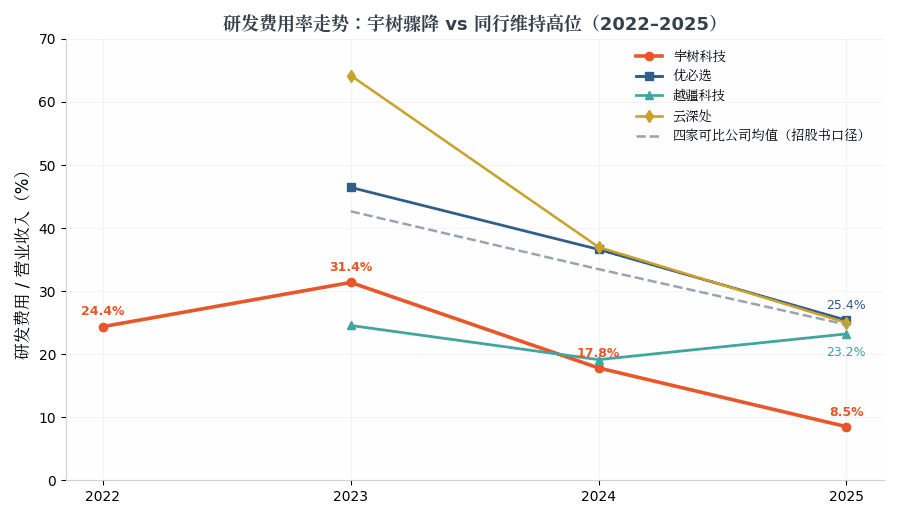
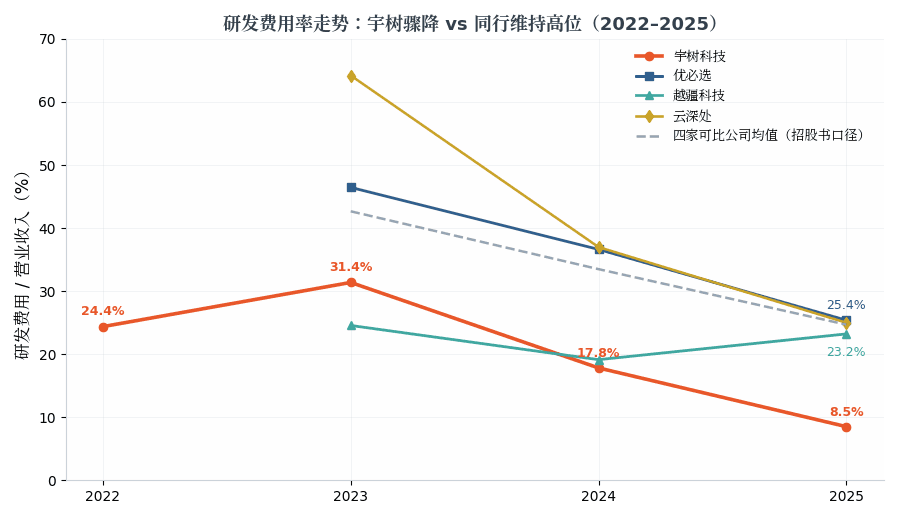
Unitree's "low" R&D expenditure is real, but it is "low" in relative terms, not in trend: From 2022 to 2025, its R&D expenses increased from RMB 29.98 million to approximately RMB 145 million, growing year by year in absolute terms. What actually plummeted was the R&D expense ratio—from 31.39% in 2023 down to 8.53% in 2025 (even dipping to 7.73% in the first three quarters). During the same period, the average for the four comparable companies—UBTECH, Dobot, CloudMinds, and Leju—was 24.7% (CNFOL Finance). The main reason for the sharp decline in the ratio is the denominator effect: revenue surged 332% to RMB 1.699 billion in 2025, with revenue growth nearly four times the growth rate of R&D investment (36Kr).
However, "low R&D" is also a result of strategic choices: Unitree has adopted a "cerebellum-first, cost-leading" approach, concentrating resources on deterministic hardware such as motors, reducers, and motion control (with over 90% self-developed core components and a BOM cost of approximately RMB 41,600 for the G1). In contrast, investment in the "brain" of embodied intelligence has been restrained—the prospectus admits that during the reporting period, its self-developed general-purpose embodied large model had not yet been applied at scale to products (Sina Tech).
The assessment of "true technological strength" is layered: In four dimensions—motion control (cerebellum), hardware engineering, cost control, and mass production commercialization—Unitree is among the global top tier or even number one. However, it lags significantly in embodied intelligence large models, patent reserves (only 20 domestic invention patents, roughly 1/87 of UBTECH's), and R&D talent scale (175 people vs. UBTECH's 948) (Sina Finance). The low R&D expenditure buys a better-looking current income statement (2025 non-GAAP net profit of approximately RMB 591 million, making it one of the few profitable robot manufacturers globally), but at the cost of ammunition disadvantage in the brain race—which is precisely why nearly half (RMB 2.022 billion) of its IPO proceeds of RMB 4.202 billion are earmarked for "intelligent robot model R&D" (36Kr).
1. Factual Layer: How "Low" Is Unitree's R&D Expenditure Really?
1.1 Three Sets of Numbers to See "Low"
Unitree's R&D data needs to be examined in three different scopes; mixing them together is the source of most misunderstandings.
The first set is absolute amounts. During the reporting period (2022–first three quarters of 2025), R&D expenses were RMB 29.9848 million, RMB 49.9518 million, RMB 70.0170 million, and RMB 90.2094 million, respectively; for the full year 2025, it was approximately RMB 145 million (CNFOL Finance). Absolute amounts have grown every year, and the first three quarters of 2025 alone already exceeded the full year of 2024—the company has not cut R&D.
The second set is relative values (expense ratios). From 2022 to 2025, R&D expense ratios were 24.39%, 31.39%, 17.84%, and 8.53%, respectively, a decline of about 23 percentage points over two years (CNFOL Finance). This decline is unique in the industry: during the same period, UBTECH fell from 46.46% to 25.4%, Dobot remained in the 19%–24.6% range, CloudMinds dropped from 64.2% to 25.0%, and the average for the four comparable companies in 2025 was still 24.7%—Unitree is less than one-third of that (Guancha).
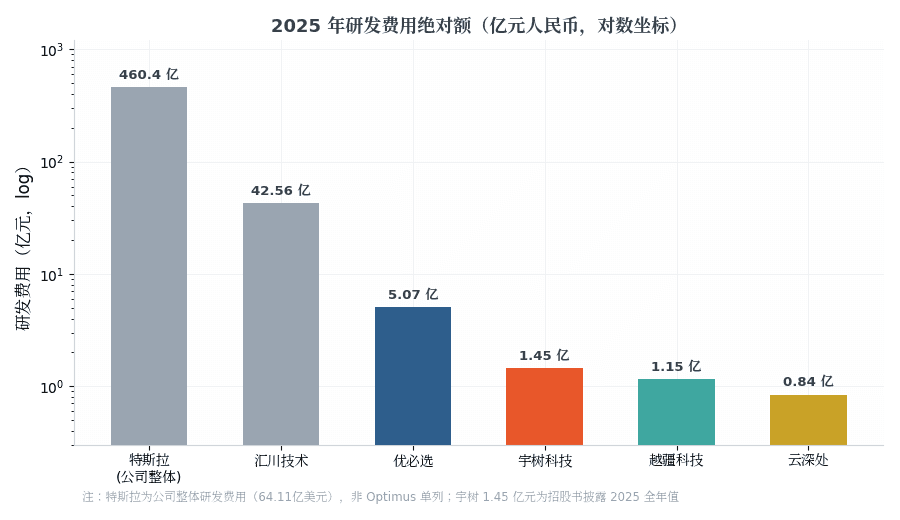
The third set is the absolute gap with peers. Over the three full years from 2022 to 2024, Unitree's total R&D expenses were approximately RMB 150 million, only about one-ninth of UBTECH's total during the same period (RMB 1.397 billion). In 2024 alone, UBTECH's R&D investment was RMB 478 million, nearly seven times that of Unitree (Sina Finance). In a broader context: Inovance Technology's 2025 R&D investment was RMB 4.256 billion (expense ratio 9.44%), and Tesla's company-wide R&D expenses in 2025 were USD 6.411 billion (approximately RMB 46 billion, up 41.2% year-over-year) (sina.com.cn).
1.2 Internal Structure of R&D Expenditure: Where the Money Goes
Looking at the expense structure, Unitree's R&D spending is highly "labor-intensive": employee compensation has consistently accounted for 63%–70% of R&D expenses. In the first three quarters of 2025, out of RMB 90.2094 million in R&D expenses, employee compensation was RMB 57.0798 million, accounting for 63.27%, with an average monthly salary of approximately RMB 36,200 per R&D personnel. From 2022 to 2024, the average annual salary of R&D personnel rose from RMB 302,500 to RMB 463,600 (CNFOL Finance). This indicates that Unitree's R&D is almost entirely expensed, with little capitalization and limited large-scale equipment or computing power expenditures—a supporting piece of evidence is that "cloud computing rental and cloud service fees" only increased from RMB 1.13 million in the full year 2024 to RMB 8.345 million in the first three quarters of 2025, after strengthening large model R&D (Tencent News).
From the perspective of ongoing projects, the shift in investment focus is clear: in the first three quarters of 2025, the "bionic small bipedal robot project" received RMB 25.3668 million, and the "multimodal general-purpose embodied intelligence large model project" received RMB 13.0496 million, together accounting for 42.6% of current R&D expenses (TMTPost). Hardware remains the core, but the "brain" has started to burn cash—this also foreshadows a likely rebound in the R&D expense ratio after listing.
1.3 R&D Team: Lean but Thin
As of the end of September 2025, Unitree had 480 employees, of whom 175 were R&D personnel, accounting for 36.46%, more than double the 72 at the end of 2022. The R&D team includes 4 PhDs and 69 master's degree holders, covering 12 key positions such as AI algorithms, motion control, and perception interaction (jinantimes.com.cn). For comparison, UBTECH's R&D team has 948 people (430 with master's degrees or above), Dobot has 241 R&D personnel, and Zhiyuan's backdoor-listed Shanghai Wei New Materials has 180–227 people in its consumer-grade embodied robot R&D team alone (with over 67% holding master's or doctoral degrees) (Shenzhen News).
More noteworthy is the structural thinness: Unitree has only 3 recognized core technical personnel (Wang Xingxing, Yang Zhiyu, Zhang Yangguang), with no additions during the reporting period. Moreover, of the 26 recipients of equity incentives across two phases from 2017 to 2024, 9 have already left, a turnover rate of 34.6% (TMTPost). For a company aiming for "full-stack self-development," this is a talent depth risk that cannot be ignored.
2. Attribution Layer: Why Is Unitree's R&D Expenditure Low?
2.1 Denominator Effect: The Most Direct Accounting Explanation
R&D expense ratio = R&D expenses ÷ Operating revenue. From 2023 to 2025, Unitree's R&D expenses increased from RMB 49.95 million to approximately RMB 145 million (about 2.9 times), while operating revenue surged from RMB 159 million to RMB 1.699 billion (about 10.7 times), with a year-over-year growth of 332%–335% in 2025 alone (36Kr). The numerator is rising, but the denominator is rising faster—Unitree's official explanation in the prospectus is precisely that "operating revenue grew rapidly, with revenue growth far exceeding R&D expense growth, leading to a relative decline in the R&D expense ratio due to economies of scale" (ifeng.com).
This logic has precedents in tech history: Tesla's R&D expense ratio fell from 7.0% to 4.7% between 2018 and 2020, but its absolute R&D spending did not decline; the market eventually accepted the "denominator effect" explanation (Tencent News). The difference is that Tesla's absolute investment scale at the time (over a billion USD per year) was sufficient to support multiple technology fronts simultaneously, whereas Unitree's annual R&D investment of RMB 145 million raises the real question of whether it can sustain a dual-front battle of "body + brain."
2.2 Strategic Choice: A Proactively "Restrained" Cerebellum-First Strategy
The denominator effect is merely an accounting appearance; the deeper reason is the active choice of technical roadmap. Unlike UBTech's "brain + cerebellum full-stack emphasis" and Zhiyuan's "more than three-quarters of R&D manpower and expenses invested in the brain and cerebellum AI," Unitree has taken the "cerebellum-first, cost-leading" route: first perfecting the most certain hardware—motors, reducers, and motion control—to the extreme, rapidly scaling up with ultimate cost-effectiveness, and then circling back to strengthen the brain (Sina Finance).
The rationality of this route is based on founder Wang Xingxing's judgment in 2016: electric drive (direct-drive outer-rotor brushless motors) replacing hydraulics can make robots "lower cost, higher reliability, and easier to commercialize" (chinaventure.com.cn). A decade later, it has proven correct—Unitree's R&D is highly focused on reusable, engineerable, and quickly monetizable directions: the motors, reducers, and motion control algorithms of quadruped robots can almost be directly transferred to humanoid robots. The "Superman" humanoid robot went from project initiation to completion in just over 3 months, and this iteration speed itself reflects R&D efficiency (pconline.com.cn). When R&D avoids spreading thin and speculative fronts, costs naturally stay low.
2.3 Supply Chain Dividend: China Manufacturing's "External R&D Subsidy"
Unitree's third pillar of low R&D costs is its position atop the world's thickest robot supply chain. The company's core components are self-developed and self-produced at a rate exceeding 90%—motors, reducers, encoders, drivers, and controllers are all independently designed, with only raw materials like copper wire and magnets purchased externally; outsourced components (battery cells, computing modules, storage modules, some sensors, and optional high-spec LiDAR/dexterous hands) account for only 14%–18% of total cost (Mobile Sina). Self-produced motor costs can be as low as 30%–40% of overseas counterparts, with the G1's full material cost around 41,600 RMB, estimated at approximately 8,976 USD by overseas teardown analyses (Mobile Sina).
The key point: a 90% self-research rate is only possible because of the mature supply chain support in the Yangtze River Delta/Pearl River Delta—"suppliers to robot companies are just a few hours away by high-speed rail, samples arrive the same or next day, and vertical iteration is measured in weeks, not quarters" (zhidx.com). In effect, the R&D accumulation of China's entire manufacturing sector over the past two decades in motors, precision machining, and lithium batteries has become an "external R&D subsidy" that Unitree doesn't need to repay. American peers lack this subsidy: Boston Dynamics' per-unit cost is hundreds of thousands of dollars, Figure 03 is priced over 50,000 USD, while Unitree's G1 sells for about 27,300 USD including tax, and the R1 Air starts at just 29,900 RMB domestically (sina.cn).
2.4 The "Time Lag" in Brain Investment: Not Yet at the Stage of Heavy Spending
The final reason is the most direct: embodied intelligence large models are currently the most expensive R&D direction in the robotics industry, and Unitree's substantial investment in this area has only just begun. The prospectus states candidly: "Early R&D focused on body structure and motion control... Starting in 2024, we gradually increased investment in embodied large models; with global technical routes and data scenarios still unclear, we have not yet conducted large-scale real-data collection or factory deployment training during the reporting period" (36Kr). The company only open-sourced the WMA architecture model UnifoLM-WMA-0 in September 2025 and the VLA architecture model UnifoLM-VLA-0 in January 2026, and during the reporting period, it had not yet scaled its self-developed general-purpose embodied large model into products (Wallstreetcn).
Comparing the spending scale of the "brain school" reveals how much this "time lag" is worth: Zhiyuan invests over three-quarters of its R&D resources in AI brain and cerebellum; UBTech allocates about 70% of R&D to software directions (embodied large model Thinker, world model Thinker-WM, swarm brain network); Figure AI has raised approximately 1.9 billion USD cumulatively, with the vast majority burned on the Helix large model and GPU computing (iyiou). Over the past three years, Unitree has largely avoided this computing arms race, which is a key reason for its low expense ratio and consecutive profitability in 2024–2025 (2025 non-GAAP net profit of approximately 591 million RMB) (TMTPost)—but you can run only so far, and this is exactly what the next section will discuss.
III. Comparison Layer: Peers' R&D Ledgers
3.1 Panoramic Comparison of Domestic Peers
The table below summarizes the R&D investments and key operational data of major domestic robot companies (fiscal year 2025, unless otherwise noted):
| Company | Revenue | R&D Expenses | R&D Expense Ratio | R&D Personnel | Authorized Patents (Inventions) | Profit/Loss | Main Application Scenario |
|---|---|---|---|---|---|---|---|
| Unitree Robotics | RMB 1.699 billion (36Kr) | Approx. RMB 145 million (InfoObs) | 8.53% | 175 people (36.5%) (jinantimes.com.cn) | 262 items (35 inventions) (Guancha.cn Fengwen Community) | Non-GAAP net profit +RMB 591 million (TMT Post) | Scientific research & education + commercial consumption (over 70%) (Guancha.cn Fengwen Community) |
| UBTECH | RMB 2.001 billion (Sina Finance) | RMB 507 million (leaderobot.com) | 25.4%–25.6% | 948 people (430 master's/PhD) (Shenzhen News Network) | 2,985 items (1,742 inventions, world No.1 in humanoid patents) (Shenzhen News Network) | Net loss RMB 789 million (Sina Finance) | Industrial manufacturing (auto factories, etc., over 500 units delivered in industrial scenarios) (Xueqiu) |
| Dobot (Yuejiang Tech) | RMB 493 million (China Industry News Network) | RMB 115 million (cninfo.com.cn) | 23.23% | 241 people (31.4%) (China Industry News Network) | 625 domestic items (233 inventions) (China Industry News Network) | Net loss RMB 84 million (China Industry News Network) | Collaborative robots (global share 13.2%, No.1) (China Industry News Network) |
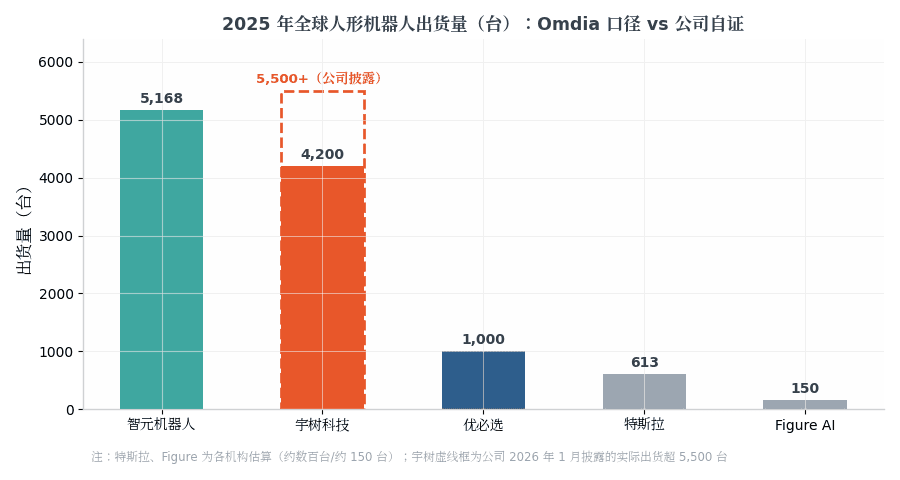
| Agibot (Zhiyuan Robot) | 2025 revenue over RMB 1 billion (East Money Guba) | Not separately disclosed; shell entity Swancor 2026H1 R&D RMB 180 million, ratio 22.46% (cj.sina.cn) | — | Swancor basis: 227 people (67% master's/PhD) (tidenews.com.cn) | Swancor basis: 273 cumulative applications (tidenews.com.cn) | Loss (shell entity 2026H1 loss RMB 167 million) (cj.sina.cn) | Entertainment & commercial performances, data collection, industry (global shipment No.1, 5,168 units/Omdia) (East Money Guba) |
| Deep Robotics (Yunshenchu) | Approx. RMB 340 million (back-calculated from ratio) | RMB 84.2 million (InfoObs) | 25.0% | 172 people (40.3%) (Xueqiu) | 121 items (25 inventions) (Guancha.cn Fengwen Community) | Loss | Four-legged industrial applications (power line inspection, etc.) (Xueqiu) |
| Leju Robotics (Leju Intelligent) | Approx. RMB 260 million (per prospectus) | Not fully disclosed; plans to raise RMB 2.6 billion for R&D and datasets (The Paper) | — | 149 people (31.8%) (Beijing Business Today) | 175 items (85 inventions) (Guancha.cn Fengwen Community) | Loss, earliest expected turnaround in 2028 (The Paper) | Scientific research & education, data collection |
| Inovance Technology (industrial control reference) | RMB 45.105 billion (sina.com.cn) | RMB 4.256 billion (sina.com.cn) | 9.44% | 7,670 people (sina.com.cn) | 3,375 patents and software copyrights (sina.com.cn) | Net profit attributable to parent RMB 5.05 billion (sina.com.cn) | Industrial automation |
Several structural observations are worth elaborating. First, Unitree is the only company with a significantly lower expense ratio than peers while also being the only one to achieve large-scale profitability — these two facts are causally linked: the low expense ratio protects profits, and profitability frees the company from relying on external financing (holding RMB 1.8 billion in cash before IPO with no short-term loans) (CNFO Online Finance). Second, UBTECH's loss-for-R&D model and Unitree's profit-funded R&D model essentially represent two different scenario choices — UBTECH focuses on demanding applications like automotive factories requiring "8-hour continuous operation without downtime and millimeter-level precision," necessitating sustained investment in industrial AI applications; the Walker S2 costs about RMB 760,000 per unit, with 1,079 full-size humanoid robots delivered in 2025. Unitree's core markets are scientific research & education and commercial consumption, where users are price-sensitive and relatively less demanding on durability; the G1's hardware cost can be compressed to RMB 60,000–70,000 (ifeng.com). Third, even the 'second tier' is making heavy bets on the 'brain': Deep Robotics plans to allocate 46.7% of its proposed RMB 2.503 billion fundraise to embodied algorithms and models; Leju Robotics separately lists "high-quality large-scale dataset construction projects" in its fundraising purposes (Xueqiu). Across the entire industry, only Unitree's R&D expense structure remains primarily hardware-focused.
3.2 International Peers: An Arms Race of a Different Magnitude
Most overseas comparable companies are not publicly listed and do not disclose R&D expenses under audit standards, but their funding amounts and headcounts are sufficient to reflect the scale of investment. Figure AI has raised approximately $1.9 billion in cumulative funding, with a valuation of $39 billion (Series C, September 2025), and employs about 425 people. Its core investment is in the fully self-developed Helix vision-language-action large model and the BotQ factory (designed annual capacity of 12,000 units), yet it shipped only about 150 units in all of 2025—the money it burned is roughly dozens of times Unitree's total R&D spending over a decade, while its shipments are less than 3% of Unitree's (Tech Market Briefs) . Agility Robotics has raised approximately $640 million in cumulative funding, with a valuation of $2.12 billion, and its RoboFab factory plans an annual capacity of 10,000 units (Sacra) . Boston Dynamics, backed by Hyundai Motor Group (which acquired an 80% stake for $1.1 billion in 2021; Hyundai announced a $21 billion U.S. investment plan in 2025, with $6 billion earmarked for robotics and AI), plans to ship about 1,500 units of its electric Atlas in 2026, with a target annual production of 30,000 units by 2028 (humanoid.guide) . Tesla reported company-wide R&D expenses of $6.411 billion in 2025 (up 41.2% year-over-year), with AI and Optimus being the primary growth areas; the Optimus Gen-3 is planned for release in Q1 2026, with production starting by year-end, and a long-term goal of million-unit annual capacity (Macrotrends) .
Looking at these two lines together, a clear contrast emerges: Chinese companies fight this war with "engineering efficiency," while American companies fight it with "capital density." Unitree's 2025 R&D expenses were approximately $20 million, even less than a fraction of Figure AI's single funding round, yet it achieved a 32.4% global share of humanoid robot shipments (company-reported over 5,500 units) (pconline.com.cn) . This is not a question of right or wrong, but rather the optimal solution under two different resource endowments—China's supply chain advantages lower the R&D cost of "building the body," while America's computing power and capital advantages are concentrated in "building the brain."
3.3 R&D Efficiency: How Extreme Is Unitree's "Input-Output Ratio"
If we roughly measure R&D commercialization efficiency by "revenue generated per yuan of R&D spending," Unitree achieves approximately 11.7 yuan in 2025, UBTech about 3.9 yuan, JAKA about 4.3 yuan, and Deep Robotics about 4.0 yuan; measured by revenue per R&D employee, Unitree reaches about 9.71 million yuan per person, which is 4.6 times that of UBTech (about 2.11 million yuan per person).
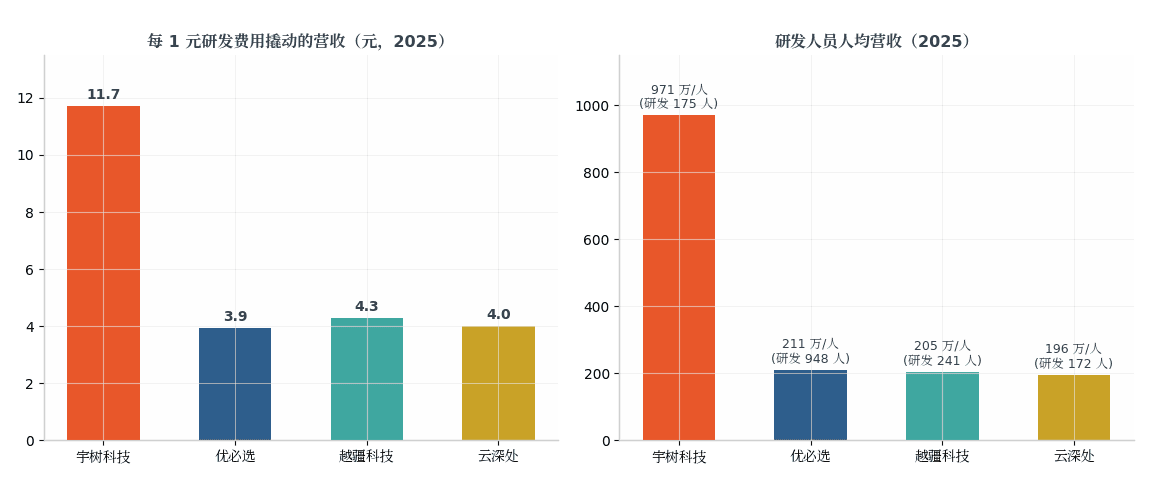
However, it must be noted that this metric has limitations: it rewards "rapid productization of mature technology" and penalizes "betting on uncertain long-term technology." UBTech's R&D generates only 3.9 yuan in revenue per yuan, but of its 507 million yuan R&D spending, about 70% goes to software and the brain, resulting in 1,742 invention patents, the world's largest number of humanoid robot patents, and an early foothold in industrial scenarios (Sina Finance) . The true measure of R&D efficiency can only be answered on a decade-long scale—this is also why the capital market assigns completely different valuation logics to the two companies (Unitree's issue market cap of 61 billion yuan corresponds to a "profit-driven" PE of about 70x, while UBTech's Hong Kong market cap once reached 56 billion HKD, driven by "story + option" logic) (ifeng.com) .
IV. Evaluation Layer: Real Technological Strength Behind "Low R&D"
4.1 A Six-Dimensional Evaluation Framework
R&D expenses are only a proxy variable for technological strength, not the strength itself. This report evaluates "real technological strength" from six dimensions: motion control (cerebellum), embodied intelligence large models (brain), patents and IP reserves, mass production and commercialization, cost control/supply chain, and R&D talent scale. It should be noted that the chart below is a qualitative scoring (1–5 points) based on public evidence, intended to illustrate structural differences rather than precise measurements.
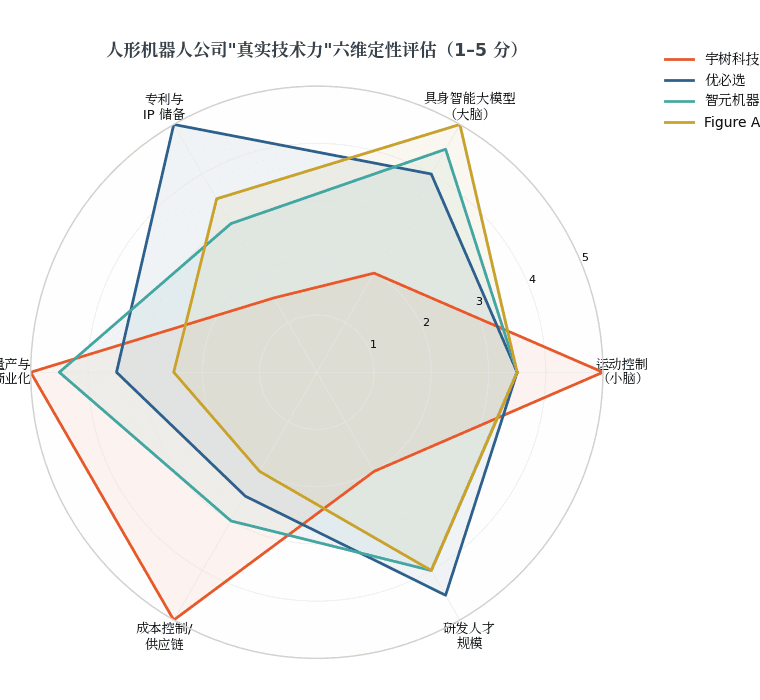
4.2 Unitree's Strengths: The Body and the Art of Building the Body
In the motion control dimension, Unitree is a globally recognized top player. In H1 2023, it broke the full-size humanoid walking speed record at 3.3 m/s; in August 2026, its "Superman" robot achieved a standing vertical jump of 2 meters and a top speed of 12.66 m/s (adjusted for leg length, surpassing human records); during the 2026 Spring Festival Gala's "Wu BOT" performance, dozens of G1/H2 robots executed difficult moves such as drunken boxing, nunchaku, and a three-meter airborne backflip in a live global broadcast with no remote control or editing, achieving zero errors throughout, with a fastest positioning speed of 4 m/s (ifeng.com) . Its self-developed M107 joint motor delivers a maximum torque of 360 N·m, with torque density at a globally leading level (ifeng.com) .
In the mass production and commercialization dimension, Unitree has the strongest evidence chain: in 2025, it shipped over 5,500 humanoid robots (company-reported; Omdia estimates 4,200), securing a global share of about 32.4%, ranking first; its quadruped robots have held about 70% of the global market for years; its overall gross margin is 60.13%–60.27%, with humanoid robot gross margin around 63%, making it one of the very few profitable whole-machine companies in the industry (Sina Finance) . There is also an often-overlooked "ecosystem technological strength": Unitree maintains 47 open-source projects on GitHub, with the unitree_rl_gym community star count around 3.3k, providing three reinforcement learning simulation-to-real (Sim2Real) pipelines via Isaac Gym/Isaac Lab/MuJoCo—a large number of university labs worldwide use Unitree hardware as the standard platform for embodied intelligence research, a developer ecosystem and potential data entry point that is difficult for competitors to replicate, earned through low-cost hardware (CSDN Blog) .
4.3 Unitree's Weaknesses: Brain, Patents, and Talent Depth
The weaknesses are equally clear. First, the brain. Unitree's prospectus admits that during the reporting period, it did not scale its self-developed general-purpose embodied large model to products, only piloting it in its own factory; in contrast, UBTech's open-source embodied large model Thinker has "won nine global firsts" and formed a closed loop in industrial scenarios, Figure's Helix 02 has achieved whole-body control with a single neural network and completed a 200-hour continuous warehouse operation livestream, and AgiBot has established itself through high-quality operation datasets and open-source strategies (Sina Finance) . The industry's assessment of "strong body, weak brain" still holds for Unitree (36Kr) .
Second, patents. As of January 31, 2026, Unitree holds 262 patents, of which only 20 are domestic invention patents (invention patents account for 11.8% of domestic patents, and 11 of the 20 were filed after March 2025—only 9 were accumulated in the previous nine years); it has 93 overseas patents, including 15 inventions (Sina Finance) . In comparison, UBTech has 2,985 granted patents (1,742 inventions, 508 overseas), JAKA has 233 domestic inventions, and Leju has 85 inventions. Unitree's patent defense system is severely mismatched with its "world's No.1 in shipments" status, and its prospectus itself lists "insufficient patent numbers, making it difficult to effectively prevent technology infringement risks" as a risk factor (Shenzhen News) . (To be fair, Unitree's 2017 patent for an electric-driven quadruped leg power system has been cited 114 times, indicating that its early core patents are of high quality; the issue lies in quantity and temporal distribution (TMTPost) .)
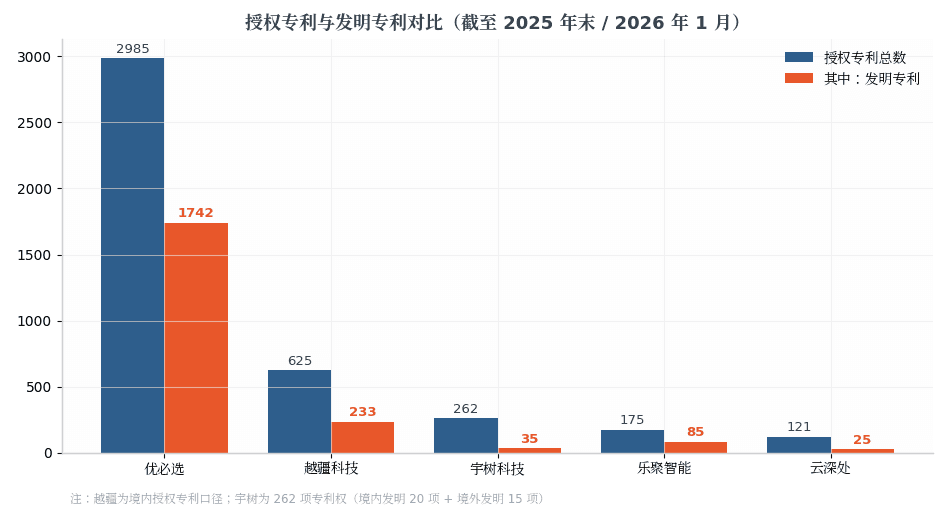
Third, talent depth, referring to the aforementioned 175-person R&D team, 3 core technical personnel, and a 34.6% turnover rate among incentive recipients (TMTPost) . These three weaknesses collectively point to a conclusion: Unitree's low R&D spending is not "doing the same amount of R&D with less money," but rather "selectively not doing a portion of R&D"—its technological strength structure is lopsided.
4.4 Benchmarking Against Peers
UBTECH is the control group for "full-stack heavy R&D": a 948-person R&D team, 70% of R&D investment in software, a tech stack comprising the Thinker large model + world model + swarm brain network, 1,742 invention patents, and leadership in multiple national standards for humanoid robots—at the cost of a net loss of 789 million yuan in 2025 (Sina Finance). Zhiyuan represents the "AI-native" path: founded only three years ago, it achieved shipments of 5,168 units in 2025 (ranked first globally by Omdia) and revenue exceeding 1 billion yuan, relying on data闭环 and open-source ecosystems. Over three-quarters of its R&D resources are allocated to the brain and cerebellum. After backdoor listing via Shangwei New Materials, it invested 180 million yuan in R&D in just the first half of 2026 (R&D expense ratio of 22.46%) (East Money Guba). Figure AI represents the extreme of the "capital + large model" path: nearly all of its $1.9 billion in funding is bet on Helix and BotQ. An 11-month pilot at a BMW factory (30,000 vehicles, 90,000 parts, 1,250 hours) is currently the most convincing industrial validation overseas (Tech Market Briefs). Yuejiang, Deep Robotics, and Leju have each validated differentiated paths such as "collaborative arm reuse," "quadruped industry applications," and "dataset construction," with R&D expense ratios all maintained in the 19%–25% range (China Industry News Network).
Juxtaposing these reveals the true picture of the industry: In the "cerebellum/body" dimension, Unitree's low R&D has not caused it to fall behind; instead, it has established a generational cost advantage. In the "brain" dimension, the gap caused by low R&D is objectively real, and this dimension is precisely the variable that industry consensus believes determines long-term victory—"the industry's competitive focus is shifting from 'who moves better' to 'who thinks better'" (iyiou).
V. Deduction Layer: Is the Low R&D Model Sustainable?
5.1 Arguments Supporting "Sustainability"
The core argument of the optimistic camp is the authenticity of R&D efficiency. Unitree's low expense ratio is not the result of cutting investment but a structural product of "focus + reuse + supply chain dividends": quadruped and humanoid robots share motors, reducers, and motion control stacks, diluting the marginal R&D cost of each product line; self-developed core components allow it to profit from both "upstream components" and "whole machine assembly" (gross margin rising from 44% to 60% in three years); and the company is not short of cash—holding 1.8 billion yuan in cash before listing with no short-term borrowings, and a non-GAAP net profit of 591 million yuan in 2025, theoretically allowing it to increase investment at any time (CNFolio Finance). Judging from its performance at the 2026 Spring Festival Gala, the iteration speed of its motion capabilities (from yangge dance to drunken fist backflips in one year) has not slowed due to the declining expense ratio (Tencent News).
5.2 Arguments Supporting "Unsustainability"
The pessimistic camp sees three looming pressures. First, the entry fee for the brain race is computing power and data, neither of which can be cheaply obtained through "engineer dividends"—cloud computing rental fees have already entered Unitree's top five R&D expense items. Once large model R&D enters a high-intensity consumption phase, the R&D structure will shift from "labor-cost-dominated" to "labor + computing power both high" (Tencent News). Second, price cuts to boost volume are eroding the profit cushion: the average unit price of humanoid robots fell from 593,400 yuan in 2023 to 167,600 yuan in 2025. In Q1 2026, revenue growth slowed to 68.49%, and non-GAAP net profit fell 52.55% year-on-year—if revenue growth returns to normal while absolute R&D investment must increase, both the expense ratio and profit margin will come under pressure (TMT Post). Third, concerns about customer structure: scientific research, education, and commercial consumption account for over 70% of Unitree's revenue. The company admits in its prospectus that "it does not fully grasp the specific usage scenarios of its customers, and its current advantage relies mainly on cost-effectiveness rather than irreplaceability"—such markets can support shipment volumes but cannot sustain industrial-grade data闭环 and scenario depth (Guancha.cn Fengwen Community).
5.3 The Direction of Raised Funds Is the Company's Own Answer
The company provides its own answer to the above debate through its fundraising structure: of the 4.202 billion yuan in proposed raised funds, 85% is allocated to R&D, with the largest single item being the "Intelligent Robot Model R&D Project" at 2.022 billion yuan (48% of total, including 721 million yuan for R&D personnel salaries and approximately 900 million yuan for implementation costs like cloud computing), exceeding the sum of body R&D (1.110 billion yuan) and manufacturing base (624 million yuan); the three R&D projects collectively plan to recruit R&D personnel for approximately 50 types of positions within three years, with a total salary budget exceeding 1.1 billion yuan (rccaijing.com). A company that went public on the strength of its hardware manufacturing capabilities is placing its largest fundraising bet on the part it is least good at and hardest to buy—"an R&D expense ratio of 8.53%" is likely the lowest point in Unitree's history, not the norm (36Kr).
5.4 Industry Coordinates: Competitive Position in 2026
Placing Unitree back into the 2026 industry coordinate system: there are over 140 domestic humanoid robot manufacturers and over 330 released products. In 2025, the sector raised over 51.1 billion yuan in financing (3.5 times year-on-year), with at least 13 unicorns valued at over 10 billion yuan (Huxiu). Tesla Optimus Gen-3, Figure BotQ production lines, and the ten-thousand-unit capacity plans of Zhiyuan and UBTECH will all be realized or disproven between 2026 and 2028 (chinaventure.com.cn). Unitree currently holds a triple lead in shipment volume, cost, and profitability, but the length of its lead window depends on whether it can use the 6.1 billion yuan raised from its IPO to fill the "brain gap" in the brain race—while not losing the engineering efficiency that keeps its R&D expense ratio low.
VI. Conclusion
Unitree Technology's "low" R&D expense is a three-layer nested phenomenon: the surface layer is the denominator effect (a 332% surge in revenue dilutes the expense ratio), the middle layer is route selection (prioritizing the cerebellum, focusing on reusable deterministic hardware, and temporarily avoiding the computing power arms race), and the bottom layer is endowment utilization (China's supply chain dividends + founder-level technical intuition + high per-capita efficiency of a lean team). The combination of these three layers has created a unique profile—"145 million yuan in R&D expenses, 5,500 units shipped globally (first place), and 591 million yuan in non-GAAP net profit"—unmatched anywhere in the global robotics industry.
The account books of peers provide a complete comparison spectrum: UBTECH (507 million R&D / 25.4% expense ratio / 948 people / 2,985 patents, trading for industrial scenario positioning and brain depth at the cost of an annual loss of 789 million), Zhiyuan (over three-quarters of R&D invested in the brain, trading for top shipment volume in three years), Figure ($1.9 billion in funding, trading for the Helix large model and BMW production line validation), and Inovance (4.256 billion R&D / 9.44% expense ratio, the benchmark investment intensity of a mature industrial leader). No company is "right"—they are merely prepaying different ticket prices for their respective judgments of the endgame.
The final judgment on "true technical capability" is this: Unitree has achieved world-class proficiency in "building the robot body" and proven that this skill can be directly monetized. But the next exam in the robotics industry is the "brain"—the exam fee is high, there are no retakes, and the examiners (generalization ability and real-world scenario data) will not lower the standard just because the candidate was previously unbalanced. Unitree's low R&D expense is neither a sin nor a medal, but a time-limited boarding pass—the 2.022 billion yuan bet on embodied models in its fundraising is the start of the redemption. For observers, the truly noteworthy indicator is not the R&D expense ratio itself, but whether Unitree's absolute R&D investment can reach the 1 billion yuan level between 2026 and 2028, whether invention patent applications can continue to grow, and whether the UnifoLM series of models can move from open-source demos to large-scale deployment.
Disclaimer: This report is compiled and analyzed based on public information. All data sources are marked. The company comparisons and six-dimensional scores in the text contain subjective judgments based on public evidence. This report is for general information reference only and does not constitute any investment advice. Market risks exist; investment requires caution.
(IT之家) : https://ithome.com/tags/%E5%AE%87%E6%A0%91%E7%A7%91%E6%8A%80
(Tencent News) : https://view.inews.qq.com/a/20260513A02WOE00
(ifeng.com) : https://h5.ifeng.com/c/vivoArticle/v002jSeeZ6nP2RZGU1EPAXMFTwhWM5wVGejtjremNB--Ixwc__?vivoBusiness=hiboardnews
(ifeng.com) : https://h5.ifeng.com/c/vivo/v002yHRbgnQBlSDob--syS--EDySwc3zFE--NeFoOm--lLfNuts__?isNews=1&showComments=0
(Sina) : https://k.sina.com.cn/article_7879922977_1d5ae152106801iic6.html?from=finance
(Xueqiu) : https://xueqiu.com/1866014742/405650987
(ZAKER) : https://app.myzaker.com/news/article.php?pk=6a7c542c8e9f094ad6555021
(China Industry News Network) : https://www.cinn.cn/yc/2026/07-30/PDEpMndr.html
(cninfo.com.cn) : http://dataclouds.cninfo.com.cn/sjother2/documents/2026/2026-07-15/08d3ba075e763ad581b4455ea6fc3597.pdf
(Sina Finance) : https://finance.sina.com.cn/stock/observe/2026-03-27/doc-inhsmnzp9517235.shtml?wm=
(TMTpost) : https://www.tmtpost.com/7924277.html
(chinaventure.com.cn) : https://m.chinaventure.com.cn/news/78-20260326-390666.html
(Wall Street CN) : https://wallstreetcn.com/articles/3773085
(Guancha Fengwen Community) : https://user.guancha.cn/main/content?id=1660847&s=fwtjgzwz
(pconline.com.cn) : https://zhizao.pconline.com.cn/2180/21805726.html
(feheadline.com) : https://webapp.feheadline.com/news/10593108/58467
(East Money Guba) : https://guba.eastmoney.com/news,hk09880,1650922327.html
(Huxiu) : https://www.huxiu.com/article/4830308.html
(Sina Finance) : https://finance.sina.cn/tech/2026-01-23/detail-inhifzue2170031.d.html?vt=4
(Opening a 30,000 yuan massage chair: 10 massages, 7 times falling asleep) : https://t.cj.sina.cn/articles/view/1278485542/4c34242602002dvba
(tidenews.com.cn) : https://tidenews.com.cn/news.html?id=3530740
(The Robotic Life) : https://theroboticlife.com/top-10-humanoid-robot-startups-2026/
(Tech Market Briefs) : https://techmarketbriefs.com/pre-ipo/figure-ai/
(jinantimes.com.cn) : https://www.jinantimes.com.cn/news-70-10403997.html
(Sacra) : https://sacra.com/c/agility-robotics/
(Layer3 Labs) : https://www.layer3labs.io/robotics/humanoid-robot-companies
(humanoid.guide) : https://humanoid.guide/fr/robotique-humanoide-la-carte-de-la-consolidation/
(CNFOL Finance) : http://mp.cnfol.com/31441/article/1776133839-142358176.html
(Macrotrends) : https://www.macrotrends.net/stocks/charts/TSLA/tesla/research-development-expenses
(Sina) : http://k.sina.com.cn/article_7857201856_1d45362c001903hteu.html
(XC Sports Technology Co., Ltd.) : https://www.falconvac2008.com/news/1221.html
(Wallstreet Sights) : https://wallstreetcn.com/articles/3768005
(rccaijing.com) : https://m.rccaijing.com/news-7441267069385635239.html
(Mobile Sina) : https://tech.sina.cn/2026-08-18/detail-ininthzt7354354.d.html?vt=4&cid=79649&node_id=79649
(sina.cn) : https://cj.sina.cn/articles/view/7880068204/1d5b04c6c06801fjgy?froms=ggmp&vt=4
(Sina) : https://k.sina.com.cn/article_7879848993_1d5acf42106802yzqo.html?from=tech
(zhidx.com) : https://m.zhidx.com/p/564434.html
(OFweek Robot) : https://robot.ofweek.com/2026-08/ART-898890-12005-30697537.html
(TMTPost) : https://www.tmtpost.com/8056293.html
(ifeng.com) : https://h5.ifeng.com/c/vivo/v002XAnPANK3kSTmAAU5gIz-_ASiRywIH--8AM7yeigHSM9YQ__?isNews=1&vivoBusiness=browser&showComments=0
(Sina Finance) : https://cj.sina.com.cn/articles/view/7879848900/1d5acf3c406802zvwi?froms=ggmp
(Sina Finance) : https://finance.sina.com.cn/stock/csjzbj/2026-08-10/doc-inimvnpi1258897.shtml?froms=ggmp
(EEFocus) : https://www.eefocus.com/article/2026974.html
(Xueqiu) : https://xueqiu.com/7157351566/392299319
(Shenzhen News) : http://www.sznews.com/news/content/2026-03/31/content_31999448.htm?prolongation=1
(leaderobot.com) : https://www.leaderobot.com/news/7511
(CSDN Blog) : https://blog.csdn.net/u011487024/article/details/162086616
(Sina Finance) : https://finance.sina.com.cn/wm/2026-04-01/doc-inhsynca1799944.shtml
(36Kr) : http://www.36kr.com/p/3947320384208256
(Xueqiu) : https://xueqiu.com/9210717241/389757778
(sina.com.cn) : https://money.finance.sina.com.cn/corp/view/vCB_AllBulletinDetail.php?stockid=300124&id=12222830
(Infoobs) : https://www.infoobs.com/article/20260727/71701.html
(Beijing Business Today) : https://m.bbtnews.com.cn/article/229429
(ageclub.net) : https://m.ageclub.net/article-detail/8720
(EqualOcean) : https://www.iyiou.com/analysis/202606011131578
(The Paper) : https://www.thepaper.cn/newsDetail_forward_33200994