Comparison of On-Chain Transaction Channel Fees: On the Same Chain, Which Channel Saves the Most Money?
Data as-of 2026-09-11 | Fees change frequently with platform policies; please refer to the official fee page before placing an order.
1. Executive Summary: Lowest-Fee Route Table for Each Chain
On Solana, swapping $10,000 worth of tokens using Phantom's built-in swap costs $85 more than using Jupiter's manual mode—same chain, same pool, same route, the only difference is the entry point[1][3]. Across all chains and channels covered in this report, the one-way net fee rate (total actual cost borne by the user ÷ transaction amount) ranges from a minimum of 0% to a maximum of approximately 2.25%. The extreme spread exceeding 2 percentage points comes entirely from two layers: "channel stacking fees" and "launchpad structural fees"—the gas difference between chains themselves has shrunk to a negligible level[9]. The summary table is sorted by the "five-layer pyramid"—direct contract/manual mode (0% platform fee) → DEX official frontends and aggregators (0–0.3%) → exchange Web3 wallets (0–0.5%) → wallet built-in swaps (0.25%–1%) → trading terminals/TG bots (0.5%–1%/side). The lower the layer, the cheaper it is. Busy readers only need this page: the summary table gives the lowest-fee route for ten high-frequency scenarios (all figures as-of 2026-09-11), and six conclusion boxes provide decision rules.
1.1 One-Page Quick Reference Table
The net fee rates in the table below are one-way; underlying pool fees and gas are common costs across all channels, unless otherwise noted.
| Chain × Scenario | Lowest-Fee Channel | Net Fee Rate (as-of 2026-09) | Second-Best Channel | Channels to Avoid |
|---|---|---|---|---|
| Solana regular swap | Jupiter Manual / Backpack | 0% platform fee, only pool fee 0.01%–0.30% + gas <$0.01 [1][2] | Jupiter Ultra 0–0.1% (SOL-stablecoin pair 2bp) [1] | Phantom built-in swap 0.85%[3] |
| Solana sniping new tokens (launch snipe) | Trojan (recommended + rebate) | ≈0.55% [4] | Terminal ≈0.65% / Axiom 0.75% [4][5] | GMGN, Photon 1% fixed no rebate [6]; BullX ceased operations in 2026-06 [7] |
| Solana new token launches (pump.fun curve tokens) | pump.fun official site | 1.25% (contract-layer structural fee, unavoidable on any frontend) [8] | Axiom one-way 2.00–2.20% [5] | GMGN one-way ≈2.25%, round-trip ≈4.5% [9] |
| EVM regular swap | Uniswap official frontend (interface fee zeroed on 2025-12-27) / 1inch / Matcha Standard | 0% interface fee, only pool fee 0.01%–0.3% [10][11] | Rabby 0.25% [12] | MetaMask built-in swap 0.875% [13] |
| EVM large amount · MEV sensitive | CoW Swap / UniswapX (structurally sandwich-resistant) | filler/solver spread approx. 1–5bp, zero cost on failure [14] | 1inch Fusion (gasless) [11] | Going directly through public RPC: average loss from sandwich attacks 0.41% [15] |
| BSC·Base memecoin | PancakeSwap / Aerodrome official frontend | Only pool fee 0.01%–0.3%, no interface fee [16] | Banana Gun manual mode 1% (Base/BSC fee rate, only if sniping is truly needed) [17] | bot 1% tier stacked with Clanker 1.2% / Bankr 1.75% pool-layer fee [17][18] |
| Exchange wallet users | Binance Wallet (mainstream/stablecoin/Alpha list pairs) | 0%; outside list 0.5%, minimum 0.35% after rebates [19] | Bitget 0.3% / OKX 0–0.5% four tiers [20][21] | MEXC DEX+ 1% [22] |
| Tron USDT transfer | Self-staked energy | Marginal cost ≈0 (requires staking several thousand TRX) [23] | Rented energy 2–3 TRX / GasFree ≤$1 [23][24] | Direct burn approx. 6.4 TRX (new addresses approx. 13 TRX) [23] |
| TON transfer/swap | Telegram contact transfer (off-chain 0 fee); swap via DeDust stable pool | Transfer 0%; stablecoin swap 0.05% + gas [25][26] | STON.fi standard pool 0.3% [26] | MyTonWallet built-in aggregator adds 0.875% (single source, medium confidence) [27] |
| Sui swap | Cetus CLMM 0.01% tier / Turbos 0.01% tier | 0.01% + gas ≈$0.005 [28] | Bluefin perpetual Maker 0.01% [29] | Slush built-in swap: frontend fee not disclosed, cannot be verified [30] |
The summary table reveals four patterns. First, the "Lowest Fee Channel" column is highly concentrated: in nearly 70% of the ten scenarios (six clear scenarios), the optimal solution falls into the bottom two layers of the five-tier pyramid (direct/manual mode and official frontend/aggregator). Wallet-integrated swaps and terminals are never the best in terms of fees—their charges are pure service fees stacked on the same liquidity; switching entry points saves the full amount. Second, the "Must Avoid" column is divided into two categories: MetaMask 0.875%, Phantom 0.85%, and bot 1% are channel overlay fees that can be bypassed; pump.fun 1.25% and Clanker/Bankr pool-level fees are structural fees written into the contract, the same across all frontends, and the only way to save is to avoid stacking terminal fees. Third, exceptions do exist: the speed premium for sniping new listings, energy purchases on Tron, and off-chain transfers on TON do not follow the single logic of "lower fees are always better"—this is why the "Suboptimal Channel" column exists. Fourth, fee rates are in a period of high volatility: over the past 12 months, BullX shut down, Uniswap interface fees dropped to zero, and the OKX meme tier was halved from 0.85% to 0.5%[7][10][21]. Any static fee table becomes outdated within six months; for large operations, always verify with the official fee page.
1.2 Six Shortest Conclusions
Conclusion 1|Channel is a larger cost variable than chain. Gas differences between major chains have narrowed to the $0.01 magnitude, while different entry points on the same chain can differ by over 2 percentage points. A $10,000 trade via MetaMask's built-in swap costs $87.5 more than directly connecting to 1inch—purely paying for the interface[11][13].
Conclusion 2|Solana execution-type trades only take the 0% path. For regular swaps, use Jupiter Manual or Backpack, with platform fees at 0[1][2]. The terminal's 1% buys speed and anti-sandwich protection within seconds of a listing, and only pays off when sniping new coins; if a terminal is necessary, choose Trojan with the lowest net fee after rebates, ≈0.55%[4].
Conclusion 3|Sniping new listings cannot avoid structural fees, but can avoid overlay fees. The pump.fun curve fee of 1.25% is the same on the official site and terminals[8]; buying via GMGN adds overlay fees, making one-way ≈2.25% and round-trip ≈4.5%, which is 1 percentage point per side more expensive than buying directly on the official site[9]. This is the most expensive common path in the entire report.
Conclusion 4|The era of EVM official frontends has returned. After Uniswap's interface fee dropped to zero on 2025-12-27, the old strategy of "bypassing the official frontend to save fees" became invalid; for regular swaps, use the official frontend or a zero-fee aggregator; for large amounts with fear of sandwich attacks, use CoW Swap/UniswapX[10][14].
Conclusion 5|Among exchange wallets, only Binance's 0% is close to truly zero fees. Its 0% is limited to mainstream/stablecoin/Alpha list pairs; outside the list, it reverts to 0.5%[19]. The OKX meme tier has been reduced from 0.85% to 0.5%—the "OKX 0 fee" and "0.85%" in old posts are outdated[21].
Conclusion 6|On low-fee chains, the real differentiator is procurement and entry points. Tron transfers rent energy for 2–3 TRX vs. bare burning of about 6.4 TRX[23]; TON transfers between acquaintances via Telegram's off-chain channel at 0 fee[25]; Sui directly connects to Cetus at the 0.01% tier[28]. Common answer: bypass fee-charging frontends and connect directly to official channels.
The comparison basis for the above figures—the full definition of net fee rate, the derivation of the five-tier pyramid, and why higher tiers do not bring better prices—is elaborated in Chapter 2.
2. What Truly Counts as Cheap: Net Fee Rate Definition and the Five-Tier Channel Pyramid
For the same $10,000 swap on the same chain and the same liquidity pools, simply due to different entry points, the one-way cost can range from $0 to over $100—the difference comes not from the chain, but from channel overlay fees. Therefore, comparing channels cannot rely on each platform's advertised nominal rates; a unified standard must be used: Net fee rate = Total actual cost borne by the user ÷ Transaction amount, i.e., the full-cost rate derived from the "amount received."
2.1 Net Cost Definition: Nominal Rate Is Just One of Six Layers
The total cost of an on-chain swap can be broken down into six layers (magnitudes are typical ranges as of 2026-09):
| # | Cost Layer | Description | Typical Magnitude | Varies by Channel? |
|---|---|---|---|---|
| 1 | Platform/Terminal Fee | Trading terminal, TG bot per-side commission | 0.5%–1%/side [1] | Yes, largest variable between channels |
| 2 | Interface/Wallet Fee | Explicit service fee for wallet-integrated swaps | 0.25%–0.875% [2] | Yes |
| 3 | Protocol (LP) Fee | DEX pool fee, goes to liquidity providers | 0.01%–1% (Uniswap v3 four tiers; Curve stable pool ≈0.04%) [3] | Mostly no (same across channels for the same route) |
| 4 | Gas & Priority Fee/Tip | Network gas, priority fee, Jito tip (paid on Solana to block builders for speed and anti-sandwich) | L2 often <$0.01; for small trades under $1,000, over 98% of cost is gas [4] | Partial (default tip settings vary by channel) |
| 5 | Spread & Slippage | Price impact and routing quality | For large trades over $100k, about 77% of cost comes from this [4] | Partial (routing engine differences) |
| 6 | MEV Loss | Value extracted by sandwich attacks, etc. | According to 2025 research, sandwiched trades lose an average of 0.41% of trade value [5] | Yes (channel anti-sandwich capability differs) |
This table yields three direct inferences. First, only layers 1 and 2 are freely priced by channels; layer 3 is uniform across all channels for the same route—when comparing channels, common costs should be excluded first. Second, layers 4–6 are strongly correlated with trade size: small trades are dominated by gas, large trades by spread and MEV; academic estimates show that for trades over $100k, price impact plus slippage account for about 77% [4], so the answer to "which channel is cheaper" varies with amount. Third, nominal rates (layers 1 and 2) are the only costs known with certainty before placing an order, which is why they are amplified in marketing; in practice, the "estimated amount received" on the quote page should be the only comparable metric.
2.1.1 "Zero Platform Fee" Does Not Equal "Zero Cost"
0 Fee aggregators hide their monetization in quotes, mainly in four forms: surplus capture (when the execution price is better than the quote, the difference goes to the platform—1inch's swap surplus is retained by 1inch Business [6]; Velora allocates 50% of surplus to the DAO when partners do not mark up [7]; CoW Swap has charged a volume fee of 2bps since 2025-02 and takes 50% of quote improvements, capped at approximately 0.98% [8]); positive slippage retention (Odos retains it at the contract level, with code and documentation publicly verifiable [9]); resolver/filler spread (UniswapX and 1inch Fusion have fillers pay gas and recover costs from the 1–5bps execution spread, embedded in the quote) [10]; and API subscriptions. The conclusion: these hidden costs are typically in the single-digit bps range, one to two orders of magnitude lower than the explicit fees of wallets (0.875%) or terminals (1%)—zero-platform-fee channels are almost always the cheapest path, but "zero fee" does not mean zero cost; when comparing, you still need to look at the net amount received.
MEV (Maximum Extractable Value, referring to value extracted by block builders/searchers through reordering or sandwiching user transactions) deserves special mention: it is a "hidden tax" of the same magnitude as platform fees—on Solana, sandwich attacks caused $370–500 million in losses over 16 months [11]; on Ethereum, BEV extraction in 2025 was approximately $540 million (third-party monitoring citing Flashbots Research, medium confidence) [12]. The ability to resist sandwich attacks varies greatly across channels; details are covered in Chapter 7. For now, just remember: low-fee channels that go directly through public RPCs may give back the saved fees to sandwich bots.
2.2 The Five-Layer Pyramid of Channels
Arranging mainstream channels by "platform/interface layer fee" from low to high yields a five-layer pyramid (one-sided, as of 2026-09-11; each layer excludes common costs from layers 3–6):
| Layer | Typical Fee Range | Representative Channels | Can It Be Bypassed? |
|---|---|---|---|
| L1 Direct contract/manual mode | 0% platform fee | Jupiter Manual [13], direct DEX contract calls | Baseline layer |
| L2 DEX official frontends and aggregators | 0%–0.3% | 1inch 0% [6], Matcha Standard 0% [26], Jupiter Ultra 0–0.1% (0.5% for tokens less than 24h old) [13], Uniswap frontend (interface fee waived since 2025-12-27) [3] | The optimal solution for most trades is in this layer |
| L3 Exchange Web3 wallets | 0%–0.5% | OKX 0/0.1/0.25/0.5% four tiers [14], Binance Wallet 0% for selected pairs, 0.5% for others [15], Bitget Wallet 0.3% [16] | Can be bypassed (connect directly to its underlying aggregator) |
| L4 Wallet built-in swap | 0.25%–1% | Rabby 0.25% [17], Phantom 0.85% [18], MetaMask 0.875% [2], Coinbase Wallet up to 1% [27] | Can be bypassed; connecting directly to an aggregator saves the full amount |
| L5 Trading terminals/TG bots | 0.5%–1%/side | Trojan after rebates approximately 0.55%, Axiom 0.75%–0.95%, GMGN/Photon 1% [1][19] | Execution-type trades can be bypassed; sniper, copy-trading, and other discovery features are exclusive to them |
The pyramid has two notable characteristics. First, adjacent layers differ in fees by about 2–5 times, and crossing two layers means nearly an order of magnitude difference: switching from L4 MetaMask (0.875%) to L2 1inch (0%) reduces the channel fee for the same trade from $87.5 per $10,000 to $0. Second, each layer's fee is "additive" rather than "substitutive"—L3–L5 channels route to the same underlying pools (as argued below), and their fees are pure service charges that do not yield better execution prices; the exception for L5 is speed and discovery features (new token sniping, auto copy-trading), which are paying for tools rather than prices, with applicability boundaries discussed in Chapter 3. Also note that "0%" at L3 and L4 often comes with conditions: Binance's 0% applies only to selected pairs [15]; Trust Wallet officially states 0% service fee [20], but third-party reviews estimate its quotes include an undisclosed spread of about 0.5–1% (estimated, medium confidence) [21]—for any "explicit 0%", you should verify with the net amount received.
2.2.1 Why Higher Layers Don't Bring Better Prices: The Same Liquidity Argument
Wallets and terminals share the same underlying liquidity as aggregators. On Solana, "all Solana wallets route through Jupiter," and Jupiter officially allows integrators to add a markup on swaps [22]; on EVM, 0x officially confirms its infrastructure serves MetaMask, Coinbase, Phantom, Robinhood, and Trust Wallet [23], while users connecting directly to 1inch pay no platform fee [24]. In other words, wallet and terminal fees do not change execution quality; they are purely additive interface premiums—which is why the "Can It Be Bypassed?" column in the pyramid almost entirely says "Yes."
2.2.2 Calculation Example: $10,000 Same-Chain Swap, MetaMask vs Direct 1inch (as of 2026-09-11)
| Cost Item | Direct 1inch | MetaMask Built-in Swap |
|---|---|---|
| Platform/interface fee | 87.50 (0.875%) [2] | |
| Underlying pool fee (approx. 0.05%–0.3%) | $5–$30 | $5–$30 (same routing, same) |
| Gas | Same (less than $0.01 on L2, a few dollars on mainnet) | Same |
| Hidden surplus/spread | Single-digit bps | Same as left; if via 0x Standard for selected pairs, may add another 0.15% [25] |
| Net channel difference | — | Approximately $87.5 per $10,000 |
The entire difference comes from MetaMask's 0.875% service fee, unrelated to liquidity, gas, or token price—because both paths use the same set of routes. Putting it in real trading frequency: a one-way difference is $87.5, a full round trip difference is about $175; if you make 4 round trips per month at this scale, the annual difference is about $8,400, which is 84% of the principal. This is the baseline criterion for the entire book: for execution-type trades where you already know what to do, any channel fee above the L2 layer is pure waste; higher-level channels must prove their worth with quantifiable benefits in speed, discovery, or front-running protection, which subsequent chapters will examine chain by chain.
3. Solana: Is the Terminal's Speed Premium Worth It
On Solana, "which channel is cheapest" depends on what you're buying: for mainstream coins, Jupiter's manual mode net fee can be as low as 0% platform fee; for new coins on the pump.fun curve, the structural 1.25% curve fee is unavoidable regardless of channel, and the 0.75–1 percentage point difference between channels comes entirely from whether terminal fees are stacked[1][2]. As of 2026-09, the nominal fees of mainstream trading terminals and TG bots are almost uniformly pegged at 1%/trade, charged on both buy and sell sides (2% round trip), and the net fee difference is entirely determined by the rebate system[3]. Conclusion first: The terminal's 1% buys speed and anti-MEV, not price—worth it for sniping new coin launches, not for executing a trade you already knew you wanted to make.
3.1 Trading Terminals and TG Bots
3.1.1 Terminal Net Fee Ranking
The table below is sorted by "minimum achievable effective net fee rate" (net fee rate = total actual cost borne by user ÷ trade volume, one-way, excluding priority fees and underlying protocol fees):
| Rank | Channel | Nominal Fee | Reduction Path | Minimum Effective Net Fee Rate | Status Notes |
|---|---|---|---|---|---|
| 1 | Trojan | 1% (referral price 0.9%) | Referral link + Arena loyalty rebate up to 45% (Titan tier) | ≈0.55% | Rebates accumulate by trading volume, secondary sources consistent, official full tier table not published[3] |
| 2 | Terminal (formerly Padre, renamed after acquisition by Pump.fun in 2025-10[4]) | 1% | Referral link account opening locks 35% SOL rebate (direct opening only 10%) | ≈0.65% | Rebate rate locked at account opening, cannot be changed later[4] |
| 3 | Maestro | 1% | /cashback volume-based rebate up to 30% | ≈0.70% | Anti-front-running routing claims to be enabled by default at no extra charge[5] |
| 4 | Axiom | 1% | Seven-tier volume rebate 0.05%–0.25% + referral registration 10% off | 0.75% (Champion tier) | Desktop terminal market share #1; stacking rules for rebate and referral discount not public[6] |
| 5 | Bloom | 1% (referral price 0.9%) | Referral price + standard fee 10% rebate | ≈0.81% | TG minimalist operation oriented[7] |
| 6 | Banana Gun | Solana 1% | No direct fee discount; holding 50+ $BANANA shares 40% of platform fee revenue every 4 hours | 1% (nominal) | ETH manual order 0.5% is the lowest single tier across all categories[8] |
| 7 | GMGN | 1% | Official documentation: no rebates, no user-side referral discounts | 1% (fixed) | Rumored "referral price 0.70–0.90%" conflicts with official documentation, low confidence, actual deduction in-app prevails[9] |
| 7 (tie) | Photon | 1% | Official GitBook explicitly states no discounts/rebates | 1% (fixed) | 30-day gross fees down ~99.4% from 2025-01 peak[10] |
| — | BullX NEO | 1% | Referral 0.9% + access code additional 10% off ≈0.81% | Unavailable | ⚠️ Official announcement: trading suspended since 2026-06-01, only withdrawals retained[11] |
Three key takeaways. First, the convergence of nominal fees (all 1%) means "choosing a terminal" is essentially "choosing a rebate system": Trojan's Arena rebate is most favorable for high-frequency, high-volume traders, but its highest tier of 45% requires massive trading volume, with ordinary users actually falling in the 0.8–0.9% range; Terminal's 35% rebate is determined by the "account opening action" rather than "trading volume," so new users must register via a referral link, as direct opening only gets 10% and cannot be supplemented or changed later[4]. Second, BullX's historical selling point of 0.81% has disappeared with its shutdown; migrating users' realistic choices are Axiom (desktop) or Trojan (TG); although Photon is still operating, its 1% fixed fee combined with shrinking market share makes it less cost-effective[10][11]. Third, GMGN has the strongest smart wallet and copy-trading analysis capabilities but no fee reductions; the sensible approach is to use it as a research layer and execute with Axiom or Trojan to avoid its net fee disadvantage[9].
3.1.2 Execution Layer Costs: The Underestimated Fixed Items
Platform fees are only half the terminal cost. Solana's base gas of ~0.000005 SOL is negligible, but the terminal's default priority fee (additional fee paid to validators for faster inclusion) and Jito tip (tip paid via Jito block engine to compete for block order) are the main fixed costs: Axiom defaults to 0.001 SOL each per trade[6]; GMGN officially recommends 0.002–0.005 SOL for regular trades and ≥0.006 SOL for automated orders[9]; Bloom's Auto Tip range is as high as 0.015–0.15 SOL[7]. Anti-front-running is not free either: GMGN enabling Anti-MEV requires priority ≥0.002 SOL plus tip ≥0.0001 SOL[9]. According to third-party modeling, for small orders under 1 SOL, fixed network costs account for about half of the total cost—in such cases, switching terminals to save on fees has limited impact, and lowering priority/tip is the main cost reduction lever[12].
3.2 Aggregators and DEX Official Channels
When not sniping launches and only doing regular swaps, costs on the second layer of the pyramid are an order of magnitude lower than terminals. Jupiter is Solana's liquidity gateway, and its fees are divided into four modes:
| Mode | Platform Fee | Description |
|---|---|---|
| Manual / Swap V2 Router | 0% | Only Metis on-chain routing, only pays underlying pool fees + gas (< $0.01)[1][13] |
| Ultra / Swap V2 Meta-Aggregator | 0–50 bps tiered | SOL-stablecoin 2 bps; general pairs 10 bps; Jupiter ecosystem tokens and pegged assets 0 bps; new coins within 24h of launch 50 bps[1] |
| Trigger Limit Order | 0.03% (stablecoin pairs) / 0.1% (others) | May also incur Ultra fee depending on routing[14] |
| Recurring (DCA) | 0.1% | Uniform for all DCA orders[14] |
Ultra's 2–10 bps is not pure premium: it integrates with RFQ market maker auctions like JupiterZ, where mainstream quotes often outperform purely on-chain routing by 5–20 bps. Combined with gasless transactions, the net cost frequently beats manual mode[13]. Manual mode is suitable for small, price-insensitive swaps and for advanced users who want full control over routing. If bypassing the aggregator to connect directly to a DEX's official front-end, Raydium AMM v4 pool fees are fixed at 0.25%, while CPMM/CLMM each have 21 tiers (0.005%–4% / 0.01%–4%, default 0.25%); Orca Whirlpools have nine tiers from 0.01%–2%, and neither official front-end charges an interface fee[15][16]. A pitfall to avoid: swapping via Raydium links shared by others (Referrals & Blinks) incurs a 1% referral fee added by the link sender, equivalent to paying an extra tier of terminal fee[15].
3.3 Wallet Built-in Swaps and pump.fun Ecosystem
3.3.1 Wallet Built-in Swap Fee Ranking
Wallet built-in swaps generally route through Jupiter, with identical pool fees across channels; all differences stem from wallet-level markups (one-sided, excluding pool fees and gas):
| Rank | Channel | Wallet/Platform Fee | Notes |
|---|---|---|---|
| 1 | Backpack | 0% | Previously charged 0.85% in 2024, now removed; consistent across multiple 2026 reviews[17] |
| 1 | Jupiter Direct (jup.ag manual) | 0% | Baseline[1] |
| 3 | OKX Web3 Wallet | 0–0.5% tiers | SOL→meme pair at 0.5% (announced at 0.85% in 2025-08, later reduced); referral rebates reduce by 0–20%[18] |
| 4 | Bitget Wallet | 0.3% | Uniform across the board; Solana meme fee waiver campaign ended in 2025-09[19] |
| 5 | Solflare | ~0.5–0.8% | No official fee page; two 2026 secondary sources diverge, range cited[20] |
| 6 | Phantom | 0.85% (gasless 1.5%) | Official help center confirms 0.85%; gasless 1.5% is consistently reported by third parties[21] |
| 7 | Coinbase Wallet (Base App) | Up to 1% | Solana in-app swaps suspended since late 2025 due to security upgrades, currently unavailable[22] |
The essence of wallet-level markup is the resale of the Jupiter integrator fee mechanism—Jupiter allows integrators to add 50–255 bps to swaps and keep 20% of the fee[13]. Taking Phantom as an example: using the same route via Jupiter's manual mode directly saves 0.85 percentage points; a user swapping $10,000 monthly spends approximately $1,020 more per year[21]. Actionable advice: stick with Backpack (0%) or use jup.ag directly; keep Phantom only for scenarios where its signature experience is advantageous, and switch to other channels for large swaps.
3.3.2 pump.fun Structural Fees and Tier-by-Tier Calculation
Buying a coin on pump.fun's curve has a completely different fee structure: during the bonding curve phase, each buy/sell incurs 1.25% (creator 0.30% + protocol 0.95%, no LP fee). This is a structural fee collected at the contract level that no front-end can avoid. After graduation to PumpSwap, fees are tiered by market cap, gradually decreasing from 1.25% to approximately 0.30% (for market cap >$20M tier)[2][23]. Terminal fees are explicitly stacked on top: terminal documentation shows "Curve Fee 1.25% + Terminal Fee 1.00% = Total 2.25%"[24].
Tier-by-tier calculation: Buying a curve coin with 1 SOL as an example—
These numbers answer the chapter title: buying curve coins via terminals costs 1 percentage point more per side and 2 percentage points round trip compared to the official site. This 2% buys speed for early entry and MEV protection—in scenarios where prices can fluctuate tens of percentage points within seconds of launch, the speed premium may pay off. However, for a coin listed hours ago with stable liquidity, executing the same trade on the official site or Jupiter makes this 2% pure waste. After graduation to the PumpSwap phase, the terminal premium remains unchanged while the underlying fee rate decreases with market cap; the larger the market cap, the less reason to use terminals[23][24].
4. EVM Chains: Official Front-ends, Aggregators, Wallets, and Bots
On Ethereum mainnet, L2s (Base/Arbitrum/Optimism), and BSC, "which entry point you use" now has a greater impact on net fee rates than "which chain you use": the same underlying liquidity pool incurs 0% surcharge when routing directly through an aggregator, 0.25%–1% via wallet built-in swaps, and an additional 0.5%–1%/side via TG bots and trading terminals. As of 2026-09-11, the net fee rate ranking for EVM channels is stable: DEX Official Front-end ≈ Aggregator (pool fee only 0.01%–0.3%) < Wallet Built-in Swap (0.25%–1%) < TG Bot/Terminal (0.5%–1%/side). The following breaks down each layer.
4.1 DEX Official Front-ends: Interface Fee Zeroed Out, Pool Fees Unavoidable
Uniswap's official interface fee was zeroed on 2025-12-27 — the "UNIfication" governance proposal passed with approximately 99.9% approval and was executed on-chain. The official help center (updated 2026-01-14) confirms that the Web App, mobile wallet, and API no longer charge any interface fee [1][2]. Previously, the 0.15%/0.25% interface fee was the sole reason for the "bypass the official frontend and use an aggregator" strategy, and that reason no longer exists. Traders still need to pay pool fees: v2 is fixed at 0.30% (now split as LP 0.25% + protocol 0.05%), and v3 maintains four tiers: 0.01%/0.05%/0.3%/1%. Protocol fees are deducted from the LP share, the fee rate faced by traders remains unchanged [3]. The only thing to watch out for is v4: starting from late July 2026, approximately 229,000 v4 pools activated a trader-side "add-on" protocol fee, configured per pool by the governance policy contract. Before routing through v4, you should verify each pool individually [4].
| DEX | Primary Battlefield | Trader Pool Fee (as of 2026-09) | Official Interface Fee | Protocol Fee/Revenue Share Method |
|---|---|---|---|---|
| Uniswap v2 | Ethereum mainnet and multi-chain | 0.30% fixed | 0% (since 2025-12-27) [1] | 0.05% deducted from LP share, no additional cost to traders [3] |
| Uniswap v3 | Same as above | 0.01% / 0.05% / 0.3% / 1% four tiers | 0% [1] | Takes 1/4 (low tier) or 1/6 (high tier) of LP fees [3] |
| Curve | Ethereum/L2 | Stable pools typically 0.04%, factory pools 0.04%–1% | No fee records | Admin fee is always 50%, goes to veCRV [5] |
| Balancer v3 | Multi-chain | Weighted pools 0.001%–10%, stable pools 0.0001%–10% | No fee records | Takes 25% of swap fees, no additional cost to traders [6] |
| Aerodrome | Base | Stable pools 0.05%, volatile pools 0.30%; Slipstream dynamic fees average approximately 6bp in practice | None | Zero protocol revenue share, 100% goes to veAERO [7] |
| PancakeSwap | BSC/Base | v2 fixed 0.25%; v3 0.01%–1% four tiers; StableSwap 0.01%–0.04% [8] | No fee records | v2 split as 0.17% LP + 0.0225% treasury + 0.0575% CAKE buyback [9] |
| Sushi | Multi-chain | v2 0.3% (0.25% LP + 0.05% xSUSHI); v3 four tiers | No fee records | Frontend has transitioned to aggregator (RouteProcessor 6) [10] |
Three key conclusions. First, in 2026, interface fees no longer constitute a path difference: after Uniswap zeroed its fee, all major DEX official frontends have no interface markup, and the old strategy of "bypassing the official frontend to save fees" is obsolete. Second, pool fees and protocol fees are contract-level fees. Whether you go through the official frontend, an aggregator, or connect directly to the contract, you pay the same fee rate for the same pool—no path can bypass this. The real variable in channel selection is not at this level. Third, there is still a clear gradient for choosing pools by chain: on Base, Aerodrome (stable pools 0.05%, Slipstream average approximately 6bp) is the native lowest-fee path; on BSC, PancakeSwap v3 low-tier pools start at 0.01%, significantly lower than v2's 0.25%; for stablecoin swaps, Curve's typical 0.04% tier is the first choice. The exception is Uniswap v4's add-on protocol fee—this is the only mechanism in 2026 that could make the "official frontend" more expensive than "aggregator routes," so you should check the target pool configuration before large trades.
4.2 Aggregators: Explicit Fees Approach Zero, Battlefield Shifts to Surplus Capture
Competition in the aggregator layer has driven explicit fee rates down to 0–0.1%, at the cost of shifting fees to implicit forms: surplus retention (the difference when the execution price is better than the quote), solver/filler spreads, and API subscriptions. A widespread misconception needs clarification: some Chinese-language sources claim 1inch charges a "0.3% platform fee" [11], which directly contradicts 1inch's official help center statement that it "does not charge a fixed protocol fee"—the 0.3% is the typical value of the underlying DEX pool fee, mistakenly recorded as a platform fee. 1inch's actual monetization is surplus retained by 1inch Business, optional infrastructure fees, and API subscriptions [12][13].
| Aggregator | Explicit Fee Rate | Implicit Costs | Gas Responsibility | Monetization Model |
|---|---|---|---|---|
| 1inch | 0% (no fixed fee) [12] | Surplus retention; optional infrastructure fee | Fusion mode: resolver pays, included in exchange rate; Classic: user pays [12] | API subscriptions + surplus |
| CoW Swap | Volume fee 2bp (0.3bp for correlated assets, partially exempt on mainnet) + 50% surplus/quote improvement share, capped at 0.98%/trade [14][15] | Half of surplus goes to the protocol | Solver pays, zero cost on failure [14] | Price improvement share + partner fee (≤100bp) |
| Matcha | Standard 0%; Auto 0.05% (stablecoin pairs) / 0.25% (non-stablecoin pairs) [16] | Auto fee is gas + MEV protection bundled price | Auto embedded in trade [16] | Auto fees + 0x ecosystem traffic |
| Velora (formerly ParaSwap) | Default 0%, partners can add markup (DAO takes 15%) [17] | Surplus defaults to 50% user / 50% DAO | User pays; Delta mode optimized by agent | Surplus share + integrator fees |
| OpenOcean | Frontend 0.1%; API tiered 0.01%–0.5% [18] | Positive slippage attribution disputed (questionable) | User pays | Platform fees + institutional SaaS |
| Odos | 0% [19] | Positive slippage retained by router contract; multi-input swap fee cap 0.5% [19] | User pays | Positive slippage + referral share |
| UniswapX | Protocol fee cap 0.05% (governance switch, currently no explicit fee enabled) [20] | Filler spread 1–5bp embedded in execution price [20] | Filler pays, zero cost on failure [20] | Filler market-making spread |
"0 platform fee" does not equal "0 cost", but the magnitude of implicit costs (surplus or spread in single-digit bps) is still far lower than the explicit 0.25%–0.875% fees at the wallet layer. Choose by scenario: Large amounts and MEV-sensitive (mainnet, pairs prone to sandwich attacks) → use CoW Swap or UniswapX—the former structurally eliminates sniping, has zero cost on failure, and charges nothing without quote improvement; the latter relies on filler competition, with spreads typically only 1–5 bp [14][20]. Regular small-to-medium amounts (especially on L2) → use Matcha Standard (0% + gas only) or 1inch Fusion (gasless, resolver Dutch auction for price discovery); compare net received amount before executing. Two pitfalls to avoid: OpenOcean's front-end 0.1% is the highest explicit fee among major aggregators; third-party interfaces integrated via the 0x Standard API add a 0.15% swap fee on-chain, and integrators can further increase it [21].
4.3 Wallet Built-in Swaps & TG Bots: Pure Interface Premium on the Same Liquidity
4.3.1 Wallet Built-in Swap Fee Ranking
The underlying routing for wallet built-in swaps uses the same liquidity as aggregators—0x has confirmed its infrastructure simultaneously serves MetaMask, Coinbase, Phantom, and Trust Wallet; Rabby defaults to 1inch; Zerion aggregates 1inch + 0x [22]. Therefore, wallet fees are purely additive interface premiums, ranked as follows (as of 2026-09-11):
| Channel | Explicit Fee Rate | Implicit Cost / Notes | Underlying Routing |
|---|---|---|---|
| Trust Wallet | 0% (officially stated no fee) [23] | Third-party provider spread embedded in quotes; estimated 0.5%–1% per third-party reviews [24] | THORChain, 1inch, Axelar, etc. [23] |
| imToken (Tokenlon) | Stablecoin pairs 0.04%, general pairs 0.3%, LON discount min 0.1% [25] | Gas and transaction fee charged as the higher of the two | Tokenlon protocol |
| Rabby | 0.25% [26] | No written fee page on official site; based on 2024-07 official announcement | Default 1inch, backup 0x/CoW |
| Zerion | 0.67%; Premium subscription 0.25%; Gold DNA free [27] | Only publicly disclosed tiered reduction; fee-collecting vault addresses auditable on-chain | Aggregates 1inch + 0x |
| Rainbow | 0.85% [28] | No written fee page on official site; value from revenue model disclosure, consistent with on-chain fee data | Self-developed Rainbow Router (0x system) |
| MetaMask | 0.875%, unchanged since launch in 2020, no public fee waiver tiers [29][30] | Included in quote, independent of gas and underlying routing costs | 0x, 1inch, Uniswap, private market makers, etc. [29] |
| Coinbase (Base App) | Up to 1%, aggregator routing fees additional [31] | Expressed as "up to 1%" cap, reflected in received amount | 0x, etc. |
Two takeaways. First, "0% wallet fee" does not equal cheapest: Trust Wallet officially charges no fee, but the implicit spread from third-party providers is estimated at 0.5%–1% (low-confidence estimate, not itemized per trade), so the actual cost may not be lower than Rabby's explicit 0.25% [23][24]. Second, fee level is unrelated to routing quality—MetaMask's 0.875% and Rabby's 0.25% call the same set of aggregator liquidity; the extra payment buys only interface integration. For large swaps, the default action should be to exit the wallet and use a fee-free aggregator or the DEX's official front-end.
4.3.2 TG Bots & Launchpad Pool-Level Fees
TG bots and terminals add another 0.5%–1%/side on top of the same EVM liquidity; launchpad fees are written into the pool/Hook contracts and are independent of the front-end choice:
| Channel | Explicit Fee Rate | Implicit Cost / Notes | Underlying Routing |
|---|---|---|---|
| Banana Gun (TG bot) | ETH manual 0.5%; Base/BSC 1%; EVM stablecoin swaps 0% [32] | $BANANA cashback + holders get 40% of fees, but nominal net fee rate unchanged | — |
| Maestro (TG bot) | All EVM chains 1% [33] | EVM-side fees accumulated and deducted in one lump sum; risk of unexpected deductions | — |
| Unibot (TG bot) | Default 1%, loyalty program min 0.5% [34] | Fee deducted directly from transaction ETH by router contract | — |
| GMGN (terminal) | All chains 1%, no tiers, no user-side discounts [35] | Priority fee/tip paid separately; failed transactions still charge gas | — |
| Clanker / Bankr (launchpad pool fee) | Pool-level 1.2% / 1.75% [36][37] | Structural fee written into pool/Hook contracts; unavoidable regardless of front-end | Uniswap v4 hook |
The 1% charged by bots/terminals buys speed and anti-MEV (sniping, private mempools)—valuable for "information speed" scenarios like sniping new tokens, but pure waste for "known trades" like rebalancing or adding positions. Clanker's 1.2% and Bankr's 1.75% are structural pool-level fees [36][37], unaffected by changing interfaces; the only way to save is to avoid stacking the bot's 1%—when trading newly launched tokens from launchpads, the net fee difference between the official front-end and a bot is exactly 1 percentage point/side.
4.3.3 Case Study: Cost Comparison Across Six Channels for a $10,000 Same-Chain Swap
Assume the same $10,000 same-chain swap (e.g., ETH→USDC), identical underlying liquidity and pool fees, only channel surcharges considered (net fee rate basis, excluding gas):
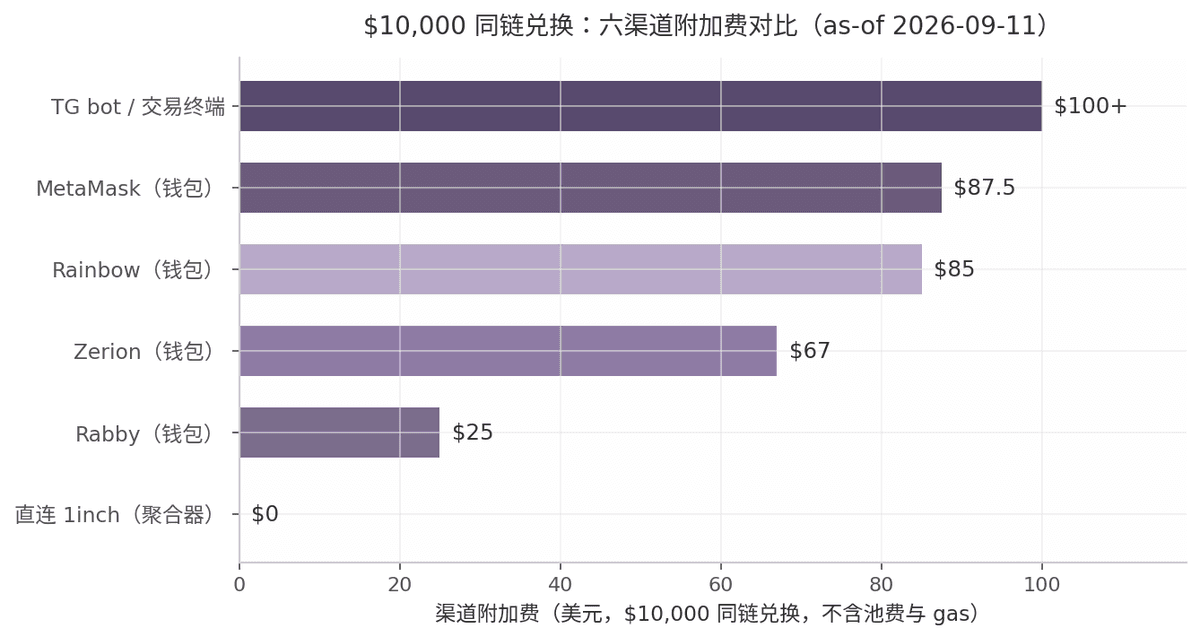
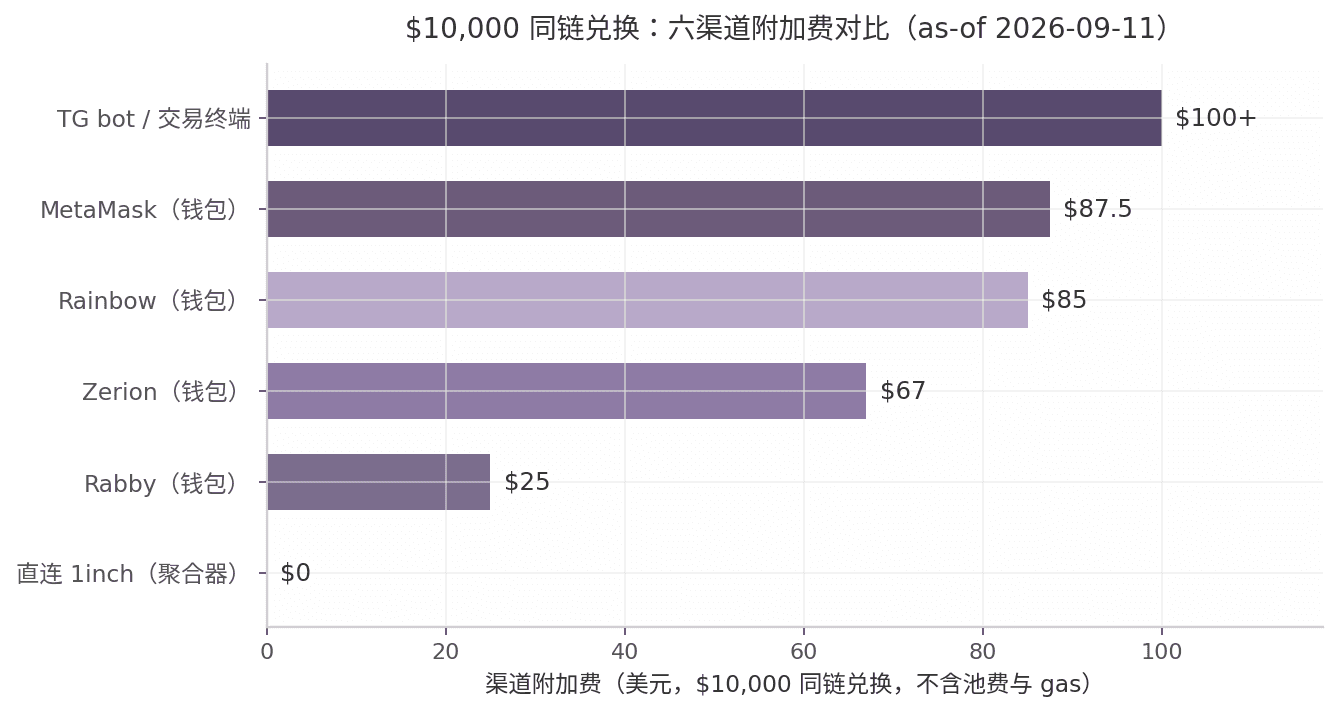
Note: Channel surcharge = explicit fee rate × $10,000; direct 1inch has no platform fee (surplus retained is implicit cost, magnitude in single-digit bps); terminals/bots calculated at 1%. Source: Official fee pages of each channel, as of 2026-09-11 [12][26][27][28][29][35].
The compounding effect of fee differences far outweighs any single trade impression: MetaMask's $87.5 per trade is 3.5 times Rabby's $25; if you execute 4 $10,000 portfolio rebalancing trades per month, annual channel fees are $4,200 vs. $1,200, a difference of $3,000—equivalent to 30% of the principal. A terminal/bot round trip costs $200 (2% net fee), which is only justified if it provides more than a 2% execution advantage in snipe scenarios. The decision rule is therefore straightforward: Default to a no-surcharge aggregator or the official DEX frontend; choose Rabby (0.25%) or Zerion Premium (0.25%) when a wallet-integrated experience is needed; use MetaMask/Rainbow/Coinbase's built-in swap only when convenience outweighs cost; restrict bots/terminals to new token launches and high-frequency scenarios.
One layer remains unexplored: exchange Web3 wallets (OKX, Binance Wallet, etc.) compress fees to 0–0.5%, placing them between aggregators and self-custodial wallets, but introduce custody and review dimensions—this is the subject of Chapter 5.
5. Exchange Web3 Wallets: Convenience or Hidden Markup
Among the five exchange-affiliated Web3 wallets, only Binance Wallet maintains a 0% platform fee for stablecoins, major L1 native coins, and Alpha token pairs; the remaining four charge interface fees ranging from 0–1% (OKX tiers fees by token at 0–0.5%, with some token pairs at 0%) (these are service fees charged by the platform on top of DEX quotes; gas and underlying pool fees are separate) [1][2][4][8]. The key point: these wallets route through the same underlying liquidity as the aggregators in Chapter 4—OKX uses its proprietary X Routing to aggregate quotes across DEXs [12], and Bitget Super DEX directly aggregates Jupiter, Uniswap, PancakeSwap, and hundreds of other DEXs [3]—so this fee buys execution quality and convenience, not cheaper liquidity itself.
5.1 Fee Comparison Across Five Wallets
5.1.1 Fee Table (as of 2026-09)
| Platform | Current Fee Structure | Rebates/Discounts | Meme Tier | Premium vs. Native Zero-Fee Channel on Same Chain* |
|---|---|---|---|---|
| Binance Wallet | 0% for stablecoins/major L1 native coins/Alpha token pairs; 0.5% for others [1] | Invite cashback up to 30%, minimum fee 0.35% [1] | 0% for Alpha list, 0.5% for non-Alpha | $0–$50 / $10,000 |
| Bitget Wallet | 0.3% flat + gas [2] | Trading rebate program (invite-only in Phase 1) [3] | 0.3% | ~$30 / $10,000 |
| OKX Wallet | Four tiers: 0 / 0.1 / 0.25 / 0.5% [4] | Invite rebates, user-side discount 0–20% [5] | 0.5% | ~$50 / $10,000 |
| Bybit Alpha | Fixed 0.5%, gas auto-deducted [6] | 0.5% partially rebatable (per third-party guides) [6] | 0.5% | ~$50 / $10,000 |
| MEXC DEX+ | Fixed 1%, gas-free, no external wallet needed [8] | Referral rebate 40–50% (promotional side) [8] | 1% | ~$100 / $10,000 |
\* Zero-fee benchmark = Jupiter manual mode 0% protocol fee [9], 1inch 0% platform fee [10], Uniswap official frontend reportedly removed interface fees in late 2025 per third-party reviews [11]; underlying LP pool fees (~0.05%–0.3%) and gas exist across all channels and are not included in the premium.
This table has three implications. First, Binance's 0% is bounded: it applies only to Alpha list and major coin pairs; long-tail coins outside the list revert to 0.5% (minimum 0.35% after rebates) [1]—whether meme traders get zero fees depends on whether the token is on the Alpha list. Second, the meme tier ranking is Binance (0) < Bitget (0.3%) < OKX = Bybit (0.5%) < MEXC (1%); MEXC DEX+'s 1% reaches the fee level of trading terminals/TG bots, which is a high premium relative to its positioning as an "exchange interface directly on-chain." Third, note Bybit's product line change: its Web3 wallet swap (Swap & Bridge, DEX Pro) was discontinued on 2025-05-31 [7], leaving only Alpha with a fixed 0.5% as the on-chain entry point [6]; the low-cost option no longer exists.
5.1.2 OKX Fee Changes: Why Old Posts Are Unreliable
OKX is a minefield of fee misreadings, with three different figures belonging to three periods: before 2025-08-25, it long marketed "0 transaction service fee" as a core selling point [12]; from 2025-08-25 onward, fees were introduced with a three-tier structure of 0 / 0.25 / 0.85%, with meme (Category 1/2 ↔ other tokens) at 0.85% [5]; the current table (consistent across multiple independent sources from June–September 2026) is four tiers: 0 / 0.1 / 0.25 / 0.5%, with the meme tier reduced to 0.5% [4]. The exact date of the 0.85%→0.5% reduction was not found in official announcements but can be narrowed to between late September 2025 and June 2026. The direct implication for readers: any page in 2026 still claiming "OKX DEX zero fees" or citing 0.85% is outdated; under current rates, a $10,000 meme trade incurs an OKX interface fee of approximately $50, not the $85 calculated from old posts.
5.2 Comparison with Native Channels
5.2.1 Same-Liquidity Overlay Argument and $10,000 Comparison Case
Assume buying $10,000 of a meme coin on Solana, with underlying pool fees and gas identical across channels, comparing only the platform-level markup: direct Jupiter manual mode costs $0 [9]; OKX Wallet adds ~$50, Bitget ~$30, MEXC DEX+ ~$100; if the token is on the Binance Alpha list, Binance Wallet also costs $0 [1].
The premium buys three things, ranked by value: MEV protection (anti-sandwich attack, i.e., preventing bots from cutting in line and sandwiching your execution price — Bitget multi-chain enabled by default [13], OKX integrates Consensys SERVO [14]); aggregation routing and order splitting (large orders split across pools to optimize slippage [12][3]); gas fee delegation (Bybit Alpha automatically deducts gas, no need to hold native chain tokens [6]).
Execution decision: If the trading asset is on the Binance Alpha list, Binance Wallet's net fee rate is 0, making it the optimal solution at the exchange wallet layer; if not on the list, go directly to the same-chain native zero-fee channel, or use Bitget's flat 0.3% as the "convenience cap"; MEXC DEX+'s 1% is only worth paying if you want to completely avoid wallet and gas management.
6. Tron, TON, and Sui: Low-Fee Paths at a Glance
To transfer USDT on Tron, the correct cost as of September 2026 is burning approximately 6.4 TRX (≈$1.9), not the 13–27 TRX cited in old tutorials — those figures are outdated data from before Proposal #104 on 2025-08-29 slashed the energy unit price from 210 sun to 100 sun. This price adjustment directly reduced the energy cost of smart contract operations by about 50% and introduced a quarterly dynamic adjustment mechanism[1]. The fee halving means all cost estimates involving Tron must be as-of date specific; more importantly, even under the new fee schedule, "direct burning" remains the worst of the four paths.
6.1 Tron: Four Cost Paths for USDT Transfers
Using a standard USDT transfer (recipient address already holds USDT, consuming approximately 64,285 energy) as an example, as-of 2026-09:
| Path | Cost per Transfer | Savings vs. Burning | Suitable For |
|---|---|---|---|
| Direct TRX Burn | ~6.4 TRX (≈$1.9); new address ~13 TRX (≈$3.9)[2] | — | Emergencies, one-time use |
| Energy Rental | ~2–3 TRX (often <$1)[3] | 50%–90% [3] | Occasional to daily users |
| Self-Staking (Stake 2.0) | Marginal cost ≈0 TRX, but requires staking thousands of TRX[4] | ≈100% | High-frequency merchants/institutions |
| GasFree (Pay Fees in USDT) | Cap ~$1, activation fee on first use[5] | ~50% and up | Those who don't want to hold TRX |
The core takeaway from this table is: Tron's network fee is not a "price" but a "procurement problem." The rental market (aggregators like Netts, TronSave) sells energy wholesale at ~40 sun/unit, pushing single transfer costs down to 2–3 TRX; the official JustLend DAO path (measured at pre-adjustment old prices) showed rental at ~$1.17 vs. burning at ~$4.3, saving over 70%[3]. Self-staking reduces marginal cost to zero, but at the cost of locking up thousands of TRX and a thawing period of ~3–14 days, making it worthwhile only for merchants processing multiple daily transactions[4]. GasFree's value lies not in being the cheapest, but in allowing users who don't want to hold TRX at all to pay fees directly in USDT, capped at ~$1[5]. One-sentence decision: Don't hold TRX? Use GasFree. Occasional transfers? Rent energy. High daily volume? Self-stake. Under any circumstances, avoid naked burning.
At the swap level, Tron's official front-end is not expensive: SunSwap V2 charges 0.3% (0.25% to LPs, 0.05% to the SUN holder pool)[6]; V3 offers four tiers: 0.01% / 0.05% / 0.3% / 1%, and using the 0.01% tier for stablecoin pairs gives access to the lowest protocol-level rate on the network[7]. For meme token launches, use the official SunPump front-end with a 1% trading fee; using third-party terminals will only be more expensive[8].
6.2 TON and Sui
TON's lowest network-wide fee path is not on any DEX, but in the Telegram built-in Wallet: transfers of USDT/TON between contacts are off-chain, officially 0 fees[9] — this is the only "true zero fee rate" across all chains and channels covered in this report. On-chain swaps follow a standard pattern: STON.fi standard pool 0.3% (0.2% LP + 0.1% protocol)[10]; DeDust also 0.3%, but its Stableswap stablecoin pool is only 0.05%, plus ~0.01–0.03 TON network fee[11]. Channel layering also exists: Tonkeeper's built-in swap totals ~0.3%–0.5% (per third-party reviews), while MyTonWallet's built-in aggregator adds a fixed 0.875% on top of network fees[12] — the same liquidity, but net fee rates differ by over 0.5 percentage points depending solely on the entry point (this figure is from a single third-party cross-review, confidence medium)[12].
Sui's low-fee paths are concentrated in Cetus and Turbos' concentrated liquidity pools. Cetus CLMM's official documentation lists 16 permissionless fee tiers (0.01%–4%), with stablecoin pairs falling into the 0.01% tier; the protocol defaults to taking a 20% cut from swap fees[13]. Turbos offers three tiers: 0.01% / 0.3% / 1%[14]. Perpetual contract traders can use Bluefin: BTC/ETH/SOL/SUI-PERP official specs are Maker 0.01% / Taker 0.035%, with on-chain costs below $0.005/trade[15]. A note of caution: Mysten Labs' official wallet Slush's terms of service reserve the right to charge an Interface Fee but have never disclosed a specific percentage; the actual net fee rate for its built-in swap cannot be verified, so for large swaps, the final amount received on the quote page should be used as the reference[16].
| Chain | Scenario | Lowest Fee Path | Net Fee/Cost (as-of 2026-09) |
|---|---|---|---|
| Tron | USDT Transfer | Rent Energy / GasFree / Self-Staking | 2–3 TRX or ≤$1 or ≈0 (Staking) [3][4][5] |
| Tron | Stablecoin Swap | SunSwap V3 0.01% Tier | 0.01% + Energy Cost [7] |
| TON | Transfer to Acquaintances | Telegram Contact Transfer | 0% (Off-chain) [9] |
| TON | Stablecoin Swap | DeDust Stableswap Pool | 0.05% + ~0.01–0.03 TON gas [11] |
| Sui | Stablecoin Swap | Cetus / Turbos 0.01% Tier | 0.01% + ~$0.005 gas [13][14] |
| Sui | Perpetual Contract | Bluefin Maker Order | Maker 0.01%, Taker 0.035% [15] |
The common pattern across the three chains is that protocol-level fees have been compressed to the order of 0.01%–0.05%. The real gap in net fees is still determined by the entry layer—on Tron, it's the energy procurement method (burning vs. renting differs by 2–3 times); on TON, it's the wallet aggregator's surcharge (0 vs. 0.875%); on Sui, it's the unannounced and unverifiable front-end fee. The direct implication for readers: on these three chains, the answer for the "lowest fee channel" is always to bypass the fee-charging front-end, connect directly to the official front-end or protocol, and treat Tron's energy as a resource that needs to be procured rather than burned by default.
7. Hidden Costs: MEV, Spread, and Default Tips
The fee table only determines half of the net fee. On-chain data shows that MEV (Maximal Extractable Value, i.e., value extracted by bots through front-running or sandwiching your transaction) is a "hidden tax" of the same magnitude as platform fees, and it is strongly coupled with channel choice: for the same transaction, the 0.3% interface fee saved by using a public RPC directly could be entirely lost to a sandwich bot (which buys before you and sells immediately after you to capture the spread).
7.1 MEV Magnitude and Protection
7.1.1 Loss Magnitude: Comparable to Platform Fees
On Solana, according to Jito's internal on-chain analysis, over the 16 months up to May 2025, sandwich bots extracted $370 million–$500 million from users, with a single program vpeNALD…Noax38b accounting for nearly half of all sandwich attacks on the network [1]. On Ethereum, according to media reports citing Flashbots Research monitoring, BEV (Blockchain Extractable Value) extraction was approximately $540 million in 2025, with sandwich attacks causing trader losses of about $60 million from November 2024 to October 2025 [2] (this figure is a media report, no original report seen). Regarding hit rate and per-trade loss, according to a 2025 study cited by third parties, approximately 1.2% of Ethereum DEX trades are sandwiched, with the average victim losing 0.41% of the trade value [3]—note that 0.41% already exceeds the interface fee of most aggregators.
An extreme case illustrates the upper limit: On March 12, 2025, a trader swapped 220,764 USDC for USDT on Uniswap v3, receiving only 5,271 USDT after being sandwiched. The attacker profited over $215,000, of which $200,000 was paid as a tip to the block builder. It was later confirmed that the transaction was not sent via the Uniswap official front-end, which has MEV protection and default slippage settings [4].
7.1.2 Protection is a Channel Attribute, Not an Option
Academic research (analyzing all Uniswap transactions) found that private RPCs (channels where transactions do not enter the public mempool) almost completely eliminate adversarial slippage: among 8,294 transactions in the USDC pool and 8,629 in the PEPE pool via private interfaces, only 3 and 12 transactions, respectively, showed negative adversarial slippage exceeding $5, and manual verification confirmed none were sandwiches [5]. Even among private channels, quality varies: a benchmark study submitting 273 identical test transactions to four major private RPCs showed that MEV Blocker had the fastest inclusion (average 1.34 blocks) and the highest rebate (average 0.0035 ETH/trade), making it the best overall [6]. On the Solana side, Jito bundle's dontfront mechanism forces the user's transaction to be first in the bundle, making front-running impossible, with a minimum tip of 1,000 lamports paid only upon execution [7]; GMGN's Anti-MEV requires a priority fee ≥0.002 SOL plus a minimum tip of 0.0001 SOL [8]. A Solana bot team's self-reported empirical data from 5,000+ trades claims that the public mempool path silently extracts approximately 30–80 bps per trade [9]—this figure comes from an interested party and has low confidence, but is consistent in magnitude with the on-chain aggregate data above.
7.2 How Hidden Costs Eat Away Fee Differences
7.2.1 Comparison of Five Types of Hidden Costs (Magnitude as-of 2025–2026 from Various Sources)
| Cost Type | Magnitude | Affected Channels | Mitigation |
|---|---|---|---|
| MEV Sandwich | Ethereum: average loss of 0.41% per victim trade [3]; Solana public pipeline: ~30–80 bps/trade (self-reported by interested party) [9] | All channels using public RPC directly | Private RPC / Jito bundle / CoW batch auction [5][6][7] |
| Default Tip/Priority Fee Overpayment | MetaMask default priority fee of 2 gwei, ~20x the required amount during non-congested times [10]; Axiom default 0.001 SOL priority fee + 0.001 SOL Jito tip/trade [11] | Built-in wallet swaps, trading terminals | Manually lower defaults, verify item by item |
| Routing Spread/Routing Accidents | A single trade in March 2025 lost ~1,000 SOL due to routing to a shallow pool [12] | Terminals and wallets with weak routing engines | Use meta-aggregators for price comparison on large amounts |
| Slippage Setting Exploitation | Slippage tolerance = attacker's profit cap; tight slippage of 0.1%–0.3% can make sandwiches unprofitable [13] | Front-ends with loose default slippage | Set 0.1%–0.3% for deep pools |
| Hidden Spread (Unlisted Exchange Rate Markup) | Trust Wallet claims 0 fees, but according to a single third-party allegation, it embeds a 0.5%–1% spread in the exchange rate [14] | Wallets claiming "zero fees" | Compare final amount received, not nominal fee rate |
This table can be read on three levels. First, all five cost categories are orthogonal to the "fee rate": a channel with 0% platform fee can lose 1% on MEV and spread, while a terminal charging 1% that defaults to Jito for sandwich protection may actually have a lower net cost—the only comparable metric between channels is the amount received. Second, the distribution is asymmetric: for small orders (<$1,000), the main hidden costs are gas and fixed tips; academic estimates show that for trades under $1,000, over 98% of costs are gas [5]; for large orders (>$100,000), price impact, slippage, and MEV dominate. Third, the outliers are all in the "not listed" category: routing incidents and opaque spreads do not appear in any fee table and can only be exposed through simultaneous price comparison.
7.2.2 Real Round-Trip Drag and Compounding Calculation for a "1% Bot"
A terminal's nominal 1% per-side fee, combined with default tips on both sides and slippage on both sides, often results in a real round-trip drag of 3%–6%. Even looking only at the differences within the fee table, the compounding effect is enough to change conclusions: using the 2026-08 fee baseline as an example, the difference between Photon's 2.00% round-trip and GMGN's invite-code price of 1.40% round-trip (0.70% per side; this invite price is disputed—GMGN's official fee page states a fixed 1% with no discounts, and the invite price appears only in third-party reviews, so confidence is low; this is used only as a calculation example) is 0.6 percentage points [15]. Assuming each round-trip leaves the principal multiplied by , after 20 equal round-trips:
That is, about 11.3% of the principal is consumed by the fee difference (approximately 12 percentage points on a simple-interest basis) [15]. For a high-frequency meme trader, 20 round-trips represent just one to two weeks of trading volume—for strategies with more than 5 round-trips per month, the fee table difference is the decisive factor; conversely, for low-frequency large-amount trades with only a few round-trips per year, fixed costs (gas, tips) and routing quality are the dominant factors, and a 0.6pp fee difference may not be worth sacrificing execution and protection quality. This is the quantitative foundation for the criterion of "when is a 1% fee bot worth it": the terminal's fee buys speed and sandwich protection, and it is only worthwhile when these hidden benefits exceed the fee difference amplified by compounding.
8. Usage Recommendations and Channel Net Cost Self-Checklist
The data in this book boils down to one sentence: on the same chain and with the same pool liquidity, the net cost per side can vary by more than 2 percentage points across channels, and every layer of added fees can be consciously avoided. Recalling the five-layer pyramid from Chapter 2, the action principle is simple—stay in the 0-fee layer by default, and only pay actively for "speed and sandwich protection".
8.1 Decision Rules by Scenario
8.1.1 Four Rules Cover 95% of Trading Scenarios
8.2 Net Cost Self-Checklist
8.2.1 Six Checks Before Placing an Order
| Check Item | Self-Check Method | Pass Line/Reference Value (as-of 2026-09) |
|---|---|---|
| Whether frontend/wallet fees are added | Check the channel's official fee page and compare with the same amount on an aggregator quote | Wallet built-in swap 0.25%–0.875% (Phantom 0.85%, MetaMask 0.875%) [7]; 0-fee layer should be 0% [1] |
| Default tip/priority fee tier | Open settings before trading and check each item | Axiom default 0.001 SOL priority fee + 0.001 SOL Jito tip per transaction, both adjustable [8]; for small orders <1 SOL, fixed tips often exceed the platform fee itself |
| Whether using private RPC/MEV protection | Confirm the trade goes through Jito bundle (dontfront) or EVM private RPC | Private channels almost eliminate sandwich losses [9]; Solana public pipeline silent cost is about 30–80bps per transaction (self-reported by interested parties, low confidence) [10] |
| Routing spread comparison | For large orders, use DefiLlama Swap to compare the received amount across multiple aggregators at the same time, with 0 markup [11] | For orders above $100,000, RFQ+order splitting can improve price by over 30bps [12]; if the quote difference is >0.1%, switch channels |
| Rebate conversion | Only count SOL/stablecoin instant rebates; treat all points as 0 | Genius zeroed out all historical points unilaterally in 2026-01, proving that point value can be reset at any time [13] |
| Frequency amplifier | Round-trip net fee rate × monthly round-trips | 0.6pp round-trip difference × 20 round-trips ≈ 12% of principal [3] |
The first three items in the checklist check "money outside the fee table" (added fees, tips, MEV), and the last three check "illusions within the fee table" (spread, fake rebates, compounding), corresponding one-to-one with the hidden cost structure in Chapter 7. The most easily misjudged is rebate conversion: Axiom's SOL rebate can be immediately offset against the net fee rate, while GMGN's points have no official value commitment; the two look similar on the fee table, but the net cost difference after conversion can be as much as 0.2 percentage points. Also underestimated are default tips—on small orders at the 0.1 SOL level, they can reach 2% of the transaction amount, higher than the fee difference saved by switching channels; small-order high-frequency users should prioritize comparing default tips over nominal fee rates.
8.2.2 Review Case: Reconstructing the Net Fee Rate of a Phantom Built-in Swap
Using the checklist to reconstruct a $1,000 SOL→USDC Phantom wallet built-in swap (as-of 2026-09 fees): wallet fee 0.85% = $8.50 [7]; underlying DEX pool fee about 0.25% = $2.50; Solana gas and priority fee about $0.003 [2]. Total about $11.0, net fee rate about 1.10%. The same trade via Jupiter Manual only incurs the pool fee of $2.50, net fee rate about 0.25% [1][2]—Phantom's underlying routing actually goes through aggregators like Jupiter [14], so it's the same liquidity, and the 0.85 percentage points is a pure added service fee. If this trade is done 20 times per month on one side, the 0.85% added fee alone results in a monthly loss of about 17% of the principal (), and on a simple-interest basis, the annualized loss exceeds 2 times the principal.
8.2.3 Timeliness Reminder: Fee Conclusions Must Carry an as-of Date
In the past 12 months, BullX announced its shutdown on 2026-06-01 [15], Padre was acquired by Pump.fun and rebranded as Terminal [16], Uniswap has eliminated all interface fees since 2025-12-27 [17], and OKX Web3 slashed its meme coin fee from 0.85% to 0.5% as of 2025-08 [18]. All rates in this report are as-of 2026-09; any static fee schedule becomes outdated within six months—please refer to the official fee page before placing an order. Additionally, please note that the data in this report is sourced from official pages and third-party reviews, and no first-hand order testing has been conducted—beyond the nominal rates, please verify based on the actual amount received.
References
[1] Jupiter Official Developer Documentation Ultra Fees[EB/OL]. [2026-09-11]. https://developers.jup.ag/docs/ultra/fees
[2] Pump Parade《Phantom vs Backpack 2026》[EB/OL]. (2026-03-31)[2026-09-11]. https://blog.pumpparade.com/reviews/phantom-vs-backpack-best-solana-wallet-2026/
[3] CryptoNewsSOL《Backpack Wallet Review》[EB/OL]. (2026-07-16)[2026-09-11]. https://cryptonewssol.com/wallets/backpack-wallet/
[4] Phantom Official Help Center《Swap crypto in Phantom》[EB/OL]. [2026-09-11]. https://help.phantom.com/articles/swap-crypto-in-phantom-5985106844435
[5] telegramtrading.net《Trojan Review》[EB/OL]. (2026-09-02)[2026-09-11]. https://telegramtrading.net/trojan-telegram-bot-review/
[6] terminalpedia Terminal (formerly Padre) Guide[EB/OL]. (2026-08-06)[2026-09-11]. https://terminalpedia.com/guides/getting-started/terminal-formerly-padre
[7] CoinBureau Axiom Review[EB/OL]. (2026-06-09)[2026-09-11]. https://coinbureau.com/review/axiom-trade-review
[8] GMGNGuide《GMGN Fees Explained》[EB/OL]. (2026-08-06)[2026-09-11]. https://gmgnguide.com/guides/fees/gmgn-fees-explained
[9] photonguides《Photon Fees Explained》[EB/OL]. (2026-08-14)[2026-09-11]. https://photonguides.com/guides/fees/photon-fees-explained
[10] Moby《BullX Shutdown Announcement》[EB/OL]. (2026-05-31)[2026-09-11]. https://moby.win/learn/bullx-shutdown/
[11] pump.fun Official Documentation Fees Page[EB/OL]. (2026-05-20)[2026-09-11]. https://pump.fun/docs/fees
[12] terminalpedia Terminal Fee Test[EB/OL]. (2026-08-06)[2026-09-11]. https://terminalpedia.com/guides/fees
[13] Uniswap Labs Official Help Center《What are Uniswap Labs' fees?》[EB/OL]. (2026-01-14)[2026-09-11]. https://support.uniswap.org/hc/en-us/articles/42640092742541-What-are-Uniswap-Labs-fees
[14] The Block《Uniswap passes UNIfication proposal》[EB/OL]. (2025-12-25)[2026-09-11]. https://www.theblock.co/news/ecosystems/2025-12-25-uniswap-passes-unification-proposal-383742
[15] 1inch Official Help Center《Do I pay fees when using 1inch?》[EB/OL]. (2026-03-05)[2026-09-11]. https://help.1inch.com/en/articles/13531432-do-i-pay-fees-when-using-1inch
[16] ABMedia Transcript of Rabby Official Announcement[EB/OL]. (2024-07-05)[2026-09-11]. https://abmedia.io/rabby-wallet-in-built-swap-fee
[17] MetaMask Official Help Center《User guide: swaps》[EB/OL]. [2026-09-11]. https://support.metamask.io/trade/swap/user-guide-swaps/
[18] CoW Protocol Official Documentation《Fees》[EB/OL]. (2026-03-17)[2026-09-11]. https://docs.cow.fi/governance/fees
[19] Eco Support Center UniswapX Guide[EB/OL]. (2026-05-26)[2026-09-11]. https://eco.com/support/en/articles/11852773-what-is-uniswapx-2026-guide
[20] spark.money《Slippage》Glossary Entry[EB/OL]. [2026-09-11]. https://www.spark.money/glossary/slippage
[21] CoinBureau《PancakeSwap Review》[EB/OL]. (2026-01-14)[2026-09-11]. https://coinbureau.com/review/pancakeswap-cake
[22] Infrared Trading Technical Documentation[EB/OL]. (2026-07-09)[2026-09-11]. https://docs.infraredtrading.com/learn/protocols/velodrome/mechanics
[23] Banana Gun Official Website FAQ[EB/OL]. (2026-04-20)[2026-09-11]. https://bananagun.io/
[24] Clanker Official GitBook《Creator Rewards & Fees》[EB/OL]. (2026-07-01)[2026-09-11]. https://clanker.gitbook.io/documentation/general/creator-rewards-and-fees
[25] Bankr Official Documentation[EB/OL]. [2026-09-11]. https://docs.bankr.bot/token-launching/overview/
[26] Odaily (Binance Wallet Fee Announcement)[EB/OL]. (2025-11-25)[2026-09-11]. https://www.odaily.news/zh-CN/newsflash/458180
[27] CoinBureau《Bitget Wallet Review》[EB/OL]. (2025-10-01)[2026-09-11]. https://coinbureau.com/review/bitget-wallet-review
[28] Coin Bureau《OKX Wallet Review 2026》[EB/OL]. (2026-07-16)[2026-09-11]. https://coinbureau.com/review/okx-wallet
[29] Foresight News《MEXC DEX+ Usage Tutorial》[EB/OL]. (2026-05-12)[2026-09-11]. https://foresightnews.pro/article/detail/96981
[30] Odaily (TRON Proposal #104 Energy Price Adjustment Report)[EB/OL]. (2025-09-11)[2026-09-11]. https://www.odaily.news/zh-CN/post/5206264
[31] CoinCodeCap Tron Energy[EB/OL]. (2026-06-09)[2026-09-11]. https://coincodecap.com/tron-energy
[32] Odaily GasFree Operation Guide[EB/OL]. (2025-06-23)[2026-09-11]. https://www.odaily.news/zh-CN/post/5204557
[33] Telegram Wallet Official Help Page《Fee rates and limits》[EB/OL]. (2026-09-01)[2026-09-11]. https://help.wallet.tg/article/50-fee-rates-and-limits
[34] telegram-store TON DeFi Guide[EB/OL]. (2026-03-18)[2026-09-11]. https://telegram-store.com/crypto/defi-guide/ton-defi-dedust-stonfi-liquidity-guide
[35] tontry《STON.fi vs DeDust Practical Comparison》[EB/OL]. (2026-07-16)[2026-09-11]. https://tontry.com/articles/ston-fi-vs-dedust/
[36] ton-adoption.xyz 2026 Wallet Comparison[EB/OL]. (2026-03-10)[2026-09-11]. https://ton-adoption.xyz/en/blog/mytonwallet-vs-tonkeeper-comparison-2026/
[37] Cetus Official Documentation[EB/OL]. (2025-09-24)[2026-09-11]. https://cetus-1.gitbook.io/cetus-docs/clmm/fees
[38] Turbos Official Documentation[EB/OL]. (2024-02-02)[2026-09-11]. https://turbos.gitbook.io/turbos/products/concentrated-liquidity-amm/fee-tier-for-token-pairs
[39] Bluefin Official Learn Documentation Contract Specs[EB/OL]. [2026-09-11]. https://learn.bluefin.io/bluefin/bluefin-perps-exchange/trading/contract-specs
[40] Slush Official Terms of Service[EB/OL]. (2025-01-21)[2026-09-11]. https://slush.app/terms-of-service
[41] photonguides「Solana Terminal Fee Index」[EB/OL]. (2026-08-18)[2026-09-11]. https://photonguides.com/guides/fees/solana-terminal-fee-index
[42] arXiv:2309.13648v2《Don't Let MEV Slip》[EB/OL]. (2024-04-17)[2026-09-11]. https://arxiv.org/html/2309.13648v2
[43] Velora Official User Documentation《Fee Sharing》[EB/OL]. (2026-03-06)[2026-09-11]. https://docs.velora.xyz/integrating-velora/integrating-velora-overview/fee-sharing
[44] Odos Router V2 Official GitHub README[EB/OL]. (2023-05-23)[2026-09-11]. https://github.com/odos-xyz/odos-router-v2
[45] sanj.dev《Solana MEV and Jito Deep Dive》[EB/OL]. (2026-04-03)[2026-09-11]. https://sanj.dev/post/solana-mev-jito-deep-dive/
[46] CryptoKeySafe《2026 Crypto Threat Report》[EB/OL]. (2026-04-01)[2026-09-11]. https://cryptokeysafe.io/blog/2026-crypto-threat-landscape
[47] Jupiter Official Zendesk《What fees apply on Ultra》[EB/OL]. [2026-09-11]. https://jupiverse.zendesk.com/hc/en-us/articles/22627786632092-What-fees-apply-on-Ultra
[48] ChainCatcher Transcription of Rabby Official Announcement[EB/OL]. (2024-07-05)[2026-09-11]. https://www.chaincatcher.com/en/article/2132276
[49] axiompedia《Axiom Fee Guide》[EB/OL]. (2026-08-06)[2026-09-11]. https://axiompedia.com/guides/fees
[50] Trust Wallet Official Website Swap Page FAQ[EB/OL]. [2026-09-11]. https://trustwallet.com/swap
[51] Vultisig《Crypto Wallet Swap Fees Compared》[EB/OL]. (2026-06-22)[2026-09-11]. https://vultisig.com/articles/crypto-wallet-swap-fees-compared
[52] SolanaFloor (Phantom Swap Fee Controversy Report)[EB/OL]. (2024-11-26)[2026-09-11]. https://solanafloor.com/en/news/phantom-attacked-swap-fees-reigniting-web3-revenue-stream-debate
[53] The Defiant (0x Cross-Chain API Launch Report)[EB/OL]. (2026-06-04)[2026-09-11]. https://thedefiant.io/news/defi/0x-opens-cross-chain-api-general-availability-12-bridge-partners
[54] deBridge Learn《Cheapest Crypto Swap》Guide[EB/OL]. (2026-03-25)[2026-09-11]. https://debridge.com/learn/guides/cheapest-crypto-swap/
[55] 0x Official Help Center《0x API Pricing FAQ》[EB/OL]. (2026-06-25)[2026-09-11]. https://help.0x.org/articles/3042324687-0x-api-pricing-faq
[56] Stablecoin Insider《Top Stablecoin Aggregators》[EB/OL]. (2025-10-09)[2026-09-11]. https://stablecoininsider.org/best-stablecoin-aggregators/
[57] Coin Bureau《Coinbase Wallet Review 2026》[EB/OL]. [2026-09-11]. https://coinbureau.com/review/coinbase-wallet-review
[58] CoinCodeCap《Trojan Setup Guide》[EB/OL]. (2026-05-15)[2026-09-11]. https://coincodecap.com/best-settings-for-trojan-bot
[59] telegramtrading.net Maestro Review[EB/OL]. (2026-09-01)[2026-09-11]. https://telegramtrading.net/maestro-sniper-bot-review/
[60] solanatradingbots Bloom Guide[EB/OL]. (2026-03-06)[2026-09-11]. https://solanatradingbots.com/bloom-bot-how-to-use/
[61] Bloom Official Documentation docs.bloombot.app[EB/OL]. (2026-03-30)[2026-09-11]. https://docs.bloombot.app/solana/solana-bot/settings/presets/copy-presets
[62] Banana Gun Official Blog《Best Solana Trading Bots Right Now》[EB/OL]. (2026-07-31)[2026-09-11]. https://blog.bananagun.io/blog/best-solana-trading-bots-right-now
[63] photonguides《Photon vs Axiom Comparison》[EB/OL]. (2026-08-18)[2026-09-11]. https://photonguides.com/compare/photon-vs-axiom
[64] Jupiter Official Developer Documentation Swap Overview[EB/OL]. [2026-09-11]. https://developers.jup.ag/docs/swap
[65] Jupiter Official Developer Documentation《Add Integrator Fees》[EB/OL]. [2026-09-11]. https://developers.jup.ag/docs/ultra/add-fees-to-ultra
[66] Jupiter agent-skills Official Skill Pack Mirror[EB/OL]. (2026-06-18)[2026-09-11]. https://tessl.io/registry/tessl-skill-index-evals/jup-ag__agent-skills__integrating-jupiter/0.0.1
[67] jupiter.mintlify.app Recurring Page[EB/OL]. (2026-07-17)[2026-09-11]. https://jupiter.mintlify.app/recurring
[68] Raydium Official Documentation Fee comparison[EB/OL]. [2026-09-11]. https://docs.raydium.io/reference/fee-comparison.md
[69] Raydium Official Documentation llms.txt[EB/OL]. [2026-09-11]. https://docs.raydium.io/llms.txt
[70] Orca Official Documentation llms.txt[EB/OL]. [2026-09-11]. https://docs.orca.so/llms.txt
[71] Sina Finance Repost from Wu Blockchain[EB/OL]. (2025-08-25)[2026-09-11]. https://cj.sina.cn/articles/view/5953466437/162dab045067099s60?froms=ggmp
[72] jb51.net《What is the OKX Fee? 2026 Edition》[EB/OL]. (2026-07-03)[2026-09-11]. https://www.jb51.net/blockchain/1033357ftxc.html
[73] Odaily (Bitget Wallet Event Announcement)[EB/OL]. (2025-08-27)[2026-09-11]. https://www.odaily.news/zh-CN/newsflash/445314
[74] bytwork Solflare Review[EB/OL]. (2026-06-05)[2026-09-11]. https://bytwork.com/en/wallets/solflare
[75] uwuu.ai Solflare Review[EB/OL]. (2026-05-25)[2026-09-11]. https://uwuu.ai/blog/solflare-wallet-review
[76] Datawallet Phantom Review[EB/OL]. (2026-07-15)[2026-09-11]. https://www.datawallet.com/crypto/phantom-wallet-review
[77] CryptoNews Coinbase Wallet (Base App) Review[EB/OL]. (2026-01-09)[2026-09-11]. https://cryptonews.com/reviews/coinbase-wallet-review/
[78] CoinBureau "Best Solana DEX Platforms in 2026"[EB/OL]. (2026-06-19)[2026-09-11]. https://coinbureau.com/analysis/top-solana-dex-platforms
[79] GMGNGuide "How to Trade on GMGN"[EB/OL]. (2026-08-25)[2026-09-11]. https://gmgnguide.com/guides/getting-started/how-to-trade-on-gmgn
[80] CoinCodeCap GMGN Setup Guide[EB/OL]. (2026-08-19)[2026-09-11]. https://coincodecap.com/best-settings-for-gmgn-bot
[81] arXiv "Causal Effects of Protocol-Fee Changes on Liquidity Provision in AMMs"[EB/OL]. (2025-12-27)[2026-09-11]. https://arxiv.org/html/2607.08525v1
[82] Blockworks "Uniswap: Data Dashboard Primer"[EB/OL]. (2026-08-12)[2026-09-11]. https://blockworks.com/insights/uniswap-data-dashboard-primer
[83] Curve Official Documentation (curve.readthedocs.io)[EB/OL]. [2026-09-11]. https://curve.readthedocs.io/exchange-pools.html
[84] Balancer Official Documentation "Swap Fee" / "Protocol Fee Operations"[EB/OL]. [2026-09-11]. https://docs.balancer.fi/concepts/vault/swap-fee.html
[85] findas.org "The Tokenomics of PancakeSwap"[EB/OL]. (2025-12-01)[2026-09-11]. https://www.findas.org/tokenomics-review/coins/the-tokenomics-of-pancakeswap-cake/r/7u4Evnw3NKKJvADrfFRwd4
[86] CoinBureau "SushiSwap Reviewed 2026"[EB/OL]. (2026-01-15)[2026-09-11]. https://coinbureau.com/review/sushiswap-sushi
[87] Script House "Jupiter vs 1inch Comparison"[EB/OL]. (2026-01-21)[2026-09-11]. https://www.jb51.net/blockchain/1013720.html
[88] CoinBureau "1inch Exchange Review 2026"[EB/OL]. (2026-01-16)[2026-09-11]. https://coinbureau.com/review/1inch-exchange
[89] CoW DAO Governance Forum CIP-61 Original Text[EB/OL]. (2025-01-10)[2026-09-11]. https://forum.cow.fi/t/cip-61-price-improvement-share-revenue-share-and-fees-on-cow-protocol/2741
[90] stablecoininsider "Best Stablecoin Aggregators" (Matcha Pricing)[EB/OL]. (2025-08-22)[2026-09-11]. https://stablecoininsider.com/best-stablecoin-aggregators/
[91] OpenOcean Official Documentation "API Pricing & Access"[EB/OL]. [2026-09-11]. https://docs.openocean.finance/docs/swap-api/api-pricing-and-access
[92] flerwows "Tokenlon Fee Details"[EB/OL]. (2025-09-29)[2026-09-11]. https://flerwows.com/1108.html
[93] Zerion Official Help Center "What is Zerion Premium?"[EB/OL]. (2026-02-20)[2026-09-11]. https://help.zerion.io/en/articles/9760851-what-is-zerion-premium
[94] CoinLaw "Rainbow Wallet Statistics"[EB/OL]. (2026-02-26)[2026-09-11]. https://coinlaw.io/rainbow-wallet-statistics/
[95] Coin Bureau "MetaMask Review 2026"[EB/OL]. (2026-08-26)[2026-09-11]. https://coinbureau.com/review/metamask-review
[96] Coin Bureau "MetaMask vs Coinbase Wallet"[EB/OL]. (2026-08-07)[2026-09-11]. https://coinbureau.com/analysis/metamask-vs-coinbase-wallet
[97] Maestro Official Documentation FAQ-Fees[EB/OL]. [2026-09-11]. https://docs.maestrobots.com/sniper/faq/fees
[98] Unibot Official Tutorial Loyalty Program[EB/OL]. [2026-09-11]. https://learn.unibot.app/faq/loyalty-program
[99] Odaily (Bitget Wallet Swap Upgrade Super DEX)[EB/OL]. (2025-03-19)[2026-09-11]. https://www.odaily.news/newsflash/423872
[100] ABMedia Chain News (OKX Fee Announcement and Referral Mechanism)[EB/OL]. (2025-08-25)[2026-09-11]. https://abmedia.io/okx-wallet-referal-fee-exchange
[101] Script House (Bybit Alpha Tutorial)[EB/OL]. (2025-12-31)[2026-09-11]. https://www.jb51.net/blockchain/1011406.html
[102] ChainCatcher (Bybit Shuts Down Web3 Wallet Swap Coverage)[EB/OL]. (2025-05-25)[2026-09-11]. https://www.chaincatcher.com/article/2183080
[103] HodlFM (Jupiter Review)[EB/OL]. (2025-09-22)[2026-09-11]. https://hodlfm.com/reviews/jupiter-exchange-review/
[104] EarnPark "Uniswap Cuts Fees: Impact on Traders and DEX Competition"[EB/OL]. (2026-01-15)[2026-09-11]. https://earnpark.com/en/posts/uniswap-cuts-fees-impact-on-traders-and-dex-competition/
[105] Odaily (OKX DEX X-Routing Press Release Repost)[EB/OL]. (2023-11-08)[2026-09-11]. https://www.odaily.news/post/5190878
[106] crypto.news (Bitget Wallet Multi-Chain MEV Protection Enabled by Default)[EB/OL]. (2025-03-17)[2026-09-11]. https://crypto.news/bitget-wallet-upgrades-mev-protection-after-viral-215k-mev-bot-attack-on-uniswap/
[107] CoinGlass / Cointelegraph (OKX Wallet Integrates Consensys SERVO MEV Protection)[EB/OL]. (2025-06-24)[2026-09-11]. https://www.coinglass.com/zh/news/496434
[108] yieldo.me《Cheapest Network to Send USDT》[EB/OL]. (2026-07-05)[2026-09-11]. https://yieldo.me/blog/fees/cheapest-network-to-send-usdt
[109] netts.io Tron USDT Energy Handbook[EB/OL]. (2026-08-23)[2026-09-11]. https://netts.io/blog/tron-usdt-energy-handbook-2025?lang
[110] tronscan.energy《What is Energy》[EB/OL]. (2026-03-28)[2026-09-11]. https://tronscan.energy/what-is-energy.php
[111] tronxenergy.com《Reduce TRON Fees Guide》[EB/OL]. (2026-05-06)[2026-09-11]. https://tronxenergy.com/blog/reduce-tron-fees-tronex-guide
[112] TronSave Official Blog[EB/OL]. (2025-10-28)[2026-09-11]. https://blog.tronsave.io/trx-lend-energy-earn-passive-income-on-tron-2025/
[113] SunSwap V2 Official FAQ[EB/OL]. [2026-09-11]. https://faq-v2-sunswap-en-us.pages.dev/
[114] tronorigin.io (DEX and AMM Mechanism Research)[EB/OL]. (2026-05-24)[2026-09-11]. https://tronorigin.io/learn/dex-and-amm/
[115] Odaily / ChainCatcher (Sun.io Data Report)[EB/OL]. (2025-07-03)[2026-09-11]. https://www.odaily.news/zh-CN/post/5204810
[116] Nansen《What is SunSwap V3》[EB/OL]. (2026-08-12)[2026-09-11]. https://nansen.ai/post/what-is-sunswap-v3
[117] ChainCatcher News[EB/OL]. (2024-12-06)[2026-09-11]. https://www.chaincatcher.com/en/article/2155495
[118] BingX Learn《What is SunPump》[EB/OL]. (2025-06-19)[2026-09-11]. https://bingx.com/en/learn/article/what-is-sunpump-and-how-to-launch-a-tron-memecoin-on-it
[119] 8Blocks《STON.fi Tokenomics and Value Capture Analysis》[EB/OL]. (2026-08-20)[2026-09-11]. https://8blocks.ae/blog/ston-fi-tokenomics-value-capture
[120] Alchemy DApp Directory[EB/OL]. [2026-09-11]. https://www.alchemy.com/dapps/list-of/defi-dapps-on-sui
[121] sui.io Official Blog[EB/OL]. (2024-01-10)[2026-09-11]. https://www.sui.io/blog/bluefin-defi-derivatives-volume
[122] Sui Official Documentation[EB/OL]. [2026-09-11]. https://docs.sui.io/onchain-finance/asset-custody/wallets/slush
[123] TronWeekly / CoinPaper (Uniswap Sandwich Incident Report)[EB/OL]. (2025-03-13)[2026-09-11]. https://www.tronweekly.com/stablecoin-trader-loses-215k-in-unexpected/
[124] arXiv:2505.19708 "Private MEV Protection RPCs: Benchmark Study"[EB/OL]. (2025-05-26)[2026-09-11]. https://arxiv.org/html/2505.19708v1
[125] Chainstack Docs (Solana MEV protection / Jito dontfront and minimum tip)[EB/OL]. (2026-07-01)[2026-09-11]. https://docs.chainstack.com/docs/solana-mev-protection
[126] pumpvolumebot.fun《Anti-MEV on Solana》[EB/OL]. (2026-04-25)[2026-09-11]. https://www.pumpvolumebot.fun/blog/anti-mev-on-solana-jito-private-relays
[127] stengarl.eth.limo《MEV, Private Order Flow and OFA Mechanism Research Notes》[EB/OL]. (2026-04-20)[2026-09-11]. https://stengarl.eth.limo/posts/mev-private-order-flow-and-ofa-mechanisms/
[128] axiompedia《Getting Started》[EB/OL]. (2026-08-25)[2026-09-11]. https://axiompedia.com/guides/getting-started
[129] BlockBeats (Solana Routing Incident Report)[EB/OL]. (2025-03-17)[2026-09-11]. https://www.theblockbeats.info/news/57319
[130] Yellow.com《How to Trade on DEX》[EB/OL]. (2026-03-30)[2026-09-11]. https://yellow.com/learn/how-to-trade-on-dex
[131] InsideCryptoReview《Jupiter Actual Cost Test》[EB/OL]. (2026-02-16)[2026-09-11]. https://insidecryptoreview.com/en/dex/jupiter
[132] DefiLlama Swap[EB/OL]. (2023-01-02)[2026-09-11]. https://swap.defillama.com
[133] Eco《Best DEX Aggregators in 2026》[EB/OL]. (2026-07-31)[2026-09-11]. https://eco.com/support/en/articles/13314092-best-dex-aggregators-in-2026-1inch-jupiter-paraswap-and-more
[134] Odaily《Genius New Regulation Interpretation》[EB/OL]. (2026-01-20)[2026-09-11]. https://www.odaily.news/en/post/5208849
[135] Coin Bureau《Phantom Wallet Review》[EB/OL]. (2026-06-06)[2026-09-11]. https://coinbureau.com/review/phantom-wallet-review
[136] uwuu.ai《Padre/Terminal Review》[EB/OL]. (2026-07-01)[2026-09-11]. https://uwuu.ai/blog/padre-terminal-review
[137] fomoappguide.com Crypto Trading App Fee Comparison[EB/OL]. (2026-08-20)[2026-09-11]. https://fomoappguide.com/compare/crypto-trading-app-fees-compared
[138] 36Kr / Foresight News《Web3 Wallet Rant Session》[EB/OL]. (2025-03-25)[2026-09-11]. https://m.36kr.com/p/3221287835437954
[139] followin.io OKX Wallet Fee Information[EB/OL]. (2025-08-20)[2026-09-11]. https://followin.io/zh-Hans/feed/19571583
[140] Chain Circle《GMGN Fee Tutorial》[EB/OL]. (2025-03-27)[2026-09-11]. https://www.wwsww.cn/btbjiaoxue/31268.html
[141] Datawallet《Phantom Wallet Review》(Chinese Version)[EB/OL]. (2026-07-16)[2026-09-11]. https://www.datawallet.com/zh/隐蔽性/phantom-wallet-review
[142] smithii.io《pump.fun vs PumpSwap Comparison Guide》[EB/OL]. (2026-06-17)[2026-09-11]. https://smithii.io/en/differences-pumpfun-pumpswap/
[143] uwuu.ai《Trojan Bot Review》[EB/OL]. (2026-06-22)[2026-09-11]. https://uwuu.ai/blog/trojan-bot-review
[144] solanatools.io《Solana Trading Bot Fee Breakdown》[EB/OL]. (2026-05-12)[2026-09-11]. https://solanatools.io/solana-trading-bot-fees