MiniMax and Zhipu: Two Ways of Living for China's AI Model Duo — A Comparative Research Report
Research Date: July 30, 2026 | Targets: MINIMAX-W (00100.HK), Zhipu AI (02513.HK) | This report is for research and analysis purposes only and does not constitute investment advice
Executive Summary
Core Conclusion 1: Listed on the same day but on diverging paths—C-end overseas expansion vs. government/enterprise privatization. The two companies were listed on the Hong Kong Stock Exchange on January 8 and 9, 2026, respectively, making them the only "listed and still competing in foundational models" among the "Six Little Tigers" [Source: Caixin, as of 2026-05-22]. MiniMax focuses on C-end applications and overseas expansion, with 2025 overseas revenue of $57.66 million, accounting for 73% [Source: MiniMax 2025 Annual Performance Announcement, 2026-03-02]; Zhipu AI is rooted in government/enterprise privatization, with localized deployment revenue accounting for 73.7% and a renewal rate of 95% [Source: Zhipu AI 2025 Annual Report, 2026-03-31]. This divergence in paths determines that the former has a higher ceiling but is subject to regulatory and geopolitical variables, while the latter has stronger certainty but is constrained by project-based economics.
Core Conclusion 2: Market capitalization diverges by more than 5 times, but both prices include a scarcity premium for the circulating float, a premium that has been "falsified" twice. On July 30, 2026, Zhipu AI closed at HKD 862, with a market cap of approximately HKD 400 billion (static P/S of ~500x), while MiniMax closed at HKD 203.8, with a market cap of approximately HKD 71 billion (~23x April ARR) [Source: iFinD, as of 2026-07-30; BofA Investor Meeting Minutes, 2026-07]. Two falsifications have already occurred: On July 9, MiniMax's 63% share lock-up expiry led to an -18% drop on the day; on July 17, following the Kimi K3 release, Zhipu AI fell -42.5% cumulatively over two trading days (1,548→890.5 HKD) [Source: Caixin/Tencent News/Nandu, 2026-07-09/07-21]. The fragility of scarcity pricing has shifted from a theoretical scenario to a constant pressure.
Core Conclusion 3: Financials show simultaneous revenue growth with diverging loss quality; cash burn is rapid for both, and both have completed large-scale refinancing. MiniMax's 2025 revenue was $79.038 million (+158.9%), gross margin 25.4%, and adjusted net loss only expanded by 2.7% YoY [Source: MiniMax 2025 Annual Performance Announcement, 2026-03-02]; Zhipu AI's revenue was RMB 724 million (+131.9%), gross margin 41.0%, and adjusted net loss was RMB 3.182 billion (+29.1%) [Source: Zhipu AI Prospectus/Annual Report, 2025-12/2026-03]. In July 2026, the two companies completed refinancing of approximately HKD 16 billion and HKD 31.4 billion, respectively. Zhipu AI plans to raise an additional RMB 15 billion via A-shares (80% for general-purpose foundational models) [Source: Caixin/HKEX Announcement, 2026-07-10; Zhipu AI STAR Market Listing Guidance Documents, 2026-06].
Core Conclusion 4 (New in this revision): Model capability itself is not the gap between the two; the divergence lies in computing power autonomy and monetization pace. By late July, the open-source leaderboard was taken over by Kimi K3 (AA Index 57), with GLM-5.2 (51) falling to second place but holding the cost-efficiency benchmark (output price ~1/3.4 of K3). MiniMax M3 ranked second domestically with an SWE-bench Verified score of 80.5% [Source: Artificial Analysis v4.1, as of 2026-07-23; Caixin/NetEase Tech Pricing Summary, 2026-07-17/22]. The real structural divergence is in computing power: Zhipu AI has deployed a 1GW-level fully domestic data center and completed pure domestic training validation, while MiniMax relies on Alibaba Cloud (with related-party transaction constraints) [Source: Yicai/Economic Observer, 2026-07-20/21; Moore Threads Announcement, 2026-06]. The strongest demand-side signal is "dual sales suspension"—Zhipu AI's Coding Plan has been suspended since January, and Kimi has paused new C-end subscriptions; these are the only two model companies to do so [Source: Zhipu AI Official Announcement, 2026-01-21; Moonshot AI Official Statement, 2026-07-19].
Core Conclusion 5 (New in this revision): DeepSeek has transformed from a "variable" into a "gravitational force." Within three months, it completed its first financing round of over RMB 50 billion (post-money valuation ~USD 52 billion, with Liang Wenfeng personally contributing RMB 20 billion and external investors having no voting rights), launched a second round (pre-money valuation ~USD 71 billion), and is preparing for a STAR Market IPO—its primary market valuation has already surpassed Zhipu AI's H-share market cap [Source: Tencent Tech/Yicai, 2026-07]. Liang Wenfeng's 4-hour internal speech (leaked transcript, unofficial) provided two critical judgments: the "ten-month payback" pricing philosophy will anchor prices long-term; and the convergence list of "two large companies, two small companies" means both companies' valuations must be repriced as "convergence survivors" [Source: Tencent Tech Transcript, 2026-07-22—leaked transcript, unofficial].
Core Conclusion 6: Valuation must use the "sandwich method" rather than extrapolating current multiples, and the sandwich anchor has been updated. The primary and issuance markets price "pure large model" assets at an initial ~80–150x P/S, with SenseTime's normalized range at ~10–11x P/S, and overseas OpenAI/Anthropic at ~15–30x EV/ARR; the new anchor is DeepSeek's primary market valuation of USD 71 billion and Kimi's rumored USD 31.5 billion [Source: Caixin/Shanghai Securities News, 2025-12~2026-01; IT Home, 2026-05-08; Yicai/Tencent Tech, 2026-07]. Sell-side divergence is equally sharp: On July 21, JPMorgan lowered its 2030 expected P/E for both companies from 30x to 20x, cutting Zhipu AI's target price from HKD 2,400 to HKD 1,600 (maintaining Overweight) and MiniMax's from HKD 240 to HKD 160 (maintaining Neutral, current price HKD 203.8, above target) [Source: East Money/Sina Finance citing JPMorgan Research, 2026-07-23]; BofA maintains a Buy on MiniMax with a target price of HKD 500 (corresponding to year-end USD 1 billion ARR guidance) [Source: BofA Investor Meeting Minutes, 2026-07].
Core Conclusion 7: The second half of 2026 enters a dense verification window, and the window schedule has been rearranged. August 6: MiniMax expected to be included in Stock Connect; August–September: 2026 interim reports for both companies (testing MiniMax's H1 progress toward its year-end USD 1 billion ARR guidance and whether Zhipu AI's cloud gross margin can break 30%); August–October: GLM-5.5 (rumored) and M3 Pro (rumored) trillion-parameter model windows; End of 2026: DeepSeek's STAR Market filing and Kimi's HK IPO as two "valuation anchor" events; January 8, 2027: Zhipu AI's 39.99% major lock-up expiry; July 12, 2027: Disney lawsuit trial [Source: BofA/36Kr, 2026-07; The Information/CSDN citing JPMorgan, 2026-06~07 (rumored); Yicai, 2026-07; Zhipu AI Prospectus Lock-up Arrangements, 2026-01; US District Court for the Central District of California Docket, 2026-05].
Core Conclusion 8 (v3 Addition): The baseline scenario for competitive landscape evolution is "convergence into a list"—boldly hypothesize, falsify point by point. Chapter 8 presents a three-act scenario for 2026–2030 and ten falsifiable judgments: Open-source weight from domestic sources exceeds 80% by 2027 (70% probability); Six Little Tigers consolidate to no more than three independent entities by end of 2027 (70%); Zhipu AI's endgame is "AI national team integrator" (65%); Coding Agent duopoly and DeepSeek's trillion-level listing (60% each); MiniMax becomes more deeply tied to Alibaba or solidifies as a vertical platform (55%). Five systematic counterarguments are listed simultaneously; any one triggered would lead to a full reassessment of the scenario [Source: This report's scenario analysis; factual anchors in Chapter 8].
The key divergence between the two companies is not model capability—M3 and GLM-5.2 have both been "open-source number one" under different metrics, a position that changes weekly—but rather in monetization mechanisms, computing power autonomy, and risk structure: MiniMax is a "high-beta cash flow story," while Zhipu AI is a "policy premium option story." Both must re-prove themselves under the convergence list and price anchor defined by DeepSeek. Chapter 1 of this report establishes the industry coordinate system; Chapter 2 builds the evidence base for model capability and R&D competition; Chapter 3 analyzes the DeepSeek variable; Chapters 4 and 5 provide deep dives into each company; Chapter 6 compares them within the same coordinate system; Chapter 7 presents the valuation framework and verification cadence; Chapter 8 offers a 2026–2030 competitive landscape scenario; Chapter 9 provides a risk register and trackable indicators.
1. Industry Background: China's Large Model Landscape and Commercialization Paths
From 2024 to 2026, China's large model industry underwent its first round of consolidation, transitioning from the "Battle of a Hundred Models" to "head convergence." To understand the valuation and fundamental divergence between MiniMax and Zhipu AI, one must first establish the industry coordinate system: who remains in the foundational model (general-purpose large models trained from scratch) competition, how tech giants are reshaping traffic and pricing dynamics, and which paths startups are taking to monetize. This chapter builds a framework from three dimensions: competitive landscape, commercialization paths, and the policy and computing power environment. Company-level financial and product details are reserved for Chapters 4 and 5.
1.1 Differentiation of the Six Little Tigers and Pressure from Tech Giants
1.1.1 Current Status of the Six Little Tigers: Two Listed, Two Preparing, Two Transitioning Out of Foundational Model Competition
The "Six Little Tigers of Large Models" (Zhipu AI, MiniMax, Moonshot AI, Baichuan Intelligence, 01.AI, and Stepfun) formed by end of 2024 have clearly diverged: only four—Zhipu AI, MiniMax, Moonshot AI, and Stepfun—continue to persist in pre-training foundational models, while Baichuan Intelligence and 01.AI have largely exited the foundational model competition [Source: Caixin Data In-Depth Feature "How Are the AI 'Six Little Tigers' Performing?", as of 2026-05-22].
| Company | Capitalization Status | Strategic Status |
|---|---|---|
| Zhipu (02513.HK) | Listed on HKEX on 2026-01-08, issue price HKD 116.2, public subscription oversubscribed 1,159 times; 2026-06-17 STAR Market IPO辅导验收, plans to raise RMB 15 billion, pursuing "A+H" [Source: Caixin, as of 2026-06-18] | Largest independent large model company by domestic revenue; 2025 revenue RMB 724 million (+132%); 2026-06 open-sourced GLM-5.2, ranked second globally in third-party blind test Code Arena [Source: Caixin, as of 2026-06-18] |
| MiniMax (00100.HK) | Listed on HKEX on 2026-01-09, issue price HKD 165, oversubscribed 1,837 times, setting the fastest record from founding to IPO for a global AI company (approx. 4 years); 2026-05-29 submitted A-share辅导备案; 2026-07-10 completed approx. HKD 16 billion placement + convertible bond financing [Source: Caixin, as of 2026-07-10] | C-end + overseas expansion path; 2025 revenue USD 79.038 million (+158.9%), overseas revenue share approx. 73% [Source: MiniMax annual report/prospectus, cited by TMTPost on 2026-03-03] |
| Moonshot AI (Kimi) | Not listed; valuation rose from USD 4.3 billion in 2025-11 to over USD 20 billion in 2026-05, raised over USD 3.9 billion in six months; currently dismantling VIE/red-chip structure to prepare for HK IPO [Source: 36Kr, as of 2026-05-31] | Abandoned C-end user acquisition, pivoted to "productivity tools" (coding/Agent) narrative [Source: 36Kr, as of 2026-05-31] |
| Stepfun | Not listed; 2026-01 completed RMB 5 billion Series B+ round, 2026-05 nearly closed approx. USD 2.5 billion financing, post-investment valuation approx. USD 10 billion, preparing for HK listing [Source: Caixin/National Business Daily, as of 2026-07-08] | Deeply tied to Geely Auto's "industrial capital route", multimodal + terminal (AI phones, intelligent driving) [Source: National Business Daily, as of 2026-07-08] |
| Baichuan Intelligence | Advancing capital operations [Source: Baidu Baike "AI Six Little Dragons", as of 2026-07-18] | Fully retracted to the medical vertical; 2026-07 co-founder and co-president Ru Liyun resigned [Source: Baidu Baike "AI Six Little Dragons", as of 2026-07-18] |
| 01.AI | Preparing for HK IPO [Source: National Business Daily, as of 2026-07-08] | Abandoned large model pre-training, pivoted to enterprise-level Agent/business decision AI, benchmarking Palantir [Source: National Business Daily, as of 2026-07-08] |
The table presents three structural signals. First, capitalization has become a standard for leading companies—all six are either listed or preparing for listing. The HKEX 18C special technology channel and the "A+H" dual listing are mainstream paths, reflecting the dual pressure of primary market exit and computing power capital expenditure. Second, the two companies that exited the foundational model competition have both pivoted to vertical scenarios, indicating that the capital threshold for general pre-training has exceeded the affordability of most startups. Third, organizational turmoil and strategic contraction are synchronized: in the first half of 2026 alone, 5 companies reported 13 executive changes, with 12 departures [Source: Baidu Baike "AI Six Little Dragons" citing reports, as of 2026-07]. In this landscape, Zhipu and MiniMax are the only two targets that are "listed and still competing in foundational models", forming the basis for the comparative sample in the following text.
1.1.2 Big Tech monopolizes C-end traffic and B-end token share, ByteDance's ARR of USD 4 billion exceeds the sum of all startups
The pressure faced by independent model companies occurs simultaneously on both the C-end and B-end. On the C-end traffic front, in June 2026, Doubao's MAU (Monthly Active Users) reached 382 million (YoY +172%), Alibaba's Tongyi Qianwen 167 million, DeepSeek 130 million, Tencent's Yuanbao 48.84 million; among startups, Kimi's MAU was only around tens of millions and declined YoY [Source: QuestMobile, cited by Caixin/Wall Street CN, as of 2026-06]. On the B-end token call share front, from 2025-03 to 2026-02, Alibaba's Tongyi Qianwen accounted for 32.1% of daily token calls in the Chinese market, Doubao 21.3%, DeepSeek 18.4%, with the top three totaling approx. 72% [Source: Lanjinger Finance citing industry data, as of 2026-04-29].
The gap in revenue scale is even more intuitive: ByteDance's large model business ARR (Annual Recurring Revenue) has reached USD 4 billion, exceeding the sum of all startup revenues [Source: Caixin "ByteDance Adjusts AI Business Structure", as of 2026-07-30]; DeepSeek also completed its first round of financing of approx. RMB 50 billion, with a post-investment valuation of RMB 350.877 billion (approx. USD 49 billion), with 12 investors including Tencent, NetEase, and JD.com [Source: Caixin based on Kaishun Holdings announcement, as of 2026-07-17]. Therefore, the survival space for startups is not in "doing what big tech already does", but in niche scenarios where big tech has insufficient coverage (overseas C-end, government/enterprise privatization with high data security requirements)—this is the logical starting point for MiniMax and Zhipu's respective positioning. Additionally, the API price war once squeezed independent vendors' profits to the limit (Zhipu GLM-4-Flash once dropped to RMB 0.06/million tokens), and it wasn't until 2026, under the supply shortage of computing power, that the industry shifted to price increases [Source: 36Kr, as of 2025-01; Caixin, as of 2026-06-02].
Three supplementary data points from July 2026: First, ByteDance's dominance has further strengthened—in 2025, among the 1,944 trillion tokens called on domestic public cloud large models, Volcano Engine accounted for 49.5%, ranking first; Doubao's daily tokens reached 180 trillion (10x in one year); the video model Seedance's annualized revenue was USD 2 billion (a single product approx. 5 times MiniMax's entire company ARR) [Source: Volcano Engine/IDC data, cited by Wall Street CN in 2026-07]. Second, DeepSeek launched its second round of financing (pre-money approx. USD 71 billion) just six weeks after closing its first round and is preparing for a STAR Market IPO, changing the industry valuation anchor and capital diversion logic (see Chapter 3 for details) [Source: Yicai/Tencent Tech, 2026-07]. Third, Stepfun completed its share reform and obtained a strategic cooperation with Tencent Cloud, becoming a candidate for the "third listing ticket" [Source: National Business Daily/Tencent Cloud announcement, 2026-04~07].
1.2 Four Commercialization Paths
1.2.1 Comparison of Gross Margin and Moat for C-end Subscription/Advertising, MaaS API, Government/Enterprise Privatization, and Open Source Ecosystem
After three years of exploration, Chinese large model companies have formed four identifiable monetization paths: C-end subscription and advertising (represented by MiniMax), MaaS (Model as a Service) API calls, government/enterprise privatization deployment, and open source ecosystem indirect monetization. These four paths differ fundamentally in gross margin structure, scalability, and moat sources.
| Dimension | C-end Subscription/Advertising (MiniMax Path) | MaaS API | Government/Enterprise Privatization (Zhipu Path) | Open Source Ecosystem |
|---|---|---|---|---|
| Gross Margin | Medium: Inference computing power included in operating costs; high-frequency C-end calls make costs rigid [Source: Wall Street CN prospectus analysis, as of 2025-12-21] | Low→Recovering: Cloud gross margin once fell from 76.1% in 2022 to -0.4% in 2025H1, 3.3% in 2024, recovered to 18.9% in 2025 (continued improvement after price hikes in 2026Q1) [Source: Zhipu prospectus/annual report, cited by Tencent News 2025-12-22, OFweek 2026-06-21] | High: 59–66% (66.0% in 2024, 59.1% in 2025H1) [Source: Zhipu prospectus, cited by 36Kr 2026-01-09] | Weak direct monetization, relies on "open source customer acquisition → API/enterprise version monetization" conversion [Source: JPMorgan research report, cited by Observer 2026-07-08] |
| Scalability | High (replicable globally for C-end) | Highest (diminishing marginal costs) | Low (project-based, heavy delivery) | High (ecosystem leverage) |
| Moat Source | First-mover user pool + content community stickiness | Model gap (ephemeral) | Qualifications + customer relationships + data security compliance | Developer standards and mindshare |
| Core Risk | Content regulation, ARPU ceiling | Price war, model commoditization | Customer concentration, growth ceiling | Indirect monetization, fragile pricing power |
The essence of path selection is a trade-off in the "gross margin—scalability—moat" impossible triangle. Government/enterprise privatization has the highest gross margin but limited expansion: Zhipu's top five customers in 2024 accounted for 45.5% of revenue, with the largest single customer at 19%, raising doubts about the revenue replicability of the project-based model [Source: Zhipu prospectus, cited by 36Kr/Tiger Sniff 2025-12-23]. MaaS has the strongest scalability but the weakest moat, with pricing power depending on whether the model can remain in the first tier—MiniMax M3's launch price doubled compared to the previous generation, but about a week later, it announced a permanent 50% discount on API, interpreted by JPMorgan as the price hike not being recognized by the market [Source: Caixin, as of 2026-07-10]. The bottleneck for C-end is per-user value: MiniMax's AI native product MAU is 27.6 million, paying users 1.77 million, with ARPPU (Average Revenue Per Paying User) only about USD 15 [Source: MiniMax prospectus, as of 2025-09-30]. The open source path is more like an option: on the OpenRouter weekly call ranking, DeepSeek-V4-Flash, MiniMax-M3, and GLM-5.2 ranked with 5.44T, 4.24T, and 2.9T tokens respectively; Chinese large model weekly calls exceeded 23.45 trillion tokens and ranked first globally for 10 consecutive weeks [Source: Caixin, as of 2026-07-08; Shanghai Securities News via Wall Street CN, as of 2026-07-16], but the conversion efficiency of ecosystem voice to revenue remains a key variable.
1.3 Policy and Computing Power Environment
1.3.1 Compliance Constraints of the Filing System and New Anthropomorphic Interaction Regulations on C-end Companion Products
Domestic generative AI regulation is based on the filing system: the "Interim Measures for the Management of Generative AI Services" (effective 2023-08) requires services with public opinion attributes or social mobilization capabilities to complete security assessments and filings. The number of filings increased from 302 services at the end of 2024 to a cumulative total of 988 service filings plus 598 application/function registrations as of 2026-06-30 [Source: National Internet Information Office announcement, cited by Sun Yat-sen University Digital Economy Weekly/Shanghai Securities News 2026-07-15]. More binding for C-end companion products is the "Interim Measures for the Management of AI Anthropomorphic Interactive Services" effective 2026-07-15, which sets red lines in three areas: minor protection, prevention of emotional dependence, and consumption inducement, imposing incremental compliance costs on Talkie/Xingye-type businesses [Source: Shanghai Municipal Cyberspace Administration, cited by IT Home 2026-06-26]. During the same period, in the "Qinglang·Rectifying AI Application Chaos" special action, the first phase in Shanghai alone dealt with over 18,000 illegal accounts and removed over 14,000 AI agents [Source: IT Home, as of 2026-06-26]. The tightening of regulations structurally suppresses vendors whose core scenario is emotional companionship and is expected to continue raising their content review and modification costs.
1.3.2 Impact of Indefinite Suspension of H20 Sales and Domestic Computing Power Substitution on Model Companies' Cost Structures
Computing power supply is the tightest constraint variable in the industry today. U.S. export controls have escalated step by step: A100/H100 banned in October 2022, H800/A800 banned in October 2023, the China-specific H20 discontinued in April 2025, and the H20 entering an "indefinite suspension" state in 2026; NVIDIA's share of high-end chips in China has dropped from 95% to 0 [Source: EET China/NetEase Tech, as of April 2026; Caixin, as of March 29, 2025]. Domestic substitution has accelerated accordingly: Huawei's Ascend 950PR entered mass production in March 2026 and received bulk orders of approximately 750,000 units (ByteDance 120,000–130,000 units, Tencent and Alibaba included), and DeepSeek V4 fully migrated to the Ascend+CANN framework in April 2026; in 2025, the domestic chip share of China's AI accelerator server market was about 41% [Source: EET China, as of April 6, 2026; IDC data cited by Sohu on June 4, 2026].
Computing power constraints create a triple transmission to the cost structure of model companies. First, capital expenditure becomes rigid: both Zhipu AI and MiniMax allocate 70–80% of their financing to computing power and model R&D, with MiniMax using 80% of its July 2026 financing for AI infrastructure [Source: Caixin, as of July 10, 2026; Beijing Business Today, as of June 2, 2026]. Second, supply-demand imbalance creates a seller's market: after Zhipu AI raised API prices by 83% in Q1 2026, call volume still grew 400%, with the computing power shortage temporarily restoring independent vendors' pricing power [Source: Caixin, as of June 2, 2026]. Third, supply chain strategies diverge: Zhipu AI has been reported to be considering self-developed custom AI chips, while MiniMax switched its largest supplier to an international cloud vendor providing Singapore-based computing power [Source: The Information, via Caixin on July 8, 2026; Tencent News on December 22, 2025]. It is expected that the pattern of rising domestic chip share alongside overseas computing power circumvention will persist, and the unit inference cost curve and computing power acquisition capability are projected to become core variables driving margin divergence and valuation reassessment among model companies.
2. Model Strength and R&D Race: Capability Coordinates, Computing Power Autonomy, and Demand Signals
The prerequisite for valuation discussion is "capability ranking." This chapter ignores stock prices and focuses solely on models: third-party benchmarks for flagship models, R&D pace, computing power autonomy, and a demand-side signal overlooked by most discussions—sales restrictions. Any information not officially confirmed (rumors/previews/leaks) is separately marked with an "evidence grading" disclaimer and is not treated as established fact.
2.1 Flagship Model Benchmark Matrix: Open-Source Top Spot Changes Hands in July
Third-party evaluation from Artificial Analysis Intelligence Index v4.1 (captured on July 23, 2026) shows: Kimi K3 ranks third globally and first in open source with a score of 57, trailing only Claude Fable 5 (60) and GPT-5.6 Sol (59); GLM-5.2 ranks second in open source with 51 (it held the top open-source spot in the July 13 snapshot); Claude Opus 4.8 scores 56, GPT-5.5 scores 55, DeepSeek V4 and MiniMax M3 both score 44, and Qwen3.8-Max scores approximately 46 (preview caliber) [Source: Artificial Analysis Intelligence Index v4.1, cited via CSDN/AI Programming Community, as of July 23, 2026].
| Model | Vendor | Total Params / Active | Context | AA Index | SWE-bench Verified | SWE-bench Pro | AIME 2026 | License |
|---|---|---|---|---|---|---|---|---|
| GLM-5.2 | Zhipu AI | 753B / 40B | 1M | 51 (2nd open source) | ~80* | 62.1 | 99.2 | MIT Open Source |
| MiniMax M3 | MiniMax | 428B / 23B | 1M | 44 | 80.5 | Not disclosed | Not disclosed | Community License |
| DeepSeek V4 Pro | DeepSeek | 1.6T / 49B | 1M | 44 | 80.6 | 55.4 | 99.4† | MIT Open Source |
| Kimi K3 | Moonshot AI | 2.8T | 1M | 57 (1st open source) | ~78* | Not disclosed | ~93* | Modified MIT |
| Claude Opus 4.8 | Anthropic | Not disclosed | — | 56 | 88.6 | 69.2 | 95.7 | Closed Source |
| GPT-5.5 | OpenAI | Not disclosed | — | 55 | 88.7 | 58.6 | 98.3 | Closed Source |
Note: * denotes previous generation or community estimates; † denotes media-cited values from non-comparable calibers; GLM-5.2's SWE-V was not independently benchmarked and is estimated based on GLM-5.1's 78.9% [Source: Official model cards from each vendor and Artificial Analysis, as of July 23, 2026; SWE-bench official leaderboard, as of July 2026].
Three conclusions. First, GLM-5.2's "open-source first" was once a solid third-party measurement (SWE-bench Pro 62.1 surpassing GPT-5.5's 58.6, AIME 99.2 near perfect), but was rewritten by K3 in late July; it still lags behind Claude Opus 4.8 (SWE-V 88.6) and GPT-5.5 (88.7) by one tier on the main coding leaderboard [Source: Zhipu AI official model card, June 17, 2026; Artificial Analysis/SWE-bench, as of July 23, 2026]. Second, MiniMax M3's text flagship has not "fallen behind"—SWE-bench Verified 80.5% ranks second domestically, just 0.1 percentage points behind DeepSeek V4 Pro, and JPMorgan turned positive after third-party verification; but the AA composite index of 44 trails GLM-5.2 by seven points, and OpenRouter's approximately 500 billion daily tokens include 50% discounts—retention after discounts end is the next verification point [Source: JPMorgan research report, cited by Observer Network on July 8, 2026; SWE-bench, as of July 2026]. Third, K3's lead is also supported by coding benchmarks: Code Arena front-end coding blind test 1,679 Elo ranks first globally, ProgramBench 77.8 surpasses Fable 5 and Sol; but SWE-V is roughly tied with GLM-5.2 (about 78 vs. 77.8), and LiveCodeBench and Design Arena still favor GLM-5.2—"K3 is stronger" holds in composite scores but is not a sweep across all items [Source: Code Arena/ProgramBench/LiveCodeBench leaderboards, cited via 36Kr and Phoenix New Media Tech, as of July 21, 2026].
2.2 Economics: GLM-5.2's Defensive Position Lies in Price
Beyond capability ranking, per-token economics forms a second front. GLM-5.2 official API: input 8 yuan, output 28 yuan, cache hit 2 yuan per million tokens (USD: 1.40/4.40/0.26, as low as 0.42/1.32 on OpenRouter third-party); Kimi K3: input 20 yuan, output 100 yuan (3/15 USD), with output price being the highest among domestic mainstream models, about 3.4 times that of GLM-5.2; DeepSeek V4 Pro peak/off-peak billing output is about 0.87 USD [Source: Caixin, July 17, 2026; official pricing pages from each vendor, compiled by NetEase Tech on July 22, 2026; OpenRouter, as of July 13, 2026]. For a typical non-cached coding project (1 million input + 300,000 output tokens), GLM-5.2 costs about 16.4 yuan, K3 about 32 yuan—nearly double; only in long-cycle cache reuse scenarios is the gap eliminated. GLM-5.2's 744B parameter size also makes local deployment costs far lower than K3's 2.8T—second in capability, first in cost-effectiveness, and friendly for government/enterprise deployment, forming Zhipu AI's actual defensive position after being "overtaken in ranking."
2.3 R&D Pace and Rumor Grading
The release cadence from mid-2025 to July 2026 shows: Zhipu AI maintains approximately two-month iterations for its text flagship (GLM-5 on February 12, 2026; 5.1 on April 7; 5.2 on June 17), while MiniMax's M series iterates roughly every six weeks (M2 on October 27, 2025; M2.5 on February 10, 2026; M2.7 on March 18; M3 on June 1) and maintains parallel progress in video (Hailuo 2.3), voice (Speech-2.8), and music (Music-3.0, July 16) [Source: Zhipu AI/MiniMax official model release records, as of July 16, 2026]. The following three key pieces of information are not officially confirmed and are separately marked by evidence grading: ① GLM-5.5—JPMorgan research report states the release window is August 2026, community leaks claim total parameters exceed 1 trillion, but Zhipu AI is still promoting GLM-5.2 and has not confirmed any specifications (rumor); ② M3 Pro—The Information reports MiniMax is developing a model with approximately 2.7 trillion parameters, planning an open-source release in Q3, but the company has not responded (rumor); ③ Hailuo 03—MiniMax's official annual review has previewed it, but as of July 27, 2026, verification shows the public API is not yet online, and the media-expected "June" window has passed (preview issued but no timeline set) [Source: CSDN citing JPMorgan's June 25, 2026 research report and community leaks, July 22, 2026; The Information, July 8, 2026; EvoLink verification of MiniMax official API documentation, July 27, 2026]. If all three materialize, they would respectively alter Zhipu AI's scale narrative, MiniMax's ranking narrative, and the video front landscape.
2.4 Computing Power Autonomy and "Dual Sales Restrictions": The Biggest Divergence in This Chapter
Zhipu AI on July 20 launched a 1GW-level data center fully equipped with domestically produced AI chips (partially operational, multiple clusters each with over 10,000 chips, power supply equivalent to approximately 750,000 households). On the same day, it announced the acquisition of Zhongke Jiahe (affiliated with the Chinese Academy of Sciences Institute of Computing Technology) for hundreds of millions of yuan to complete its heterogeneous computing software stack. Previously, it had completed pure domestic training validation for GLM-Image (full training on Ascend Atlas 800T A2 + MindSpore) and inference adaptation for the GLM-5 series on over 10 domestic platforms including Ascend, Moore Threads, and Cambricon [Source: Yicai/Economic Observer, 2026-07-20/21 (company has not officially responded); Xueqiu column/Yun 88 citing official information, 2026-01/2026-07]. MiniMax's domestic computing power efforts remain on the inference side: Moore Threads announced Day-0 adaptation for M3 (2026-06), but no self-built computing infrastructure has been disclosed. Training and inference rely on Alibaba Cloud procurement—Alibaba simultaneously holds a 12.52% stake, constituting a related-party transaction constraint [Source: Moore Threads announcement, 2026-06; MiniMax prospectus, cited by 21st Century Business Herald on 2025-12-22]. As a benchmark, DeepSeek V4 is fully natively adapted to Ascend 950, independent of CUDA, with single-card inference throughput 2.87 times that of H20 and a 75% reduction in cost per million tokens. The Shenzhen He Tao team completed full-parameter post-training for V4-Pro 1.6T on Ascend 910C (MFU>30%, the world's first third-party practice) [Source: IT Home/Shenzhen Release, 2026-07].
The demand side of the same coin is sales restrictions: Zhipu AI's GLM Coding Plan officially announced sales restrictions on 2026-01-21 (after the launch of GLM-4.7, user growth surged, leading to temporary computing power constraints. From 01-23, daily available sales dropped to 20%, refreshed daily at 10:00). As of June, all three tiers—Lite, Pro, and Max—were fully restricted, selling out within one minute during peak hours (renewals unaffected) [Source: Zhipu AI official announcement, cited by Pinguan/IT Home on 2026-01-21; 51CTO/CSDN selection guide verified restriction status, 2026-06]. Kimi's request volume approached cluster capacity limits within 48 hours of the K3 launch. On the night of 07-19, it announced a suspension of new C-end user subscriptions, dedicating all computing power to existing subscribers [Source: Moonshot AI's "Explanation on Computing Power Shortage and Membership Suspension," cited by Beijing Business Today on 2026-07-21]. Among model vendors' proprietary Coding products, only these two have hit computing power ceilings due to genuine demand, leading to sales restrictions (MiniMax, DeepSeek, and Qwen have not imposed restrictions; the purchase limits on Volcano Engine and Alibaba Bailian are channel inventory phenomena with different definitions). "Can't buy" is the strongest validation of demand—Zhipu AI and Kimi are currently the two de facto usable domestic Coding leaders, pushing computing power elasticity as a new competitive threshold. Summary of this chapter: Model capability itself is not the gap for these two companies; the divergence lies in computing power autonomy and delivery pace.
3. DeepSeek Variables: Financing, 4-Hour Speech, and Industry Convergence
This chapter analyzes an entity not covered by this report, yet it is an unavoidable gravitational source for understanding the valuation and competitive positioning of the two companies: DeepSeek completed a shift from "no financing, no IPO, no commercialization" to "two rounds at a $71 billion valuation + preparing for a STAR Market IPO" within three months. Meanwhile, a 4-hour internal speech (investor closed-door meeting on 2026-05-20, leaked on 07-23) laid out its pricing philosophy, convergence judgments, and commentary on the battle lines of Zhipu AI and MiniMax.
3.1 Financing and IPO: Primary Market Anchor Already Exceeds Listed Companies
DeepSeek's first external financing round closed in late May 2026: raising over 50 billion yuan (approximately $7.4 billion), with a pre-money valuation of approximately 367.5 billion yuan ($54.3 billion). The capital structure was highly unusual: Liang Wenfeng personally contributed 20 billion yuan as the largest single investor, Tencent contributed 10 billion yuan (largest external investor), CATL 5 billion yuan, JD.com, NetEase, and IDG each 3 billion yuan, and the National AI Industry Investment Fund 1 billion yuan with a board seat. This round was not open to foreign capital, and all external investors entered a limited partnership managed by Liang Wenfeng—holding only economic rights, no voting rights [Source: Tencent Tech, 2026-07-22; Investment Circle/Kairun Stock announcement penetration calculation, 2026-05~06]. Just six weeks after the first round closed, the second round was initiated: pre-money valuation of approximately $71 billion (about 480 billion yuan, +37%), with full-scale preparation for a STAR Market IPO, targeting filing by end of 2026 at the earliest and listing in 2027. Proceeds are directed toward building data centers, procuring AI chips, and developing proprietary inference chips (to reduce reliance on Nvidia and Huawei), with a plan to at least double the workforce [Source: Yicai, 2026-07; Tencent Tech, 2026-07-22—IPO timeline not officially confirmed by the company].
The financing motivation is equally straightforward: inference computing costs are rising exponentially, and High-Flyer Quant's profits can no longer sustain the burn rate of a 10,000-card cluster. Additionally, stock options are needed to stabilize the team and counter poaching after competitors go public (at least five core R&D staff have left in the past year, including a DeepSeek-R1 core researcher who moved to ByteDance) [Source: Tencent Tech, 2026-07-22; skwnet citing "China Entrepreneur" verification, 2026-07-24]. In comparison to the secondary market: Zhipu AI's H-share market cap is approximately $51 billion, MiniMax approximately $9.1 billion (2026-07-30 close, USD/HKD 7.8 conversion)—the strongest asset in the sector is not yet listed, yet primary market pricing has already surpassed the two listed companies. The day DeepSeek lists in 2027 will be the third time the "pure model target scarcity premium" is diluted (first was Kimi K3 launch, second was Kimi's own IPO).
3.2 Key Points from the 4-Hour Speech: Pricing Philosophy and Convergence List
On May 20, 2026 (during the latter half of the first financing round), Liang Wenfeng held a nearly 4-hour closed-door exchange with DeepSeek investors. A transcript leaked in the early hours of July 23, published in full by Tencent Tech (118 Q&A pairs, approximately 30,000 words). "China Entrepreneur" and attending investment institutions verified the source; DeepSeek has not commented officially. Quotes from the speech in this chapter are marked as "Leaked transcript·Not officially confirmed" [Source: Tencent Tech's "4 Hours, 11 Topics, 118 Answers," 2026-07-22; Touzhongwang, 2026-07-26—Leaked transcript·Not officially confirmed].
Six judgments from the speech directly relevant to this report:
Additionally, the speech provided two commercial baselines: B-end API revenue "with sufficient computing power, ARR could reach hundreds of millions of dollars, covering all R&D costs"; "in the worst case, selling API alone might support a listed company." And an organizational baseline: "The greatest core interest is maintaining team stability, which can even be considered the only core interest"—the primary purpose of financing is to stabilize the team [Source: Same as above].
3.3 Transmission to the Two Covered Targets
The transmission to the valuation framework has three layers. First, scarcity logic gives way to survivor logic: With DeepSeek ($71 billion second-round pre-money) and Kimi (reportedly $31.5 billion pre-money, ARR exceeding $300 million) successively moving toward public markets, the supply of "pure model targets" continues to increase. The scarcity premium in the valuations of the two companies will be repriced based on "convergence survivors"—whether they can stay on the "two small companies" list replaces "whether they are open-source first" as the primary valuation question [Source: Yicai/Tencent Tech, 2026-07; Sina Finance/TMT Post, 2026-07-20/21]. Second, price anchor becomes long-term: Liang Wenfeng's "ten-month payback" pricing philosophy means DeepSeek will not leave pricing room for competitors through price increases. Combined with peak-valley billing, Zhipu AI's cloud gross margin recovery and MiniMax's M3 high-end pricing retention must both hold under the constraint that "DeepSeek won't raise prices" [Source: Tencent Tech transcript, 2026-07-22—Leaked transcript·Not officially confirmed]. Third, computing power constraints are industry-wide and long-term: DeepSeek's self-built data centers and proprietary inference chips, along with Zhipu AI's 1GW data center and MiniMax's domestic cluster plans, all point in the same direction—the endpoint for model company financing is computing power, and the domestic computing power chain is the most certain cash flow destination in this wave of financing [Source: Yicai, 2026-07; Zhipu AI/MiniMax announcements, 2026-06~07].
4. MiniMax In-Depth Analysis
In the differentiated landscape of the "Six Little Tigers," MiniMax (Xiyu Technology, stock abbreviation MINIMAX-W, 00100.HK) is a representative sample that has chosen the "C-end application + overseas market + full modality" path. It is also the second company globally and the second in China to list on the capital market among AI large model companies. This chapter conducts a unilateral analysis from five dimensions: company overview and equity, finance, business and products, models and technology, and post-IPO stock price trajectory. Horizontal comparison with Zhipu AI is reserved for Chapter 6.
4.1 Company Overview and Equity
4.1.1 Yan Junjie Team, 385–428 Employee Scale, Shanghai Headquarters
MiniMax's listed entity is MiniMax Group Inc., registered in the Cayman Islands on June 30, 2021, and listed on the Main Board of the Hong Kong Stock Exchange under Chapter 18C "Commercialized Company" standards on January 9, 2026, taking only about 4 years from inception to listing, the fastest record among AI large model companies [Source: iFinD — Basic Stock Information (0100.HK), as of 2026-07-30; The Paper / Caixin, 2026-01-09]. Its domestic operating entities are Shanghai Xiyu Intelligent Technology Co., Ltd. (registered capital 4 billion RMB, legal representative Yan Junjie) and Shanghai Xiyu Technology Co., Ltd. (legal representative Zhou Yucong), headquartered in Shanghai's Xuhui District [Source: Tianyancha — Business Information · Basic Company Info, query date 2026-07-30].
Founder and CEO Yan Junjie (born 1989) holds a Ph.D. (2015) from the National Key Laboratory of Pattern Recognition at the Chinese Academy of Sciences' Institute of Automation, was a postdoctoral fellow at Tsinghua University, and previously served as Vice President and Deputy Director of the Research Institute at SenseTime [Source: Phoenix Finance, 2026-01-09; Shangguan News, 2026-01-20]. The core team is notably young: Co-founder/COO Yun Yeyi is 31, Head of Large Language Models Zhao Pengyu is 29, and Head of Visual Models Zhou Yucong is 32 [Source: Huxiu, 2026-01-09; 36Kr / Leidi, 2026-01-08]. Employee headcount exists in three versions: 385 (prospectus, as of 2025-09-30, average age 29, R&D personnel ~74%), 428 full-time employees (2025 annual report), and 415 (iFinD record). These figures are not aligned; this chapter primarily uses the prospectus and annual report figures [Source: MiniMax Prospectus, via 36Kr/Huxiu reports, 2026-01; Nanfang Daily, 2026-03-06; iFinD — Basic Stock Information, as of 2026-07-30]. Supporting $79.04 million in 2025 revenue and full-modality self-developed technology with a team of around 400 people highlights the organization's output per capita and R&D concentration.
4.1.2 Shareholder Structure (Alibaba 12.52%, miHoYo 5.87%, Tencent 2.37%) and WVR Voting Rights Arrangement
Before its IPO, MiniMax completed approximately $1.55 billion in funding across 7 rounds, with a shareholder list covering nearly all core capital from China's internet and consumer industries [Source: Sina Finance/Leidi, 2026-01-09; Netease Tech, 2026-01-09; InfoQ, 2025-12-22]. The company adopts a Weighted Voting Rights (WVR) structure, where Class B shares carry 10 votes per share. The post-IPO major shareholder structure is as follows:
| Shareholder | Shareholding | Voting Rights | Notes |
|---|---|---|---|
| Yan Junjie and affiliates (Alpha EXP, etc.) | ~28.25% (pre-IPO) | ~74.91% (pre-IPO) | Controlling shareholder group; post-IPO Alpha EXP 20.49%/60.45% voting rights, Yan Junjie directly 3.77%/11.12% voting rights [Source: Phoenix Finance citing prospectus, 2026-01-09; 36Kr/Leidi, 2026-01-08] |
| Alibaba (Alisoft China Holding) | 12.52% | 3.69% | Largest external institutional shareholder; Alibaba's VP of Strategic Investments Chen Yingjie serves as non-executive director [Source: 36Kr/Leidi, 2026-01-08; Xueqiu compilation, 2026-04-21] |
| miHoYo | 5.87% | 1.73% | Continued investment since angel round [Source: 36Kr/Leidi, 2026-01-08] |
| Sequoia China (HSG) | ~3.49% | Undisclosed | Lead investor in Series A+ round [Source: Sina Finance/Jinshi Zatan, 2026-02-19] |
| IDG | 2.57% | Undisclosed | Participated since angel round [Source: Sina Finance/Jinshi Zatan, 2026-02-19] |
| Tencent (Yixiang Architecture Investment (HK)) | 2.37% | 0.70% | Series A investor [Source: 36Kr/Leidi, 2026-01-08] |
The WVR arrangement allows Yan Junjie to control approximately three-quarters of the voting rights with less than one-third of the economic interest, resulting in highly concentrated founder control; external shareholders simultaneously bring together industrial capital from Alibaba, Tencent, and miHoYo. The flip side of this binding is exposure to related-party transactions: Alibaba is both the largest external shareholder and a core supplier and channel — MiniMax purchases cloud services from Alibaba Cloud ($58.4 million in the first nine months of 2025), with annual caps for 2026–2028 set at $115/125/135 million, while also selling API services to Alibaba [Source: Prospectus, via 21st Century Business Herald, 2025-12-22]. After a placement in July 2026, total shares increased from 314 million to 349 million, diluting Yan Junjie's stake from 25.22% to 22.65% (further to 21.46% if all convertible bonds are converted) [Source: Zhidongxi citing company announcement, 2026-07-10]. Regarding shareholder stability, the founding team voluntarily locked up for 12 months, Alibaba and miHoYo publicly pledged "no share sales" in June 2026, and over 80% of pre-IPO and cornerstone shareholders expressed intentions to continue holding [Source: Tencent News AI Daily, 2026-06-23; 36Kr/IPO Early Knowledge, 2026-07-10] — however, the market reaction on the unlock date (see 2.5) indicated that the pledges did not fully offset the supply shock.
4.2 Financial Analysis
4.2.1 2025 Revenue $79.04M (+158.9%), Gross Margin 25.4%, Adjusted Net Loss $251M (Three-Year Financials)
MiniMax reports under International Financial Reporting Standards (IFRS), in USD, with the fiscal year ending December 31. Key financial indicators for 2023–2025 are as follows:
| Indicator | 2023 | 2024 | 2025 |
|---|---|---|---|
| Revenue | $3.46M [Source: Prospectus, via 36Kr/21st Century Business Herald, 2025-12] | $30.523M (+782%) | $79.038M (+158.9%) |
| Gross Margin | -24.7% [Source: Prospectus, via 36Kr, 2025-12] | 12.2% (Gross Profit | 25.4% (Gross Profit20.079M, +437.2%) |
| Annual Loss (IFRS) | 465.2M | 1,589.9M non-cash fair value loss on preferred shares) | |
| Adjusted Net Loss (Non-IFRS) | Undisclosed | 250.9M (+2.7% YoY) | |
| R&D Expenditure | Undisclosed | 252.8M (+33.8%) | |
| Sales & Distribution Expenses | Undisclosed | 51.9M (-40.3%) | |
| Administrative Expenses | Undisclosed | 36.8M (+155.9%, incl. $6.88M listing expenses) |
[Source: Unless otherwise noted, MiniMax 2025 Annual Performance Announcement, 2026-03-02]
The three-year data reveals three trends: "revenue scaling, margin recovery, and loss convergence." The +782% hyper-growth in 2024 came from a very low base; growth slowed to +158.9% in 2025, but the absolute increase (~$48.52M) exceeded the entire 2024 revenue. Gross margin recovered from -24.7% in 2023 (early stage where inference costs exceeded revenue) to 25.4%, driven by improved model inference efficiency and a structural shift towards higher B-side API revenue share. The most critical signal is the slope of the adjusted loss: the 2025 adjusted net loss of $250.9M expanded only 2.7% YoY, while revenue grew 158.9%, narrowing the adjusted loss ratio from ~800% in 2024 to ~317%, indicating clear marginal improvement in unit economics. The expense structure confirms this assessment: Sales & distribution expenses fell 40.3% while revenue grew 1.6x, suggesting C-end products have moved past the user-acquisition-driven stage; R&D spending increased 33.8% to $252.8M, becoming the largest expense item. The IFRS-reported $1.8716B loss includes $1.5899B in non-cash fair value changes for preferred shares; post-IPO, these preferred shares have been converted to common shares, so this item is not expected to recur. The debt-to-asset ratio of 343.3% (187.8% at end-2024) is also expected to improve fundamentally [Source: MiniMax 2025 Annual Performance Announcement, 2026-03-02; Wall Street Journal·Financial Reports, 2026-03-02].
4.2.2 Cash Reserves 280M, July 2026 HK$16B Placement + Convertible Bonds
As of December 31, 2025, the company's total cash reserves were $1.0503 billion (Cash & Equivalents $508M + Financial Assets at Fair Value 20.4M + Time Deposits 880.6M at the end of 2024 [Source: MiniMax 2025 Annual Performance Announcement, 2026-03-02; Guoxin Securities Research Report, 2026-03-04]. However, operations are still consuming cash: net cash flow from operating activities in 2025 was -423M from financing activities [Source: iFinD — Cash Flow Statement (0100.HK, FY20251231), as of 2026-07-30; Note: This data is from iFinD's as-reported format, not verified line-by-line against the original announcement]. IPO proceeds were also consumed relatively quickly — by June 30, 2026, approximately 77% of the portion allocated for AI infrastructure and model R&D had been used [Source: Zhidongxi citing company announcement, 2026-07-10].
Against this backdrop, the company announced on July 10, 2026, and completed on July 16, a total financing of approximately HK$16 billion via a "placement + convertible bonds" structure: placement of 35.6 million new Class A shares at HK$267.99 each (net proceeds ~HK$9.44–9.49 billion), plus issuance of HK$6.5 billion in convertible bonds (initial conversion price HK$335, maturing 2027, arranged by Morgan Stanley/UBS); ~80% allocated to AI infrastructure and model R&D, achieving 7x oversubscription with participation from over 20 sovereign and long-only funds. There is a conflict in reported coupon rates for the convertible bonds: Caixin states "zero coupon," while Ruicaijing cites the offering document stating an annual rate of 2.75%. This chapter considers the offering document rate (2.75%) more credible, pending confirmation from the original announcement [Source: Caixin, 2026-07-10; Ruicaijing, 2026-07-17; Zhidongxi, 2026-07-10]. Combined with net IPO proceeds of approximately HK$5.293 billion (another source cites HK$5.461 billion), it is estimated that the company raised over HK$21 billion within six months of listing; based on a static calculation of 2025 operating cash outflow of ~2.2B), the cash runway is estimated to exceed five years, making short-term refinancing pressure limited. The real constraint lies in the efficiency of converting capital into computing power supply [Source: Wall Street Journal·Financial Reports, 2026-03-02; Zhidongxi, 2026-07-10].
4.3 Business and Products
4.3.1 Product Matrix and Revenue Split: Talkie/Xingye, Hailuo AI, Open Platform
MiniMax's product matrix spans both C-end applications and B-end services: C-end includes AI companion products Talkie (overseas)/Xingye (domestic), video and full-modal creation tool Hailuo AI, Mavis (formerly MiniMax Agent) upgraded and renamed in May 2026 with multi-Agent parallelism, and voice products; B-end is an open platform (API/MaaS) for enterprises and developers [Source: MiniMax official website/prospectus; Shangguan News, 2026-05-30; NetEase News, 2025-10-31]. Revenue by product (first nine months of 2025, prospectus口径) is as follows:
| Product | Revenue (USD 10k) | Share | Positioning |
|---|---|---|---|
| Talkie/Xingye | 1,875.0 | 35.1% | AI companion (overseas/domestic), subscription + in-app purchase + advertising |
| Hailuo AI | 1,746.4 | 32.6% | Video/full-modal creation, subscription-based |
| Open platform and enterprise services | 1,542.0 | 28.9% | API calls/MaaS and customized enterprise delivery |
| MiniMax Voice | 105.0 | 2.0% | Voice synthesis and dialogue capability output |
| MiniMax App | 75.6 | 1.4% | Assistant-type app (later upgraded to Mavis) |
[Source: MiniMax prospectus, via 36Kr/DoNews, 2026-01-08/09]
Structurally, the two C-end products (Talkie/Xingye + Hailuo AI) together contributed approximately 67.7% of revenue, forming the current revenue base; however, the fastest-growing segment is the open platform—on a full-year 2025 basis, AI native product revenue was USD 53.075 million (67.2%, +143.4%), while open platform and other AI enterprise service revenue was USD 25.963 million (32.8%, +197.8%), with B-end growth outpacing C-end [Source: MiniMax 2025 Annual Performance Announcement, 2026-03-02]. On the user side, in the first nine months of 2025, AI native products had 27.6 million monthly active users (MAU) and 1.7716 million paying users (119,700 in 2023 → 650,300 in 2024), while the open platform had approximately 2,500 paying customers spending over USD 50 annually; as of the end of 2025, it had served 236 million individual users across over 200 countries, with Google Vertex AI, Microsoft Azure AI Foundry, and Notion having deployed its models [Source: Prospectus, 2025-12; MiniMax 2025 Annual Performance Announcement, 2026-03-02; Nanfang Daily, 2026-03-06]. The rising B-end share and the nearly 15-fold expansion of paying users over three years form the demand-side foundation for gross margin recovery; however, 1.77 million paying users against 27.6 million MAU implies a paying penetration rate of approximately 6.4%, leaving significant room for deeper C-end monetization.
4.3.2 Overseas Revenue Accounting for 73%: The Overseas Structure and Talkie Removal Incident Review
MiniMax is a benchmark sample for Chinese AI application going global: in 2025, overseas revenue was USD 57.66 million, accounting for 73% (up 3 percentage points year-on-year), while mainland China revenue was approximately USD 21.38 million (27%); by region in the first nine months of 2025, Singapore accounted for 24.3% and the US 20.4%, making them the top two markets [Source: MiniMax 2025 Annual Performance Announcement, 2026-03-02; East Money, 2026-05-30; Prospectus via 21st Century Business Herald, 2025-12-22]. This structure both captures the dividends of the global AI companion track—which generated USD 150 million globally in Q1 2026, up over 12 times from the same period in 2023 [Source: SensorTower, via The Paper 2026-06-05]—and amplifies geopolitical and content compliance exposure.
The Talkie removal incident is the most representative risk sample: on November 30, 2024, it was removed from the App Store in Japan, and on December 14 in the US, citing content compliance issues; before removal, Talkie was the fourth most downloaded AI app in the US in the first half of 2024, with the US market contributing 68% of revenue from 28% of downloads; during the removal period, average daily downloads evaporated by 16,800. After about six months of rectification, it was relisted in June 2025, while the domestic version Xingye was also removed in October 2025 due to copyright disputes and content rectification [Source: Caixin, 2024-12-20; TMTPost, 2026-05-06; 36Kr, 2025-04-10; Sina Tech, 2025-11-19]. The regulatory environment continues to tighten: the "Interim Measures for the Management of AI Anthropomorphic Interactive Services" took effect on July 15, 2026, directly constraining AI companion products from three aspects: minor protection, prevention of emotional dependence, and consumption inducement [Source: Shanghai Cyberspace Administration, via IT Home 2026-06-26]; in September 2025, Disney, Universal, and Warner Bros. jointly sued MiniMax/Hailuo AI for copyright infringement, with potential compensation reaching hundreds of millions of dollars [Source: TMTPost/36Kr, 2025-09]. Overseas revenue accounting for 73% means such policy and litigation impacts directly affect the revenue base, and compliance and content governance investments are expected to become an incompressible part of the company's medium- to long-term cost structure.
4.4 Models and Technology
4.4.1 M-Series Open-Source Model Iteration (M2→M3→M3 Pro Under Development) and Full-Modal Matrix
MiniMax's language model mainline is the M-series, mostly open-source: M2 (released and open-sourced on October 27, 2025, the first Chinese model on OpenRouter with daily token consumption exceeding 50 billion, ranked first on HuggingFace global hot list) → M2.5 (February 2026, set a new record on SWE-Bench Verified) → M2.7 (March 18, 2026, featuring "model self-evolution," with its Agent Harness framework undertaking 30%–50% of workload in some company R&D scenarios) → M3 (released mid-2026, new sparse attention architecture, 9.7x faster prefilling, 15.6x faster decoding, mixed pricing at USD 0.22/million tokens; Citigroup cited Artificial Analysis Intelligence Index calling it the world's top open-source model; as of the July 23 ranking, M3 scored 44 points, ranking in the second tier domestically, with the open-source top spot taken over by Kimi K3 (57 points) [Source: Artificial Analysis v4.1, as of 2026-07-23]) → M3 Pro under development (The Information reports parameter scale of 2.7 trillion, planned to be open-sourced) [Source: MiniMax 2025 Annual Performance Announcement, 2026-03-02; Observer/Shangguan News, 2026-05-30; 36Kr/IPO早知道, 2026-07-10].
On the multimodal side, video model Hailuo 2.3 has generated over 590 million videos cumulatively, voice model Speech-2.6 achieves 250ms first-packet latency and has generated over 220 million hours of voice cumulatively, along with music model Music-2.6 and image model Image-01, forming a full-modal matrix of text, voice, video, music, and image [Source: NetEase/Xinmin Evening News, 2025-10-31; 36Kr/Leidi, 2026-01-08]. Technically, the company adopts a large-scale mixture of experts (MoE) architecture and self-developed linear attention, focusing on cost-effective inference—Bank of America estimates M2.7's inference profit margin exceeds 40% [Source: 36Kr/IPO早知道, 2026-07-10]; a macro footnote to efficiency advantage: the company's cumulative R&D investment is approximately USD 500 million, only about 1% of OpenAI's concurrent investment (USD 40–55 billion) [Source: Huxiu, 2026-01-09]. In terms of computing power, the company has legally obtained high-quality overseas computing power and plans to build its first domestic computing power cluster (inference-first) by the end of Q3 2026 [Source: 36Kr/IPO早知道, 2026-07-10]; against the backdrop of long-term restrictions on high-end GPU exports to China (H20 in "indefinite suspension" status in 2026), the dual-track layout of overseas computing power plus domestic clusters is a key variable in maintaining model iteration speed [Source: EET China/NetEase Tech, 2026-04; Sohu "2026 Domestic AI Chip Industry Public Opinion Report," 2026-06-04].
4.5 Post-IPO Stock Price Trajectory
4.5.1 Full Review from HKD 165 Issue Price → HKD 1,330 Peak → Lockup Expiry Crash → Closing at HKD 203.8 on July 30 (Stock Price Chart)
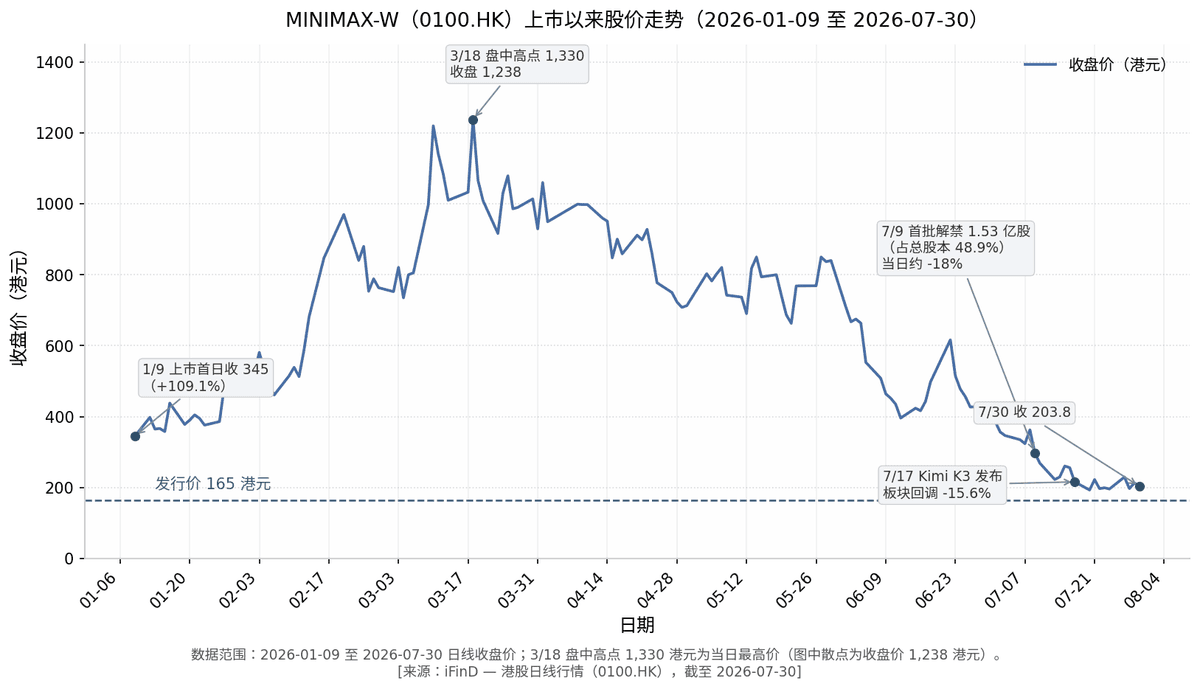
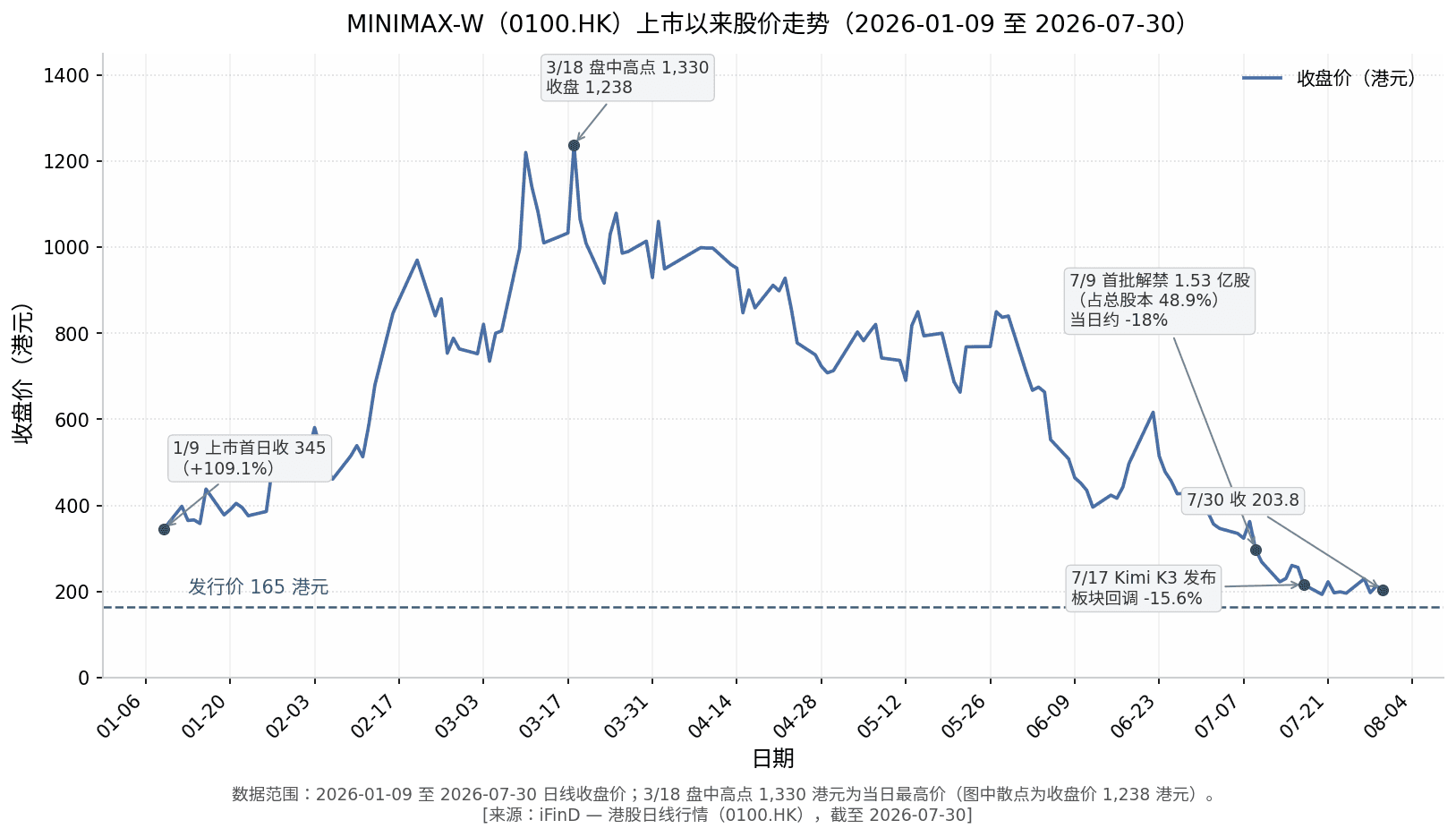
MiniMax was priced at HKD 165/share (upper end of the range), with the Hong Kong public offering oversubscribed 1,837 times (approximately 420,000 participants), 14 cornerstone investors subscribing for USD 350 million, including Abu Dhabi Investment Authority (ADIA, USD 65 million) and Alibaba (USD 30 million) [Source: Caixin, 2026-01-09; The Paper, 2026-01-09]. On its listing day, January 9, 2026, it opened at HKD 235.4 (+42.67%) and closed at HKD 345 (+109.09%), with a market cap of approximately HKD 106.7 billion [Source: Caixin, 2026-01-09; NetEase Tech, 2026-01-09]. Thereafter, it rose along a catalyst chain of "performance announcements + model releases + index inclusions": on March 12, it closed at HKD 1,084, with a market cap of approximately HKD 339.9 billion (briefly surpassing Baidu); on March 18, it hit an intraday high of HKD 1,330, a cumulative increase of about 7.1 times from the issue price [Source: Xueqiu, 2026-03-13; East Money, 2026-05-30].
From April to June, the stock price entered a high-level volatile decline, closing at HKD 840 on May 29 with a market cap of HKD 263.45 billion; inclusion in the Hang Seng Tech Index on June 8 failed to reverse the trend [Source: East Money/Shangguan News, 2026-05-30; Observer, 2026-05-30]. July saw two sharp drops: first, on July 9, the initial lockup expiry of 153 million shares (48.9% of total share capital) caused a daily plunge of about 18%, with shareholder "no-sell" commitments failing to offset the supply shock of nearly half the share capital entering circulation [Source: Sohu Finance, 2026-07-10; 21st Century Business Herald, 2026-07-10]; second, on July 17, Moonshot AI released Kimi K3, raising the ceiling of open-source model capabilities and triggering a revaluation of the scarcity premium for model companies, with MiniMax falling 15.63% that day and closing at HKD 193.1 on July 20 [Source: Caixin, 2026-07-20]. On July 30, 2026, it closed at HKD 203.8 (-4.23%), with an estimated market cap of approximately HKD 71 billion based on about 349 million shares after placement (self-estimated value), still +23.5% from the issue price but down about 85% from the March peak [Source: iFinD — Hong Kong Stock Closing Summary (0100.HK), as of 2026-07-30; total share capital per company announcement cited by Zhidongxi, 2026-07-10].
Reviewing the entire process, the stock price trajectory can be divided into four stages: "Issuance Scarcity Pricing → Model Catalyzing Bubble → Unlock Supply Shock → Scarcity Premium Revaluation": The intraday high of 1,330 HKD on March 18 corresponded to a market cap of approximately 410 billion HKD (estimated based on ~314 million shares pre-placement) against an annual revenue of less than 80 million USD, implying a price-to-sales ratio of over 500x, essentially a liquidity-driven pricing of the "China Consumer AI Application Leader" narrative; the two rounds of decline in July were triggered by share supply (unlock) and competitive landscape (Kimi K3 compressing technological scarcity), neither due to fundamental deterioration. Sellers maintain positive ratings: Goldman Sachs "Buy" with a target of 860 HKD, BofA and Citi "Buy" (BofA expects inclusion in Stock Connect on August 6), Guosen Securities forecasts 2026–2028 revenue of 2.5/6.5/12.9 billion USD [Source: 36Kr/IPO早知道, 2026-07-10; Guosen Securities Research Report, 2026-03-04]. The current market cap of ~71 billion HKD corresponds to a price-to-sales ratio of ~36x based on 2026 forecast revenue, indicating that valuation digestion is largely complete; subsequent stock price sensitivity to unlock tranches and open-source model competition is expected to persist, while the realization speed of ARR exceeding 300 million USD (management statement on May 28, 2026, unaudited) will be the core observation variable for the valuation shift from narrative to performance verification [Source: East Money/National Business Daily, 2026-05-30].
Chapter Supplement (v2): BofA investor meeting minutes show MiniMax's April 2026 ARR reached 400 million USD, with management confident in at least 1 billion USD ARR by year-end (enterprise and cloud API share significantly increased). BofA maintains Buy with a target of 500 HKD; Citi/Haitong International maintained ratings on 07-27 and confirmed that M3 promotional pricing pressure on gross margin has significantly recovered, with the next-generation model having approximately 3 trillion parameters [Source: BofA Investor Meeting Minutes, 2026-07; Citi/Haitong International Research Report cited, 2026-07-27]. In contrast, JPMorgan on 07-21 lowered its MiniMax target price from 240 HKD to 160 HKD (maintaining Neutral, current price is 203.8 HKD, above target) [Source: East Money/Sina Finance citing JPMorgan Research Report, 2026-07-23]. On the legal front, the Disney/Universal/Warner Bros. v. Hailuo AI case had two of MiniMax's dismissal motions (jurisdiction and "characters not protected by copyright" claim) denied by the Central District of California on 2026-05-22, moving the case to merits discovery. MiniMax has filed an answer and counterclaimed that the plaintiff's investigators violated the user agreement. Trial is set for 2026-07-12 [Source: US District Court for the Central District of California documents, cited via TMT Post/36Kr, 2026-05~06].
5. In-depth Analysis of Zhipu
Chapter 4 focused on MiniMax's consumer overseas path. This chapter turns to Zhipu (Beijing Zhipu Huazhang Technology Co., Ltd., 02513.HK, English abbreviation Z.AI), which was listed in Hong Kong concurrently, examining its government/enterprise privatization base, financial structure, model iteration, and post-IPO stock price trajectory.
5.1 Company Overview and Equity
5.1.1 Founding Team from Tsinghua (Tang Jie/Zhang Peng/Liu Debing), 1094 Employees
Zhipu was established on June 11, 2019, registered in Tsinghua Science Park, with its technological roots in the Knowledge Engineering Group (KEG, established 1996) of Tsinghua University's Computer Science Department and its AMiner platform (2006) [Source: Tianyancha — Business Info-Company Basic Info, as of 2026-07-30; Caixin "Zhipu Trio: How the Tsinghua Team Built a Trillion-Yuan AI Company" — 2026-07-02]. Corporate governance exhibits a dual "academic + commercialization" structure: Chief Scientist Tang Jie (Professor and Deputy Head of Tsinghua CS Department) controls the technology roadmap, CEO Zhang Peng (Tsinghua Innovation Leading Engineering PhD) leads commercialization, and Chairman Liu Debing oversees overall operations and capital deployment. The three collectively hold approximately 25% beneficial economic interest [Source: Caixin — 2026-07-02]. Employee count grew from 883 at end-June 2025 (657 R&D, >74% share) to 1,094 at end-2025, with 452 employee shareholders holding 51.2% [Source: Prospectus (cited via Chuangyebang/36Kr) — 2026-01-08; iFinD — Company Data, as of 2026-07-30]. The structure of over 70% R&D personnel and majority employee shareholding indicates it remains in a phase of intensive talent investment for model capability.
5.1.2 State-Owned Shareholder Matrix (SSF, Beijing/Shanghai/Hangzhou Local SOEs) and "National Team" Positioning
Zhipu's shareholder list exhibits a density of state-owned capital rare among AI model companies: at the central level, the China Social Security Fund's Zhongguancun Independent Innovation Fund (1.66% pre-IPO); at the local level, Zhongguancun Science City, Beijing AI Industry Investment Fund, Shanghai Pudong (Pudong Venture Capital/Zhangjiang Group), Hangzhou City Investment, Zhuhai Huafa, Chengdu Hi-Tech Zone, Tianjin Haihe, etc. In 2025 alone, state capital from Hangzhou, Zhuhai, Chengdu, Beijing, and Shanghai invested intensively [Source: Prospectus (cited via Caijing/Claics) — 2026-01; Tianyancha — Business Info-Shareholders, as of 2026-07-30]. At IPO, 11 cornerstone investors subscribed for a total of 2.984 billion HKD, including "Beijing Core State Capital" [Source: Prospectus and IPO reports (Shanghai Securities News/Caijing) — 2025-12~2026-01]. Among financial investors, Junlian Capital (6.16% post-issue) is the largest external shareholder, with Meituan, Ant Group, Tencent, Qiming, and Sequoia also on the list [Source: Prospectus — 2026-01]. The state capital matrix has two direct implications: first, it creates an entry barrier and trust advantage in government and SOE procurement, mutually reinforcing its 73.7% revenue share from local deployment; second, the "indigenous control" narrative gains shareholder backing — against the backdrop of an "indefinite suspension" of high-end AI chip sales to China by the US and domestic AI chip market share in China surpassing 52.3% in Q1 2026 (media estimate), Zhipu's GLM architecture has been adapted to over 40 domestic chips (Ascend, Cambrian, Moore Threads, etc.), becoming a primary candidate to absorb "sovereign AI" demand [Source: EET China 2026-04-06; Sina BigNews 2026-06-02; Caixin — 2026-06]. The trade-off is decision-making and incentives constrained by diverse shareholders, and valuation relying significantly on sentiment towards a scarce asset rather than fundamentals.
5.2 Financial Analysis
5.2.1 2025 Revenue 724 Million RMB (+131.9%), Gross Margin 41.0%, Adjusted Net Loss 3.182 Billion RMB
Key financial indicators from Zhipu's prospectus (2022–2024 and H1 2025) and its first post-listing annual report (FY2025, released 2026-03-31) are as follows:
| Indicator (RMB) | 2022 | 2023 | 2024 | 2025H1 | FY2025 |
|---|---|---|---|---|---|
| Revenue | 57 M | 125 M | 312 M | 191 M (+325% YoY) | 724 M (+131.9%) |
| Net Loss | 144 M | 788 M | 2.958 B | 2.358 B | 4.718 B (+59.5%) |
| Adjusted Net Loss | 97 M | 621 M | 2.466 B | 1.752 B | 3.182 B (+29.1%) |
| Gross Margin | 54.6% | 64.6% | 56.3% | 50.0% | 41.0% |
| R&D Expenditure | 84 M | 529 M | 2.195 B | 1.595 B | 3.180 B (+44.9%) |
[Source: Zhipu HK IPO Prospectus (cited via 36Kr/ZDNet/Claics) — 2025-12-19~21; Zhipu FY2025 Performance Announcement/Annual Report (cited via Wall Street CN/ZT News) — 2026-03-31]
The trends can be interpreted on three levels. Revenue side, growing from 57 million to 724 million RMB over 3.5 years, with the 2025 YoY growth rate (+131.9%) lower than H1 2025's +325%, implying a slowdown after a higher H2 base, but the absolute scale is the largest among domestic AI model companies (MiniMax 2025 revenue ~560 million RMB) [Source: Prospectus/Caixin — 2026-02]. Loss side, the 2025 net loss of 4.718 billion RMB includes a 937 million RMB non-cash loss from fair value changes of financial instruments issued to investors; the adjusted figure of 3.182 billion RMB better reflects operations. The core drag is R&D expenditure of 3.180 billion RMB, ~4.4x revenue, with computing costs accounting for 70% of R&D spend in 2024 and rising to 71.8% in H1 2025, indicating the widening loss is fundamentally driven by proactive computing procurement, not operational inefficiency [Source: Prospectus/Annual Report — 2025-12/2026-03]. Gross margin side, declining steadily from a 2023 peak of 64.6% to 41.0%, the mechanism requires decomposition by revenue structure (see 5.2.2).
5.2.2 Structure: Local Deployment 73.7% vs Cloud MaaS 26.3% and Gross Margin Divergence
The FY2025 annual report provides the following revenue breakdown by deployment method and business type:
| Dimension | Sub-category | FY2025 Revenue | YoY Change | Share | Gross Margin |
|---|---|---|---|---|---|
| By Deployment | Local Deployment | 534 M RMB | +102.3% | 73.7% | 48.8% (2024: 66.0%) |
| By Deployment | Cloud Deployment (MaaS) | 190 M RMB | +292.6% | 26.3% | 18.9% (2024: 3.3%) |
| By Business Type | Enterprise General LLM | 366 M RMB | N/A | 50.4% | N/A |
| By Business Type | Open Platform & API | 190 M RMB | +292.6% | 26.3% | N/A |
| By Business Type | Enterprise Agent | 166 M RMB | +248.8% | ~23% | 52.3% |
[Source: Zhipu FY2025 Performance Announcement/Annual Report (cited via Wall Street CN) — 2026-03-31]
The mechanism for the overall gross margin decline from 56.3% to 41.0% can be decomposed into two factors: first, the gross margin of local deployment (over 70% of revenue) fell from 66.0% to 48.8%, mainly due to heavy revenue recognition and delivery implementation costs for government/enterprise projects, plus pricing pressure from increased competition; second, the rapid increase in the share of low-margin cloud business from ~13% to 26.3% caused structural dilution [Source: Prospectus/Annual Report — 2025-12/2026-03]. However, the cloud gross margin improvement from 3.3% to 18.9% is a key marginal improvement signal: MaaS (Model as a Service, standardized API products billed per token or subscription) has low marginal cost and is replicable. Combined with an 83% cumulative API price increase in Q1 2026 while call volume still grew 400% (management earnings call statement), the cloud business has a path to recover to over 30% gross margin [Source: Caixin/NetEase Tech — 2026-04~05]. The risk is that Zhipu's weekly token consumption rank on OpenRouter has slipped from 3rd globally to 17th (2026-04), and the price elasticity boundary of the pricing strategy remains to be tested [Source: NetEase Tech "Token is Not a Good Business" — 2026-05].
5.2.3 Cash 2.259 Billion RMB, 93% IPO Proceeds Consumed, 31.4 Billion HKD Placement and A+H Plan
As of the end of 2025, Zhipu had cash and cash equivalents of RMB 2.259 billion, bank borrowings of RMB 690 million, and a debt-to-asset ratio of 15.2%; shareholders' equity was -RMB 8.111 billion, due to the accounting treatment of convertible financial instruments before listing, which were converted into equity after listing [Source: Zhipu 2025 Annual Report — 2026-03-31]. Compared with an adjusted annual loss of RMB 3.182 billion and operating cash outflow of approximately RMB 1.33 billion in H1 2025, the existing cash is insufficient to support more than one year of consumption, indicating high financing dependence. In fact, as of 2026-06-30, the company had utilized 93% of the net IPO proceeds (HK$4.588 billion) (net proceeds corresponding to approximately HK$4.9 billion after full exercise of the greenshoe, including the over-allotment portion), which directly led to the placement of 19.78 million H-shares at HK31.41 billion [Source: HKEX Announcement (via Caixin) — 2026-07-10]. Meanwhile, the company is advancing its A+H dual listing: on the STAR Market, it plans to issue A-shares representing 2%–8% of total share capital, raising no more than RMB 15 billion (RMB 12 billion for foundational model R&D, RMB 2 billion for the MaaS platform, and RMB 1 billion for working capital). The辅导 acceptance was completed on 2026-06-17, but as of 2026-07-22, the formal application had not yet been submitted to the Shanghai Stock Exchange [Source: Caixin/STAR Market Daily/Yicai — 2026-06~2026-07-22]. If the potential ammunition totaling approximately HK$47 billion from the placement and A-share return is successfully secured, it could cover about three to four years of adjusted losses. However, the dilution of per-share value from continuous equity financing cannot be ignored—after this placement, H-shares account for 51.78% of total share capital.
5.3 Business and Products
5.3.1 GLM Model Iteration (GLM-5/5.1/5.2 Open Source) and MaaS Platform ARR of RMB 1.7 Billion
Zhipu's foundational model adopts the self-developed GLM architecture (launched in 2021), with an iteration cadence of approximately one version per quarter: GLM-4.5 (open-sourced 2025-07) → GLM-4.7 (end of 2025) → GLM-5 (open-sourced 2026-02-12, 744 billion parameters, trained on 28.5 trillion tokens, MIT license) → GLM-5.1 (2026-04-08, supports 8-hour long-range tasks, first to surpass Claude Opus 4.6 on SWE-bench Pro) → GLM-5.2 (launched and open-sourced 2026-06-17, 1 million token lossless context; Artificial Analysis comprehensive score of 51, tied for top three with Anthropic/OpenAI, first among open-source models; Code Arena global second) [Source: Sina Tech/IT Home/Caixin/STAR Market Daily — 2025-08~2026-07]. Model capabilities are converging towards engineering (coding + Agent), and the market label has shifted from "China's OpenAI" to "China's Anthropic" [Source: Caixin — 2026-06-22].
On the commercialization front, the MaaS platform's Annual Recurring Revenue (ARR) reached RMB 1.7 billion (as of 2026-03, a 60-fold increase in one year), with 242,000 paying developers, over 4 million registered platform users, covering 218 countries/regions [Source: Zhipu 2025 Annual Report — 2026-03-31]. The product matrix includes the code subscription GLM Coding Plan (monthly fee starting from approximately RMB 20, with a price increase of over 30% in 2026-02) and the Agent subscription Claw Plan (subscriptions exceeded 400,000 within 20 days of launch). On the C-end, "Zhipu Qingyan" had over 25 million users by mid-2025 [Source: CGTN — 2026-01-09; Wall Street CN — 2026-03-31]. The explosion in ARR mainly occurred after the open-sourcing of the GLM-5 series, indicating that the conversion chain of "open source builds developer mindshare → subscription/API monetization" has been initially validated. However, compared to the recognized revenue of RMB 724 million in 2025, the RMB 1.7 billion ARR implies that a large portion of ARR is still in a low-ARPU subscription form, making the recognition pace and renewal rate key points for subsequent observation.
5.3.2 Government/Enterprise Private Deployment Foundation: Renewal Rate 95%, Increasing Customer ARPU, Decreasing Customer Concentration
Localized deployment targets government, state-owned enterprises, finance, energy, and leading internet clients with customized delivery. During the prospectus period (2022–2025H1), over 84% of revenue came from this business, dropping to 73.7% in 2025, but it remains the absolute foundation [Source: Prospectus/Annual Report — 2025-12/2026-03]. The quality indicators of the customer base are generally improving: the renewal rate is 95%, and the revenue share of the top five customers decreased from 55.4% in 2022 and 61.5% in 2023 to 45.5% in 2024 and 40.0% in 2025H1, showing a continuous decline in concentration, indicating that reliance on single large customers for revenue is easing [Source: Prospectus (via Sina Finance) — 2025-12-20]. In terms of customer scale, as of 2025-09-30, the model covered approximately 12,000 enterprise clients globally and over 80 million terminal devices. Daily token consumption was 4.2 trillion in 2025-11. After the release of GLM-5, nine of China's top ten internet companies deeply integrated GLM [Source: Prospectus (via Cailianshe/Zhidongxi) — 2025-12; Wall Street CN — 2026-03-31]. It should be noted that the moat of this foundation comes more from government/enterprise access and domestic computing power adaptation (co-design with over 40 domestic chips) than from the scale of token calls—based on public cloud MaaS call volume in 2025, Volcengine, Alibaba Cloud, and Baidu together accounted for nearly 90% of the market share, with Zhipu holding a very small share [Source: NetEase Tech (via IDC) — 2026-05]. The ceiling of the government/enterprise market and the payment cycle will constrain the long-term growth rate of this foundation.
5.4 Post-Listing Stock Price Trajectory
5.4.1 IPO at HK$116.2 → HK$2,980 Trillion Market Cap → Kimi K3 Impact → Closed at HK$862 on 7/30
Zhipu was listed on the Main Board of the Hong Kong Stock Exchange on 2026-01-08 at HK$116.20 per share, issuing 37.4195 million H-shares, with total proceeds of approximately HK$4.348 billion (before greenshoe), an IPO market cap exceeding HK$51.1 billion, and a Hong Kong public offering oversubscription of 1,159 times [Source: Offering Circular and Listing Reports (Shanghai Securities News/Caixin) — 2025-12-30~2026-01-08].
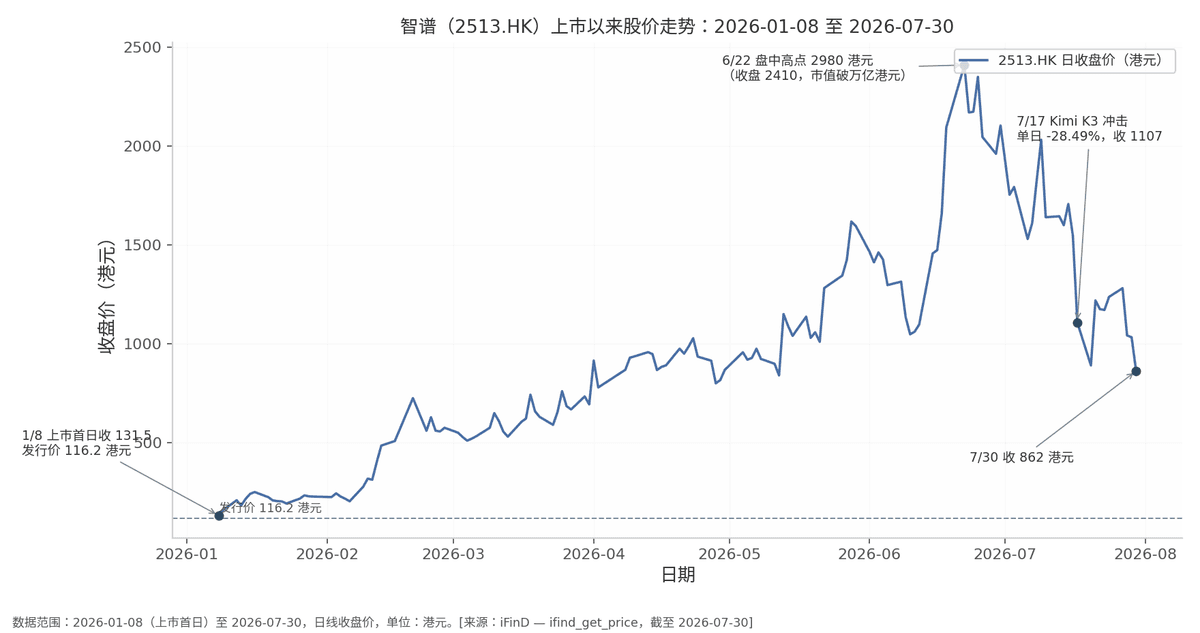
The stock price trajectory can be divided into three phases. Phase 1 (Jan–Feb) Steady Rise: Closed at HK$131.5 on the first day of listing. After the open-sourcing of GLM-5 (2-12), the stock price rose from the HK$240 range to above HK$500 within two weeks. Phase 2 (Mar–Jun) Accelerating Peak: Driven by catalysts such as the disclosure of RMB 1.7 billion ARR in the 2025 annual report and inclusion in the Hang Seng Tech Index and Stock Connect (6-08), it hit an all-time high of HK$2,980 intraday on 6-22, closing at HK$2,410, with a market cap briefly exceeding HK$1 trillion, a maximum increase of over 24 times from the IPO price [Source: iFinD — Historical Quotes 2513.HK, as of 2026-07-30; Caixin — 2026-05-29]. Phase 3 (Jul) Sharp Correction: On 7-08, when the cornerstone lock-up expired for 25.6816 million shares (5.76% of total share capital), the stock actually rose 13% that day. However, on 7-17, Moonshot AI released Kimi K3 (2.8 trillion parameters, ranked third globally by Artificial Analysis), directly impacting Zhipu's scarcity premium as "open-source number one." The stock price plummeted 28.49% in a single day, closing at HK$1,107, marking the largest drop since listing [Source: Caixin — 2026-07-08/07-20/07-25; iFinD — ifind_get_price, as of 2026-07-30]. Subsequently, it fluctuated downwards, closing at HK$1,033 on 7-29 and HK$862 on 7-30, a retracement of approximately 64% from the closing price on 6-22, but still about 7.4 times the IPO price. Based on a total share capital of approximately 465.6 million shares, the estimated market cap is around HK$400 billion (total share capital has definitional differences; market cap is an estimate) [Source: iFinD — ifind_get_price, as of 2026-07-30; Tianyancha — Business Information, as of 2026-07-30].
Based on 2025 revenue of RMB 724 million, even after the correction, the price-to-sales ratio corresponding to the market cap is still approximately 500 times. The huge divergence between UBS's target price of HK$1,160 (2026-04-21) and JPMorgan's target price of HK$2,000 (2026-07-08) essentially reflects different pricing of the sentiment premium for a "national team scarce target" [Source: Zhitong Finance/Caixin — 2026-04-21/07-08]. Looking ahead, three variables will dominate the valuation center: first, whether the revenue growth rate in the August 2026 interim report can maintain above 100% and whether the cloud gross margin can break through 30%; second, the progress of the formal application for the RMB 15 billion A-share fundraising; third, the large-scale lock-up expiration of 39.99% of total share capital on 2027-01-08 and the continuous raising of the open-source capability ceiling by competitors like Kimi K3 and DeepSeek V4—if the "open-source number one" position is lost and the growth rate of the government/enterprise foundation slows down, the supporting logic for the current valuation will face a systemic reassessment.
Chapter Supplement (v2): Substantial progress in the A-share process—Zhipu received the completion letter for the listing辅导 acceptance from the Beijing Securities Regulatory Bureau on 2026-06-29 and is about to formally submit its STAR Market application; it plans to issue 9.0988 million to 38.769 million new A-shares, raising net proceeds of approximately RMB 15 billion, of which 80% (RMB 12 billion) will be invested in general-purpose foundational models; the sponsor has been changed from China International Capital Corporation to Guotai Haitong [Source: Beijing Securities Regulatory Bureau辅导 Acceptance Letter/Zhipu辅导 Documents, via 36Kr and STAR Market Daily 2026-06~07 reports]. On the computing power side, on July 20, the company launched a 1GW-level all-domestic AI chip data center (partially operational) and acquired Zhongke Jiahe to complete the software stack—compared to media descriptions in mid-April that it still "lacked self-built computing centers," this sharp turnaround in three months is highly synchronized with the A-share application timeline [Source: Yicai/Economic Observer Online, 2026-07-20/21; Economic Observer Online, 2026-04-18]. On the operational side, after cumulative price increases of over 80%, call volume has instead quadrupled, continuing the seller's market pattern [Source: Huxiu, 2026-07-09]. On the valuation expectation side, JPMorgan on 07-21 lowered its target price for Zhipu from HK$2,400 to HK$1,600 (maintaining overweight) [Source: Oriental Fortune/Sina Finance citing JPMorgan Research Report, 2026-07-23].
6. Dual Company Comparative Analysis
Among the four commercialization path frameworks established in Chapter 1 (C-end subscription/advertising, MaaS API, government/enterprise private deployment, open-source ecosystem), MiniMax and Zhipu happen to occupy opposite ends of the path spectrum: the former focuses on C-end applications and overseas expansion, while the latter is rooted in government/enterprise private deployment and the open-source ecosystem. This chapter places the two companies in the same coordinate system, conducting a systematic comparison from four dimensions: business model, financial quality, technology ecosystem, and moat. A note on reporting currency is necessary: MiniMax reports in USD, Zhipu in RMB. This chapter retains the original currencies for comparison and presents converted values, using an approximate conversion rate of 1 USD ≈ 7.1 RMB and 1 HKD ≈ 0.91 RMB (all converted values in this chapter are estimates, not disclosed figures).
6.1 Business Model Comparison
6.1.1 Differences in Revenue Quality: C-end Traffic Monetization vs. B/G-end Project-based (Comparison Table)
| Dimension | MiniMax (00100.HK) | Zhipu (02513.HK) |
|---|---|---|
| Main Path (per Chapter 1 framework) | C-end subscription/advertising + MaaS API | Government/enterprise privatization + open-source ecosystem conversion |
| Revenue Structure | AI-native C-end products account for 67.2%, open platform and enterprise services account for 32.8% (FY2025) [Source: MiniMax FY2025 results announcement, 2026-03-02] | Local deployment accounts for 73.7%, cloud MaaS accounts for 26.3% (FY2025) [Source: Zhipu FY2025 results announcement, as cited by Wallstreetcn, 2026-03-31] |
| Geographic Structure | Overseas revenue accounts for 73%, with Singapore and the US as the top two markets [Source: MiniMax FY2025 results announcement, 2026-03-02; prospectus via 21st Century Business Herald, 2025-12-22] | Primarily domestic government/enterprise, overseas exposure undisclosed |
| Customer/User Base | Cumulative 236 million individual users, 1.7716 million paying users (first nine months of 2025), paying penetration ~6.4% [Source: MiniMax prospectus, 2025-12] | ~12,000 enterprise customers, renewal rate 95%, top five customers' share down to 40.0% (H1 2025) [Source: Zhipu prospectus, as cited by Cailian Press/Sina Finance, 2025-12] |
| Pricing Model | Subscription + in-app purchases + advertising + API usage-based | Project-based custom delivery + MaaS subscription/per-token billing |
| Revenue Replicability | High: C-end products globally replicable, marginal delivery cost near zero | Low: Local deployment implementation-heavy, revenue recognized per project |
| Core Risks | Content regulation (new rules on anthropomorphic interactions), copyright litigation, overseas geopolitical exposure | Project-based growth ceiling, collection cycle, small public cloud token share |
From a revenue quality perspective, the difference between the two companies is essentially the difference between a "traffic business" and an "order business." MiniMax's revenue granularity is small and dispersed—1.77 million paying users correspond to an ARPPU (average revenue per paying user) of only about $15 [Source: MiniMax prospectus, as of 2025-09-30], and the loss of a single customer barely affects the financials, but monetization depth is constrained by individual users' willingness to pay. Zhipu's revenue granularity is large and recognition is heavy—local deployment projects have high individual contract values, and the 95% renewal rate provides visibility, but the top five customers still account for 40% of revenue, and revenue pacing is governed by bidding and acceptance cycles [Source: Zhipu prospectus, as cited by Sina Finance, 2025-12-20]. Growth structure also shows divergence signals: MiniMax's B-end open platform revenue grew +197.8% YoY in 2025, surpassing C-end growth of +143.4% [Source: MiniMax FY2025 results announcement, 2026-03-02]; Zhipu's cloud MaaS revenue grew +292.6%, with MaaS ARR (annual recurring revenue) reaching RMB 1.7 billion (as of 2026-03) [Source: Zhipu 2025 annual report, 2026-03-31]. Both companies are hedging toward each other's path—MiniMax uses B-end APIs to smooth C-end regulatory volatility, while Zhipu uses cloud subscriptions to mitigate the project-based ceiling. The dual-track structure of "main path + secondary path" is expected to become the common form of revenue evolution for both companies in 2026–2027.
6.1.2 Gross Margin Structure: MiniMax 25.4% vs. Zhipu 41.0% and Its Causes
In 2025, Zhipu's consolidated gross margin was 41.0%, while MiniMax's was 25.4%. The 15.6-percentage-point gap is not a difference in operational efficiency but an accounting reflection of revenue structure [Source: Zhipu 2025 annual report, 2026-03-31; MiniMax FY2025 results announcement, 2026-03-02].
The mechanism needs to be dissected from both ends. MiniMax's low gross margin stems from rigid C-end inference costs: high-frequency calls from C-end companion and creation products directly include inference compute as cost of goods sold; the more active the users, the more rigid the costs. In 2023, gross margin was once -24.7% (inference costs exceeded revenue) [Source: MiniMax prospectus, via 36Kr, 2025-12]. Its recovery path relies on two levers—model inference efficiency (Bank of America estimates M2.7 inference profit margin exceeds 40%) and a rising share of high-margin B-end API revenue. The recovery to 25.4% in 2025 is the result of both factors [Source: 36Kr/IPO早知道, 2026-07-10; MiniMax FY2025 results announcement, 2026-03-02]. Zhipu's high gross margin comes from government/enterprise project pricing but is being eroded by two forces: first, the gross margin of local deployment, which accounts for over 70% of revenue, fell from 66.0% in 2024 to 48.8% in 2025, reflecting intensified competition in government/enterprise projects, rising delivery and implementation costs, and pricing pressure; second, the cloud business, with a gross margin of only 18.9%, saw its share rise from ~13% to 26.3%, creating structural dilution [Source: Zhipu FY2025 results announcement, as cited by Wallstreetcn, 2026-03-31]. In other words, Zhipu's gross margin curve is a downward combination of "declining project margins + low-margin cloud scaling," while MiniMax's is a recovery combination of "inference efficiency gains + rising B-end share." The two are moving in opposite directions: in 2023, Zhipu's gross margin (64.6%) exceeded MiniMax's (-24.7%) by nearly 90 percentage points; by 2025, the gap had narrowed to 15.6 percentage points. If Zhipu's cloud business recovers to gross margins above 30% (after an 83% API price increase in Q1 2026, call volumes still grew 400%) and MiniMax's inference efficiency gains continue, the two companies' gross margin centers are expected to converge in the 30%–40% range, but the speed of convergence depends on when Zhipu's local deployment gross margins stabilize [Source: Caixin/NetEase Tech, 2026-04~05].
6.2 Financial Quality and Cash Burn Comparison
6.2.1 Loss Rate, R&D Expense Ratio, and Cash Runway Calculation (Comparison Table)
| Metric (FY2025) | MiniMax | Zhipu |
|---|---|---|
| Revenue | $79.038 million (approx. RMB 561 million, estimated), +158.9% | RMB 724 million (approx. $102 million, estimated), +131.9% |
| Gross Margin | 25.4% | 41.0% |
| Adjusted Net Loss | $250.9 million (approx. RMB 1.781 billion, estimated), +2.7% YoY | RMB 3.182 billion (approx. $448 million, estimated), +29.1% YoY |
| Adjusted Loss Rate (Loss/Revenue) | ~317% (2024: ~800%) | ~439% (2024: ~790%) |
| R&D Expenses | $252.8 million (+33.8%), R&D expense ratio ~320% | RMB 3.180 billion (+44.9%), R&D expense ratio ~439% |
| Cash and Equivalents (end of 2025) | $508 million; total cash reserves including financial assets $1.0503 billion (approx. RMB 7.46 billion, estimated) | RMB 2.259 billion; plus bank borrowings of RMB 690 million |
| Static Cash Runway (estimated) | Narrow (cash and equivalents) ~2.0 years; broad (total cash reserves) ~4.2 years | ~0.7 years (~8.5 months) |
| Pro Forma (including July 2026 financing, estimated) | +HK$16 billion placement and convertible bonds (approx. $2.05 billion, estimated), broad runway expected to exceed 5 years | +HK$31.410 billion placement (approx. RMB 28.9 billion, estimated), static estimate ~8–10 years |
| IPO Proceeds Consumption | ~77% of R&D-related portion used (as of 2026-06-30) | 93% of net proceeds used (HK$4.588 billion, as of 2026-06-30) |
[Source: MiniMax FY2025 results announcement, 2026-03-02; Zhidongxi citing company announcements, 2026-07-10; Zhipu FY2025 results announcement, 2026-03-31; HKEX announcements via Caixin, 2026-07-10; cash runway = cash and equivalents ÷ annualized adjusted net loss, estimated per this chapter]
Three comparisons in the table merit further discussion. First, the difference in loss quality is greater than the difference in loss scale. MiniMax's adjusted net loss expanded only 2.7% YoY, while revenue grew 158.9%; the adjusted loss rate narrowed from ~800% to ~317% in one year, indicating a clear improvement trajectory in unit economics. Zhipu's adjusted net loss expanded 29.1% YoY, with a loss rate of 439% still higher than MiniMax's, but compute costs account for over 70% of its R&D expenses (70% in 2024, 71.8% in H1 2025). The loss expansion is driven by proactive compute procurement rather than operational deterioration [Source: MiniMax FY2025 results announcement, 2026-03-02; Zhipu prospectus/annual report, 2025-12/2026-03]. Second, the contrast in R&D expense ratio (320% vs. 439%) and absolute R&D spending (approx. RMB 1.8 billion vs. 3.18 billion, estimated) reveals two R&D organizational models: MiniMax supports full-modality self-development with a team of ~400 and cumulative R&D investment of ~$500 million, with high per-capita intensity; Zhipu uses a team of 1,094 and outsourced compute to trade for iteration speed, with high capital intensity [Source: MiniMax prospectus/Nanfang Daily, 2026-01/03; Huxiu, 2026-01-09; Zhipu 2025 annual report, 2026-03-31]. Third, the limitations of the cash runway metric must be clearly stated: the static runway annualizes the 2025 adjusted loss and does not account for dynamic loss expansion—Zhipu's R&D spending growth of +44.9%, if sustained, would significantly shorten its actual coverage period (Chapter 5 estimates that the July placement and A-share return, totaling ~HK$47 billion, could cover about three to four years under a loss expansion scenario); it also does not include MiniMax's post-July 2026 placement proceeds or Zhipu's potential RMB 15 billion A-share return financing [Source: Caixin/STAR Market Daily, 2026-06~07]. Overall, neither company faces near-term survival financing pressure, but Zhipu's reliance on equity financing (93% of IPO proceeds consumed within a year, H-shares accounting for 51.78% of total share capital after the placement) is higher than MiniMax's, and per-share dilution is a key negative for its financial quality [Source: HKEX announcements via Caixin, 2026-07-10].
6.3 Technology and Ecosystem Comparison
6.3.1 Open-Source Ecosystem Position (GLM-5.2 vs. M3), Token Call Volume, and Third-Party Rankings
| Dimension | MiniMax (M Series) | Zhipu (GLM Series) |
|---|---|---|
| Flagship Open-Source Model | M3 (Mid-2026, sparse attention architecture, 9.7x prefill speedup / 15.6x decoding speedup, blended pricing $0.22/million tokens); M3 Pro under development (reported 2.7 trillion parameters) [Source: Guancha.cn/Shangguan News, 2026-05-30; 36Kr/IPO Zao Zhidao, 2026-07-10; The Information via Caixin] | GLM-5.2 (Launched and open-sourced 2026-06-17, 1 million token lossless context, MIT license) [Source: Caixin/STAR Market Daily, 2026-06] |
| Third-Party Ranking Position | Citigroup cites Artificial Analysis Intelligence Index stating M3 ranks first globally among open-source models; M2.5 previously set SWE-Bench Verified record [Source: 36Kr/IPO Zao Zhidao, 2026-07-10; MiniMax 2025 Annual Performance Report, 2026-03-02] | Artificial Analysis Composite Score 51, tied with Anthropic/OpenAI in top three, first in open-source; Code Arena global second [Source: Caixin/STAR Market Daily, 2026-06~07] |
| OpenRouter Weekly Token Usage | M3: 4.24 trillion tokens | GLM-5.2: 2.90 trillion tokens |
| Open-Source Ecosystem Scale | M2 was the first Chinese model on OpenRouter to exceed 50 billion daily token consumption, ranked first on HuggingFace Global Trending; established dedicated open-source fund (Yan Junjie pledged 1% personal shares) [Source: MiniMax 2025 Annual Performance Report, 2026-03-02; Caixin, 2026-07-10] | GLM series cumulative open-source downloads exceeded 45 million; 242,000 paying developers, platform registered users over 4 million, covering 218 countries/regions [Source: Zhipu Prospectus, 2025-12; Zhipu 2025 Annual Report, 2026-03-31] |
| Ecosystem Monetization | Open platform revenue $25.963 million (+197.8%), models deployed on Google Vertex AI, Microsoft Azure AI Foundry, Notion [Source: MiniMax 2025 Annual Performance Report, 2026-03-02; Nanfang Daily, 2026-03-06] | MaaS ARR 1.7 billion RMB (as of 2026-03, 60x increase in one year); GLM Coding Plan, Claw Plan subscription matrix [Source: Zhipu 2025 Annual Report, 2026-03-31] |
| Multimodal Layout | Full modality: Video (Hailuo 2.3 cumulatively generated over 590 million videos), Speech (Speech-2.6 cumulatively over 220 million hours), Music, Image [Source: NetEase/Xinmin Evening News, 2025-10-31; 36Kr/Lei Di, 2026-01-08] | Language/Programming/Agent as main axis, GLM-4.5V covers visual reasoning [Source: Sina Tech/IT Home, 2025-08] |
[Source: OpenRouter weekly usage data cited from Caixin, as of 2026-07-08; Shanghai Securities News via Wall Street CN, as of 2026-07-16]
Interpretation on three levels. First, the title of 'Open-Source Number One' changes hands frequently, and its pricing significance outweighs its technical significance. M3 and GLM-5.2 are both called 'Open-Source Number One' under different metrics (Intelligence Index cited by Citigroup vs. Artificial Analysis Composite Score). After Moonshot AI's Kimi K3 (2.8 trillion parameters, Artificial Analysis global third) was released on July 17, 2026, Zhipu's stock price fell -28.49% and MiniMax fell -15.63% on the same day – the market's pricing of 'open-source capability ceiling' is revalued on a weekly basis, indicating this position is essentially a liquidity premium anchor rather than a stable asset [Source: Caixin, 2026-07-20]. Second, there is a divergence between token usage and monetization efficiency. M3's weekly usage (4.24 trillion tokens) is higher than GLM-5.2's (2.90 trillion tokens), but Zhipu's MaaS ARR (1.7 billion RMB, approximately $240 million, estimated) is several times MiniMax's open platform annualized revenue – usage reflects developer mindshare, ARR reflects paid conversion. Zhipu currently has higher conversion efficiency in the 'open-source acquisition → subscription/API monetization' chain, while MiniMax M3's repeated pattern of 'doubling the launch price then announcing permanent 50% API discount about a week later' exposes its lack of pricing power despite usage volume advantages [Source: Shanghai Securities News via Wall Street CN, 2026-07-16; Zhipu 2025 Annual Report, 2026-03-31; JPMorgan Research Report via Caixin, 2026-07-10]. Third, the technical depth directions differ: MiniMax's moat is built on full-modality data and productization (scale effects in video and speech generation volume), while Zhipu's depth lies in programming/Agent long-horizon tasks and domestic chip adaptation (co-design with over 40 types of domestic chips) [Source: Caixin, 2026-06]. It is expected that relative positions on open-source leaderboards will continue to swap frequently, and their impact on valuation will give way to quarterly verification of ARR and usage-to-paid conversion rates.
6.4 Moat and Weaknesses
6.4.1 MiniMax: User Pool + Full Modality vs. Regulatory Exposure; Zhipu: Government/Enterprise Barriers vs. Project-Based Ceiling
Judging the moats of the two companies requires strictly distinguishing between 'temporary advantages' (erodible by competition within 1–2 years) and 'structural lock-ins' (supported by barriers to entry, switching costs, or network effects).
On MiniMax's side. There are two structural components: First, a C-end user pool of 236 million individual users and 1.77 million paying users, combined with the community and content accumulation of Talkie/Xingye. User switching costs accumulate with usage time, providing a first-mover lock-in effect within the window before major domestic companies fully expand overseas for AI companionship [Source: MiniMax Prospectus, 2025-12]. Second, the productization depth of full-modality capabilities – text, video, speech, music, and image five modality lines share a base model and cross-promote each other. The generation scale of 590 million videos and 220 million hours of speech constitutes a multimodal data flywheel, difficult for single-point imitators to replicate at low cost [Source: NetEase/Xinmin Evening News, 2025-10-31; 36Kr/Lei Di, 2026-01-08]. The temporarily leading components are model performance and overseas revenue structure: M3's open-source leaderboard position has been challenged by Kimi K3; the 73% overseas revenue share itself does not constitute a barrier but rather amplifies regulatory exposure – Talkie was removed twice (US/Japan in 2024, domestic Xingye in 2025), the 'Interim Measures for the Management of AI Anthropomorphic Interactive Services' took effect in July 2026, and copyright lawsuits from three major studios including Disney (potential compensation up to hundreds of millions of dollars) all directly impact the revenue base [Source: Caixin, 2024-12-20; Sina Tech, 2025-11-19; Shanghai Cyberspace Administration via IT Home, 2026-06-26; TMTPost/36Kr, 2025-09].
On Zhipu's side. Structural components are concentrated in government/enterprise access: a shareholder matrix including the National Social Security Fund and five regional state-owned capital entities, a 95% renewal rate, and deep adaptation for over 40 types of domestic chips. These three factors reinforce each other, forming trust and qualification barriers under the 'self-controllable' procurement logic that competitors cannot easily overcome in the short term [Source: Zhipu Prospectus, 2026-01; Caixin, 2026-06]. The temporarily leading components are the 'Open-Source Number One' label and high MaaS growth rate: the former has been proven to change hands weekly (Kimi K3's -28.49% stock price impact on the day serves as pricing evidence), while the latter faces price elasticity limits – after an 83% price increase in Q1 2026, OpenRouter weekly token ranking dropped from global 3rd to 17th [Source: Caixin, 2026-07-20; NetEase Tech 'Tokens Are Not a Good Business', 2026-05]. Its weaknesses are homologous to its moat: government/enterprise privatization accounting for 73.7% means growth is constrained by a project-based ceiling – on-premise gross margin dropped from 66.0% to 48.8% within two years, revenue expansion under a heavy delivery model must match delivery headcount growth, and in the public cloud MaaS usage share, Volcengine, Alibaba Cloud, and Baidu together account for nearly 90%, leaving Zhipu with a very small share, so the second growth curve remains unverified [Source: Zhipu 2025 Annual Report, 2026-03-31; NetEase Tech (citing IDC), 2026-05].
Juxtaposing the two yields an asymmetric conclusion: MiniMax's structural moat (C-end user pool) is built on the demand side, with high ceilings but dominated by regulatory and geopolitical variables, resulting in high volatility; Zhipu's structural moat (government/enterprise access) is built on supply-side qualifications, with high certainty but constrained by project-based economics, resulting in low elasticity. For investors, MiniMax's valuation elasticity comes from the interplay between ARR realization and regulatory risk; Zhipu's valuation support depends on whether the growth rate of the government/enterprise base and cloud margin recovery can outpace the decay rate of the 'Open-Source Number One' scarcity premium – the former is a 'high-beta cash flow story', the latter is a 'policy premium option story'. Their risk-return profiles are expected to remain significantly divergent before the mid-2026 interim report verification window.
7. Valuation Analysis
This chapter provides a valuation framework and reference anchors for MiniMax (00100.HK) and Zhipu (02513.HK). It does not constitute investment advice and does not provide target prices. Core methodological premise: Both companies are unprofitable large model enterprises, making profitability metrics inapplicable. The EV/Sales and EV/ARR (Enterprise Value / Annual Recurring Revenue) frameworks are applicable. Furthermore, the current secondary market prices of both companies are distorted by extreme shareholding structures; direct extrapolation using static multiples would lead to systematic misjudgment.
7.1 Comparable Company Valuation Anchors
7.1.1 Normalized Range of 10.8x P/S for SenseTime and 1.8x P/S for 4Paradigm vs. the Scarcity Premium of Hundreds of Times P/S for the Two Newcomers
Two AI companies listed in Hong Kong for over three years with revenue in the tens of billions of RMB can serve as 'normalized multiple' references, creating a clear four-tier valuation stratification with the two newly listed large model companies:
| Company | Closing Price (2026-07-30) | Total Shares (Approx.) | Market Cap (Approx.) | 2025 Revenue | Static P/S (Approx.) |
|---|---|---|---|---|---|
| Zhipu (02513.HK) | 862.0 HKD [Source: iFinD — cmd_history_quotation, as of 2026-07-30] | 466 million shares (after July placement) [Source: Caixin, 2026-07-10] | 400 billion HKD | 724 million RMB (+132%) [Source: Zhipu 2025 Annual Report, via Cloud Headlines, 2026-06-09] | Approx. 500x (free float <14%, severely distorted) |
| MiniMax (00100.HK) | 203.8 HKD [Source: iFinD — cmd_history_quotation, as of 2026-07-30] | 349 million shares (after July placement) [Source: Caixin, 2026-07-10] | 71 billion HKD | USD 79.038 million (approx. 560 million RMB, estimated, +158.9%) [Source: Caixin, 2026-07-09] | Approx. 120x |
| SenseTime-W (0020.HK) | 1.41 HKD [Source: iFinD — cmd_history_quotation, as of 2026-07-30] | 42.217 billion shares (after April placement) [Source: Viewpoint Network, 2026-04-24] | 59.5 billion HKD | 5.015 billion RMB (+32.9%, generative AI accounts for 72.4%) [Source: SenseTime 2025 Annual Report, 2026-03-24] | Approx. 10.8x |
| 4Paradigm (6682.HK) | 27.64 HKD [Source: iFinD — cmd_history_quotation, as of 2026-07-30] | Approx. 520 million shares [Source: iFinD — get_stock_info, as of 2026-07-30] | 14.4 billion HKD | 7.135 billion RMB (+35.6%, adjusted net profit turned positive) [Source: 4Paradigm 2025 Annual Report, 2026-03-30] | Approx. 1.8x |
Note: P/S is converted at approximately 0.91 RMB per HKD, based on market cap rather than strict EV/Sales; Zhipu and MiniMax have net cash on their books of approximately 34 billion and 24 billion HKD respectively, so strict EV/Sales would be slightly lower than the figures in the table.
The above stratification contains two independent pieces of information. First, SenseTime's approximately 10.8x P/S (Goldman Sachs' 2026 expected P/S of 10.7x corroborates this [Source: East Money citing Goldman Sachs research report, 2026-06-15]) represents the market-based pricing center for "generative AI companies with scaled revenue"; 4Paradigm's approximately 1.8x suggests that when revenue is heavily mixed with low-margin computing and integration services, even with a larger absolute revenue, the market multiple drops by another order of magnitude. Second, there is no continuous comparable relationship between Zhipu's static P/S of approximately 500x and MiniMax's approximately 120x and their fundamental multiples—the nearly 4x difference, despite similar revenue scales (724 million RMB vs. approximately 560 million RMB, estimated), is itself evidence of non-market pricing. The divergence primarily stems from free float structure (see 5.2) and the scarcity premium of the "B/G-end national team narrative" relative to the "C-end overseas narrative," rather than a comparable gap in revenue quality.
Another independent anchor is the primary and IPO markets. Zhipu's IPO market cap was approximately 51.1–51.8 billion HKD, corresponding to approximately 150x P/S on 2024 revenue; MiniMax's IPO market cap was approximately 51.8 billion HKD, corresponding to approximately 87x P/S on 2025 revenue [Source: Zhipu offering announcement and listing reports, via Shanghai Securities News/Caixin, 2025-12-30 to 2026-01-08; Caixin, 2026-01-09]. The primary and IPO markets set an initial pricing range of approximately 80–150x P/S for "pure large model" assets—an anchor formed by institutions under the most complete information and real capital commitment constraints, with credibility higher than early-stage distorted secondary market prices.
7.1.2 Overseas OpenAI/Anthropic 15–30x EV/ARR Reference
The overseas primary market provides the pricing ceiling for global leading large model assets. OpenAI completed a USD 122 billion funding round in March 2026, with a post-money valuation of approximately USD 852 billion; its ARR rose from approximately USD 25 billion in April 2026 to nearly USD 60 billion by the end of July 2026, implying an EV/ARR of approximately 14–34x (varying by ARR measurement timing) [Source: Huxiu, 2026-05-25; IT Home, 2026-05-08; CNBC via NetEase Tech, 2026-07-30]. Anthropic's post-Series H valuation in May–June 2026 was approximately USD 900–965 billion, with ARR of approximately USD 44–47 billion, EV/ARR approximately 20x [Source: FT/WSJ/Bloomberg, cited by IT Home 2026-05-08, zaowu.world 2026-07-01]. Overall, the two largest and fastest-growing global large model companies are priced in the approximately 15–30x EV/ARR range. The implication is that even with the strongest growth certainty premium globally, the market pays no more than USD 30 for every USD 1 of annual recurring revenue—providing a ceiling reference for assessing the reasonable value of Zhipu's MaaS ARR (1.7 billion RMB) and MiniMax's ARR (over USD 300 million per management guidance as of May 2026).
7.2 Free Float Structure and Pricing Distortion
7.2.1 Zhipu Free Float <14%, MiniMax 51.9% Post-Lockup: Divergent Share Structures
The comparability of the two companies' current prices is severely undermined by share structure differences:
| Dimension | Zhipu | MiniMax |
|---|---|---|
| Initial free float at listing | Approx. 2.67% (approx. 11.74 million shares / total shares approx. 446 million) [Source: Caixin/Bloomberg, 2026-07-09] | Approx. 5.4% [Source: Cailianshe, 2026-07-17] |
| Key share event | 2026-07-09 placement of 19.78 million H-shares (1,588 HKD/share, raising approx. 31.4 billion HKD) [Source: HKEX announcement, via Caixin, 2026-07-10] | 2026-07-09 lockup expiry of 153 million shares (over 48% of total shares) [Source: Caixin, 2026-07-09] |
| Free float after event | Still less than 14% of total shares [Source: Cailianshe, 2026-07-17] | Approx. 51.9% [Source: Caixin/Bloomberg, 2026-07-09] |
| Stock price reaction on event day | Rose 13% on cornerstone lockup expiry day (07-08) [Source: Caixin, 2026-07-08] | -17.98% on lockup expiry day, market cap fell below 100 billion [Source: Caixin, 2026-07-09] |
The mechanism of the free float scarcity premium is as follows: when tradable shares account for only 2%–14% of total shares, marginal buy/sell orders determine the price, and a small amount of incremental capital can push the market cap to levels disconnected from fundamentals. This price does not carry the information content that "all shareholders are willing to trade at this price." Zhipu's initial free float of 2.67% means its rise from an IPO market cap of approximately 51.1 billion HKD to a peak of approximately 1.27 trillion HKD in late June was primarily driven by share scarcity rather than a revaluation of cash flow expectations; even after the July placement expanded the free float to less than 14%, its approximately 500x P/S cannot be extrapolated as a market-based multiple or used as a pricing benchmark for other large model assets. MiniMax serves as a natural control group: post-lockup, its free float surged from 5.4% to approximately 51.9% (denominator: approximately 349 million shares after placement), and price discovery quickly reverted toward the IPO anchor—the July 30 closing price of 203.8 HKD was only about 24% above the IPO price of 165 HKD, implying an approximately 120x P/S that has converged roughly 85% from its peak (approximately 390–410 billion HKD market cap). Of the roughly 4x P/S gap between the two, a significant portion is expected to be a pricing illusion due to free float differences, which will face convergence pressure when Zhipu's lockup on approximately 40% of total shares expires in January 2027 [Source: Zhipu prospectus lockup arrangements, via Caixin, 2026-01].
7.3 Valuation Framework Recommendations
7.3.1 Pincer Method: IPO Multiples (80–150x P/S) and Normalized Multiples
Based on the above anchors, this report recommends using a "pincer method" to replace direct reference to current secondary market valuations: the upper bound is the approximately 80–150x P/S validated by the IPO market (pricing formed by primary/IPO institutions with real capital commitments), and the lower bound is SenseTime's normalized range of approximately 10–11x P/S (the center for generative AI companies with scaled revenue and sufficient free float); if the revenue mix includes a higher proportion of low-margin project-based and computing resale businesses, a discount toward 4Paradigm's approximately 2x scenario is warranted. For portions with high MaaS and subscription revenue, EV/ARR cross-validation can be applied: Zhipu's open platform ARR of 1.7 billion RMB [Source: Zhipu 2025 Annual Report, via Caixin, 2026-07-08], MiniMax's ARR over USD 300 million (management guidance, unaudited) [Source: East Money/National Business Daily, 2026-05-30], compared with the overseas upper bound of 15–30x EV/ARR, can independently estimate the implied value of that business line and cross-validate with market cap.
Within this framework, sell-side target prices can be viewed as third-party anchors rather than conclusions of this report: Goldman Sachs' target price for MiniMax is 860 HKD, with BofA and Citi maintaining "Buy"; UBS initiated coverage on Zhipu with a target price of 1,160 HKD, while JPMorgan raised its target to 2,000 HKD, emphasizing the "option value" of its open weighting [Source: 36Kr/IPOne citing Goldman Sachs/BofA/Citi research reports, 2026-07-10; Zhitong Finance/Caixin, 2026-04-21/07-08].
The convergence direction of the pincer range depends on three trackable validation variables: first, whether revenue growth can sustain above 100%—if MiniMax's USD 300 million ARR and Zhipu's 1.7 billion RMB MaaS ARR are realized and sustained in the 2026 interim report, the implied multiple will naturally decline through denominator expansion; second, the gross margin structure—Zhipu's cloud gross margin of 18.9% and MiniMax's comprehensive gross margin of 25.4%—whether they can break through 30%–40% determines whether they should converge toward SenseTime (10–11x) or SaaS-type multiples; third, ARR realization quality—retention and call volume elasticity after price increases (Zhipu's 83% price increase in Q1 2026 led to a 400% increase in call volume, MiniMax's M3 "price increase—half price" oscillation) will test ARR sustainability. It is expected that before the three variables are validated by the interim report, the market caps of both companies will continue to fluctuate within the wide range between the IPO anchor and the normalized anchor, with free float events (lockup expiries, placements, A-share listings) likely to cause greater short-term price volatility than fundamental information.
7.4 DeepSeek Anchor and Valuation Validation Rhythm (Scenarios and Discipline, Not Investment Advice)
After this revision, the valuation question needs to be reframed: not "it has fallen a lot, so it must be cheap," but "what is already priced in at the current price, and what is not yet priced in." The declines of the two companies appear similar (MiniMax down ~85% from its peak, ZhiPu down ~71%), but their structures are completely different. Most of MiniMax's bad news has already occurred: the supply overhang from the 63% share lock-up expiration has cleared (07-09), the narrative of falling behind and the K3 shock have been priced in, JPMorgan's target price of HKD 160 serves as a "seller's floor" reference below the current price, and the current price is only +23.5% above the issue price [Source: CICC/Dongfang Caijing via, 2026-07; JPMorgan Research Report, 2026-07-21]. Most of ZhiPu's bad news has not yet occurred: the current price is still ~7.4 times the issue price, free float is less than 14%, static P/S is ~500x, and the biggest calendar risk (39.99% of total shares unlocking on 2027-01-08) and the pricing mapping of A-shares to H-shares are both ahead [Source: iFinD/ZhiPu Prospectus, as of 2026-07-30].
A new valuation anchor is on the way: DeepSeek's pre-IPO valuation of USD 71 billion (~HKD 550 billion) has already surpassed ZhiPu's H-share market cap. Its 2026 year-end filing and 2027 listing, along with Kimi's IPO (reportedly at a pre-IPO valuation of USD 31.5 billion), will jointly provide a public pricing reference for "stronger assets" — the scarcity premium for pure model targets faces its third dilution [Source: Yicai/Tencent Tech, 2026-07; Sina Finance/TMTpost, 2026-07-20/21]. Scenario analysis (subjective calibration, not a prediction): Base case (~55% probability) is "three-layer solidification" — ByteDance/DeepSeek/Alibaba in the general layer, ZhiPu and Kimi as a duopoly in the high-value vertical layer (lock-up has validated demand), and MiniMax retreating to full-modality in the application layer, ending price wars and starting a price increase cycle; Integration scenario (~30%) sees the "Six Tigers" become "2 independent + 2 acquired + 2 transformed," with Alibaba already holding 12.52% of MiniMax and controlling its compute lifeline; Black swan scenario (~15%) involves a price war restart triggered by a leap in domestic compute capacity, or a C-end regulatory/copyright precedent severely impacting MiniMax's overseas model.
A research-based answer to "is now a good time to buy" (not investment advice): On a risk-return structure, MiniMax has better symmetry than ZhiPu — not because it is better, but because most of its worst-case events have already occurred and are priced in. However, regardless of which company is chosen, "staggered verification points" are superior to "buying all at once": Southbound flows after the Stock Connect inclusion on August 6, M3 post-discount retention and ZhiPu's cloud gross margin in the August-September interim reports, the credibility of two trillion-model rumors from August to October, and DeepSeek's year-end filing re-anchoring valuation in 2026 — these are four objective verification points for adding or reducing positions. Another equally honest option is "buy neither, or buy a higher-certainty link": the end destination for all model company funding rounds is compute power (DeepSeek building data centers + self-developed chips, ZhiPu's HKD 41 billion placement for compute, MiniMax's HKD 16 billion with 80% for infrastructure). Over the next two years, the cash flow certainty of the domestic compute chain is higher than that of the model companies themselves; if one must hold model stocks, DeepSeek's 2027 IPO is the best quality seat in the sector.
8. Landscape Projection: Three Acts and Ten Falsifiable Judgments for 2026–2030
8.1 Methodology and Discipline
This chapter is the only one in the report primarily based on "projection" rather than "facts," and three disciplines must be established first. First, projection ≠ prediction: each judgment provides a subjective probability and time window, along with a clear falsification signal — if the signal is triggered, the judgment is void, with no post-hoc embellishment. Second, the evidence grading follows the report-wide standard: projections are only allowed based on already-graded facts (official announcements/benchmarks/brokerage/rumors). Liang Wenfeng's speech content is treated as "leaked transcript · not officially confirmed" and is not used as a deterministic premise. Third, be bold but anchored: all projections start from the four pillars established in the previous eight chapters: ① The "two big, two small" convergence list (leaked transcript); ② The "ten-month payback" price anchor as a long-term feature (leaked transcript); ③ Compute constraints as a hard variable for 1–3 years (Huawei capacity bottleneck口径); ④ The scarcity premium has been falsified twice (07-09 lock-up expiration, 07-17 K3 launch). This chapter does not constitute investment advice.
8.2 Three-Act Timeline: Convergence, Realization, Stabilization
Act I "Listing" (2026H2–2027): Capital events are密集, the scarcity premium ends. DeepSeek files and lists, Kimi's HK IPO, ZhiPu's A-share issuance, MiniMax's position defense — four events simultaneously draining liquidity, turning "pure model targets" from scarce to oversupplied. Valuation logic switches from "scarcity pricing" to "survivor pricing": the market no longer asks "is this an LLM stock?" but "will it be on the convergence list?" Price wars will not restart (the owner of the price anchor has publicly committed to not raising prices, implying also no price war — "even selling API at worst can sustain a listed company"), and the price increase cycle has already been rehearsed with the two locked-up companies. The mode of clearance here is not bankruptcy but acquisition: Tencent's RMB 13.5 billion acquisition of Manus is the template [Source: Tencent Tech/Sina Finance, 2026-06~07; Yicai, 2026-07].
Act II "Compute and Agent Realization" (2027–2028): Constraint variables reverse, revenue structure shifts. Huawei's 950-class supernode capacity ramp-up (bottleneck口径 1–3 years), combined with leading firms' self-developed inference chips coming online, could reduce inference costs by another order of magnitude; compute shifts from a "constraint" to a "weapon," and building DCs and self-developed chips transform from defensive moves to margin sources. On the revenue side, Coding Agent moves from "lock-up validated demand" to large-scale commercial use on a "per-task" billing model, with agentic revenue share exceeding chatbot subscriptions for the first time. This act determines the fate of the second tier: those that can realize ARR stay, those that cannot are acquired or transformed by 2028.
Act III "Stabilization" (2029–2030): Two big, two small land, competition moves up a dimension. The general foundation layer stabilizes into two major companies plus two independent firms; after model capabilities converge, the main battlefield shifts to compute-power costs, scenario depth, and ecosystem distribution. China's open-source weight dominates global open-source usage, and API出海 transitions from a company-level action to an industry narrative — "token exports" begin to be discussed as a new type of service trade. The landmark event of this act is not a specific launch, but a sovereign wealth fund or multinational corporation listing "Chinese model API" on its key supplier list.
8.3 Ten Falsifiable Judgments
The following ten items are ranked by subjective probability from high to low. Each is tied to a fact anchor and a falsification signal. Probabilities are the report's subjective calibration, not statistical estimates.
| # | Judgment | Time Window | Subjective Probability | Falsification Signal | Anchor Basis |
|---|---|---|---|---|---|
| 1 | Chinese vendors account for over 80% of global open-source model usage by weight (top four on open-source leaderboard are already domestic models) | Within 2027 | 70% | Meta/OpenAI return to open-source and top third-party rankings | Artificial Analysis v4.1 open-source leaderboard, as of 2026-07-23 |
| 2 | The "Six Tigers" shrink to no more than 3 companies still independently operating foundation models (clearance via acquisition/transformation, not bankruptcy) | By end of 2027 | 70% | Jieyue/BaiChuan etc. receive new large independent funding and product lines fully recover | Tencent RMB 13.5B acquisition of Manus, Jieyue share reform, 2026-04~07 |
| 3 | ZhiPu becomes an "AI national team integrator": completes A+H dual listing, maintains >30% market share in government/enterprise private deployment; valuation undergoes a deep correction before switching from P/S to P/E | 2026H2–2028 | 65% | Cloud MaaS revenue share rises above 40%, or A-share issuance is directly priced at HK P/S and fully subscribed | A-share planned to raise RMB 15B (80% for foundation), tutoring completion accepted, 2026-06 |
| 4 | Coding Agent becomes the largest revenue category for domestic model API (share >40%), with ZhiPu and Kimi forming a de facto duopoly | Within 2028 | 60% | Revenue growth for both falls below 50% after lock-up expires, or price war restarts | Both locked up (ZhiPu 01-21 announcement, Kimi 07-19 statement); K3 and GLM-5.2 coding benchmarks |
| 5 | DeepSeek lists on the STAR Market, with first-year market cap entering the top five domestic tech stocks (trillion RMB level) | 2027 | 60% | Filing delayed beyond mid-2027, or IPO day price falls below issue price | Pre-IPO valuation USD 71B, IPO preparation reports, 2026-07 |
| 6 | Domestic training compute self-sufficiency rate exceeds 50%, inference side exceeds 80%; self-developed inference chips become standard for leading model companies | Within 2028 | 60% | Huawei capacity bottleneck persists beyond 3 years, or H-series chip decontrol to China changes supply-demand | Huawei 950 substitute口径, DeepSeek self-developed chips, ZhiPu 1GW DC, 2026-07 |
| 7 | Alibaba increases its stake in MiniMax to over 20% or signs an exclusive compute-equity agreement; if not, MiniMax solidifies as "AI content's NetEase" — stable in vertical, hard to return to center | Within 2027 | 55% | ARR reaches USD 1B and Alibaba has not increased stake, no exclusive agreement | Alibaba holds 12.52% and controls compute lifeline, BofA ARR guidance, 2026-07 |
| 8 | Token export trade-ification: overseas revenue from Chinese model API exceeds 25% at the industry level, "power + inference cost → token export" becomes an explicit narrative | Within 2028 | 55% | Overseas access restrictions on Chinese models, or domestic inference cost advantage is erased | MiniMax overseas revenue share 73% (2025 annual report); inference cost structure analysis |
| 9 | "Two big, two small" seat conjecture: Big company seats are ByteDance and Alibaba; independent seats are DeepSeek and Kimi; ZhiPu does not enter the general layer list, but becomes a giant in the government/enterprise layer (this is the report's named conjecture, Liang Wenfeng's original words did not name names) | Before 2029 | 50% | GLM-5.5 returns to top of open-source leaderboard and cloud revenue doubles; or ByteDance/Alibaba reduces foundation investment | Volcano 49.5% call volume share, Kimi fundraising and C-end ceiling, convergence list口径 |
| 10 | Leading firms achieve large-scale commercial use of "pay-per-task-result" billing; subscription share in high-value scenarios declines | Within 2028 | 50% | Agent task success rate fails to exceed 80% within three years, no firm dares to commit to pay-per-result | Liang Wenfeng AGI roadmap (Agent → continual learning) and Coding first落地口径 |
8.4 Implications of the Projection for the Two Targets
ZhiPu: Re-evaluated from "China's OpenAI candidate" to "Government/Enterprise National Teammate Integrator." Under the projection chain, ZhiPu's best outcome is not to squeeze into the two general-layer seats, but to turn government/enterprise private deployment into an AI-era "New UF + New Neusoft" complex, with its open-source ecosystem serving as a customer acquisition funnel rather than a capability declaration. This means the valuation method must inevitably switch from P/S to project-based P/E, accompanied by a deep squat during the transition — the distance between the current ~500x static P/S and the "integrator endgame" is the time risk borne by H-share holders. The path is in the market Liang Wenfeng personally ceded: "Government/enterprise localization is something we actively choose not to do" — provided GLM-5.5 does not completely fall behind to the point of losing technical credibility [Source: Tencent Tech transcript, 2026-07-22 — leaked transcript · not officially confirmed; judgment is the report's projection].
MiniMax: Either be acquired or become a vertical platform; there is no middle ground. Under the deduction chain, MiniMax's full-modal content business is "a good business but not the main storyline" — this both exempts it from being directly crushed by DeepSeek and dooms it to marginalization in the general intelligence narrative. The upward path is ARR realization ($1 billion by year-end) to make itself an "AI-era content platform"; the downward path is deepening ties with Alibaba, which controls the critical compute resources, until it is controlled. The middle state (independent + a seat in the general layer) has the lowest probability under the logic of convergence lists. There are only two key observation points: the quality of the mid-year ARR and the direction of Alibaba's equity/compute agreement [Source: Bank of America investor meeting minutes, 2026-07; MiniMax prospectus shareholder structure, 2026-01; judgment based on this report's deduction].
8.5 Counterevidence List: What Would Overturn the Entire Deduction
Five systematic counter-evidences; if any one holds, the deduction in this chapter requires a complete reassessment. ① Price war restart: If domestic compute capacity jumps faster than expected or demand collapses, the premise of "long-term price anchor" is invalidated, and all judgments based on the price increase cycle (Items 3 and 4) fail simultaneously. ② Overseas countermeasures against open source: If the US imposes distribution restrictions on Chinese open-source weights, Items 1 and 8 (open-source dominance, token exports) fail, and the overseas path is entirely reassessed. ③ Power and energy bottleneck: If data center energy consumption approvals tighten, both compute weaponization (Item 6) and the cost advantage of token exports (Item 8) are damaged. ④ Agent deployment falls short: If the task success rate of Coding Agent stagnates long-term, Items 4 and 10 fail, and the revenue structure shift is delayed. ⑤ DeepSeek listing breaks issue price: If the falsification signal in Item 5 is triggered, the scarcity premium is not "ended" but "transferred to the primary market," and all secondary pure-model targets will undergo a third and deepest revaluation — this is the most destructive single-point event in this deduction chain.
9. Risks, Catalysts, and Tracking Framework
9.1 Risk Register
9.1.1 Top Five Risks for Each Company (Risk Table: Probability × Impact)
The register is split by company, with probability and impact qualitatively graded as "High/Medium/Low" over a 12-month baseline; for lock-up expiration risks, the event itself is certain, and the probability grade measures the likelihood of "actual selling pressure materializing"; observation signals are leading indicators verifiable through public channels.
| Risk Item | Company | Probability | Impact | Observation Signal |
|---|---|---|---|---|
| C-end content compliance and overseas regulation (Talkie was removed twice; "Interim Measures for the Management of AI Anthropomorphic Interactive Services" effective 2026-07-15 directly constrains the AI companion category [Source: IT Home, 2026-06-26]) | MiniMax | Medium | High | App Store removal notice; changes in the Cyberspace Administration备案 list; U.S. app store removal/device ban/investment review triple risk related legislative developments [Source: CNFOL, 2026-04-02] |
| Copyright lawsuit (Disney/Universal/Warner v. Hailuo AI; motion to dismiss denied 2026-05-22, entering substantive trial, trial set for 2027-07-12 [Source: U.S. District Court for the Central District of California documents, cited by TMTPost/36Kr, 2026-05~06]) | MiniMax | Medium | High | 2027-07-12 trial and pre-trial settlement progress; changes in annual report contingent liability items |
| Alibaba Cloud procurement dependency (2026–2028 procurement cap 125M/$135M [Source: Prospectus, cited by 21st Century Business Herald, 2025-12-22]) | MiniMax | Medium | Medium | Whether related procurement approaches the cap; progress in switching to Singapore-based international cloud vendors |
| Share structure and refinancing structure (first lock-up expiration of 48.9% of shares, -18% on the day [Source: Caixin, 2026-07-09]; HK$6.5 billion convertible bonds due 2027, conversion price HK$335 [Source: Ruicai Jing, 2026-07-17]) | MiniMax | High | High | Shareholder reduction announcement; spread between stock price and conversion price; changes in Stock Connect shareholding ratio |
| Fragile open-source pricing power (M3 launch price doubled, then permanently halved after one week [Source: Caixin, 2026-07-10]) | MiniMax | High | Medium | API pricing adjustment frequency; M3 token consumption ranking on OpenRouter weekly chart |
| Cash burn and refinancing dependency (Cash at end of 2025: RMB 2.259 billion; 93% of IPO net proceeds used up by 2026H1 [Source: HKEX announcement via Caixin, 2026-07-10]) | Zhipu | High | High | Mid-year report operating cash outflow rate; progress of A-share RMB 15 billion fundraising filing [Source: Caixin, 2026-06-18] |
| Gross margin structure deterioration (On-premise: 66.0%→48.8%, Cloud: only 18.9%, Composite: 56.3%→41.0% [Source: Zhipu 2025 Annual Performance Announcement, 2026-03-31]) | Zhipu | High | Medium | Whether mid-year cloud gross margin can break 30%; on-premise project unit price trend |
| Open-source scarcity premium fading (Kimi K3 launch day: Zhipu -28.49% [Source: Caixin, 2026-07-20]) | Zhipu | High | High | Whether the top spot on Artificial Analysis open-source leaderboard changes hands; DeepSeek V4 subsequent iterations |
| Major lock-up expiration (2027-01-08, 39.99% of total shares [Source: Zhipu Research Brief, as of 2026-07-30]) | Zhipu | High | High | Block trades and shareholder lock-up extension commitments before expiration; circulating share expansion pace |
| Token call share decline (OpenRouter weekly ranking dropped from global 3rd to 17th [Source: NetEase Tech, 2026-05]) | Zhipu | Medium | Medium | OpenRouter weekly ranking; whether call volume growth rate maintains after price increase |
| Text flagship position: M3 high-end pricing retention verification (AA index 44, second tier domestically, voice suppressed by K3/GLM-5.2 [Source: Artificial Analysis v4.1, as of 2026-07-23]) | MiniMax | Medium | High | OpenRouter daily token (after 50% discount ends); M3 Pro rumor credibility |
| Dual squeeze from DeepSeek price anchor × Kimi capability anchor (Liang Wenfeng's "ten-month payback" pricing philosophy → long-term price anchor [Source: Tencent Tech transcript, 2026-07-22 — leaked transcript, not officially confirmed]) | Shared | High | Medium | V4 peak-to-valley erosion of high-end pricing; stock price revaluation on K3-level launch day (07-17/20 Zhipu -42% over two days already occurred once) |
The register shows clear asymmetry: MiniMax's risks are concentrated on the regulatory and legal side, mostly triggered by exogenous events and difficult to hedge quantitatively; Zhipu's risks are concentrated on the financial and share structure side, all verifiable prospectively through mid-year data and equity events. MiniMax's first lock-up expiration day -18% and Zhipu's Kimi K3 shock day -28.49% have already occurred [Source: Caixin, 2026-07-09/07-20], indicating tail risks are not theoretical scenarios but normalized pressure in a high-volatility environment; Zhipu's four "High" probability risks are interconnected — if cash burn forces a delay in A-share financing, it will simultaneously amplify pre-lock-up share anxiety and the time cost of gross margin repair.
9.2 Catalyst Calendar
9.2.1 2026 Mid-Year Report, A-Share Filing, Stock Connect Inclusion, 2027 Major Lock-Up Expiration
| Time Window | Event | Company | Directional Impact | Source |
|---|---|---|---|---|
| 2026-08-06 | Expected inclusion in Stock Connect (Bank of America forecast) | MiniMax | Positive: Southbound capital expansion | [Source: 36Kr/IPO早知道, 2026-07-10] |
| 2026 Aug–Sep | 2026 Interim Results (Zhipu expected Aug, MiniMax expected Aug–Sep) | Both | Bidirectional: Verify revenue growth and gross margin | [Source: Both companies' performance disclosure practices, as of 2026-07-30] |
| End of 2026Q3 | First domestic compute cluster completed (inference first) | MiniMax | Positive: Compute cost controllability improves | [Source: 36Kr/IPO早知道, 2026-07-10] |
| 2026 H2 | A-share filing (Zhipu: coaching acceptance completed, plans to raise RMB 15 billion, not yet filed as of 2026-07-22; MiniMax: coaching filing accepted 2026-05-29, CITIC Securities coaching) | Both | Positive: "A+H" financing channel opens | [Source: Caixin/STDaily, 2026-06~07-22; CSRC coaching announcement, 2026-05-29] |
| 2027-01-08 | 39.99% of total shares lock-up expiration | Zhipu | Negative: Supply shock | [Source: Zhipu Research Brief, as of 2026-07-30] |
| 2026 Aug (rumor window) | GLM-5.5 (JPMorgan says Aug window; community leak says total parameters exceed 1 trillion; official not confirmed) | Zhipu | Bidirectional: Fulfillment strengthens scale narrative; delay weakens expectations | [Source: CSDN citing JPMorgan research report and community leak, 2026-07-22 — rumor] |
| 2026Q3 (rumor window) | M3 Pro (The Information says ~2.7 trillion parameters, planned open source; company has not responded) | MiniMax | Bidirectional: Fulfillment rewrites ranking narrative | [Source: The Information, 2026-07-08 — rumor] |
| Within 2027 | HK$6.5 billion convertible bonds due (conversion price HK$335) | MiniMax | Bidirectional: Conversion or redemption depends on stock price | [Source: Ruicai Jing, 2026-07-17] |
| Time TBD (official preview) | Hailuo 03: Previewed but not released; public API not online as of 07-27 | MiniMax | Positive: Next observation point in video front | [Source: EvoLink verification of MiniMax official API documentation, 2026-07-27 — preview not released] |
| Earliest end of 2026 (media report) | DeepSeek STAR Market filing (pre-money $71 billion in second round, listing in 2027) | Industry | Bidirectional: Valuation anchor, third dilution of scarcity | [Source: Yicai/Tencent Tech, 2026-07 — not officially announced by company] |
| Earliest within 6 months (media report) | Kimi Hong Kong IPO (rumored pre-money $31.5 billion, ARR exceeds $300 million) | Industry | Bidirectional: Scarcity premium diversion | [Source: Sina Finance/TMTPost, 2026-07-20/21 — not officially announced] |
The most certain events in the calendar are the two "calendar-type" events: lock-up expiration and convertible bond maturity, whose impact can be avoided by timing position entry; the most flexible is the 2026 mid-year report — MiniMax must use the mid-year report to first test the quality of ARR exceeding $300 million (2026-05-28, unaudited [Source: East Money/National Business Daily, 2026-05-30]), and Zhipu must verify whether cloud gross margin and cash burn are converging. The A-share filings of the two companies mirror each other: if Zhipu's RMB 15 billion fundraising lands first, it will provide a reference for MiniMax's review pace; conversely, it may cause liquidity diversion.
9.3 Tracking Indicators
9.3.1 ARR, Cloud Gross Margin, Token Call Volume Ranking, Lock-Up Expiration Nodes
ARR (Annualized Recurring Revenue). Defined as the annualized scale of subscription and API billing revenue at the current period level, suitable for measuring MaaS/subscription business momentum; disclosed at earnings calls and in periodic reports (management口径, unaudited). MiniMax baseline value: over $300 million as of 2026-05-28 (approximately doubling in 60 days) [Source: East Money/National Business Daily, 2026-05-30]; Zhipu baseline value: MaaS platform ARR of RMB 1.7 billion (as of 2026-03, a 60x increase in one year) [Source: Zhipu 2025 Annual Performance Announcement, 2026-03-31]. Threshold logic: If the sequential growth rate of interim report ARR falls below 30%, the "exponential penetration" narrative weakens, and the valuation anchor needs to revert to the issuance multiple.
Cloud Gross Margin. Defined as the gross margin of cloud deployment revenue after deducting direct costs such as inference computing power, the most direct measure of pricing power, updated at semi-annual/annual report frequency. Zhipu's cloud gross margin fell from 76.1% in 2022 to -0.4% in 2025H1, recovering to 18.9% in 2025 [Source: Zhipu Prospectus/Annual Report, 2025-12/2026-03]; the threshold is whether the interim report can break through 30%, i.e., whether the seller's market where call volume still increased 400% after an 83% price hike in 2026Q1 can continue [Source: Caixin, 2026-06-02]. On the MiniMax side, track whether the comprehensive gross margin can continue to rise from 25.4%; Bank of America's claim that the M2.7 inference profit margin exceeds 40% needs to be verified in business segment data [Source: 36Kr/IPO早知道, 2026-07-10].
Token Call Volume Ranking. Using the OpenRouter weekly leaderboard as a high-frequency external proxy variable (weekly frequency, publicly available), reflecting developer mindshare and open-source penetration. Baseline values: MiniMax M3 approximately 4.24 trillion, GLM-5.2 approximately 2.9 trillion tokens (weekly metric as of 2026-07) [Source: Shanghai Securities News via Wall Street CN, 2026-07-16]; Zhipu's precedent of falling from global #3 to #17 in 2026-04 [Source: NetEase Tech, 2026-05] indicates this metric is highly sensitive to price hikes and competitor releases; four consecutive weeks of decline should trigger a review of pricing strategy.
Lockup Expiration and Share Structure. Track block trades,减持 announcements, and Stock Connect shareholding ratio around lockup expiration dates (daily frequency/event-driven). Zhipu's cornerstone lockup expiration on July 7 saw a 13% rise, with nearly 70% of expiring shareholders stating long-term holding intentions [Source: Caixin, 2026-07-08], indicating that the impact of lockup expiration depends heavily on shareholder composition and prior communication rather than the scale itself; for the 39.99% of total share capital expiring on 2027-01-08, the market is expected to price it in one quarter in advance.
Based on the above framework, the investment implications for the two companies over the next 12 months are likely to diverge: MiniMax's pricing will be more driven by interim report ARR verification and Southbound Stock Connect fund inflows, following a "growth verification" logic; Zhipu's pricing will be more influenced by A-share financing completion and lockup expiration supply rhythm, following a "liquidity and share structure" logic. If the 2026 interim report confirms cloud gross margin exceeding 30% and ARR sequential growth does not decelerate, the valuation system for independent large model companies may shift from a scarcity premium on tradable shares to an operating premium; conversely, the current static P/S ratio of over 100x [Source: iFinD, as of 2026-07-30] will face pressure to mean-revert towards SenseTime's normalized range of approximately 11x, in which case the leading indicators in the tracking framework will provide direction earlier than financial results.
Appendix: Evidence Grading and Metric Definitions
Facts in this report are used according to a four-level evidence grading system: Official Announcement/Disclosure (Prospectus, Performance Announcements, Exchange Announcements, Official Model Cards, and Official Announcements) > Third-Party Benchmarks (Artificial Analysis, SWE-bench, Code Arena, and other public leaderboards) > Broker Citations and Mainstream Media Reports (JPMorgan/BofA/Citi research citations, Caixin/CBN, etc.) > Rumors/Previews/Leaks (The Information reports, community leaks, internal speech transcripts). Fourth-level information is explicitly marked in the text and tables as "rumor," "unreleased preview," or "leaked transcript · not officially confirmed" and is not used as established fact in conclusions. Liang Wenfeng's 4-hour speech (2026-05-20 closed-door meeting, leaked on 07-23) was published in full by Tencent Tech, with sources verified by China Entrepreneur and attending institutions, but DeepSeek has not officially commented; the entire report uniformly cites it under the leaked transcript definition.
Market and market cap data are based on iFinD closing prices on 2026-07-30 (Zhipu HKD 862, MiniMax HKD 203.8); cross-currency conversion is uniformly approximated at 1 USD ≈ 7.1 RMB, 1 HKD ≈ 0.91 RMB, USD/HKD ≈ 7.8 (converted values are estimates, not disclosed metrics). Total share capital may differ due to placements and database definitions; market caps are all estimates.